
Headline
Hamas Releases 2 Israeli Hostages In Latest Transfer
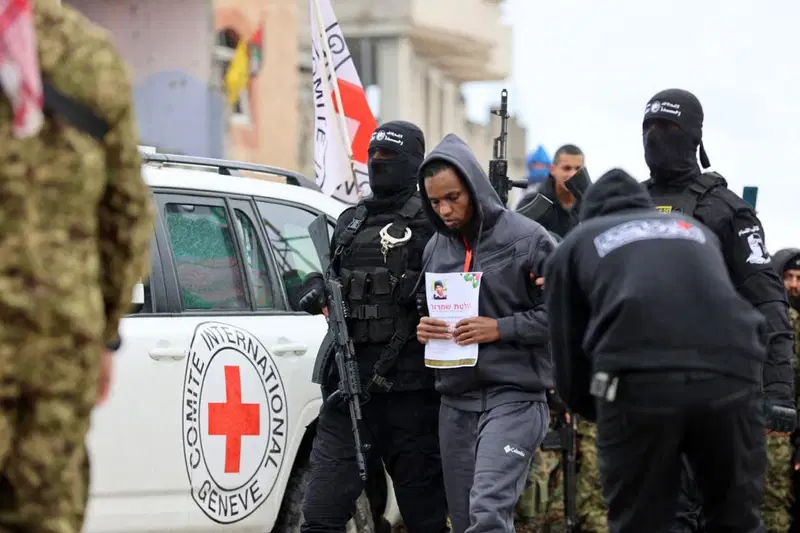
Palestinian militants on Saturday freed two Israeli hostages, among the last live captives eligible for release under the first phase of a fragile truce that is also expected to see Palestinian prisoners released.
Freedom for the captives caps an emotional two days in Israel, where the family of another hostage, Shiri Bibas, earlier on Saturday confirmed receipt of her remains.
Bibas and her two young sons had become symbols of the ordeal suffered by Israeli hostages since the Gaza war began.
Palestinian militants seized dozens of captives during their unprecedented October 7, 2023 attack on Israel which triggered more than 15 months of war in the Gaza Strip.
Militants escorted Tal Shoham and Averu Mengistu onto a stage in Rafah, southern Gaza. Shoham was made to address the gathering, flanked by armed and masked fighters dressed all in black, before both men were handed over to the Red Cross which then drove them away in a convoy.
Israeli security forces took custody of the men and returned them home to Israeli territory, the military said.
In the Israeli city of Tel Aviv, hundreds gathered at a site known as ‘Hostages Square’ reacted with applause, some appearing to weep, as they watched a broadcast of the release.
READ ALSO: Hamas To Return Bodies Of Four Israeli Hostages Amid Ceasefire Deal
Four other hostages are to be freed on Saturday morning in a separate ceremony in central Gaza.
Israeli campaign group the Hostages and Missing Families Forum had published the names of the six Israelis to be freed. The list included Eliya Cohen, Omer Shem Tov, Omer Wenkert and Hisham al-Sayed as well as Mengistu and Shoham.
Sayed and Mengistu had been held in Gaza for around a decade.
The hostages were freed under the first phase of a ceasefire deal which began on January 19 and is due to expire in early March.
A Hamas source told AFP that the Islamist group planned to also release four hostages from central Gaza’s Nuseirat later in the morning.
– Well-rehearsed ceremony –
At both locations the militants prepared for a now well-rehearsed ceremony, building stages in front of large posters advertising the militants’ cause or praising fallen fighters.
The Red Cross has repeatedly appealed for handovers to take place in a dignified manner.
Under a cold winter rain in Rafah, Hamas staged a show of force after months of bombardment and strikes that killed the group’s top leaders. Some fighters held automatic weapons, others rocket launchers, as nationalistic Palestinian music blared.
READ ALSO: Hamas Must Leave Gaza, Surrender Arms, Else…Says Israel’s Minister
Hamas’s green flag flew around the square on buildings destroyed by the war.
The Palestinian Prisoners’ Club advocacy group said Israel would free 602 inmates on Saturday as part of the exchange.
A spokeswoman for the NGO told AFP that most were Gazans arrested after the war began. She added that some of the prisoners would be deported outside of Israel and the Palestinian territories after their release.
Those expected to be expelled were serving heavy sentences.
The ceasefire has so far seen 21 living Israeli hostages freed from Gaza in exchange for more than 1,100 Palestinian prisoners released from Israeli jails.
Saturday’s release of living hostages followed the first transfer on Thursday of hostages’ bodies.
Hamas had said Shiri Bibas’s remains were among the four bodies returned on Thursday, but Israeli analysis concluded they were not in fact hers, sparking an outpouring of grief and anger.
Hamas then admitted “the possibility of an error or mix-up of bodies”, which it attributed to Israeli bombing of the area.
Late Friday the Red Cross confirmed the transfer of more human remains to Israel “at the request of both parties” but did not say whose they were.
READ ALSO: Hamas To Release Four Israeli Hostages In Truce Swap
“After the identification process at the Institute of Forensic Medicine, this morning we received the news we feared the most. Our Shiri was murdered in captivity and has now returned home to her sons, husband, sister, and all her family to rest,” the Bibas family said in a statement.
On Friday, Prime Minister Benjamin Netanyahu — under domestic pressure over his handling of the war and the hostages — vowed to “ensure that Hamas pays the full price for this cruel and evil violation of the agreement”.
– ‘No forgiveness’ –
On Friday, Israeli military spokesman Rear Admiral Daniel Hagari said, after an analysis of the remains, that Palestinian militants had killed the Bibas boys, Ariel and Kfir, “with their bare hands” in November 2023.
Hamas has long maintained an Israeli air strike killed them and their mother early in the war.
Shiri’s sister-in-law, Ofri Bibas, said Friday that the family was “not seeking revenge right now”, while levelling a measure of the blame at Netanyahu, telling him there would be “no forgiveness” for abandoning the mother and her young sons.
A fourth body, that of Oded Lifshitz, 83, was also returned Thursday.
Hamas and its allies took 251 people hostage during the October 7 attack that sparked the war. There are 65 hostages still in Gaza, including 35 the Israeli military says are dead.
The Hamas attack resulted in the deaths of 1,215 people, mostly civilians, according to an AFP tally of Israeli official figures.
Israel’s retaliatory campaign has killed at least 48,319 people in Gaza, the majority of them civilians, according to figures from the health ministry in the Hamas-run territory that the United Nations considers reliable.
AFP



Headline
Trump Warns Of More Strikes In Nigeria If Attacks On Christians Continue

US President Donald Trump has warned that he could authorise additional military strikes in Nigeria if attacks against Christians continue, citing the security situation in the West African nation as a key concern.
In an interview with the New York Times on Thursday, Trump was asked whether the Christmas Day strikes in Sokoto State, which targeted Islamist militants, were intended as part of a broader campaign. “I’d love to make it a one-time strike. But if they continue to kill Christians, it will be a many-time strike,” he said.
READ ALSO:Russia, China Afraid Of US Under My Administration — Trump
Trump’s comments follow his 2025 designation of Nigeria as a “country of particular concern” due to what he described as an “existential threat” to its Christian population. The remarks have drawn criticism from Nigerian officials, who insist that jihadist groups target people regardless of religion. “Muslims, Christians and those of no faith alike” are affected, a government spokesperson said, rejecting claims that Christians are being singled out.
When pressed about reports that most victims of jihadist groups in Nigeria are Muslims, Trump responded, “I think that Muslims are being killed also in Nigeria. But it’s mostly Christians.” Nigeria, with a population exceeding 230 million, is roughly evenly divided between Christians in the south and Muslims in the north.
The December strikes targeted camps run by a jihadist group known as Lakurawa in Sokoto, a largely Muslim region near the border with Niger. Both the US and Nigerian authorities have linked the militants to Islamic State-affiliated groups in the Sahel, although the IS has not formally claimed any association with Lakurawa. Details of casualties from the strikes remain unclear, as neither government has provided official figures.
Nigeria’s Foreign Minister Yusuf Maitama Tuggar said the operation was a “joint effort” and emphasised that it was not motivated by religion. He confirmed that the strikes had the approval of President Bola Tinubu and included
participation by Nigerian armed forces. Addressing the timing of the strikes, Tuggar added that they were unrelated to Christmas, though Trump described them as a “Christmas present”.
Headline
Science Discovers Why Hungry, Broke Men Prefer Bigger Breasts

A scientific study has found that men who feel financially insecure or hungry are more likely to find larger female breasts attractive.
The research was published in the peer-reviewed journal PLOS ONE and was conducted by psychologists Viren Swami and Martin J. Tovée.
The study examined whether breast size acts as a signal of fat reserves and access to resources, and whether men facing resource insecurity rate larger breast sizes as more attractive than men who feel economically secure.
Researchers carried out two separate studies across Malaysia and the United Kingdom.
In the first study, 266 men from three areas in Malaysia were assessed. The locations represented low, medium and high socioeconomic backgrounds. Participants were shown rotating computer-generated images of women with different breast sizes and asked to rate which they found most attractive.
READ ALSO:Wike: Why Removing Fubara Will Be Difficult – Ex-Commissioner
The findings showed a clear socioeconomic pattern.
Men from low-income rural areas preferred larger breasts.
Men from middle-income towns preferred medium to large breasts.
Men from high-income urban areas preferred smaller to medium breasts.
PLOS ONE study showing how hunger and financial insecurity affect men’s breast size preferences
Cover page of a PLOS ONE study examining how resource insecurity influences men’s breast size preferences. Source: PLOS ONE
As stated in the study, “Men from relatively low socioeconomic sites rated larger breast sizes as more physically attractive than did participants in moderate socioeconomic sites, who in turn rated larger breast sizes as more attractive than individuals in a high socioeconomic site.”
READ ALSO:Rare 1937 ‘Hobbit’ Discovered In House Clearance Sells For $57,000
The researchers noted that the lower a man’s financial security, the stronger his preference for larger breast size.
The second study focused on hunger rather than income.
In Britain, 124 male university students were divided into two groups. Sixty-six participants were classified as hungry, while 58 had recently eaten. Both groups viewed the same breast size images under identical conditions.
Hungry men consistently rated larger breasts as more attractive than men who were full.
READ ALSO:‘I Discovered My Husband Was Sterile 5 Yrs After We Got Married’
According to the researchers, “Hungry men rated a significantly larger breast size as more physically attractive than did the satiated group. Taken together, these studies provide evidence that resource security impacts upon men’s attractiveness ratings based on women’s breast size.”
The researchers explained that these shifts suggest attraction is not fixed but responsive to immediate conditions.
They noted that men experiencing hunger or financial pressure may place greater value on physical traits that signal access to resources or stability.
The study added that temporary states such as hunger can shape attraction in the same way long-term economic conditions do, reinforcing the idea that social and environmental factors play a key role in how physical attractiveness is judged.
Headline
Man With Lengthy Criminal Record Shoots Nigerian To Death Inside Bus In Canada

A 40-year-old man with an extensive criminal history has been charged with first-degree murder after a Nigerian national was shot dead on a GO bus at the Yorkdale GO Bus Terminal in Toronto, marking the city’s first homicide of 2026.
Toronto Police, in a statement on their website, said officers were called to the terminal, near Yorkdale Road and Allen Road, at about 7 p.m. on Sunday, January 4, following reports of a shooting. Investigators allege that both the suspect and the victim boarded a GO bus at the terminal, where the suspect shot the victim before fleeing the scene on foot.
According to the statement, officers arrived to find a man suffering from a gunshot wound, but despite carrying out life-saving measures, the Nigerian was pronounced dead at the scene.
The victim was later identified as Osemwengie Irorere, a 46-year-old man from Nigeria, the Toronto police said in a later statement.
READ ALSO:Canada Flags Nigeria, 16 African Countries As High-risk In New Travel Advisory
Local media reports noted that an eyewitness who was seated just behind the victim said the bus had been dark and crowded as passengers waited to depart when a single gunshot rang out.
“I assumed it was a popped tyre or something, but immediately after, a guy sitting in front of me got up, shoved his hands in his pocket and ran off the bus,” the witness said, requesting anonymity for safety reasons.
“Right after, I stood up and I looked at the seat in front of me and I saw a guy, bleeding,” he added, saying he could smell smoke in the air after the shot was fired.
Police said the suspect was located and arrested a short time later near the Yorkdale subway station, and a firearm was recovered.
READ ALSO:Nigerian Musician Dies In Canada
The accused has been identified as Tyrel Gibson, 40, of Toronto. He appeared at the Toronto Regional Bail Centre on Monday, January 5.
Court documents show that Gibson has a lengthy criminal record dating back to 2000, with nearly two dozen charges. He has previously been convicted of offences including attempted murder and firearm-related crimes. In 2015, he pleaded guilty to aggravated assault, using a firearm, possession of a firearm with ammunition and possession of an unauthorised firearm and was handed a lifetime weapons prohibition. He was sentenced to eight years in prison in 2017, although it remains unclear how much of that term he served.

 News5 days ago
How To Calculate Your Taxable Income
- Metro4 days ago
Edo widow-lawyer Diabolically Blinded Over Contract Seeks Okpebholo’s Intervention
- Headline4 days ago
Russia Deploys Navy To Guard Venezuelan Oil Tanker Chased By US In Atlantic
- News4 days ago
Expert Identify Foods That Increase Hypertension Medication’s Effectiveness
- Politics3 days ago
APC Leaders, Tinubu/Shettima Group Call For Wike’s Removal As FCT Minister
- Entertainment5 days ago
VIDEO: ‘Baba Oko Bournvita,’ Portable Drags His Father, Alleges Bad Parenting, Extortion
- Politics4 days ago
2027: Details Of PDP Leaders, Jonathan’s Meeting Emerge
- Metro5 days ago
JUST IN: Court Grants Malami, Wife, Son N500m Bail Each
- Politics3 days ago
Wike A ‘Pestilence’ On Rivers, I Resigned Because Of It – Ex-Commissioner
- Headline2 days ago
Science Discovers Why Hungry, Broke Men Prefer Bigger Breasts


