
Metro
ISWAP Makes $191m Annually Taxing Locals In Lake Chad Region — Report
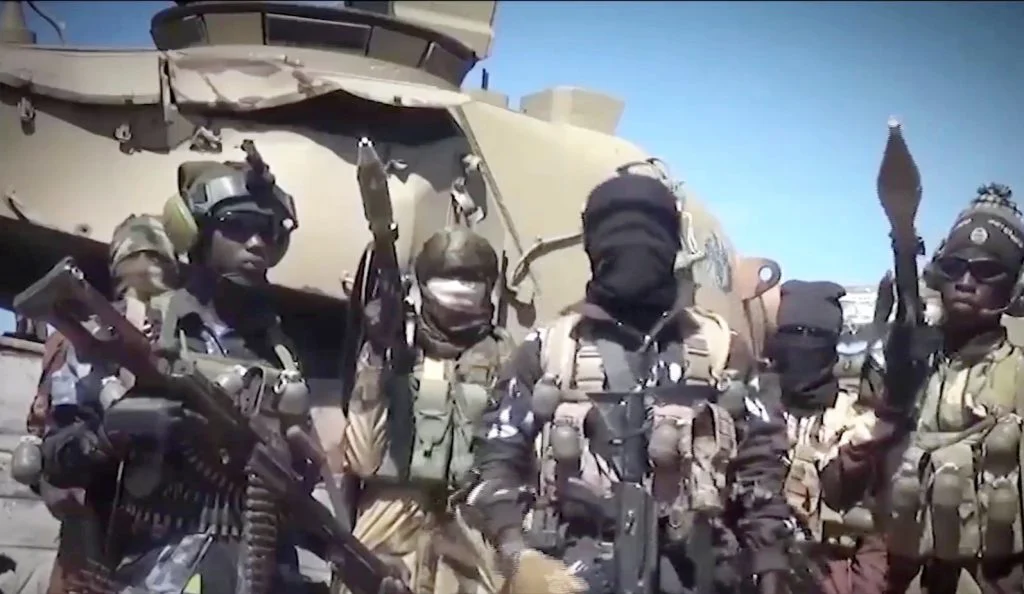
The Islamic State West Africa Province (ISWAP) has quietly built a functioning state-like economy across the Lake Chad region, controlling farms and cattle business through a complex taxation and governance regime that rivals Somalia-style jihadi fiefdoms.
According to a report by The New Humanitarian news agency, ISWAP collects an estimated $191 million annually through a formalised system of levies on fishers, farmers, traders and migrant workers.
Originally a project of the United Nations Office for the Coordination of Humanitarian Affairs (OCHA), The New Humanitarian (formerly IRIN News) operated under the UN until January 1, 2015. On March 21, 2019, IRIN relaunched independently as The New Humanitarian.
The news agency, which said its report was based on painstaking investigations, stated that what the extremists make per year vastly outstrips the official tax intake of the Borno State government, which it said took in only about $18.4 million in 2024.
“This investigation explores the system of rule and revenue streams that ISWAP has built in what it refers to as the dawla — the so-called caliphate it has established in parts of northeastern Nigeria and the Lake Chad region.
READ ALSO:Military, DSS Arrest ISWAP Leader
“The report is based on in-depth interviews with fishers and traders that regularly visit ISWAP territory on a string of islands in Lake Chad, as well as former ISWAP officials and clerics who have left the group and quietly resettled in northern Nigeria,” the agency said.
The New Humanitarian report identified three primary types of revenue for ISWAP.
They are:JUST IN: 60 Boko Haram, ISWAP Fighters Killed In Renewed Clashes
Zakat: a faith-based levy on livestock, netting around $3.7 million yearly.
Haraji: a tax for outsiders engaging in economic activity within ISWAP territory, often fishers and seasonal workers, collected through entry permits of roughly $13 each.
Darayib: a broader category including fees on trade, cattle, charcoal, and agriculture, imposed at checkpoints and markets.
“These payments,” the report said, “are enforced systematically with receipts, designated inspectors, and severe penalties for non-payment, allowing ISWAP to finance military campaigns, pay fighters and bills, and even offer rudimentary public services.
READ ALSO:ISWAP, Boko Haram: Why Tinubu Govt, Govs Can’t Dialogue With Bandits – Shehu Sani
“ISWAP administers three broad categories of taxation: zakat, haraji and darayib. Each tax has a separate receipt that is issued after payment.
“ISWAP collects zakat from cattle-owning farmers worth roughly $3.7 million a year. The tax ranges from 3.3 per cent to 1 per cent, depending on herd size — the lowest rate levied on herds of more than 60 to 80 animals.
“ISWAP does not physically take the cattle but instead collects the cash equivalent — based on a pre-determined market value, eliminating the possibility of herders undervaluing their livestock.
“It also imposes a similar tax structure on sheep and goats but does collect the animals, reportedly for festive occasions and other internal uses within the group,” the report said.
READ ALSO:Gaza Civil Defence Says Israeli Strikes Kill 30
While violent and ideologically driven, ISWAP has adopted pragmatic governance models. In many of its controlled areas, locals report being taxed for perceived “protection.”
“Before entry into ISWAP’s territory, every individual is required to pay a $13 fee. Those with cash pay immediately at the first checkpoint before being allowed to proceed. Those without the money are permitted to enter after making a pledge to pay following their business activities.
“In such cases, the group leader is held accountable for ensuring that all deferred payments are settled. Each person receives a permit or receipt, which serves as proof of payment and protects them from harassment by ISWAP’s inspection task force operating on the islands. With this permit, individuals are not disturbed.
READ ALSO:ISWAP Kills 8 Boko Haram Members, Seizes Large Quantities Of Ammunition
“Once inside, fishers are required to pay additional fees to be in allocated fishing areas. The amount depends on the size of the area requested and the fishing method they intend to use,” the report said.
Quoting fishers it interviewed, The New Humanitarian said: “These fees range from $13 to $196 and cover an entire fishing season, usually from February to June.
“Before exiting the territory with their goods, each fisher or fish trader is charged a fishing tax of around $2.60 per 100-kilogram carton of fish. During a normal fishing season, ISWAP can generate around $156,000 from entry permits alone.”
The Nigerian military has been unrelenting in tackling extremist groups in the entire North East area, which includes the Lake Chad region.
(TRIBUNE)



Metro
Police Arrest 13 During Cult Initiation In Delta
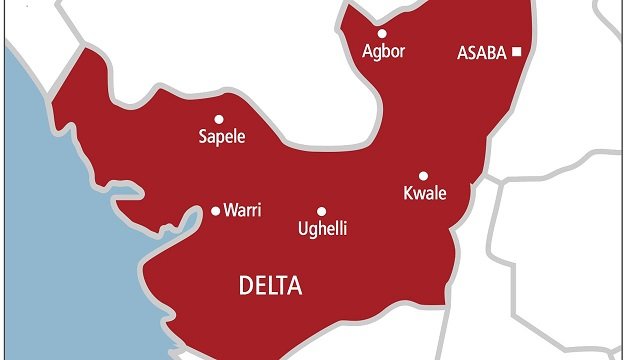
The Delta State Police Command has arrested 13 suspected members of a cult group and recovered several firearms and other dangerous items.
The suspects were arrested during an initiation ceremony at the Ekraka Community forest in Kokori on Saturday.
The operation carried out late-night during a tactical operation in Ethiope East local government area of the state followed credible intelligence that members of the Aiye Confraternity, also known as Black Axe, were planning an initiation.
Police, operatives of the Quick Response Squad, led by its commander, SP Collins Achem, were swiftly deployed to the area to prevent the gathering.
READ ALSO:
The Police Public Relations Officer, Delta State Command, SP Bright Edafe, disclosed this in a statement.
“At about 11:00 p.m., the patrol team encountered the suspects, who reportedly engaged the operatives in a gun duel upon sighting them.
“The operatives responded decisively, leading to the arrest of 13 suspects, while several others escaped deeper into the forest.
“A search of the forest resulted in the recovery of two automatic pump-action guns, one double-barrel cut-to-size gun, one single-barrel cut-to-size gun and a battle axe.
READ ALSO:
“Other items recovered included aprons bearing “NBM” insignia, razor blades cut into pieces, mobile phones, charms, and suspected hard drugs.
“In addition, seven vehicles believed to be owned and used by members of the cult group were recovered and towed to the QRS Base in Warri.
“The suspects are currently in police custody, while investigations are ongoing to determine their individual roles, dismantle the cult network, and apprehend other fleeing members,” the statement read.
The Delta State Police Command urged residents to remain vigilant and continue to support the police with credible information to enhance security across the state.
He told parents, schools, community and faith leaders, as well as youths, to see the fight against cultism as a collective responsibility.
Metro
Petrol Tanker Crashes Into Akpabio’s Convoy, Kills Police Dispatch Rider
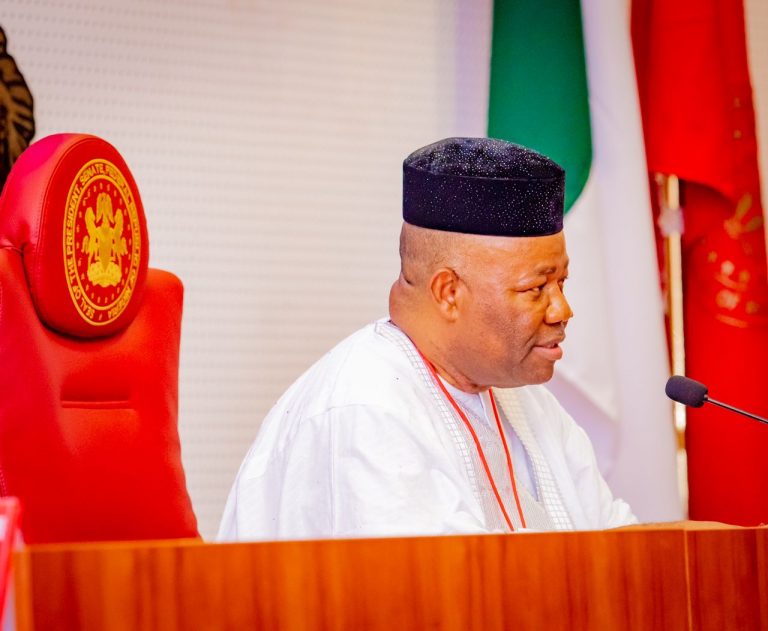
A tragic accident involving a fuel tanker and the convoy of Senate President Godswill Akpabio claimed the life of a police dispatch rider, Ibrahim Hussaini, on Sunday.
Akpabio made the announcement on Tuesday while addressing lawmakers during plenary, expressing his condolences to the family of the fallen officer.
Dispatch riders, who are typically police personnel, escort senior government officials on motorcycles marked for official use.
The Senate President arrived in the chamber shortly after the session began and informed his colleagues that Hussaini had already been laid to rest earlier that morning.
READ ALSO:SERAP Drags Akpabio, Tajudeen To Court Over Alleged Missing N18.6bn NASS Complex Project Funds
Although he did not give a precise location, Akpabio explained that the crash occurred in Ibadan, the Oyo State capital, shortly after his convoy picked him up from the airport.
He said: “We went to Oyo State for the installation of our colleague. Unfortunately, my dispatch rider was run over by a tanker driver, and his head was shattered. We just buried him 15 minutes ago in Kogi State. He left two wives and four children.
“By the grace of God, I’m recommending two of his senior children for employment immediately in any parastatals that may wish to; otherwise, I’ll employ them personally in any of my private concerns.”
He noted that the officer was buried in Kogi State and is survived by two wives and four children.
READ ALSO:‘Bribe-for-Bills’ Scandal: SERAP Drags Akpabio, Abbas To Court For Failure To Probe
Following the announcement, Sunday Karimi, the senator representing Kogi West, raised a motion on personal explanation to formally present the matter to the Senate.
Karimi described Hussaini as a Deputy Superintendent of Police who was expected to retire next year. He added that the officer, who hailed from Kogi State, had been part of Akpabio’s security detail since 2023, when Akpabio assumed office as Senate President.
Karimi also informed lawmakers of another loss: the death of Ibrahim Tukur, a long-serving driver attached to Isah Jibrin, the senator representing Kogi East. Tukur reportedly passed away at his home on Saturday after 25 years of service.
READ ALSO:Aircraft Crashes In Owerri With Four Persons Onboard
Jibrin later addressed the chamber, noting that Tukur had worked with him since his early career as a banker at the now-defunct AfriBank. He offered prayers for his former driver’s soul.
The session concluded with Akpabio asking senators to observe a minute of silence in honour of both deceased staff members.
Metro
Fintiri Pardons Man Sentenced To Death For ‘Killing Herdsman In Self-defence’, Others
Fintiri Pardons Man Sentenced To Death For ‘Killing Herdsman In Self-defence’, Others
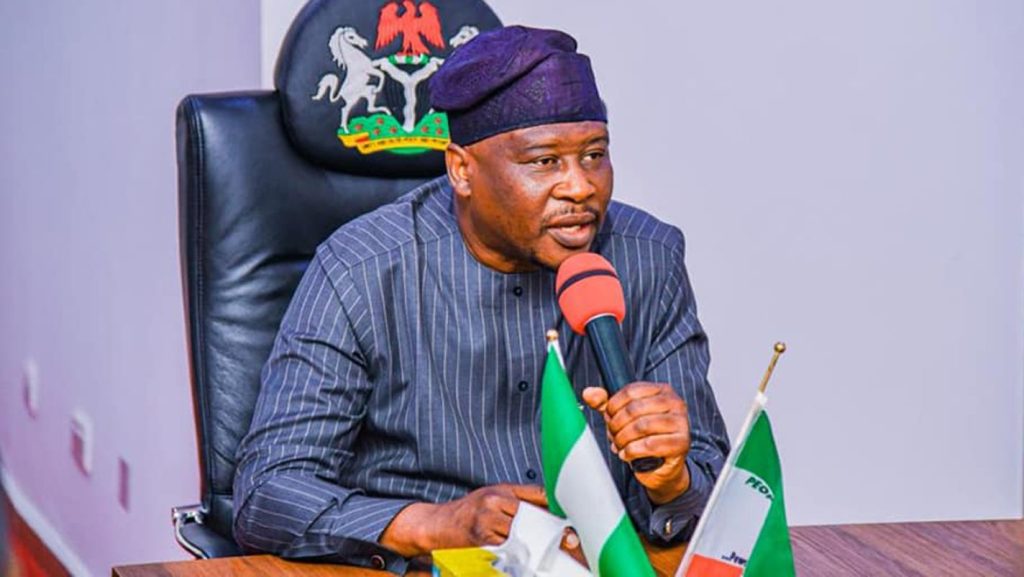
Governor Ahmadu Fintiri of Adamawa State has granted pardon to a death row inmate, Sunday Jackson.
An Adamawa farmer, Jackson is widely perceived to have been unjustly sentenced for allegedly killing a herdsman in self-defence.
There has been widespread calls for intervention in his case.
Jackson who is in Kuje Medium Security Custodial Centre was pardoned alongside Joseph Eugene from the Medium Security Custodial Centre, Yola, and Maxwell Ibrahim, serving at the Medium Security Custodial Center in Kaduna.
READ ALSO:State Police Key To Tackling Insecurity, Says Gani Adams
The pardon is in commemoration of Christmas and New Year celebrations, according to a statement released on Tuesday in Yola by Governor Fintiri’s Chief Press Secretary, Humwashi Wonosikou.
“Others who had the remainder of their sentences remitted whole include Joshua James Audo, Adamu Ibrahim, Mohammed Abubakar, Ibrahim Usman and Saidu Abubakar serving at the Medium Security Custodial Centre, Numan and Medium Security Custodial Centre, Jada,” Humwashi stated.
He explained that Governor Fintiri extended his gesture to the inmates because the inmates had demonstrated significant improvement in their behaviour and conduct.
He quoted Fintiri as saying, “In the exercise of my prerogative of mercy as enshrined in the constitution of the Federal Republic of Nigeria and in line with the recommendations of the Adamawa State Advisory Council on Prerogative of Mercy, I have granted pardon to three persons and directed the remission of the remainder of the sentences of five others who have served various jail terms and have significantly demonstrated good conduct over the years.”

 News2 days ago
PHOTOS: New Era In Furupagha-Ebijaw As Okpururu 1 Receives Staff Of Office
- Metro4 days ago
JUST IN: Former Edo Information Commissioner Is Dead
- News5 days ago
Former Delta North senator Peter Nwaoboshi Dies
- Metro4 days ago
She Grabs, Pulls My Manhood Anytime We Fight — Husband
- News4 days ago
[OPINION] Tinubu: Ade Ori Okin Befits KWAM 1, Not Awujale Crown
- News4 days ago
Coordinator, Edo First Lady Office, Majority Leader, Rights Lawyer, Others Bag 2025 Leadership Award
- News2 days ago
FG Declares Public Holidays For Christmas, New Year Celebrations
- News17 hours ago
UBTH CMD Marks 120 Days In Office, Expresses Commitment To Providing Conducive Working Environment
- News4 days ago
Delta Speaker Advocates Strict Legislative Protection Of N’Delta Environment
- Metro4 days ago
Why I Charged My Husband Money For Sex —Woman


