
Politics
Jonathan Is Angry With PDP Over 2015 Betrayal — Clark
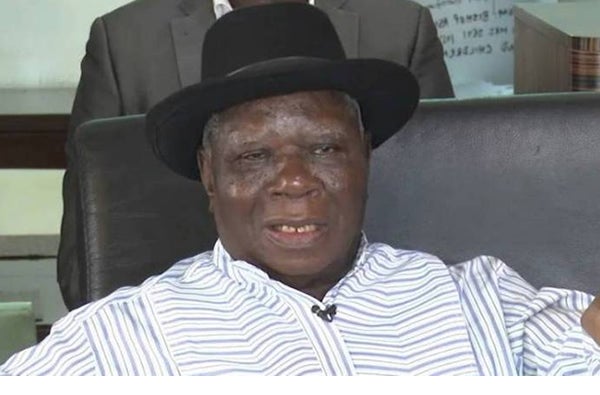
Former Federal Commissioner for Information and South-South leader, Chief Edwin Clark, on Tuesday, gave an insight into why former President Goodluck Jonathan stopped attending meetings of the Peoples Democratic Party, PDP.
According to Clark, former President Jonathan is angry with his party because of what party members, led by the former National Chairman and past Governor of Bauchi State, Adamu Muazu, did to him when he wanted to be re-elected in 2015.
Clark noted that PDP leaders from the North worked against Jonathan because, according to them, it was the turn of the North to produce the President.
He stressed that many of the PDP governors from the North mobilised funds for the then candidate of the All Progressives Congress (APC), Muhammadu Buhari, against their own flag bearer.
READ ALSO: Muslim-Muslim Ticket Dangerous Signal – Edwin Clark
The elder statesman and leader of the Pan-Niger Delta Forum, PANDEF, noted that Jonathan had learnt his lesson, which explained why he stopped attending meetings of PDP especially the National Executive Committee, NEC, of the party.
He spoke at his Asokoro residence in Abuja, when he played host to the Delta Central APC Leaders of Thought, DECALT, led by its National Leader, Chief Ominimini Obiuwevbi.
The leader of Southern and Middle Belt Leaders Forum, SMBLF, lamented that the same northern governors in the PDP, who had rejected zoning, were now talking about competence and integrity in 2022.
He accused the party of what he described as manipulation leading to the emergence of Atiku Abubakar as its presidential candidate for the 2023 election.
Clark said: “Now coming home politically, Jonathan was the President for some time as the result of the death of President Yar’Adua. Jonathan ruled for about five years, he is a Christian and the northerners said it was their turn.
“From 2011, they have been worrying Jonathan. Even in 2015, the northern PDP leaders ganged up with APC, Tinubu and removed Jonathan from office. They did not campaign, Jonathan was on his own.
“So, when people say why Jonathan is not in PDP, not attending PDP meetings, I can safely say that he’s learning his lesson that the people he trusted did not trust him.
“They squandered the party’s money and left.
“So, when people say why is Jonathan not in PDP, he knows how they betrayed him: how the northern PDP governors contributed money towards Buhari’s success, how members of government betrayed him.
“The national Chairman of PDP at the time was Governor (Adamu) Mu’azu. He did not go to his hometown to campaign, he was only following Jonathan about.
“He knew what he was doing. Everyone of them wanted Buhari to win. So, Buhari won. He has ruled for eight years.
“Now, the same northerners are now saying competence, no zoning, integrity.
READ ALSO: PDP Presidential Primary: Clark Talks Tough, Asks Ayu To Resign
“It fell for the prey, they maneuvered PDP with Alhaji Abubakar who has been wanting to be president of Nigeria over the years, championing the cause of division. So, the PDP, a party we love, PDP a party of southern Nigeria, disappointed us.
“In 2019, 11 million people voted for Atiku Abubakar (PDP). Five million from the North, five million from the South. Now he doesn’t think that we ever did anything for him.
“So, Nigeria has change. If anyone tells you that all is well in Nigeria that person living in a fool’s paradise.
“I’m happy to note that you are members of the ruling party that is APC and I will give you a message to Mr. President, who is the leader of your party.
“But we are in the minority, but in every society the minority and the majority must live together. We have never seen a community where you have only the majority. If that’s the case amongst them some will become minority.
“We are the largest ethnic nationality in Delta State, but within you some people are dominating. Because we are alive, we don’t need this society where people are not equal.
“That’s what Mandela fought for that everybody is equal. People should live in a country where you grow up to do anything God created you do.”
Clark recalled that when governors of the southern states insisted on zoning the presidency to the South, the SMBLF immediately keyed into it.
However, he regretted, despite agreement for southerners not to accept the running mate position to any Northern presidential candidate, Governor Ifeanyi Okowa of Delta State has been picked as the vice presidential candidate by the PDP even though he hosted one of the governors meeting in Asaba.
According to the South-South leader, the APC he thought the people of the South-South should have no business with, became the party that listened to the yearnings of the region over zoning and the need for the South to produce the next President come 2023.
Clark who noted that he would have voted for the ruling APC, but for his age and its decision to fly a Muslim-Muslim Presidential ticket.
READ ALSO: 2023: Clark Lambasts Southern Presidential Aspirants, Says ‘It’s Madness’ To Have Many
He said: “Several times we met here and before the PDP had their primary, we met here again and repeated the same thing.
“We didn’t know that our own Governor, who initiated this meeting, if you agreed for a meeting to be held in your house and you backed out thereafter; you have betrayed your colleagues. Isn’t it?
“So, that’s why one of my cousins called Okowa miscreant.”



Politics
2027: Why I’m Supporting Tinubu’s Re-election — Alex Otti
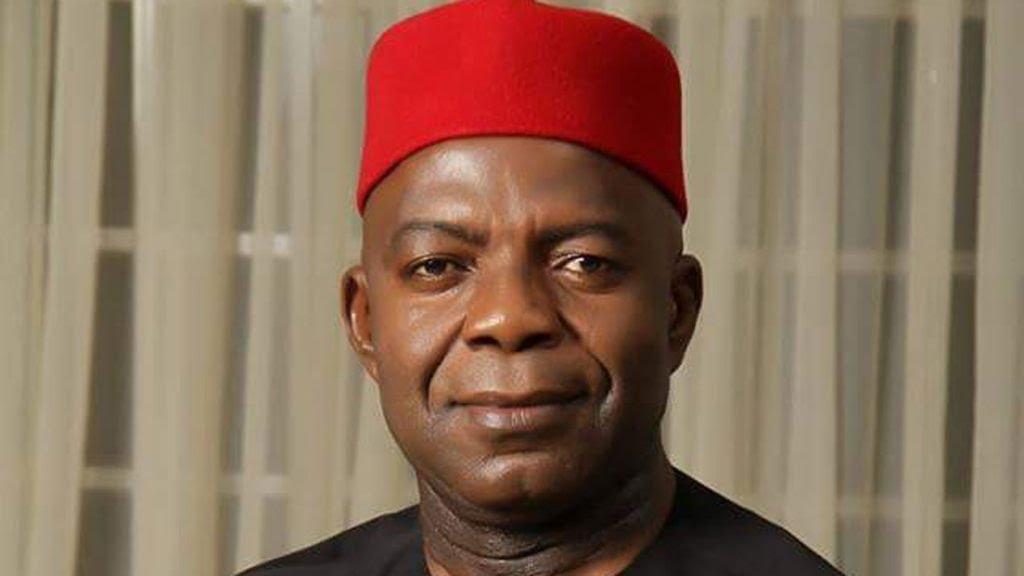
Abia State Governor Alex Otti has said his position as governor and member of the National Economic Council leaves him with no choice but to support President Bola Ahmed Tinubu’s bid for re-election in 2027, even though he belongs to the opposition Labour Party (LP).
Speaking in an exclusive interview aired on Arise Television on Friday, Otti was asked whether his backing for Tinubu amounted to a “comfortable arrangement” between him and the ruling All Progressives Congress (APC). He agreed with the characterisation, saying he was not in a position to oppose the President’s candidacy.
“It works the way you have said. It’s a statement of fact. I am not in a position to oppose his candidacy,” Otti said.
The governor explained that being part of government came with obligations that ruled out open opposition to Tinubu, warning that such a stance could trigger “implosion” within the system he serves.
READ ALSO: FBI Confirms Tinubu Was Subject Of 1990s Drug-trafficking Investigation
“And sometimes people don’t understand the opposition. When you say opposition, and you are part of a government, then what you are driving towards is implosion.
“So if I do have a problem with anything, I’ll sit down in one of our meetings and I’ll make my point. So I’m not going to oppose his candidacy,” he added.
He said his role on the National Economic Council effectively tied him to decisions taken by the Federal Government, leaving him little room to distance himself from Tinubu’s re-election project.
“I had also said that as a governor in this republic, that a lot of the things that are being, in fact, I’m part of all the things that have been done as a member of National Economic Council. So, we should distinguish that.
READ ALSO: FBI Confirms Tinubu Was Subject Of 1990s Drug-trafficking Investigation
“When somebody now says, ‘Oh, you are supporting or you’re not,’ I have to support him,” he said.
Pressed further on whether he was supporting Tinubu for re-election, Otti pointed to earlier remarks in which he said he still had a presidential candidate for the Labour Party. When the interviewer suggested Tinubu was that candidate, he pushed back.
“No, that’s not what I said,” he said.
Asked to clarify whether he meant a Labour Party presidential candidate, Otti replied, “Yes.” Returned to the question of his support for Tinubu, he responded: “What do you expect me to say? To say I’m not supporting him?”
READ ALSO: You’re Under Spell Of Marabouts, Tinubu Blasts Atiku
Otti maintained that Tinubu had every right to contest the 2027 election, and noted that several of the President’s policies aligned with positions he had long held himself, pointing to the removal of the fuel subsidy as an example.
“Quit frankly, there are a lot of things that we have talked about now, that he has implemented, that resonate with me and my thinking.
“People don’t have to agree with me, but from where I sit, I know that for instance, the fuel subsidy was even unsustainable,” Otti said.
Politics
Crisis Rocks NDC Over Obi-Kwankwaso Campaign Council
A fresh crisis appears to be brewing within the Nigeria Democratic Congress (NDC) following a sharp disagreement between the party’s National Chairman, Senator Cleopas Moses, and the OK Movement over the latter’s role and independence ahead of the 2027 general elections.
The OK Movement, in a statement signed by its National Secretary, Saadatu Sani, accused the NDC National Chairman of making statements it described as defamatory and reflective of a misunderstanding of the movement’s structure, independence and constitutional foundation.
The statement followed a recent publication attributed to Moses concerning the movement and the involvement of its National Director General, Hon. John Ughulu, in the Lagos State primaries.
The OK Movement had, on Thursday, unveiled a 59-member presidential campaign council ahead of the 2027 general elections. Cleopas, however, on Saturday, dissociated itself from the porported campaign council.
READ ALSO: 2027: NDC Demands Lagos CP’s Suspension Over Alleged Pro-Tinubu Action
The OK Movement urged the NDC chairman to familiarise himself with the party’s constitution before making assertions about the rights, responsibilities and independence of political movements associated with the party.
“Leadership is ultimately measured by knowledge, restraint, integrity and respect for established rules, not by insults, personal attacks or defamatory assertions,” the statement said.
The movement stressed that its support for the NDC and its candidates did not make it subject to the personal approval of any individual within the party.
According to the statement, the OK Movement recognises the supremacy of political parties within their constitutional and statutory sphere and intends to campaign for the NDC’s presidential and vice-presidential candidates, as well as other party candidates across the country in areas where it has resolved to support them.
READ ALSO: 2027: I Will Lead NDC To Defeat Federal Might – Seriake Dickson
However, it maintained that it remained an independent political organisation with its own leadership, organisational structure, ideology and internal processes.
“We will campaign for the presidential and vice presidential candidates of the party,” the statement said.
“We will campaign for candidates of the NDC Party across the country where the movement has resolved to support them. But we do not require the personal validation or approval of any individual before exercising our legitimate organisational functions,” it added.
READ ALSO: 2027: Court Denies Ordering Deregistration Of NDC
The movement further rejected suggestions that its activities were driven by the pursuit of political appointments or positions within the party.
It said the organisation was built from the grassroots and did not depend on the sponsorship of any individual or political office holder.
The OK Movement also claimed to have approximately 2.5 million registered members and coordinators in its internal database, describing itself as a long-term political movement rather than a temporary support group established for an election cycle.
The organisation said its objective was to mobilise Nigerians around demands for improved governance, economic opportunity, accountability and citizen-centred development.
Politics
Why I Lent Peter Obi My Vehicle During Benue Visit — Ortom
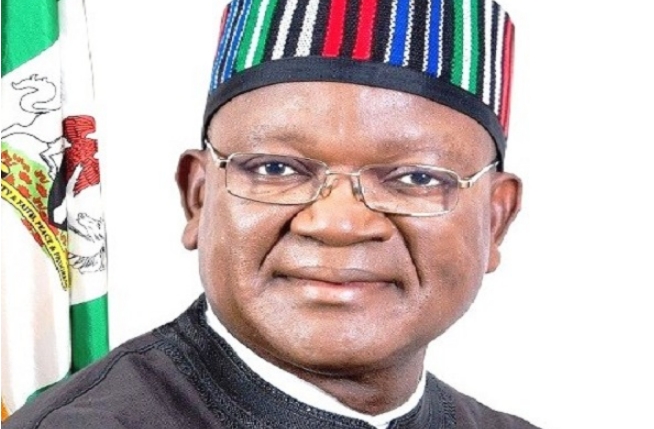
Former Benue Governor, Samuel Ortom, has explained why he lent his vehicle to the presidential candidate of the Nigeria Democratic Congress (NDC), Peter Obi, during the latter’s recent visit to the state.
Ortom, through his media aide, Terver Akase, said he decided to assist Obi with transportation as a matter of courtesy, stressing that refusing to help a former governor and presidential candidate would have been “petty” and unbecoming of a former governor.
Obi had visited Benue last Tuesday as part of plans to meet victims and families affected by the June 2025 massacre in Yelewata.
However, his planned movement from Makurdi to Yelewata was disrupted after youths reportedly blocked his convoy around Gyado Villa, a few kilometres from the airport.
READ ALSO: Peter Obi Reveals Strategy To Protect Votes During 2027 Election
Following the incident, Governor Hyacinth Alia’s Chief Press Secretary, Kula Tersoo, alleged that Ortom was involved in facilitating Obi’s visit.
Tersoo said a state government investigation traced the vehicle used to convey Obi from Makurdi Airport to Ortom.
He identified the vehicle as a Toyota Land Cruiser with registration number GWA 608 BT, claiming that Federal Road Safety Corps records showed it was registered in Ortom’s name and linked to his Judges Quarters address in Makurdi.
The governor’s aide also questioned why Ortom, who has declared support for President Bola Tinubu ahead of the 2027 presidential election, would provide his vehicle to Obi.
READ ALSO: Trump Suggests Renaming Strait Of Hormuz As ‘Trump Strait’
But Ortom dismissed the suggestion that lending his vehicle to Peter Obi amounted to political collaboration.
He said Obi, as a former governor and presidential candidate, deserved basic courtesy while visiting the state on what he described as a humanitarian mission.
“Peter Obi is a former governor, a presidential candidate and one of the most prominent political figures in the country,” he said.
READ ALSO: US Secret Service Reacts To Iran’s Alleged Threat To Trump’s Son Life
Ortom added that refusing to assist Obi would have been viewed as “petty, inhospitable and beneath the dignity of a former governor.”
He described attempts to politicise the gesture as “ridiculous and shameful”, accusing the Alia administration of creating controversy around what he called a “humane, courteous and statesmanlike gesture.”
Ortom also rejected claims that his action made him “double-faced”, noting that although he supported Obi in 2023, he had since publicly declared his support for Tinubu in the 2027 presidential election.

 News4 days ago
BREAKING: Tinubu Extends Working Vacation
- Headline4 days ago
How To Format An Academic CV For US Master’s, PhD Applications
- News4 days ago
Benue Govt Suspends Muslim Pilgrims Welfare Board Chairman, Secretary
 News3 days ago
OPINION: The Stranger In APC’s Kitchen
- Entertainment4 days ago
Why Funke Akindele Was Not At My Movie Premiere – Kamo State
- Sports4 days ago
5 Football Players Who Excelled In Multiple Positions
- Politics4 days ago
Crisis Rocks NDC Over Obi-Kwankwaso Campaign Council
- News4 days ago
FULL LIST: Names Of 37 Illegal Miners Who Died In NSCDC Custody
- News5 days ago
[OPINION] Wike-APC: Fights Always End Adultery
- Sports4 days ago
Premier League Predictions For Matchweek 5 Fixtures


