
Headline
London-based Magazine Scores Buhari’s Govt, Reveals Nigeria Army Sells Weapons To Insurgents
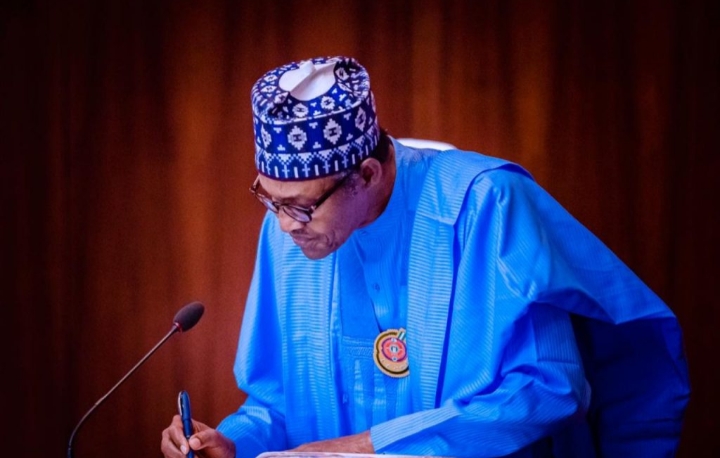
London-based news magazine, The Economist, has described the government of the President, Major General Muhammadu Buhari (retd.), as inept and high-handed, adding that he had also failed to tackle corruption.
The 178-year-old magazine said this in an editorial titled, ‘The Crime Scene at the Heart of Africa,’ which was published in its October 23, 2021, issue.
It said due to Buhari’s mismanagement of the economy, food prices had soared while life had become more difficult for Nigerians.
The editorial read in part, “Economic troubles are compounded by a government that is inept and heavy-handed. Mr Buhari, who was elected in 2015, turned an oil shock into a recession by propping up the naira and barring many imports in the hope this would spur domestic production.
“Instead he sent annual food inflation soaring above 20 per cent. He has failed to curb corruption, which breeds resentment. Many Nigerians are furious that they see so little benefit from the country’s billions of petrodollars, much of which their rulers have squandered or stolen.”
The Economist stated that even before COVID-19 last year, Nigeria was already witnessing unprecedented poverty.
The news magazine opined that this economic hardship was fuelling the current insecurity in the country.
“Two factors help explain Nigeria’s increasing instability: a sick economy and a bumbling government. Slow growth and two recessions have made Nigerians poorer, on average, each year since oil prices fell in 2015.
“Before COVID-19, 40 per cent of them were below Nigeria’s extremely low poverty line of about $1 a day. If Nigeria’s 36 states were stand-alone countries, more than one-third would be categorised by the World Bank as “low-income” (less than $1,045 a head). Poverty combined with stagnation tends to increase the risk of civil conflict,” it argued.
The Economist gave the Nigerian Army a dressing down, describing the military organisation as only strong on paper.
It alleged that the army had ghost workers on its payroll and often sold equipment to insurgents who destabilise the nation.
READ ALSO: Buratai Highlights Factors Fueling Insecurity, Suggests Ways Out
The news magazine said the Nigeria Police Force was poorly trained and underpaid hence they rob innocent citizens in order to augment their salaries.
The editorial further read, “When violence erupts, the government does nothing or crack heads almost indiscriminately. Nigeria’s Army is mighty on paper. But many of its soldiers are ‘ghosts’ who exist only on the payroll, and much of its equipment is stolen and sold to insurgents. The army is also stretched thin, having been deployed to all of Nigeria’s states.
“The police are understaffed, demoralised and poorly trained. Many supplement their low pay by robbing the public they have sworn to protect.”
It called on the Department of State Services to stop disobeying court orders and release all those being detained illegally.
The Economist described as scandalous the refusal of the Nigerian government to arrest and prosecute any of the security operatives that killed protesters in Lagos last year.
The news magazine said in order to stop the slide towards lawlessness, Nigeria’s government should make its own forces obey the law.
The editorial further read, “Soldiers and police who murder or torture should be prosecuted. That no one has been held accountable for the slaughter of perhaps 15 peaceful demonstrators against police abuses in Lagos last year is a scandal. The secret police should stop ignoring court orders to release people who are being held illegally. This would not just be morally right, but also practical: young men who see or experience state brutality are more likely to join extremist groups.”
The news magazine noted that Nigeria was home to one of the largest film industries in the world and had the most successful start-ups in sub-Saharan Africa.
It argued that despite the great potential of the country, youths were beginning to emigrate in droves because of the sorry state of Nigeria.
(PUNCH)



Headline
Why Europe Is Blocking More Nigerian Goods At Its Borders

Nigeria’s exports continue to face repeated rejection in European Union markets, a challenge caused by consistent quality failures, weak regulatory enforcement, and heavy dependence on raw commodities.
New trade figures further show that while export values expressed in naira have risen sharply, dollar earnings have continued to decline, undermining Nigeria’s competitiveness abroad.
Meanwhile, South Africa remains one of the African countries with the highest rate of export acceptance in Nigeria and the EU, highlighting the gaps between both economies’ standards and certification systems.
According to data from International Trade Centre (ITC) , Nigeria’s export earnings fell for a second consecutive year in 2024, dropping by 8.5% to $57.9 billion.
The figure had already declined from $63.3 billion in 2022 to $60.65 billion in 2023. In naira terms, however, total exports rose from ₦26.8 trillion in 2022 to ₦36 trillion in 2023 and surged to ₦77.4 trillion in 2024.
These increases reflect the naira’s steep depreciation, not an improvement in the volume or acceptance of Nigerian goods overseas.
Intelpoint data show that the naira weakened from ₦645.2 to the dollar at the end of 2023 to ₦1,478.9 in 2024, marking the sharpest yearly decline in a decade.
READ ALSO:US To Cut Military Aid To European Countries Near Russia — Official
EU border agencies have repeatedly rejected Nigerian agricultural and manufactured goods for failing to meet essential sanitary and phytosanitary requirements.
Frequent violations include excessive pesticide residue, poor traceability, contamination detected during inspection, and inconsistencies in certification documentation issued in Nigeria.
These failures stem largely from fragmented supply chains, weak monitoring capacity and a lack of internationally accredited laboratories.
South Africa, Morocco and Kenya maintain far stronger conformity systems, and South Africa in particular consistently delivers some of the highest acceptance rates across EU ports.
The ITC figures show that oil remains the backbone of Nigeria’s exports, contributing nearly 90 per cent of total earnings between 2022 and 2024. Over that period, the country earned $163.2 billion from crude oil out of total export revenues of $181.8 billion.
Despite this dominance, oil earnings have continued to fall, declining from $57.4 billion in 2022 to $55.6 billion in 2023 and then to $50.3 billion in 2024.
Because crude prices are determined externally and the product is exported with limited value addition, Nigeria gains little competitive advantage from currency depreciation.
READ ALSO:US To Cut Military Aid To European Countries Near Russia — Official
Non-oil exports recorded mixed fortunes. Cocoa earnings rose from $679 million in 2022 to $759 million in 2023 and climbed sharply to $2.6 billion in 2024.
Fertiliser exports fell from $1.9 billion in 2022 to $935.4 million in 2024. Ores and residues, however, increased from $158.6 million in 2023 to $824.4 million in 2024.
Despite positive growth in some sectors, quality problems have continued to undermine acceptance in Europe, particularly for foods such as beans, palm oil and processed crops.
Nigeria recorded stronger performance in African markets in 2024 due to the relative strength of the West African CFA franc.
Companies such as Unilever Nigeria, Cadbury Nigeria and Guinness Nigeria reported export sales of ₦22.8 billion in 2024, up from ₦9.92 billion in the preceding year. EU markets, however, maintain stricter inspection standards, and Nigeria’s structural weaknesses continue to limit penetration.
The country’s export structure remains heavily constrained by outdated processing technology, weak inspection capacity, irregular regulatory monitoring, and an overreliance on raw commodities.
READ ALSO:Putin Says Russia Ready For War, Blames Europe For Sabotaging Peace
Also, pipeline vandalism and crude theft also prevent Nigeria from meeting its production benchmark of 1.7 million barrels per day, despite a rise to 1.5 million barrels per day in 2024.
In December 2023, the Federal Government introduced the Trade Policy of Nigeria (2023–2027), aimed at aligning export regulations with World Trade Organisation rules and boosting global competitiveness.
The policy forms part of a wider reform agenda tied to the Medium-Term National Development Plan (2021–2025) and Agenda 2050.
Despite these initiatives, limited investment in quality assurance, industrial processing and standards enforcement continues to weaken Nigeria’s acceptance in high-value markets such as the EU.
Headline
US Imposes Visa Restrictions On Nigerians Linked To Religious Freedom Violations
The United States government on Wednesday announced visa restrictions targeting individuals involved in violations of religious freedom in Nigeria. The measures may also extend to immediate family members of the affected persons.
In a statement titled “Combating Egregious Anti-Christian Violence in Nigeria and Globally”, the Department of State said the restrictions were being implemented in response to mass killings and attacks on Christians by radical Islamic terrorists, Fulani militias, and other violent actors in Nigeria and elsewhere.
The statement explained that under Section 212(a)(3)(C) of the Immigration and Nationality Act, the State Department would now have the authority to deny visas to those who have “directed, authorised, significantly supported, participated in, or carried out violations of religious freedom,” with the policy potentially extending to their immediate family members.
READ ALSO:US Visa Adjudication Sparks Concerns Over Diplomatic Relations
It further cited former President Donald Trump’s remarks, noting that the United States “cannot stand by while such atrocities are happening in Nigeria, and numerous other countries.” The policy will apply to Nigeria and other governments or individuals implicated in violations of religious freedom.
The announcement follows growing international concern over attacks on religious communities in Nigeria, including targeted killings, abductions, and destruction of property attributed to armed groups.
Headline
Putin Says Russia Ready For War, Blames Europe For Sabotaging Peace
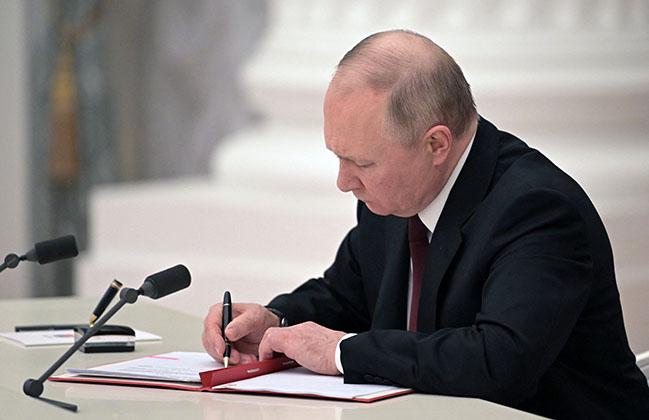
Russian President Vladimir Putin said on Tuesday that Russia was “ready” for war if Europe seeks one, accusing the continent’s leaders of trying to sabotage a deal on the Ukraine conflict before he met with US envoys.
The comments came as US envoy Steve Witkoff and President Donald Trump’s son-in-law Jared Kushner were in Moscow for high-stakes talks on ending the nearly four-year war, which were preceded by days of intense diplomacy.
“We are not planning to go to war with Europe, but if Europe wants to and starts, we are ready right now,” Putin told reporters in Moscow.
READ ALSO:Trump Blasts Ukraine For ‘Zero Gratitude’ Amid Talks To Halt War
“They have no peaceful agenda, they are on the side of war,” he added, repeating his claim that European leaders were hindering US attempts to broker peace in Ukraine.
He added that European changes to Trump’s latest plan to end the war “aimed solely at one thing — to completely block the entire peace process and put forward demands that are absolutely unacceptable for Russia”.
Washington has presented a 28-point draft to end the conflict, later amended after criticism from Kyiv and Europe, which viewed it as heeding to many of Russia’s maximalist demands.
READ ALSO:Trump Urged Ukraine To Give Up Land In Peace Deal Talks — Official
The plan to end the war is championed by Trump, but European countries fear it risks forcing Kyiv to cave in to Russian demands, notably on territory.
Fearing further Russian aggression, Europe has repeatedly said an unfair peace should not be imposed on Ukraine.
The Trump envoys are now seeking to finalise the plan with the approval of Moscow and Kyiv.
AFP

 Headline5 days ago
FULL LIST: US To Review Green Cards From 19 ‘Countries Of Concern’ After Washington Shooting
- News5 days ago
(VIDEO) Obasanjo To Tinubu: Why Are We Negotiating With Bandits?
- News3 days ago
Insecurity: What Sheikh Gumi Told Me After Visiting Bandits Hideouts — Obasanjo
- Politics4 days ago
Tinubu Sends Ex-INEC Chair, Former Oyo First Lady, 30 Additional Ambassadorial Nominees To Senate
- News2 days ago
BREAKING: Ex-CDS Musa meets Tinubu At Aso Villa
- News5 days ago
VIDEO: Jonathan Breaks Silence On Guinea-Bissau’s Military Takeover
- News3 days ago
FULL LIST: Wike revokes land belonging to Ilorin Emir, Lamido, Fayose, Iyabo Obasanjo, Others In Abuja
- Entertainment4 days ago
Organizers Cancel Burna Boy’s US Shows After Fans Refused To Buy Tickets
- News5 days ago
Why I Returned To Nigeria On Ivorian Jet — Jonathan
- News2 days ago
MOWAA: Why I Will Not Appear Before Edo Assembly Panel — Obaseki


