
Headline
Meet Couples Who Are Senior Advocates Of Nigeria

The legal profession in Nigeria is undoubtedly a vibrant one, having produced many brilliant minds who have achieved a lot in that space. FAITH AJAYI takes a look at couples where both the husbands and wives belong to the prestigious club of Senior Advocates of Nigeria
Adegboyega and Victoria Awomolo
Adegboyega
Adegboyega Awomolo was born on September 19, 1947, at Orile-Ilugun, Abeokuta, Ogun State. He attended St. James Primary School, Orile-Ilugun, for his elementary education and Anglican Secondary School (modern) Orile-Ilugun for his secondary education before proceeding to University of Ife, (now Obafemi Awolowo University) where he bagged his law degree in 1977 and was called to the Bar on July 7, 1978.
He went on to observe the mandatory one-year National Youth Service Corps scheme in Kwara State, and was posted to the Kwara State Ministry of Justice, where he was adjudged as the ‘Best Corper of the Year’, and decorated by the then military administrator of the state.
After his youth service in 1979, he joined the law office of Tunji Arosanyin & Co, in Ilorin.
Speaking in an interview some time ago, Adegboyega thanked some of the legal luminaries who helped his career. He said, “I was lucky to have the privilege of Afe Babalola (SAN) as my father in the legal profession. He was available to give me a shoulder to rest on. He gave me every chance and opportunity to grow in the knowledge of the law. He taught me to be charitable and kind to everyone around me, as a giver never lacks.
“Chief Tunji Arosanyin gave me the platform and opportunity, and I will forever remember because he gave me his office to practice, manage and cut my legal teeth from 1979 to 1983.”
In 1992, the Nigerian Bar Association, at its annual conference held in Port-Harcourt, Rivers State, was unable to conclude its election of officers. This was followed by various court orders and counter orders obtained by aggrieved members.
The military government at the time, under General Sani Abacha, then intervened at the instance of the Body of Benchers with a decree that dissolved the NBA, and gave the Body of Benchers powers to appoint administrators for the NBA.
Awomolo was then appointed as the Chairman of all the 44 branches Chairmen and Secretaries of the association. In that capacity, he travelled across the country and held meetings in almost all the branches between 1996 and 1998.
As a testament to his illustrious career, Awomolo became a SAN in July 1992. He has also handled several national and international cases, such as constitutional matters all the way to the Supreme Court, presidential and governorship election petitions, and civil and criminal cases, both as a Federal Government-appointed prosecutor and also as a defense lawyer.
The respected lawyer was also the first Attorney General and Commissioner for Justice in Osun State in 1991.
He is also a Fellow of the Nigeria Institute of Advance Legal Studies and Chartered Institute of Arbitration, as well as a member of the National Executive Council of the Nigerian Bar Association, and the Vice Chairman of the Body of Benchers.
Awomolo, who is the Asiwaju of Igbajo and Baamofin of Igbajo, is also the Chief Executive Officer of the law firm, Awomolo and Associates, where his wife, Olufunmilayo, who also became SAN in 2013, works as the managing counsel. His areas of practice include tribunal, criminal law, aviation, banking and insurance, among others.
READ ALSO: Kanu’s Release Tops Agenda As Obasanjo Meets Ohanaeze Leaders
Victoria Awomolo
Olufunmilayo Awomolo was the 18th female to become a Senior Advocate of Nigeria. She is also the Vice President of Africa North and West of the international region of the International Federation of Women Lawyers. She was elected in 2017 during a FIDA conference held in the Bahamas.
Born on December 18, 1957, she started her education at Salvation Army Primary School, Ilesa, Osun State, before proceeding to IIesha Grammar School for her secondary education. For her A levels, she attended the Kwara State College of Technology, Ilorin. She went on to study Chemistry at the University of Benin and graduated in 1981.
While undergoing her NYSC programme in 1981, she taught Chemistry at Army Day Secondary School Bida, Niger State, and later joined the Ministry of Education, Kwara State, in 1982 and was posted to Queen Elizabeth School, Ilorin, where she taught chemistry for 10 years.
She then returned to school for a second degree in Law at the University of Ibadan and emerged as the best graduating student in Labour Law in 1996. Olufunmilayo was called to the Nigerian Bar in 1998.
She has almost 20 years of experience in the field of commercial litigation and arbitration. She is a member of a number of professional organisations, such as the International Federation of Women Lawyers, and the International Bar Association. Through the FIDA platform, she showcases her passion for the protection of the rights of women and children.
She has also been involved in many constitutional and election cases and was also part of the team of lawyers that advised the Federal Government on matters relating to the oil and gas industry, and fuel subsidy.
Her love and passion for the legal profession have spurred her to attend many conferences, including the Nigerian Bar Association, International Bar Association, Commonwealth Lawyers Conference, and FIDA Convention and regional congresses.
She is a member of the Nigeria Bar Association, International Bar Association, Commonwealth Lawyers Association, International Federation of Women Lawyers Association, Chartered Institute of Arbitrators (United Kingdom), and Chartered Institute of Arbitrators of Nigeria.
She has also held several positions, which include Secretary, Organising Committee, NBA Conference Ilorin 2007; Secretary, International Federation of Women Lawyers, Kwara State Branch (2004-2006); Chairman, Organising Committee, Two decades of FIDA; and Vice Chairperson, FIDA, Abuja branch (2013-2016).
Possessing the potent combination of beauty and brain, she is the Yeyemofin of Igbajoland.
Speaking in an interview, Olufunmilayo noted that she was open to serving her people. She said, “Yes, if I have the opportunity and feel safe about it because the way politics is being played in Nigeria calls for caution. At my age, I must be careful. I won’t just jump into politics. I would rather wish to be approached to represent my people. That way, I would have their support. However, I don’t have the kind of money to put into politics, but God can provide.”
Blessed with wonderful children, she has been a pillar of support for her husband over the years.
READ ALSO: FG Begins Payment Of October 2023 Wage Award
Femi and Funmi Falana
Femi
The popular human rights activist, Femi Falana, was born on May 20, 1958, in Ilawe, Ekiti State.
He attended St. Michael’s School (1963 to 1968) after which, he went to Sacred Heart Catholic Seminary from 1971 to 1975.
He later studied English at the University of Ife (now Obafemi Awolowo University) from 1977 to 1981, but switched to Law after his first year.
He was called to the Bar in 1982 and became a SAN 30 years later in 2012.
Shortly after being called to the Bar, Femi joined the chambers of Alao Aka Bashorun, where his zeal for activism was nurtured.
In 1991, he started his chambers, which later metamorphosed into Falana and Falana Chambers, which he runs with his wife, Funmi.
In 2007, he contested and lost the governorship election of Ekiti State on the platform of the National Conscience Party, a party he served as National Chairman in 2011.
Femi was arrested on May 23, 1995, by the State Security Service and detained for 24 hours over his defence of the leader of the Movement for the Survival of Ogoni People, Ken Saro-Wiwa, who was later executed by General Sani Abacha regime.
He also was held for eight months at the Hadeja prison in Jigawa State, on the charge that he was a threat to national security.
He has held a number of positions, including being a legal adviser, Campaign for Democracy (1990-1995); Secretary-General, African Bar Association (2000 to 2004); and President, Committee for the Defence of Human Rights, (1997 to 2000).
He is also the Publisher and Editor-in-Chief, Weekly Report of Nigeria; and a member of the Council of Legal Education.
Falana belongs to many professional bodies, including the West African Bar Association; Nigerian Bar Association; Nigerian Institute of Chartered Arbitrators; Pan African Lawyers Union; International Bar Association; African Bar Association; and honourary member of the American Bar Association.
He is a recipient of several national and international awards, such as Defender of the Year Award from the International League for Human Rights in 2000; the Ogoni Merit Award in 2002; Dr Kwame Nkrumah Leadership Award in 2003; and the Bernard Simon Memorial Award for the Advancement of Human Rights in 2003.
He is the father of a popular rapper, singer, comedian and actor, Folarin (Falz).
Funmi Falana
Funmi Falana is a women’s rights activist, and she recently became a Senior Advocate of Nigeria on November 27, 2023.
For her secondary education, she attended St. Louis Girls’ Grammar School, Akure, Ondo State; before earning a Bachelor of Science degree in Physics from the University of Benin. She later went on to study Law at the University of Lagos. She also earned a Master’s degree from the same university.
She is currently the National Director of Women Empowerment and Legal Aid, a non-governmental organisation that advocates for women’s and children’s rights.
Through this organisation, she has led campaigns against rape, women’s marginalisation and participation in politics, gender-based, policy and decision-making.
She also challenged Regulation 124 of the Police Act, which prohibited female officers from getting married until after three years of service, and the provision was eventually declared unconstitutional and discriminatory against women.
On January 28, 2021, in a letter titled, ‘Request to Recall Dismissed Pregnant Police Officer’, Funmi asked the Inspector General of Police, Ibrahim Adamu, to reinstate Corporal Olajide Omotola of the Ekiti State Police Command, who was dismissed for getting pregnant out of wedlock. She said she would challenge Omotola’s dismissal at the National Industrial Court of Nigeria and pray for the annulment of Regulation 127 made pursuant to the Police Act, 2020 if the police authority failed to reinstate her within a reasonable time
The erudite lawyer is also a member of several professional and leadership organisations, both within and outside Nigeria.
She is a member of the Nigerian Bar Association, the West African Bar Association, the International Bar Association, and the Chartered Institute of Arbitrators.
READ ALSO: ‘No Gree For Anybody’, Other Slangs That Will Set Tone For 2024
Epiphany and Valerie Azinge
Epiphany
Epiphany Azinge, who was born in Aba, Abia State, on November 13, 1957, is a native of Oshi¬mili South Local Government Area, Delta State.
Between 1970 and 1975, he attended St. Patrick’s College, Asaba, before proceeding to the University of Lagos in 1976, where he obtained a degree in Law, finishing with a Second-Class Upper Division.
In 1980, he was called to Bar, after which he proceeded to the University of London for his second degree, specialising in Comparative Constitutional Law and Shipping Law in 1983.
An avid learner, he went on to bag a PhD in 1986.
His career began as a lecturer at the University of Benin in 1981, where he taught several courses, including the Nigerian Legal System, Legal Process, Juris¬prudence, Constitutional Law, Labour Law, Pub¬lic International Law and Administrative Law. He also taught Information Technology Law and Law of Taxation at the University of Abuja; as well as the Nigerian Legal System at the Nassarawa State University.
He was an external examiner of PhD dissertations at the Ahmadu Bello University, Zaria, Kaduna State; the University of Jos (2006); and the University of Kwazulu, Natal, South Africa (2008).
He was a member of the Nigerian Bar Association Section on Legal Practice (2004 -2008), Continuing Legal Education Committee (2003 -2006), the Chairman, NBA Section on Business Law, and its sub-committee on Sports and Entertainment.
He became a Senior Advocate of Nigeria in 2006.
Committed to contributing to the study of Law, Epiphany has published extensively on diverse areas in local and international journals. He has edited over 63 books.
Epiphany was appointed Special Assistant to the Attorney General of the Federation and Minister of Justice, Michael Agbamuche, from 1991 to 1997.
During that period, he contributed to many landmark legal developments that led to the promulgation of several enactments, including the Banks and Other Financial Institutions Act, Failed Banks Act, Advanced Fee Fraud Act, Money Laundering Act, and Nigerian Drug Law Enforcement Agency Act.
In May 2009, he was appointed the fifth Director General of the Nigerian Institute of Advanced Legal Studies.
Aside from his academic career, he is involved in community development through his foundation, the Sojourners Medicate Foundation, which he personally funds to help accident victims on the highways, as well as award scholarships to indigent Nigerians.
He is a member of the Nigerian Bar Association, International Bar Association, Chartered Institute of Arbitrators, Commonwealth Secretariat Arbitral Tribunal, London, United Kingdom (2015). He is also the President-General of the Asaba Development Union.
In recognition of his academic and administrative accomplishments, he was awarded a honourary LLD in 2013 by the Commonwealth University, Belize. He was also bestowed with the national honour– Officer of the Order of the Niger in 2014 by former President Goodluck Jonathan.
In recognition of his contributions to his community, he was given the chieftaincy title, ‘Okailolo of Asaba’, while his wife Dr (Mrs) Valerie Azinge, was given the title, ‘Odoziaku of Asaba’, in 2011.
Valerie Azinge
Valerie Azinge was born in Enugu North/Nsukka Senatorial Zone of Enugu State. In 1980, she graduated from the University of Jos and was called to the Nigerian Bar in 1981.
She bagged a second degree from the London School of Economics and Political Science in 1984, and obtained a PhD in Law from Ambrose Alli University, Ekpoma, Edo State, in 1990.
She is a former Commissioner and member of the Governing Council of the National Human Rights Commission, and was the first Special Rapporteur on Summary, Arbitrary and Extrajudicial Executions in Nigeria.
Valerie is a member of some professional bodies, including the Nigerian Bar Association. She is the Chairman of the association’s Committee on Family and Child’s Rights; Member, NBA Section on Legal Practice; as well as a member of the International Bar Association and World Jurists Association.
She is the author of the Jurisprudence of Failed Banks Tribunal and the Law of Broking in Nigeria.
She has held several political offices, including being a Commissioner, National Human Rights Commission (1996 -2000).
Valeria and her husband, Epiphany, founded the Azinge and Azinge Law firm, and she holds sway as the Managing Partner.
She was awarded the national honour of the Officer of the Federal Republic.



Headline
UK Introduces Powers To Seize Phones, SIM Cards From Illegal Migrants

The United Kingdom has rolled out expanded enforcement powers allowing authorities to confiscate mobile phones and SIM cards from migrants who enter the country illegally.
The new measures, which do not require an arrest, came into force on Monday at the Manston migrant processing centre in Kent and represent a significant tightening of border controls.
According to the Home Office, the powers are intended to support intelligence-gathering operations aimed at disrupting criminal networks that organise and profit from dangerous Channel crossings.
Officials at the centre are equipped with technology that enables them to extract and analyse data from seized devices, a move the government says will help track and dismantle smuggling rings.
READ ALSO:Russia-Ukraine War: Pope Leo Calls For Global Christmas Truce
Under the revised rules, migrants are permitted to be asked to remove outer garments if there is suspicion that phones are being concealed.
In certain circumstances, officers may also check mouths for hidden SIM cards or small electronic items.
The National Crime Agency said information recovered from devices could accelerate investigations and improve the effectiveness of action against organised crime groups.
Border Security Minister Alex Norris said the policy was necessary to regain control of the UK’s borders and confront human trafficking operations.
“We are committed to restoring order and tackling the people-smuggling gangs behind this lethal trade,” Norris said.
READ ALSO:
“These stronger laws give authorities the tools to disrupt, intercept and dismantle these networks more quickly and effectively,” he added.
The legislation also introduces tougher criminal penalties linked to illegal crossings.
Individuals found storing or supplying boat engines for unauthorised journeys could face prison terms of up to 14 years, while those involved in researching equipment or plotting routes may be liable to sentences of up to five years.
Government officials stressed that the powers would be exercised with discretion.
READ ALSO:UK Unveils Record-breaking Bid For 2035 Women’s World Cup
The Minister for Migration and Citizenship, Mike Tapp, said devices could be returned depending on individual circumstances and the relevance of the information obtained.
“If a device may contain intelligence that helps combat smuggling, it is right that it can be seized,” Tapp said, adding that the approach would not undermine compassion toward migrants.
However, humanitarian organisations have expressed unease about the impact of the policy.
The Refugee Council warned that mobile phones often serve as vital lifelines for migrants, enabling contact with family members and access to support services, and urged authorities to ensure the measures are applied in a proportionate and humane manner.
Headline
PROPHECY: Primate Ayodele Reveals Trump’s Plot Against Tinubu
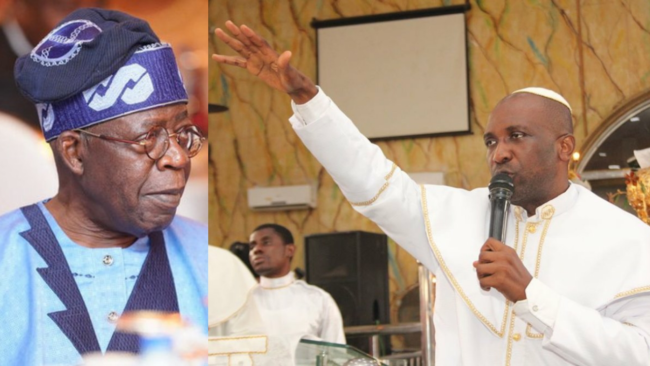
Primate Ayodele and Tinubu, Tinubu’s rice palliative, Primate Ayodele to Tinubu
Tinubu and Primate Ayodele
The leader of INRI Evangelical Spiritual Church, Primate Elijah Ayodele, has warned President Bola Ahmed Tinubu that US President Donald Trump is after removing him from office.
This comes amid the removal of Vanezuelan President Nicolás Maduro by Donald Trump.
Primate Ayodele, in a statement signed Sunday by his media aide, Osho Oluwatosin, made it known that the US President has ‘caged’ Tinubu and his plan is to ultimately see that he is removed from office.
READ ALSO:Primate Ayodele Releases Fresh Prophecies On FIRS, FAAN, Others
He stated that the support the US is giving Nigeria to fight insecurity isn’t for nothing other than ways to penetrate the government.
“Trump is adamant to remove President Tinubu. America will be part of those who will be against Tinubu. You may not see it as I am being shown, and that’s why I am saying Trump is after removing Tinubu, that’s it and nothing more.”
The cleric made it known that, despite US’ help, Nigeria will continue to fight insecurity, but the ulterior motive of the US President isn’t about ending insecurity in the country.
READ ALSO:Guber Polls: Primate Ayodele Releases Prophecies On Anambra, Ekiti, Osun
“Nigeria will still continue to fight insecurity, but either they fight it or not, Trump is focused on removing Tinubu from office, but he doesn’t know it yet. He isn’t after ending insecurity in the country, he knows what he wants and won’t stop at nothing towards achieving it.”
He urged the president to take a bold political step to overcome the plans of the US president; otherwise, he will end up succeeding with his plans.
“Tinubu must take a very bold step to overcome the plans of Trump, because he has caged him already. Tinubu must not relent his efforts and bring up strategies for him to succeed otherwise, he would be at the losing end while his defeat would be celebrated,” he added.
Headline
JAPA: Top Six Countries To Obtain Easiest Citizenship

As a Nigerian considering relocation plans, interest in countries with clear and less complicated citizenship pathways is a smart way to not just guarantee greener pastures, but also provide you with the opportunity to feel more at home in a foreign land. While some of the programmes are ancestry-based, others allow Nigerians with such a link to try other means.
Contents
1. Dominica
2. Ireland
3. Turkey
4. Portugal
5. Vanuatu
6. Italy
Though rules vary widely across borders, some nations stand out for offering citizenship through investment or family ties with fewer hurdles and faster processing timelines.
Below are the top six countries with the easiest citizenship:
1. Dominica
Dominica operates a citizenship-by-investment programme that allows applicants to qualify through a contribution to the government’s Economic Diversification Fund or by investing in approved real estate. Processing typically takes a few months. Citizens enjoy visa-free or visa-on-arrival access to over 140 countries, including the Schengen Zone. There is no residency requirement, and dual citizenship is permitted.
READ ALSO:Japa: 5 Affordable European Countries Nigerians Can Relocate To
2. Ireland
Ireland provides a clear citizenship pathway for individuals with Irish ancestry. Those with an Irish-born parent qualify automatically, while people with an Irish-born grandparent can apply through the Foreign Births Register. An Irish passport grants full European Union rights, including freedom of movement across EU countries. Dual citizenship is allowed, and there is no language requirement for applicants applying by descent.
3. Turkey
Turkey offers a fast-track citizenship option through investment. Foreign nationals who purchase qualifying real estate valued at a minimum of $400,000 can obtain citizenship within a few months. The programme does not require residency or renunciation of an existing nationality. Turkish passport holders have visa-free or visa-on-arrival access to several countries, with ongoing efforts to expand travel agreements.
4. Portugal
Portugal’s Golden Visa programme provides a residency-to-citizenship route for foreign investors. After five years of legal residence and meeting programme conditions, applicants may apply for citizenship. Approved investment options include venture capital funds and other qualifying assets. Successful applicants gain an EU passport, access to the Schengen Area, and dual citizenship, subject to passing a basic Portuguese language test.
READ ALSO:Japa: Lagos Suffers Deficit Of 30,000 Doctors, Commissioner Laments
5. Vanuatu
Vanuatu runs one of the world’s fastest citizenship programmes. Through its Development Support Programme, eligible applicants can receive citizenship in as little as two months after making the required financial contribution. The country offers visa-free access to over 100 destinations and has no tax on global income or capital gains. Residency requirements are minimal.
6. Italy
Italy grants citizenship by descent to individuals with an Italian parent or grandparent, following a 2025 legal update that tightened eligibility rules. Applicants must provide official documents proving a direct family link to an Italian ancestor. Italian citizenship comes with full EU rights, wide visa-free travel, and the ability to pass citizenship to future generations. Dual nationality is allowed, and no language test is required for descent-based applications.
(Tribune)

 News2 days ago
What I Saw After A Lady Undressed Herself — Pastor Adeboye
- Headline2 days ago
PROPHECY: Primate Ayodele Reveals Trump’s Plot Against Tinubu
- Metro2 days ago
Armed Robbers Shot PoS Operator To Death In Edo
- Politics2 days ago
Why Kano Governor Postponed Formal Defection To APC
- Metro21 hours ago
AAU Disowns Students Over Protest
- Entertainment2 days ago
Anthony Joshua Returns To UK In Private Jet
- Metro2 days ago
Gunmen Demand N200m Ransom For Kidnapped Brothers In Edo
- Metro2 days ago
Joint Task Force Kills 23 Bandits Fleeing Kano After Attacks
- Entertainment2 days ago
PHOTOS: Anthony Joshua Makes First Social Media Post After Surviving Deadly Car Crash
- Metro21 hours ago
Edo: Suspected Kidnappers Kill Victim, Hold On To Elder Brother


