

Headline
Nigeria’s Population Surge May Fuel Unrest, World Bank Warns



The World Bank President, Ajay Banga, has warned that without deliberate and coordinated global action, the growing population of young people could become a source of instability rather than a catalyst for progress.
This was as he projected that Nigeria’s population may rise by about 130 million by the year 2050.
Banga disclosed this during the 2025 Annual Meetings of the International Monetary Fund and the World Bank Group, where he warned that Africa’s explosive population growth presented both an unprecedented opportunity and a looming risk.
He cautioned that failure to create economic opportunities might turn youthful optimism into frustration, fueling unrest, insecurity, and mass migration with far-reaching consequences for every region and economy.
According to him, with the right investments focused on opportunity rather than need, Africa’s young population could become a powerful engine for sustainable growth and innovation in the decades ahead.
Banga described the coming decades as “one of the great demographic shifts in human history,” noting that by 2050, more than 85 per cent of the world’s population will live in countries currently considered developing.
He warned that over the next 10 to 15 years, approximately 1.2 billion young people will enter the global workforce, competing for only 400 million available jobs, resulting in a gap of 800 million unemployed or underemployed youths worldwide.
A transcript of his speech obtained by our correspondent on Saturday read, “Reconstruction is an essential part of our mandate. A service we stand ready to deliver whenever and wherever it’s needed and to the best of our ability. At the same time, as an institution of development, we are equally committed to conflict prevention.
READ ALSO:
“Alongside rebuilding what has been lost, we must also focus on creating the conditions for opportunity and stability. That is what motivates our actions and decisions today. We are living through one of the great demographic shifts in human history. By 2050, more than 85 per cent of the world’s population will live in countries we call “developing” today.
“In just the next 10 to 15 years, 1.2 billion young people will enter the workforce, vying for roughly 400 million jobs. That leaves a very large gap. Let me express that urgency another way: Four young people will step into the global workforce every second over the next ten years.”
He added that in the time it takes to deliver the remarks, tens of thousands would cross that threshold, full of ambition, impatient for opportunity.
The World Bank boss said the pace of population growth was most staggering in Africa, which will be home to one in four people by 2050.
“Between now and then, estimates suggest that Zambia will add 700,000 people every year. Mozambique’s population will double. While Nigeria will swell by about 130 million, firmly establishing itself as one of the most populous nations in the world.
READ ALSO:
“These young people, with their energy and ideas, will define the next century. With the right investments, focused not on need but on opportunity, we can unlock a powerful engine of global growth.
“Without purposeful effort, their optimism risks turning into despair, fueling instability, unrest, and mass migration, with implications for every region and every economy,” he added.
According to the United Nations Population Fund, Nigeria’s current population stands at about 237.5 million, already making it the most populous nation in Africa and the sixth largest globally.
However, with the projected surge of 130 million new citizens in the next 25 years, Nigeria could climb even higher, outpacing many developed nations in size and youth population.
The World Bank President described Africa as the epicentre of this demographic transformation, where birth rates remain high and economic growth has struggled to keep pace.
READ ALSO:
Banga echoed this concern, warning that failure to harness the demographic dividend could destabilise economies and fuel insecurity.
“Without deliberate action, optimism could give way to despair, driving instability, unrest, and mass migration with consequences for every region and economy,” he noted.
Banga emphasised that job creation must be at the core of all national and international development strategies.
“This is why jobs must be at the centre of development, economic, or national security strategy,” he stated.
READ ALSO:
He disclosed that the World Bank Group has expanded its financial capacity by about $100bn through new instruments and partnerships.
The multilateral development bank co-financing platform, he added, now hosts a pipeline of 175 projects, with 22 already financed, worth about $23bn.
The Bank is also working on an IFC2030 strategy aimed at mobilising more private capital to complement public investment, particularly in developing economies like Nigeria.
Nigeria’s fast-growing population has long been a source of debate among economists and policymakers. While its youthful population, estimated at over 60 per cent under age 25, offers potential for innovation and productivity, the country faces severe infrastructure deficits, high unemployment, and limited social services.
Data from the National Bureau of Statistics shows that youth unemployment stood at over 33 per cent in 2024, while millions remain underemployed or outside the formal labour force.




Headline
Oil Prices Drop After Iran Reopens Strait Of Hormuz

Global oil prices dropped sharply on Friday after Iran signalled that the Strait of Hormuz would remain open to commercial shipping during a temporary ceasefire in the Middle East.
Benchmark crude prices fell by more than 10 per cent, with West Texas Intermediate (WTI) slipping below $85 per barrel, while Brent crude declined to about $89 per barrel.
The decline follows comments by Iran’s Foreign Minister, Abbas Araghchi, who said commercial vessels would be allowed to transit the strait for the duration of a 10-day ceasefire involving Israel and Lebanon.
The truce, which began on Thursday, is reported to include the Iran-backed group Hezbollah.
READ ALSO:Crude Oil Prices Jump As Fear Mounts On Fresh Domestic Petrol Hike In Nigeria
Oil prices had surged above $100 per barrel in recent weeks amid heightened tensions in the region, with WTI reaching nearly $113 per barrel earlier this month and Brent climbing above $119 in late March.
Analysts say the reopening of the key shipping route has eased supply concerns in global energy markets.
Brian Therien, a senior investment strategist at Edward Jones, noted that oil futures are now trending lower, with projections suggesting prices could fall to the low $70 range by the end of the year. He added that a sustained drop in prices could help reduce inflationary pressures globally.
The Strait of Hormuz, which links the Persian Gulf to the Arabian Sea, is one of the world’s most critical oil transit routes, accounting for roughly one-fifth of global oil and liquefied natural gas shipments.
READ ALSO:JUST IN: Trump Orders US Naval Blockade Of Strait Of Hormuz
Shipping through the passage had been disrupted during the conflict due to security concerns, including threats of attacks and the presence of naval mines.
An Iranian official told Reuters that vessels moving through the strait during the ceasefire would be required to use designated safe lanes approved by Iranian authorities, while military ships would not be permitted to pass.
Despite the announcement, some shipping firms remain cautious. German carrier Hapag-Lloyd said it is still reviewing the situation before resuming operations in the area.
Meanwhile, Knut Arild Hareide of the Norwegian Shipowners’ Association welcomed the development but warned that uncertainties remain, particularly regarding maritime safety, operational guidelines, and the potential risks posed by unexploded sea mines.
Headline
You Can’t Go To US With Good Feelings Since Trump Returned To Power – Sports Legend


Germany legend, Oliver Kahn, has insisted that one cannot go to the United States with ‘good feelings’ since President Donald Trump returned to the Presidency.
Kahn stated this while speaking to Sky Sport Germany about the upcoming World Cup, which is to be held in the US, Mexico and Canada.
According to the former Bayern Munich goalkeeper, there are so many things happening in the US at the moment that are no longer compatible with ‘values’.
READ ALSO:Trump Tired Of War In Iran – Shehu Sani
“There are simply so many things happening in the USA right now that are no longer compatible with our understanding of values,” Kahn said.
“One example was the war, but I don’t want to list everything Donald Trump has been doing there since he returned to the presidency.
“You can’t go there with a good feeling at the moment.”
Headline
Trump Bows To Pressure, Deletes Post Depicting Self As Jesus

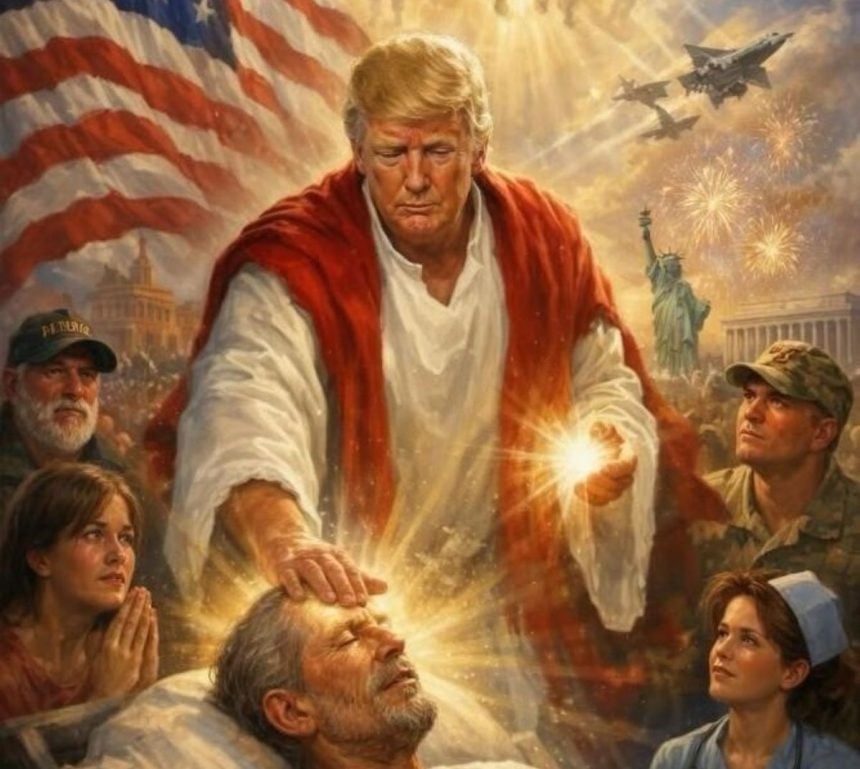
United States President, Donald Trump, has deleted a social media post that appeared to portray him as Jesus, following backlash and rising tensions with Pope Leo XIV over the Iran war.
The image, shared on Truth Social late Sunday, showed Trump as a Christ-like figure healing the sick, surrounded by American flags and eagles.
The post came shortly after the president criticised the pope for opposing the war with Iran.
By Monday morning, the image had been removed from his account. A previous link to the post now leads to a notice stating the “content is no longer available.”
READ ALSO:JUST IN: Trump Orders US Naval Blockade Of Strait Of Hormuz
Speaking later at the White House, Trump denied the interpretation of the image and said he believed it depicted him differently.
“I did post it, and I thought it was me as a doctor, and had to do with the Red Cross,” he told reporters at the White House.
He dismissed claims that the image portrayed him as Jesus, blaming the media for the narrative.
“Only the fake news” could come up with the idea that it depicted him as Jesus.
READ ALSO:I Have To Be Involved In Choosing Iran’s Next Leader – Trump
“I just heard about it, and I said, ‘How did they come up with that?’ It’s supposed to be me as a doctor making people better. And I do make people better,” he said.
The development comes amid an ongoing public disagreement between Trump and Pope Leo XIV over the Iran war.
The pope said Monday he has “no fear of the Trump administration” and would continue to speak out, despite criticism from the president, who described his stance as “terrible for foreign policy.”
Leo, the first American pope, has intensified his criticism of the war in recent days, condemning Trump’s remarks about the Iranian people as “truly unacceptable.”
(CNN)
-

 News5 days ago
BREAKING: JAMB To Release First Batch Of 2026 UTME Results Midnight
-

 News4 days ago
World Bank Flags ‘Hidden Spending System’ Diverting Over N34.53tn Of Nigeria’s Revenue
-

 News5 days ago
Popular Nigerian Broadcast Journalist Is Dead
-

 News5 days ago
FG Bans Unauthorized Use Of Ambassador Title
-

 News4 days ago
VIDEO: I Took Over Leadership From Myself; The Late Buhari Is Me — Tinubu
-

 Metro5 days ago
Police Inspector Arrested For Armed Robbery Dies From Bullet Wounds
-
News3 days ago
FG Slams Import Ban On 17 Items In New Fiscal Policy
-

 News5 days ago
OPINION: Nigerian Military: Death On Battlefield, Crumbs On Payroll
-

 Politics5 days ago
2027: Why Tinubu Should Be Scared – ADC
-

 News4 days ago
Guard Your Admission Carefully – Registrar Urges Newly Matriculated Students
