

News
World Bank Flags ‘Hidden Spending System’ Diverting Over N34.53tn Of Nigeria’s Revenue



The World Bank has raised concerns over Nigeria’s fiscal framework, revealing that more than N34.53 trillion was diverted from federation revenue over the past three years through pre-distribution deductions.
In its latest Nigeria Development Update obtained from its website, the global lender disclosed that although total federation revenue rose sharply to about N84 trillion between 2023 and 2025, about 41 per cent of the earnings did not reach the Federation Account for distribution to the federal, state and local governments.
According to the report, gross revenue increased from N17.08 trillion in 2023 to an estimated N37.44 trillion in 2025. However, deductions classified as “first-line charges” also rose significantly, from N6.22 trillion to nearly N15 trillion within the same period, reducing the pool of funds available for distribution.
The World Bank noted that the development has created a paradox in which rising revenues have not translated into improved public spending capacity, as a substantial portion is automatically retained by certain agencies before allocation.
It explained that reforms such as the removal of petrol subsidy and foreign exchange adjustments boosted nominal revenues, but much of the gains were offset by the structure of deductions tied to cost of collection and statutory transfers.
READ ALSO:World Bank Unveils Project To Upgrade 490 Secondary Schools
Agencies such as the Nigeria Customs Service, Nigerian National Petroleum Company Limited, and the Federal Inland Revenue Service account for a significant portion of these deductions. The report stated that their funding is based on fixed percentages of gross revenue, leading to higher allocations as revenues increase.
Describing the model as “pro-cyclical”, the Bretton Woods institution said it operates outside the conventional budgetary framework and weakens legislative oversight. In some cases, allocations to individual agencies exceed the revenues of several states and even the budgets of key federal ministries.
The report also highlighted the impact on public finances, noting a decline in capital expenditure from N5.5 trillion in 2024 to N4.5 trillion in 2025, with only about 25 per cent of the approved capital budget implemented. Meanwhile, the federal fiscal deficit remained elevated at N16.9 trillion, driven by debt servicing and recurrent expenditure.
The World Bank warned that the current arrangement undermines fiscal transparency and accountability, as significant portions of public revenue are spent outside the standard appropriation process.
Providing expert insight, an economist at Covenant University, Yemisi Ayinde, said the issue reflects deeper structural weaknesses in Nigeria’s public finance system.
READ ALSO:World Bank Lists Nigeria Among 39 Nations Facing Rising Poverty, Hunger
He explained that the diversion of about 41 per cent of federation earnings through pre-distribution deductions points to “a broader framework of fiscal fragmentation, bureaucratic self-allocation and weak legislative appropriation control”, resulting in what he described as a parallel fiscal system.
According to him, statutory revenue retention mechanisms, initially designed as cost-recovery tools, have evolved into entrenched structures that distort resource allocation and weaken the link between macroeconomic reforms and real sector outcomes.
Ayinde added that the trend has created a macro-fiscal paradox of rising revenues alongside shrinking discretionary fiscal space, leading to constrained capital formation, weaker fiscal multipliers and increased dominance of debt servicing over development expenditure.
He further noted that the arrangement raises concerns about transparency, accountability and legal compliance, warning that it could erode parliamentary control over public finances and weaken the social contract.
Also commenting, President of the Capital Markets Academics Association of Nigeria, Uche Uwaleke, described the World Bank’s findings as valid and consistent with concerns previously raised by local experts.
READ ALSO:World Bank To Nigerians: Don’t Oppose, Reverse Current Economic Reforms
“The Federation Account has continued to experience leakages despite reforms,” he said, noting that measures such as Executive Order 009 were steps in the right direction but insufficient.
Uwaleke called for stronger efforts to reduce the high cost of revenue collection, which he said is inconsistent with global best practices, adding that broader reforms are needed to plug persistent leakages.
Similarly, Chief Executive Officer of the Centre for the Promotion of Private Enterprise, Muda Yusuf, stressed the need for improved transparency and accountability across all tiers of government to ensure that increased revenues translate into better living conditions for citizens.
The report, titled “Nigeria’s Tomorrow Must Start Today: The Case for Early Childhood Development”, also highlighted longstanding weaknesses in Nigeria’s budget process, including the absence of a comprehensive organic budget law.
It noted that delays in budget approval—such as the late passage of the 2025 budget and the delay in approving the 2026 budget as of March 25, 2026—have reduced predictability for programme implementation.
READ ALSO:Economic Reforms: Nigerians Under Poverty Line Rise To 104m — World Bank
According to the World Bank, weak coordination between the executive and legislative arms has led to frequent and often untracked changes to budget proposals, undermining macro-fiscal planning.
“These weaknesses have contributed to unrealistic revenue and capital expenditure projections that are consistently missed,” the report stated, adding that the extension of budget cycles has resulted in overlapping implementation and weakened financial reporting.
To address the challenges, the World Bank recommended a comprehensive overhaul of the revenue management framework, including channeling agency funding through the annual budget process and subjecting it to legislative approval.
It also called for a reduction in cost-of-collection charges and the elimination of fixed-percentage allocations, noting that such reforms would boost net revenues available for development.
The institution cautioned that failure to implement these measures could further constrain Nigeria’s fiscal space and undermine recent economic reforms.
(TRIBUNE)




News
UNIMAID, Federal Polytechnic Matriculate 82 Degree Students

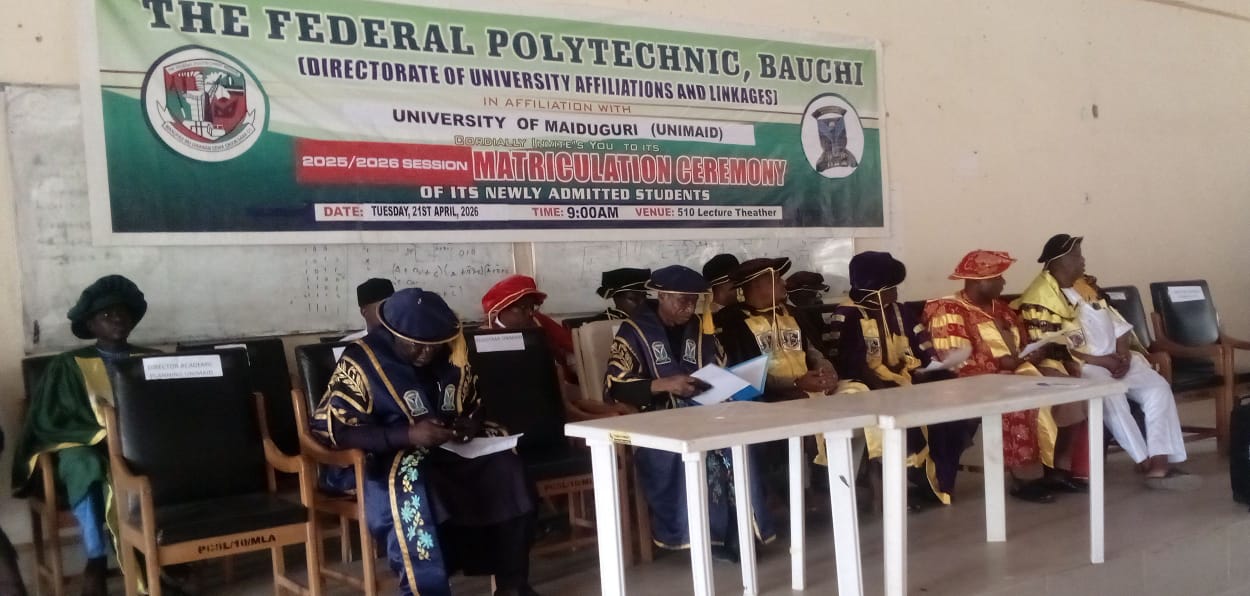
University of Maiduguri (UNIMAID) in affiliation with the Federal Polytechnic, Bauchi has matriculated 82 students into the degree programmes across five courses.
Speaking during the matriculation ceremony at the Federal Polytechnic Bauchi on Tuesday, Professor Muhammad Laminu Mele, the Vice chancellor, University of Maiduguri, charged the matriculated students to strictly adhere to the rules and regulations guiding the two institutions to enable them achieve the set objectives.
The VC, who was represented by Professor Muhammad Ahmad Waziri, Deputy Vice Chancellor Academic Services, warned that any student or group of students trying to breach the peace of the two institutions would face the full wrath of the law.
READ ALSO:NEDC Hands Over Mega School To Bauchi Govt
The Don further assured that the University and its affiliated institutions would continue to make easy access to higher quality education to the teeming population across the country.
In a remark, the Rector of the Polytechnic, Alhaji Sani Usman, said they were affiliated with the university to pursue academic excellence, describing the affiliation as a huge pillar in the education reforms.
READ ALSO:Bauchi Govt, UNICEF Strengthen Education Platforms To Improve Learning Outcomes
The Rector, who was also represented by Dr. Dalhatu Saidu, the Deputy Rector of the Polymeric, commended the university of Maiduguri for not only improving the UNIMAID’s conducive learning environment but expanding the horizon to different higher institutions of learning across Nigeria.
He therefore advised the newly matriculated students to pursue knowledge, to interact freely with the Polytechnic staff, be vigilant and be a brother’s keeper, adding that this would help to achieve the desired objectives.
The affiliated courses included BSc Mass Communication, BSc Accountancy, BSc Public Administration, BSc Business Administration and BSc Banking and Finance respectively.
News
Trouble Looms As Egbesu Group Drags FG To Court Over Resource Control, Others

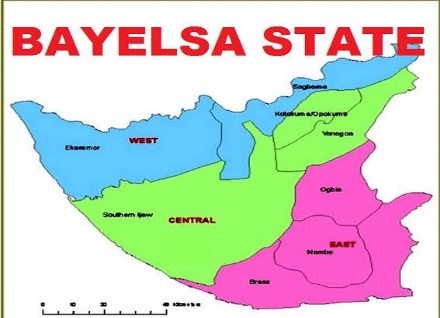
Group known as Supreme Egbesu Assembly (SEA) has dragged the Federal Government and the National Assembly to a Federal High Court, Yenagoa, over failure to create additional 24 Local government councils in Bayelsa State as the need for Ijaw to control natural resources in its territory.
The Originating Summons marked: FHC/YNA/CS/63/2026 was filed on Tuesday April 21, 2026 by the plaintiffs including; Felix Tuodolo, Weri Digifa, Ebi Waribigha, Kabowei Akamade, Rosebella Jackson, Thomas Jacklloyd, Primrose Kpokposei, David Imole and Welman Warri at the Federal High Court Yenagoa.
Joined as defendants in the suit are the National Assembly, the Clerk of the National Assembly and the Attorney General of the Federation.
In the court documents, the Egbesu Assembly premised their action on the alleged failure of the federal government particularly the National Assembly to deliberate, approve and amend the relevant provisions of the 1999 Constitution (as amended).
This, according to them, is to allow for resource control as well as the creation of additional LGAs in the state to fulfil the requirements in line with the Constitution.
READ ALSO:FG Bans Unauthorized Use Of Ambassador Title
The group is therefore seeking, among others, the amendment of the constitution by the National Assembly to allow for the right to resource control.
The Supreme Egbesu Assembly described the suit action as a promise kept.
Mranwh, In a press statement announcing the institution of the lawsuit on Tuesday, the Egbesu Assembly recalled that, on 12th February 2026, it wrote to both the Federal Government and the National Assembly wherein its gave a 21-Day ultimatum for the duo to respond to the age-long demands for resource control and creation of additional LGAs or face a lawsuit.
The statement partly reads: “Recall that on 12th February 2026, we did inform you that we have written to the National Assembly and the federal government on the need for the creation of an additional 24 Local Government Areas in Bayelsa State as well as the control of our God-given natural resources in Ijaw territory.
“We promised that if the National Assembly and or federal government did not respond to these age-long demands, we were going to seek legal actions to address our demands.
READ ALSO:
“We gave a time frame of twenty-one days for them to respond to us—we got no response!
“Today the Supreme Egbesu Assembly (SEA) has kept to its promise.
“We instituted an action at the Federal High Court Yenagoa against the National Assembly and the Federal Government after the expiration of the 21 days. Today we were in court for the first hearing of both cases.”
According to the group, creation of additional local government areas for Bayelsa is as old as the creation of the State itself.
The SEA maintained that “there is nowhere in any democracy where a state is limited to just 8 LGAs: more pathetic is the fact that Bayelsa State is an oil bearing State.
“Bayelsa State presently has twenty four Rural Development Authorities (RDA) which can be easily converted to Local Government areas thereby making the State eligible to participate in the sharing of allocation and the development of their areas for the purpose of justice and equity.
READ ALSO:
“Gentlemen, we wish to inform you that our suit on Resource Control is a revival of our age long agitation.”
The group further stated that Nigeria can no longer operate a system where contributors to the national coffers are not in charge of their resources.
The group added that the lawsuit is therefore for the Ijaw people.
“The Ijaw Nation must be free from all economic strangulation carried out against them by successive Governments,” they added.
The SEA called on all Ijaws to be steadfast and resolute, and continue to support the process by attending all court sessions, stating that “your solidarity is very vital at this point of time in our history. “
The group also called on other Ijaw organizations, communities, Niger Delta people, organizations and all people of goodwill “to join in the march to control and manage our despoiled and mismanaged natural resources.”
News
BREAKING: Tinubu Sacks Wale Edun, Dangiwa As Ministers

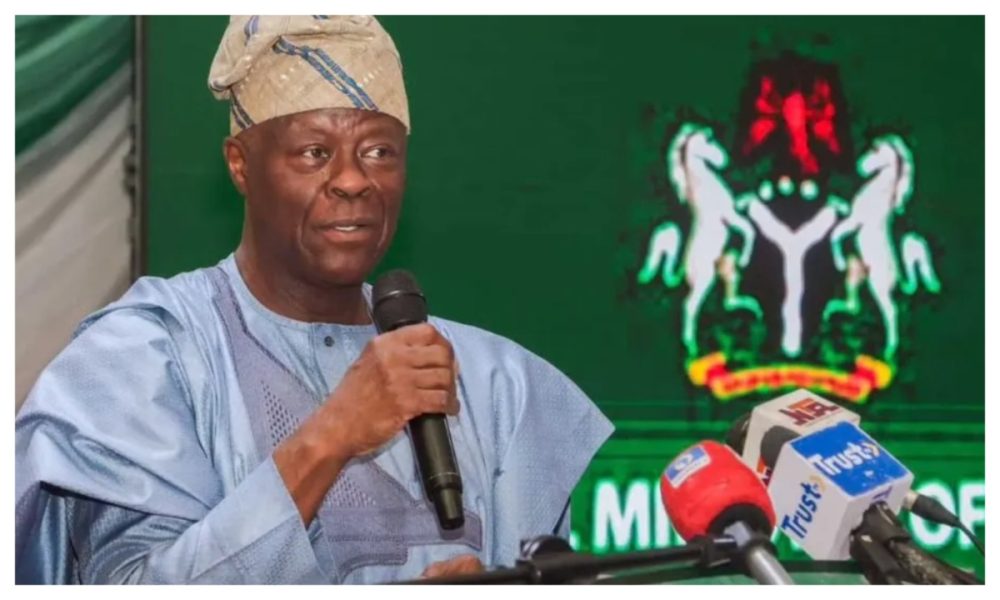
President Bola Tinubu has approved a minor reshuffle of the Federal Executive Council, removing the Minister of Finance and Coordinating Minister of the Economy, Wale Edun, and the Minister of Housing and Urban Development, Ahmed Dangiwa, from their cabinet positions.
Special Adviser, Media and Publicity to the Secretary to the Government of the Federation, Yomi Odunuga, said the development was contained in a memo signed by the
Secretary to the Government of the Federation, George Akume.
According to the memo, Taiwo Oyedele has been appointed as the new Minister of Finance and Coordinating Minister of the Economy.
Also appointed is Dr. Muttaqha Darma as Minister-designate for Housing and Urban Development.
READ ALSO:VIDEO: I Took Over Leadership From Myself; The Late Buhari Is Me — Tinubu
The memo directed the outgoing ministers to complete handover processes to their respective successors or supervising officials.
It stated that all handing over and taking over activities must be concluded on or before the close of business on Thursday, 23rd April, 2026.
Explaining the decision, Akume said the changes were aimed at improving coordination and strengthening delivery across key sectors of the economy under the Renewed Hope Agenda.
“These changes are aimed at strengthening cohesion, synergy in governance as well as achieving more impactful delivery on the economy to Nigerians, through the Renewed Hope Agenda,” Akume stated.
READ ALSO:VIDEO: Tinubu Till 2031, City Boy Movement Members Declare At Bayelsa Rally
He added that President Tinubu acted in line with his constitutional powers as provided under Sections 147 and 148 of the 1999 Constitution (as amended).
The SGF also conveyed the President’s appreciation to the outgoing ministers for their service to the nation and wished them well in their future endeavours, noting that the process of cabinet reinvigoration would remain continuous.
The statement further noted that Taiwo Oyedele was appointed as Minister of State for Finance in March 2026, while Edun was among the ministers appointed on August 16, 2023.
-

 News5 days ago
BREAKING: JAMB To Release First Batch Of 2026 UTME Results Midnight
-

 News5 days ago
Popular Nigerian Broadcast Journalist Is Dead
-

 News4 days ago
FG Bans Unauthorized Use Of Ambassador Title
-

 News4 days ago
VIDEO: I Took Over Leadership From Myself; The Late Buhari Is Me — Tinubu
-

 Metro4 days ago
Police Inspector Arrested For Armed Robbery Dies From Bullet Wounds
-
News2 days ago
FG Slams Import Ban On 17 Items In New Fiscal Policy
-

 News5 days ago
OPINION: Nigerian Military: Death On Battlefield, Crumbs On Payroll
-

 Politics4 days ago
2027: Why Tinubu Should Be Scared – ADC
-

 Politics3 days ago
ADC Penetrates Okpebholo’s District As Defections Strengthen Party in Edo Central
-

 Headline4 days ago
Oil Prices Drop After Iran Reopens Strait Of Hormuz
