
News
OPINION: Abdulkareem, The Deaf And His Son
By Suyi Ayodele
Hans Christian Andersen (April 2, 1805 – August 4, 1875), the Danish fiery-tales author once quipped: “Where words fail, music speaks.” This quote summarises the transformative power of music to address issues mere words of mouth could not convey. Music, as Literature, is deep.
The African society of old relied more on music, especially derisive songs, to address social misconducts and speak truths to power. The various festival songs in the African Indigenous Religion AIR) are composed as conveyors of the society’s disapproval of inappropriate behaviours by those in authority.
One analysis of Andersen’s quote above says that music on its own has an inherent ability “to convey emotions, tell stories, and communicate a range of human experiences without relying on verbal communication. It serves as a universal language that can touch the depths of our souls and transcend the limitations of words alone. At its core, the quote emphasizes the limitations of language while highlighting the boundless potential of music.”
I once heard a tale of a man who drew the sword and beheaded a drummer for using the instrumentality of the sounds of his talking drum to address an infraction the valiant once committed. Bards and raconteurs too, had in the past, incurred the fury of monarchs and those in authority and paid dearly for their boldness to show kings the pus oozing from the royalty’s eyes.
Whatever you want the deaf to hear, our elders advise that we should say it to the hearing of his child. Whether clinically or deliberately deaf, the favourite child has a way of getting the people’s messages across to his deaf father. The deliberately unfeeling leaders have their weak points in their favourite children. That is why, when the people are pushed to the wall, they say the unprintable things about their leaders to the hearing of the leaders’ children.
There is always a favourite child in every family. That is the type of child who has the ears of his parents, especially the father. For one to get the head of such a family’s attention, it is advisable to go through the favourite child.
I once led a group of my colleagues in my last employment to the palace of a traditional ruler in Esanland, Edo State, to resolve a naughty community issue affecting our company’s operations in his domain. We waited for close to three hours without seeing the monarch. Everyone who had gone into the inner recesses of the palace to inform the king of our presence came back with the same assurance: “The Onojie will see you soon.”
MORE FROM THE AUTHOR: OPINION: Uromi Killings And Sandalili Nursery Rhyme
We were almost losing hope of having an audience with the monarch when a young lady sauntered out of the inner chamber to the open court. An elderly man, who knew when we came into the palace, beckoned on me and whispered that we should approach the lady and ask for her assistance. The princess, he said, was the only one who could get the monarch to attend to us.
As the lady was about to enter the inner chamber again, I approached her. We exchanged pleasantries and I explained our mission and how long we had waited to see her father. I pleaded that she should help tell the monarch that we were still waiting. She was a charming, beautiful damsel. And very mannerly, too. She promised to help and went inside.
About 15 minutes later, the lady emerged again, walked up to where we were clustered and asked us to follow her. She led us to a different section of the palace where we met the Onojie on his throne. We paid the necessary homage, and the monarch waved us to our seats and apologised for keeping us waiting. He also asked the princess to wait to hear our petition.
In less than 30 minutes, we were through. The monarch approved all our proposals and asked the princess to take us to another man, a chief, who would implement the decisions. We left the palace happily because we encountered the king’s favourite child who took our case to her father. It is true that omo ina laa ran si ina (you send a fiery child to a fiery father)
The last two years have been terrible in all ramifications for Nigerians. The pains and agony occasioned by the misgovernance of President Bola Ahmed Tinubu, are just unimaginable! The man, called Jagaban, has succeeded in substituting his promise of hope with the acute reality of hopelessness! We have cried; we have wailed. Tinubu and his government remained deaf to our plights; eternally pococurante! Very sad!
MORE FROM THE AUTHOR: OPINION: Rivers, Where Is My Own 5,000 Dollars For Sallah?
Then one of us got wise and went back to the ancient wisdom of our forebears. This man realised that deaf and sadistic as Tinubu and his government are, there is a spoiled brat of the President who could take our message of pain to his father. He decided to explore that line of ancient communication that for whatever we want the deaf to hear and understand, we should say it to the hearing of his child. And not just any child of the deaf, this time around, it must be the favourite child of the deaf. The man went to the studio and waxed an album.
This is what the iconoclast, Eedris Abdulkareem, did with his latest hit album: “Tell Your Papa.” Abdulkareem is not new to protest songs. He once drew the attention of the General Olusegun Obasanjo’s government to the shenanigans going on in the country under the watch of Ebora Owu, when the artiste sang: “Nigeria Jaga Jaga.”
In that 2004 album, Abdulkareem said that insecurity had taken over the entire nation and everything was like the ‘higgledy-piggledy and topsy-turvy’ world of the Nobel Laureate, Wole Soyinka’s “The Forest of a Thousand Daemons.” Obasanjo’s immediate response was a curse that it was Abdulkareem’s life that was ‘jaga jaga’ and not Nigeria. He went ahead to ban the song from our radio stations. The ban was inutile as the song, with its four other remixes continues to be a blast till date! That was Nigeria 19 year ago.
What Abdulkareem saw 19 years ago in “Nigeria Jaga Jaga” is nothing compared to what the present ruiners have turned the nation to. Nigerians today no longer hear gunshots but the sounds of bazookas in the hands of bandits, terrorists, kidnappers and killer herdsmen that have laid the country waste! At a time, there were rumours that the nation’s security outfits had to pay a huge sum of money to buy off one of the arms in the hands of bandits that posed a huge threat to the Presidential Aircraft of the then President, Muhammadu Buhari.
So, if today, Abdulkareem sings: “Seyi, tell your papa country hard/Tell your papa people dey die/Tell your papa this one don pass jagajaga/Seyi, how far?/ I swear your papa no try/Too much empty promises/On behalf of Nigerians, take our message to him/Kidnappers dey kill Nigerians/”, is that not the naked truth? If the artiste goes ahead to say: “Seyi, try travel by road without your security make you feel the pains of fellow Nigerians/You dey fly private jets, insecurity no be your problem…”, is that not a good challenge, and is he not just stating the obvious?
MORE FROM THE AUTHOR: OPINION: A Journey Through Ogoni, The Titusville Of Nigeria
Even the blind could see that Seyi Tinubu is not just the favourite child of President Tinubu, he qualifies as the nation’s Assistant President, given the receptions he gets anywhere he travels to. Some visiting state governors are not accorded as much protocols and attention Seyi gets whenever he visits any state. Videos of his presidential convoys as the spoilt son of the president ‘tours’ the states of the Federation speak volumes of the influence of the son over his absentee President of a father!
At a time, Seyi was reported to be attending the weekly Federal Executive Council (FEC) meeting until wisdom prevailed and his father excused him. Nigerians have no doubt about the fact that Seyi is the nation’s ‘Son Excellence’, the unelected ‘Assistant President’ of Nigeria. Unarguably, the boy is more powerful, more visible and wields superior powers than the loiters around Aso Rock and many aides of the President.
That being the case, what is wrong in asking the President’s son to take the message of our pain and agony to his father, our tormentor-in-chief? What is the position of the Holy Book, the Bible, about the father being in the son and the son being in the father (John 14:11)? Whoever else could have done the job of a go-between in this circumstance between a deaf Presidency and a suffering populace more than the favourite son of the President?
What then is the colour of the problems of the Nigerian Broadcasting Commission (NBC), and its monitoring-spirit unit known as the Directorate of Broadcast Monitoring, in banning Abdulkareem’s latest song from our airwaves? Whose interest is NBC serving? And if we may ask again: what threat does “Tell Your Papa” constitute? Why is it that every dissenting voice is considered an insult to the imperial President Tinubu, who keeps behaving like the proverbial king’s executioner that dreads the presence of the sword near his own neck?
The art of protest songs is as old as human agitation for a better society. Music and politics, many opined, appear inseparable. As early as 1931, Florence Reece ((April 12, 1900 – August 3, 1986), the wife of a miner and unionist, Sam Reece, wrote the song, “Which Side Are You On?” The song was in solidarity with the miners of Kentucky, who were in battle with the exploitative mine owners. The bold lady wrote the song on an old calendar she found in her kitchen after State agents who were after her husband harassed her and her children throughout the night.
In 1964, Bob Dylan, the 83-year-old American singer, released “The Times They Are A-Changin”, Bob Marley gave us “Get Up Stand Up” in 1973. Gil Scott-Heron sang “The Revolution Will Not Be Televised” in 1971 and our legend, Fela Anikulapo Kuti used the instrumentality of music to torment bad leadership in Nigeria. The one fondly called Abami Eda (the weird one) troubled both military and civilian administrations in Nigeria to no end. He extended the whip to Africa and the entire world. His “Zombie” (1977), “Beast of No Nation” (1989), and his 1980 “I.T.T. (International Thief Thief)”, are many examples of revolutionary protest songs by the prolific musicologist, the best and most daring of his epoch. To date, Fela’s name rings as the dominant voice of the one crying in the wilderness for a better Nigeria.
Though the Nigerian nation went after Fela on many occasions as he was jailed, whipped on the road and had his house burnt and his mother Funmilayo Ransome-Kuti killed, Fela was not deterred. Rather than kill his spirit, the State harassment propelled Fela to higher heights, and almost three decades after he died, Fela’s music remains evergreen.
Nigerian leaders need to learn. Those in government need to listen, read and be schooled! If those in NBC are lettered, they would have found wisdom in the assertion of scholars on the interwoven nature of music and politics.
For instance, on March 28, 2014, the Cambridge University Press reproduced in its online platform, the article titled: “Fight the Power: The Politics of Music and the Music of Politics.” That piece had earlier appeared in An International Journal of Comparative Politics, Volume 38, issue 1, 2003, pp 113-130. In the article, it is stated that “Popular music has a long and varied association with politics. It has provided the soundtrack to political protest and been the object of political censorship; politicians have courted pop stars and pop stars …” We must add, however, that that is what leaders in sane climes of the world where dissenting voices are accorded their due respects as agents of social change, do!
Has NBC gone to check how that indiscretion on its part has promoted Eedris Abdulkareem and his latest song? Has that regulatory body asked itself, the same question Florence Reece asked 94 years ago when she penned: “Which Side Are You On?” After banning “Tell Your Papa” from our airwaves, has NBC been able to ban it from the internet and our subconscious?
And as we await the return of President Tinubu from his France trip to Aso Rock Villa, may we all rise and tell the President say: Presido, country hard/ people dey die/This one don pass jagajaga/ / We swear, Presido, you no try/ Na lie I talk?

News
Six Corps Members Receive N10m Grants To Boost Agribusiness

Six members of the National Youth Service Corps (NYSC) have received a total of N10 million in grants to expand their agribusiness ventures under the Farmers for the Future Programme.
The programme was organised on Monday by the British American Tobacco Nigeria Foundation (BATNF) in collaboration with the NYSC to encourage young Nigerians to embrace agriculture and develop sustainable businesses.
Presenting the cheques to the beneficiaries in Abuja, the NYSC Director-General, Brigadier General Olakunle Nafiu, urged Corps members to maximise the opportunities provided by the service year by venturing into commodity marketing and other viable businesses.
Nafiu said agribusiness remained a viable avenue for young people to build sustainable enterprises, create employment and generate wealth.
READ ALSO: NYSC Swears In 1,600 Corps Members In Bauchi
He also stressed the importance of value addition to the success and sustainability of business ventures, while commending BATNF for placing Nigerian youths at the centre of its entrepreneurship initiatives through value-chain development, employment creation and its partnership with the NYSC.
“I charge you to spread the news around. We have seen the outcome, and it is a good idea,” he said.
The beneficiaries are Dominic Olufemi (FC/25C/1143), who received N3 million; Temitope Adewole (ED/26A/2251), N2 million; Abdulwaheed Bala (ED/25B/1402), N2 million; Olanike Mayungbe (OG/26B/1037), N1 million; Kingsley Udoeyen (KG/26A/1735), N1 million; and Lorember Lorsue (JG/25B/1742), N1 million.
Speaking on the selection process, the Acting Director, Skills Acquisition and Entrepreneurship Development (SAED), Mrs Winifred Shopeka, said the programme began with an online registration portal through which Corps Members engaged in agribusiness submitted their business plans.
READ ALSO: NCCSALW Deploys NYSC Members In Fight Against Illegal Arms In Northeast
She said nearly 3,000 Corps members applied and underwent a rigorous selection process that produced 20 finalists.
According to her, the finalists participated in a boot camp and a final pitching session, which produced the 10 best presenters before the six ultimate winners were selected.
Shopeka said the beneficiaries had also been mentored and attached to established market operators to assist them in marketing their products.
She added that Corps Members who did not make the final stage of the competition were also trained by BATNF.
The BATNF Team Lead, Mr Oludare Odusanya, congratulated the beneficiaries and urged Corps Members engaged in agribusiness to master the fundamentals and acquire the knowledge and skills necessary to succeed.
“We are happy with our collaboration with the NYSC, and it will continue,” he said.
READ ALSO: NYSC Lauds Gov. Mohammed’s Intervention In Fence Collapse
Odusanya explained that BATNF was an independent organisation established to contribute to poverty reduction in Nigeria through sustainable agricultural practices and other interventions.
He said the Farmers for the Future Programme was instituted in collaboration with the NYSC to encourage Corps Members to venture into agribusiness and become job creators.
He added that the beneficiaries would be attached to mentors who would guide them towards achieving success in their respective businesses.
According to him, the programme has, since its inception, continued to enhance the entrepreneurial capacity of Corps Members.
News
CBN Reduces Interest Rate To 23%

The Central Bank of Nigeria (CBN) on Tuesday announced the reduction of the interest rate, also known as Monetary Policy Rate (MPR) to 23 percent.
Briefing the media in Abuja, the Governor of the CBN, Mr. Olayemi Cardoso, said at the 307th MPC meeting held on September 22, 2026 agreed the resetting of the MPR and recaliberation of the monetary policy market.
According to Cardoso, the committe is satisfied with the disinflation progress, adding that members noted stable banking sector following successful recapitalisation.
READ ALSO: CBN Monetary Tightening Worsening Nigeria’s N50tn Development Finance Gap – Group
Meanwhile, according to Nigerian Tribune, reports that that the MPC, at its 306th meeting in July 2026, disclosed its resolution to retain the interets at 26.5 percent.
According to the Governor of the CBN, Olayemi Cardoso, “the Committee’s decision to maintain the current policy stance followed a thorough assessment of the balance of risks. Although headline inflation moderated marginally in June 2026, global uncertainties have heightened, due mainly to the renewed hostilities in the Middle East.
“In view of the evolving developments, maintaining a cautious monetary policy stance remains appropriate. In arriving at its decision, the Committee noted the recent resurgence of hostilities in the Middle East, with particular attention to its spillover effects on global energy prices and the potential pass-through to domestic inflation.”
News
NURTW: KWAM1 Settles Long-time Rift Between MC Oluomo, Tafa Sego
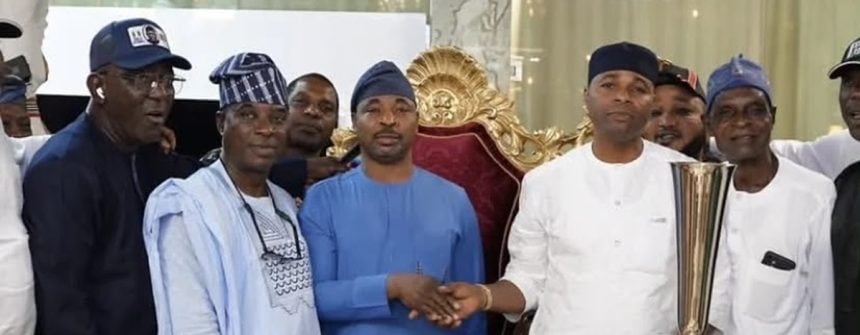
Nigerian Fuji musician, Wasiu Ayinde Marshal, popularly known as KWAM1, has brokered a peace deal between the National Union of Road Transport Workers (NURTW) National President, Musiliu Akinsanya, popularly known as MC Oluomo, and the Lagos State Chairman of the union, Mustapha Adekunle, aka Tafa Sego.
The reconciliation took place at Ojusagbola in Ijebu, Ogun State, where several NURTW chieftains gathered for the meeting.
The development was announced on Tuesday on KWAM1’s digital media page on Instagram, alongside photographs from the meeting.
According to the post, the two union leaders have resolved their differences after years of strained relations.
READ ALSO: Why FG Named KWAM 1 Aviation Security Ambassador — Keyamo
“After years of an age-long rift, MC Oluomo and Tafa Sego have finally settled their differences. And from what we know now, this is final,” the post said.
The musician was said to have intervened as the Mayegun of Yorubaland, with the aim of bringing an end to the longstanding disagreement between the two NURTW figures.
“K1 acted in his role as the Mayegun of Yorubaland by seeking an end to the long-standing rift, once and for all,” it said.
The post also described the meeting as a significant step beyond previous public displays of reconciliation.
READ ALSO: FG Gives KWAM 1 Aviation Appointment, After Airport Incident
“This time, it was not just another handshake for the cameras. The two old friends and colleagues came together at Ojusagbola, with King Wasiu Ayinde Marshal (K1) playing the peacemaker.”
Both MC Oluomo and Tafa Sego were reported to be pleased with the outcome of the intervention.
“Both parties are delighted about the new development,” the post said.
The two men had previously been allies and prominent figures within the Lagos NURTW before their relationship became strained amid disagreements linked to leadership of the union in the state.

 News3 days ago
BREAKING: Tinubu Extends Working Vacation
- News5 days ago
Six Hidden Health Benefits Of Unsweetened Zobo
- News5 days ago
Jehovah’s Witnesses Announce New Position On Blood Transfusion Policy
- News5 days ago
How 36 Nigerian States Got Their Names
- News5 days ago
2027: Step-by-step Guide To Applying For INEC Ad Hoc Staff Recruitment
- Headline5 days ago
Nigerian Man Jailed After Masturbating In Front Of Woman On UK Train
- Headline3 days ago
How To Format An Academic CV For US Master’s, PhD Applications
- Business5 days ago
Naira Appreciates Against Dollar At Official FX Market
- News5 days ago
Stop Acid Reflux Pain: Foods You Must Ban From Your Kitchen
 News3 days ago
OPINION: The Stranger In APC’s Kitchen


