

News
OPINION: KWAM 1, Eccentricity And Big Man Syndrome


By Festus Adedayo
At the risk of being labeled thanatophobic – a preoccupation with death or its anxiety – the grim reality is that, last Tuesday, Nigeria’s music world would have lost veteran Yoruba Fuji musician, Wasiu Ayinde. Being Muslim, it is in order to say the man popularly known as KWAM 1 would have been buried same Tuesday or early Wednesday. He would have been killed over a mere tiff with an airline official over allegation of carrying liquour on board an aircraft. There is no grimmer way of putting the potential calamity than this. It is a signpost of the paper-thin divide between life and death.
A footage of the musician hurriedly ducking the wing blade of a taxing ValueJet aircraft on the Nnamdi Azikiwe International Airport, with a potentially disastrous consequence, left everyone gasping for breath. KWAM 1, in his usual haughty display, had engaged the airline’s personnel in a needless altercation over his obvious breach of airline protocol. So, how do you label what the musician demonstrated that Tuesday; eccentricity, Big Manism, suicidal inclination or substance intoxication?
Looking for a musician or artist who is not eccentric may be akin to searching for the teeth of a hen. Name them: Michael Jackson, Marvin Gaye, Oscar Wilde, David Bowie, Lady Gaga, Captain Beefheart and in Nigeria, Fela Anikulapo-Kuti, Wole Soyinka, Davido, Wizkid, Portable and many others. They all have one thing in common: they are eccentric. They are weird, unconventional, against-method and display rare traits, mostly for attention and in support of their trade. For them, acting unconventionally is a private code, a badge of identity. Lady Gaga’s is in her flamboyant fashion and performances. The truth is that, eccentricity, what Americans call ‘wacky’, is the lifeblood of music, musicians and the art in entirety. For most of them, it is intentional eccentricity, a bold effort to wow the audience through appearance or presentation. The media also feeds off their wacky lifestyles, raking millions from their unconventional public images.
Michael Jackson is an example. Michael lived a bizarre life with a unique public persona, unusual lifestyle choices, as well as weird dressing and dancing styles. He deliberately cultivated a mysterious and flamboyant image with rumours and speculation enveloping his entire life. He took eccentricity to a new high as one who was not only eccentric but who was gloriously audacious. He decorated himself with clothes that charmed his vanity and was just like Oscar Wilde’s Dorian Gray, the character in his The Picture of Dorian Gray, who didn’t want to lose the purity of his youth to age, who then admonished that, “when your youth goes, your beaty will go with it…time is jealous of you and wars against your lilies and your roses”.
Michael Jackson abhorred decaying flesh and wanted longevity. To achieve this, he lived in a hyperbaric oxygen chamber, conducting extensive plastic surgeries on himself which included cosmetic procedures of rhinoplasty (nose jobs), cheekbone, forehead lifts and lip-thinning. After this, he was afflicted by vitiligo, a skin condition whose feature is pigment loss, prompting his fans to accuse him of skin bleaching. He also lived like a recluse in his Neverland Ranch home designed with amusement park rides. In the zoo, he collected exotic animals. Michael’s invitation to children to stay with him in the Ranch fueled speculations and accusation of his being a pedophile. This landed him multiple accusations of child sexual abuse, leading to prolonged legal battles which significantly impacted his mental health and public image.
MORE FROM THE AUTHOR:OPINION: Ahmadu Bello Children’s Territorial Politics
In the odd life they live, odd ways they dress, queer acts they display and their unusual performative actions on stage, artists and musicians demonstrate how eccentricity can be used as a powerful tool to shape musical identity.
Musicians’ lyrics also bring out the eccentricity in them. In 1986, New Jersey-born American singer-songwriter and pianist, Gwen Guthrey, burst the bubble of a prude world when she sang her very controversial and materialistic track, “Ain’t Nothin’ Goin’ on But the Rent”. It was raw talent combined with artistic bravura. For a world that was not used to such realistic outburst from the female to the male gender, that track, especially its matter-of-factly pronouncement, “You’ve got to have a j-o-b if you want to be with me/No romance without finance” shocked the world. Guthrie was to die of uterine cancer on February 3, 1999, thirteen years after the song. Same audaciousness went for reggae musician, Winston Hubert MclnTosh, one of the now deceased trio of Jamaican reggae group, the Wailers. Popularly known as Peter Tosh, against the grain of global public morality, Tosh’s first major hit after the separation of the band was an iconoclastic album he called Legalize It, released in 1976 with CBS Records. In it, Tosh uncompromisingly beatified the banned narcotic drug, Indian hemp, lauding its health benefits and the widespreadness of its abuse. The album sleeve had him smoking the marijuana chalice pipe in a countryside hemp plantation.
It is same for Marvin Gaye. Described as shy, fearful and ambitious, yet also capable of great passion and charisma, his eccentricity is in a complex interplay and conflict between his artistic vision, personal struggles and unconventional approach to music and life. He was a non-conformist who pushed boundaries, both musically and personally, and which sometimes manifested in his erratic behaviour of a troubled personal life, childhood abuse and his struggle with insecurity. He struggled to balance social commentary with eroticism in his songs, especially in his world classic track, ‘Sexual Healing.’ This unwittingly revealed his multifaceted personality. He also struggled to balance his feeling for his father, a strict and reputedly abusive religious figure and his love for his mother. He was eventually shot twice by his father after he intervened in an argument between his parents. He was pronounced dead upon being rushed to the California Hospital Medical Center on April 1, 1984. His father later pleaded no-contest to a charge of voluntary manslaughter in an Arlington Heights, Los Angeles, California, USA court.
Like Wasiu Ayinde, Tosh, the 6.4-footer dreadlocked singer was arrogant and self assertive. For instance, immediately his colleague, Bob Marley died, Tosh shocked the world in an interview where he made the allegorical claim that Bob peaked in his musical career while he (Peter) was decorating the stage. The truth is, Tosh was too assertive, too hot to handle and never hid his disdain for what he called “Babylonian” lifestyle of hedonism. Tosh also believed in marrying words with action. Towards the latter part of his life, he cut a queer image of a revolutionary ready to carry arms. With his imposing height as he adorned a black beret, with a guitar that had the shape of an M16 assault rifle, Tosh didn’t mince words in projecting the narrative that he was a musical militant. He told those who underrated him that he was “like you are steppin’ razor” and asked, “don’t you watch my size” as “I am dangerous!” In comparison to others, Tosh said “I’m the Toughest,” an apparent reference to the trained karate belt holder that he was. He was once asked by an interviewer why he never smiled. His reply was, since he sang revolutionary songs, not love song, nor a tea party, there was no reason to smile.
While putting up eccentric shows, however, many of the musicians and artists have met their waterloo. One of KWAM 1’s Yoruba musical ancestors, Ayinla Omowura, was not as lucky as he was on the Nnamdi Azikiwe airport tarmac. As KWAM 1 woke up that Tuesday morning in Abuja, on May 6, 1980, the Apala songster also rose at cockcrow in his Itoko, Abeokuta, Ogun State home. By midday, he was history. For the Egba-born musician, a trivia, a needless beefing over possession of a motorcycle in a barroom brawl, extinguished his hugely billowing musical career fire.
MORE FROM THE AUTHOR:OPINION: Oyinlola’s Crocodile And Fayose’s Carcass
Eccentricism comes in various forms. To some, it is in a violent lifestyle. For some others, it is acting like a child, what is called infantilization. Its victims deny their maturity and treat themselves as helpless and dependent. Many of them express their bohemianism through consumption of drugs. Apala music Lord, Omowura, Awurebe’s Dauda Epo Akara and Fuji’s Ayinde Barrister – the latter, up until a point when he left the craze before his death, consumed marijuana heavily. Omowura once walked into an Abeokuta High Court smoking the banned substance. For yet some others, it is arousing sexual desire or excitement in others through their looks, while to some others, it is blasphemy.
Take for example, The Beatles, a famous American Rock music band, widely regarded as the most influential Western popular music ever. It was formed in Liverpool in 1960 with a core lineup of artists like John Lennon, Paul McCartney, George Harrison and Ringo Starr. Lennon had sparked controversy in a 1966 interview with British reporter, Maureen Cleave, when he said The Beatles were even “more popular than Jesus”. He further said, “Christianity will go. It will vanish and shrink. I needn’t argue about that; I’m right and I will be proved right … Jesus was alright but his disciples were thick and ordinary. It’s them twisting it that ruins it for me.”
The Lennon comment resulted in a huge backlash and created an uproar which led to wide protests against the band. US religious and social conservatives were outraged. Even the Ku Klux Klan joined the fray. The controversy it sparked was such that The Vatican issued a protest letter. The Beatles’ records were also banned by Spanish and Dutch radio stations and on South Africa’s National Broadcasting Service. When the backlash became too severe, a press conference was organized for Lennon to make a clarification and he said, “If I’d said television was more popular than Jesus, I might have got away with it.,” but at further promptings from reporters, he grudgingly said, “If you want me to apologize, if that will make you happy, then okay, I’m sorry.”
The bohemian nature of The Beatles was to come out more later. They provoked a great furore in June 1966 with the cover of their Capitol LP with the title ‘Yesterday and Today.’ The album sleeve had them dressed in a butcher’s overall with raw meat and mutilated plastic baby dolls splattered on it. They grinned from ear to ear. On a tour of the Philippines the month after this furore, they unintentionally snubbed Imelda Marcos, the nation’s First Lady, who had arranged a breakfast reception for them at the Presidential Palace. Angered, the Marcos organized a nationwide riots against them. Seeing that their lives were hanging precariously in a balance, the Beatles fled the Philippines. In 1970, a legal row ensued in the band leading to its dissolution on December 29, 1974. In 1980, Lennon was murdered and in 2001, George Harrison died of cancer.
The eccentricity of Oscar Wilde, Anglo-Irish novelist, playwright, poet and critic came in a different form. He was, to date, one of Ireland’s most dramatic and eccentric writers. As brilliant and ecumenical-minded as Wilde was, he was a homosexual, a heinous crime of the world of the 19th century. Extremely talented, having been educated at Trinity College, Dublin and Magdalen College, Oxford, Wilde, son of a successful surgeon father and writer, literary hostess mother, wrote a popular string of comedies like The Importance of Being Earnest (1895) and Salome (1896). His real life was marred by drama and tragedy as well. While married to Constance Lloyd and with two sons, in 1891, his gay affair with Lord Alfred Douglas, nicknamed ‘Bosie’, was revealed by Bosie’s father, the Marquis of Queensberry.
MORE FROM THE AUTHOR:OPINION : Awujale’s Burial And Aso Rock’s Graveyard Politics
Wilde’s eccentricity is said to be a deliberate self-creation of his public persona. Famous for his flamboyant clothing, unmatchable wits, and unconventional lifestyle, he cultivated all these to carve an image of an aesthete and a dandy. Dandyism is characterized by the philosophy of placing great emphasis on appearance, fashion, and sophisticated style. This creation of an eccentric persona ultimately helped Oscar to express his artistic ideals, as well as becoming a tool to critique the rigid social norms and conventions of the Victorian society of the 19th century.
In April 1895, Oscar sued the Marquis for libel. During trial, however, evidence adduced revealed details of his private life as a homosexual. Imprisoned for two years at the Reading jail after being convicted for gross indecency, in prison, he wrote a long letter to his gay partner, Douglas which was posthumously entitled De Profundis or Letter to Sir Alfred Douglas. In the letter, he wrote, “I, once a lord of language, have no words in which to describe my anguish and shame… I disgraced (my parents’ name) eternally. I had made it a low byword among low people. I had dragged it through the very mire. I had given it to brutes that they might make it brutal, and to fools that they might turn it into synonyms for folly…the two turning points in my life were when my father sent me to Oxford and when society sent me to prison.” Upon his release, Oscar lived the rest of his life in Europe, writing his last known work in 1892 with the title ‘The Ballad of Reading Gaol’. He died in Paris on November 30, 1900.
Nigeria has its huge supply of such bohemian characters. Fela smoked marijuana everywhere with abandon, wore underwear in public and married 27 wives in a day. Davido, Wizkid and their clan frighteningly scarify their arms, necks; wear dreadlocks and hang on their necks dangling, hefty ornamented laces like prisoners’ chains. Burna Boy, a jailbird once held in a UK slammer for gang-related stabbing. wears violence on him like a necklace while Portable is brash, crude, violent and in love with disorder. But, in which of these atypical behaviour can we locate Wasiu Ayinde and his disorderly portrayal last Tuesday?
I once met KWAM 1 some two decades ago in a friend’s home. Like many of those bohemian musicians, he was brash, haughty, nutty, naughty and crude. From my examination of artists and musicians, society’s kitschy acceptance and love of their display of unnatural, artificial, even fake lifestyles fuels their eccentric behaviour. Consumer culture is in their favour. Marketing of contemporary popular music draws from this tradition that requires artists to be eccentric. It is a culture that began as Dandyism back in the 19th century. Its theme was to exalt bohemian artists, and in the words of Susan Lee Sontag, an American writer and critic, to lift up “glorified otherness/the queer, being distinguishable as an important part of artistic expression.”
On stage, wowed and giddy female audiences have reportedly removed their undies and flung them at musicians.




News
Xenophobic Attacks: Oshiomhole Tells FG To Retaliate Against South African Companies In Nigeria

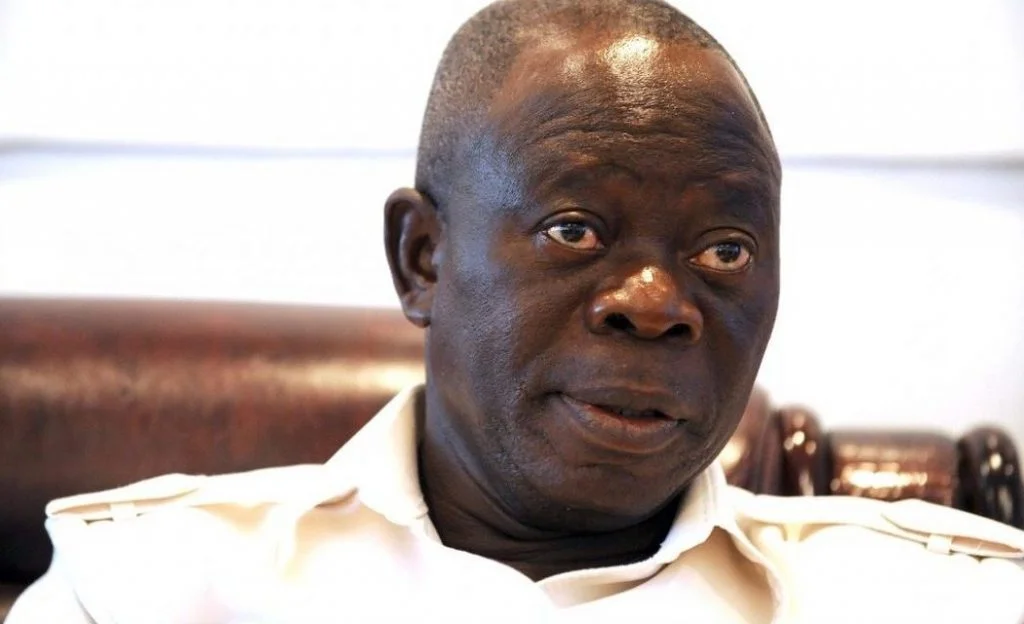
Senator Adams Oshiomhole has called on the Federal Government to retaliate against South African businesses operating in Nigeria following the recent attacks on Nigerians in South Africa.
Speaking during plenary on Tuesday, Oshiomhole said the Federal Government should consider revoking the working license of South African owned companies such as MTN and DSTV.
He argued that Nigeria must respond firmly to what he described as persistent hostility against its citizens.
READ ALSO:South Africa To Investigate ‘Mystery’ Of Planeload Of Palestinians
“I am not going to shed tears. If you hit me, I hit you. I think it is appropriate in diplomacy. It is an economic struggle,” Oshiomhole said.
He argued that while some South Africans accuse Nigerians of taking their jobs, Nigerians should return home and take over employment opportunities created by major South African companies operating in the country, including MTN and DSTV.
“When we hit back, the President of South Africa will not only talk but will also go on his knees to recognise that Nigeria cannot be intimidated.
READ ALSO:South African Ambassador Found Dead Outside Paris Hotel
“We will not condone any life being lost. If a crime has been committed under the South African law they have the right to bring any such person to justice, but to kill our people as if we are helpless, we will not allow that,” Oshiomhole added.
DAILY POST reports that several Nigerians in South Africa have reportedly been attacked, and their businesses destroyed, in ongoing xenophobic attacks in the country.
News
IGP Orders Officers Display Name Tag On Uniform, Gives Update On State Police


The Inspector General of Police, IGP, Tunji Disu, has ordered all police personnel to always have their name tags on their uniforms for easy identification.
Disu disclosed that only police personnel who are undercover are exempted from displaying their name tags.
Speaking on Tuesday, Disu said: “All police officers should have their name tags. All of us on the high table have our names apart from the undercover among us so if you look at all the Commissioners of Police we have our name tags, so it’s not our standard.
READ ALSO:
“All the Commissioners of Police are here and that is why we called this meeting, we have list of things like this that we will want to discuss with the Commissioners of Police, we have told them earlier and we will still let them know that every that happens within their area of jurisdiction falls under their control.”
On the issue of state police, the IGP said: “Since we got the signal that the Federal Government of Nigeria intend to establish State Police and since we are the federal police, we decided to take the bull by the horn and put down our own side of what we believe on how the state police should be run.
“A lot of things were taken into consideration, a lot of comparative analysis was done and it has been transmitted to the National Assembly.”
News
Court Orders SERAP To Pay DSS Operatives N100m For Defamation

The High Court of the Federal Capital Territory has ordered a non-governmental organization, the Socio-Economic Rights and Accountability Project, SERAP, to pay N100 million as damaged to two operatives of the Department of the State Services, DSS, for unjustly defaming them in some publications.
The court also ordered SERAP to tender public apologies to the defamed officers,
Sarah John and Gabriel Ogundele, in two national newspapers, two television stations and its website.
Besides, the organization was also ordered to pay the two operatives N1 million as cost of litigation and 10 percent post-judgment interest annually on the judgment sum until it’s fully liquidated.
Justice Yusuf Halilu of the High Court of the Federal Capital Territory gave the order on Tuesday while delivering judgment in a N5.5 billion defamation suit instituted against SERAP by the DSS operatives.
The judge found SERAP liable for unjustly defaming the two DSS operatives with allegations that they unlawfully invaded its Abuja office, harassed and intimidated its staff, in September 2024.
READ ALSO:How We Arrested Terror Suspect Who Threatened To Kill Students, Teachers In Abuja — DSS
In the offending publication on its website and Twitter handle, SERAP alleged that the two operatives unlawfully invaded and occupied its office with sinister motives.
The judge held that the publication was in bad taste especially from an organization established to promote transparency and accountability, as nothing in the publication was found to be truthful.
The DSS staff had listed SERAP as 1st defendant in the suit marked CV/4547/2024. SERAP’s Deputy Director, Kolawole Oluwadare, was listed as the 2nd defendant.
In the suit, the claimants – Sarah John and Gabriel Ogundele – accused the two defendants of making false claims that they invaded SERAP’s Abuja office on September 9, 2024..
Counsel to the DSS, Oluwagbemileke Samuel Kehinde, had while adopting his final address in the mater urged the judge to grant all the reliefs sought by his client in the interest of justice.
READ ALSO:DSS Arrests Suspected Gunrunner, Recovers 832 Rounds Of Ammunition
He admitted that although the names of the two claimants were not mentioned in the defamation materials, they had however established substantial circumstances that they are the ones referred to in the published defamation article by SERAP on its website.
The counsel submitted that all ingredients of defamation have been clearly established and the offending publication referred to the two officials of the secret police.
However, SERAP, through its counsel, Victoria Bassey from Tayo Oyetibo, SAN, law firm, asked the court to dismiss the suit on the ground that the two claimants did not establish that they were the ones referred to in the alleged defamation materials.
She said that SERAP used “DSS officials” in the alleged offending publication, adding that the two claimants must establish that they are the ones referred to before their case can succeed.
Similar arguments were canvassed by Oluwatosin Adefioye who stood for the second defendant, adding that there was no dispute in the September 9, 2024 operation of DSS in SERAP’s office.
READ ALSO:Alleged Cyberstalking: DSS Plays Video Evidence In Sowore’s Trial
He said that since SERAP in the publication did not name any particular person, the claimants must plead special circumstances that they were the ones referred to as the DSS officials.
Besides, he said that there is no organization by name Department of State Services in law, hence, DSS cannot claim being defamed adding that the only entity known to law is National Security Agency.
The claimants had in the suit stated that the alleged false claim by SERAP has negatively impacted on their reputation.
The DSS also stated, in the statement of claim, that, in line with the agency’s practice of engaging with officials of non-governmental organisations operating in the FCT to establish a relationship with their new leadership, it directed the two officials – John and Ogunleye – to visit SERAP’s office and invite them for a familiarization meeting.
The claimants added that in carrying out the directive, John and Ogunleye paid a friendly visit to SERAP’s office at 18 Bamako Street, Wuse Zone 1, Abuja on September 9 and met with one Ruth, who upon being informed about the purpose of the visit, claimed that none of SERAP’s management staff was in the country and advised that a formal letter of invitation be written by the DSS.
READ ALSO:DSS, Police Partner NCCSALW To End Terrorism, Mop Up Illegal Arms
John and Ogundele, who claimed that their interactions with Ruth were recorded, said before they immediately exited SERAP’s office, Ruth promised to inform her organisation’s management about the visit and volunteered a phone number – 08160537202.
They said it was surprising that, shortly after their visit, SERAP posted on its X (Twitter) handle – @SERAPNigeria – that officers of the DSS are presently unlawfully occupying its office.
The claimant added, “On the same day, the defendants also published a statement on SERAP’s website, which was widely reported by several media outfits, falsely alleging that some officers from the DSS, described as “a tall, large, dark-skinned woman” and “a slim, dark skinned man,” invaded their Abuja office and interrogated the staff of the first defendant (SERAP).
John and Ogundele stated that “due to the false statements published by the defendants, the DSS has been ridiculed and criticised by international agencies such as the Amnesty International and prominent members of the Nigerian society, such as Femi Falana (SAN)”.
“Due to the false statements published by the defendants, members of the public and the international community formed the opinion that the Federal Government is using the DSS to harass the defendants.”
READ ALSO:SERAP To Court: Stop CBN From ‘Implementing ‘Unlawful, Unjust ATM Fee Hike’
They added that the defendants’ statements caused harm to their reputation because the staff and management of the DSS have formed the opinion that the claimants did not follow orders and carried out an unsanctioned operation and are therefore, incompetent and unprofessional.
The claimants therefore prayed the court for the following reliefs: “An order directing the defendants to tender an apology to the claimants via the first defendant’s (SERAP’s) website, X (twitter) handle, two national daily newspapers (Punch and Vanguard) and two national news television stations (Arise Television and Channels Television) for falsely accusing the claimants of unlawfully invading the first defendant’s office and interrogating the first defendant’s staff.
“An order directing the defendants to pay the claimants the sum of N5 billion as damages for the libellous statements published about the claimants.
“Interest on the sum of N5b at the rate of 10 percent per annum from the date of judgment until the judgment sum is realised or liquidated.
“An order directing the defendants to pay the claimants the sum of N50 million as costs of this action.”
-

 Politics4 days ago
2027: Tinubu’s Re-election May Put An End To Nigeria — Baba Ahmed Warns
-

 Metro5 days ago
I’m A Street Girl’ – Bimbo Ademoye Clashes With Area Boys [VIDEO]
-

 Politics5 days ago
BREAKING: 2027: Former Adamawa APC Guber Candidate, Aishatu Binani Defects To NDC
-

 Politics5 days ago
Senatorial Seat: Ogbakha-Edo Warns Against Imposition Of Candidates In Edo South
-

 Business3 days ago
JUST IN: Nigerian Filling Stations Reduce Fuel Price After Hike
-

 Entertainment4 days ago
Actress Eniola Badmus Gets New Federal Appointment
-

 News5 days ago
10 African Countries With Highest Petrol Prices In Prices In April 2026
-

 News2 days ago
BREAKING: Wike Picks Alabo George For Rivers Governorship
-

 Politics3 days ago
NDC Speaks On Peter Obi, Kwankwaso Joining Party
-

 News3 days ago
OPINION: Why South Africans Murder Nigerians In Cold Blood
