
News
OPINION: Lest China seize our President
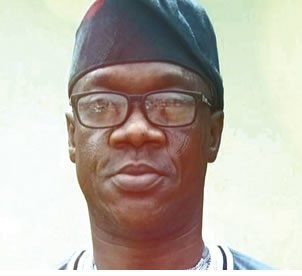
By Suyi Ayodele
“President Bola Tinubu will embark on a trip to France on Monday, August 19, departing from Abuja, the nation’s capital. The President will return to the country after his brief work stay in France.” I read this terse statement by Chief Ajuri Ngelale, Special Adviser to the President (Media & Publicity), early Monday morning, and my heart skipped. Some people are bold! Why France of all places this time around?
Has the presidency forgotten that it was in France that a Chinese company seized our presidential jets? Are those who planned the president’s trip not aware that also owe China itself a huge sum of money? Is this Efun (bewitchment), Èdì (spell) or Àsàsì (enchantment)? Are there no Yoruba among the president’s aides who planned the trip? Do they not know that the deity that seizes the home and the stream is also capable of taking over the farmland (Òòsà tó gba’lé, gba odò ó lè gba oko lówó Eni)? What if those in the Chinese Finance Ministry swallowed the wrong frog and decided to approach a French court to seek to attach the President and his entourage as collateral? How can we owe, and the number one citizen is travelling in the type of luxury his creditors cannot afford?
From time immemorial, the Yoruba traditional setting devised three methods of recovering debts from chronic debtors. These methods are employed only when the debtor becomes recalcitrant, arrogant and ostentatious. Nothing angers a Yoruba creditor more than to see his debtor eating gizzard. This is why the elders of the land warn: A kìí je iwe lójú olówó eni (You don’t eat gizzard in the presence of your creditor). The Gizzard is the most precious part of the chicken. It is reserved for the rich or the head of the family. In a case of ritual, where a chicken is used as the sacrificial object, the one on whose behalf the ritual is performed is the one that is permitted to eat the gizzard. Yet another saying confirms this assertion thus: Eni a bá torí è pa adìye níí je iwe (It is he on whose behalf the chicken is sacrificed that eats the gizzard). When a debtor is caught eating gizzard, the creditor goes for the kill and employs any of the three methods to recover his money depending on the amount of money involved, the period of the indebtedness and the antecedents of the debtor.
The first of such traditional method is known as Òsómàáló, commonly used by the Ijesha people of the present-day Osun State. Òsómàáló involves the creditor coming to the debtor’s house in the wee hours of the morning before the debtor rises from his bed, to squat while asking for his money. While in that squatting position, the creditor does all manners of things. He can, for instance, begin to drink water continuously from the gourd of water he brought along, or he begins to eat wraps of corn meal (agidi or eko) from the basket he carried to the debtor’s house. The implication of these acts is that the creditor can suffer a health challenge or die in the process. Should any of these happen, it becomes a bigger problem for the debtor and his family. To prevent such an eventuality, the moment an Òsómàáló, which means: this is how I will squat till I collect my money, shows up, the debtor’s family members rally round to raise and pay off the debt. An Òsómàáló, must not suffer any untoward consequence in the house of the debtor!
MORE FROM THE AUTHOR: OPINION: Ifa’s Message For Our President
The second method is more nauseating. It is known as Ológo or Ológodò. This method entails sending an invalid person, or someone who has infectious diseases to the house of the debtor. Lepers, people with tuberculosis, or other highly communicable infections are engaged in this case. What they simply do is that they begin to live with the debtor, eat his food without permission, use his household items freely and sleep on his bed and those of members of the debtor’s family. Again, neither the debtor nor members of his family are permitted under Yoruba tradition to chase away the Ológo or Ológodò. In some extreme cases, Ológo or Ológodò can also go violent by destroying items in the house of the debtor. The debtor’s neighbours and family members are not spared. The aim is to get the family members to pay up the debt.
The third method is the Ìwòfà system in which a relation of the debtor is pawned off to the creditor till the debt owed is paid. The one so pawned works for the creditor, while the creditor feeds him and accommodates him. But it is beyond just working for the creditor. An Ìwòfà suffers a lot in the hands of the creditors. There is no moment of respite for him; he must work continuously under the rain and scorching sun. This is why it is said that Olówó kii gelete, kí Ìwòfà na gelete (The creditor will not sit comfortably, and the pawn also sits comfortably).
There is no one among these three methods that is palatable. The best option is for one to stay out of debt. And if it is inevitable that one must owe, the debtor should refrain from eating gizzard, especially, where his creditor can easily see him. This piece of traditional advice does not hold any value in today’s Nigeria. Nigeria owes many foreign creditors, yet the country’s leader displays uncommon affluence to the chagrin of the nation’s creditors!
The last one week has not been good enough for our dear country. The international embarrassment the nation suffered at the hands of a Chinese investment company, Zhongshan Fucheng Industrial Investment Co. Ltd, leading to the seizure of three of our presidential aircraft is something that should give us all concern. In all honesty, if there is any time President Bola Ahmed Tinubu has my faint sympathy, it is over this international embarrassment. I said faintly because I have read a lot by some people who believed that the Tinubu team stage-managed the ‘seizures’ so that Mr. President could bring home his N150 billion newly acquired luxury Airbus A330. As much as one is tempted not to believe that storyline in the face of the embarrassing situation we found ourselves, the fact that the new aircraft is the one the Chinese firm graciously released to President Tinubu to travel to France, speaks volume. I cannot, indeed, beat my chest for Tinubu’s presidency over this, especially when his government has turned out to be like the Àjàntálá child that is full of mischief. We may come to this later if space permits.
MORE FROM THE AUTHOR: OPINION: ‘Protest’ That ‘Restructured’ Nigeriass
The issue of Zhongshan Fucheng Industrial Investment and the seizure of our presidential fleet should not have happened at all but for the dearth of good leadership in the country. I have read all the explanations given by the Federal Government, the Ogun State Government, and former Governor Ibikunle Amosun of Ogun state over the matter. The only message I got is that there is an acute absence of sincere leadership, especially on the part of the Ogun State Government. The contract, whatever it was or is, between the Chinese firm and the Ogun State Government, went bad 14 years ago! If it has taken the state government 14 solid years to prepare for madness, may we ask them in Ogun State when exactly would enter the market in full-blown madness? Everything that has happened in this matter is part of the lethargic system we run where no one is made accountable for anything. It is a collective shame that an ordinary company could get our sovereign assets seized just because a contractual agreement between it and a state government went bad! This is so when there is no evidence to show that those seized items were used as collateral for the agreement! But this does not exonerate the Federal Government completely.
Elementary Government teaches us that the Federal Government enters into agreements or treaties with foreign countries. It is after the Federal Government might have established a contact (bilateral) with another country that the states can begin to draw from the goodwill. This then confers the responsibility of close monitoring of any agreement by any state in the Federation with any foreign company or country, on the one entity who signed the initial bilateral agreement. So, at what point did our Federal Government get to know about the dispute? What did it do to ensure that the nation was not subjected to this kind of international ridicule? But we are in Nigeria. The responses from Abuja have always been too much grammar. Nobody will be punished. We have had Ministers of Trades and Industries in the last 14 years; nobody will ask them what they did or did not do. In a matter of days, especially now that President Tinubu has his new jet to use, this matter will be forgotten like others before it. We may not come to it until something bigger happens. And I see that happening. If a firm could seize our presidential jets over a trade dispute, China may be emboldened by that to seize our president! Alarmed?
I believe that China can seize President Tinubu as a collateral for our indebtedness to the Chinese Government because of the lifestyle of our leaders. Nigeria is behaving like the proverbial chronic debtor who eats gizzard in the presence of his creditor. The records by the Debt Management Office (DMO) showed that Nigeria owes China $5.04 billion as of March 31, 2024. That is well over N6 trillion! The same country that owes so much is the one that could afford to buy a N150 billion aircraft for the use of the president. In addition, the President now rides a Cadillac Escalade SUV that is almost N1 billion. How do we convince our numerous creditors that we are a poor country? In the face of all this profligacy by the one-wristwatch-wearing President, how do we justify our continuous borrowing like the chronic debtor-wife of Oshin?
MORE FROM THE AUTHOR: OPINION: If Tinubu Were Today’s Opposition Leader
Have we forgotten that as far back as 2020, there has been the rumour that Nigeria has been ‘colonised’ by China due to the nation’s indebtedness to Beijing? The rumour then was that Nigeria pledged its assets as collateral for the loans it took from China, such that China can come at any time to take over those assets. Rotimi Amaechi, who was the Minister of Transport, said in August 2020 that Nigeria had waived immunity on one of the loans. The simple implication is that with that waiver, China might not have to go to arbitration before the take-over. Amaechi, while dismissing the rumour, however said: “We must learn to pay our debts and we are paying, and once you are paying, nobody will come and take any of your assets.” How much have we paid back? How much do we still owe? If China were to take over our assets today, which asset is the biggest in Nigeria? We should also not forget that we took loans from France, Japan, India and Germany.
Despite all these loans, President Tinubu still, presumptuously, went ahead to purchase a N150 billion aircraft using the ignoble Service Wide Vote, a euphemism for spending without the permission of the National Assembly! How cruel can our leaders be? How unfeeling can those lording over us be? For his personal comfort alone in 15 months, President Tinubu has expended over N160 billion! Yet, his government is asking Nigerians to keep hope alive and to continue to bear with the government. From a N5 billion Presidential Yacht to the state-of-the art Cadillac Escalade SUV and now the N150 billion jet, Tinubu lives larger than life amid poverty, hunger and inflation ravaging the country. It is this same man that his deputy, Kashim Shettima, wants us to believe is modest and poor, using only one wristwatch almost his entire life!
The most embarrassing aspect of this Chinese company’s saga is the fact that President Tinubu chose to travel in the new Airbus A330 aircraft that Zhongshan Fucheng Industrial Investment Co. Ltd said it released to the president on “goodwill.” If the president must travel, couldn’t he have used another means? How will the president convince us that the whole seizure saga is indeed not an arrangee for him to bring the luxurious Airbus A330 aircraft home? How coincidental is the arrival of the new presidential jet on Sunday evening and the president jetting out in it on Monday? My major concern is that none of our foreign creditors will get the funny idea of taking human collateral for our various debts! Festus Adedayo in his Sunday, August 18, 2024, Flickers column published by the Sunday Tribune under the headline, “Nigeria as shock-horror skits”, concludes by saying: “Nigeria is a joke!” We are indeed a theatre of comedy!



News
Six Corps Members Receive N10m Grants To Boost Agribusiness
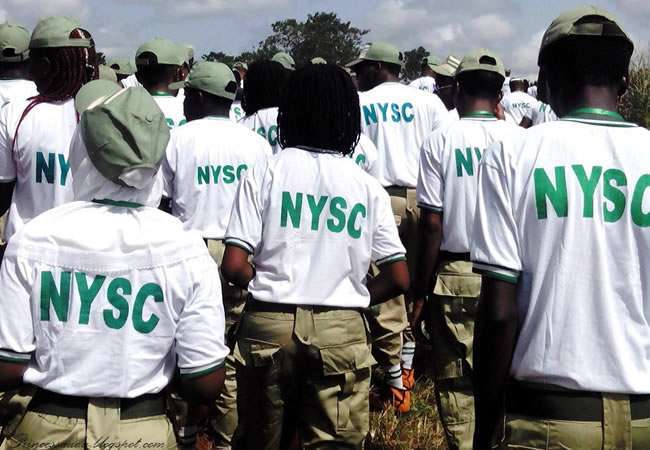
Six members of the National Youth Service Corps (NYSC) have received a total of N10 million in grants to expand their agribusiness ventures under the Farmers for the Future Programme.
The programme was organised on Monday by the British American Tobacco Nigeria Foundation (BATNF) in collaboration with the NYSC to encourage young Nigerians to embrace agriculture and develop sustainable businesses.
Presenting the cheques to the beneficiaries in Abuja, the NYSC Director-General, Brigadier General Olakunle Nafiu, urged Corps members to maximise the opportunities provided by the service year by venturing into commodity marketing and other viable businesses.
Nafiu said agribusiness remained a viable avenue for young people to build sustainable enterprises, create employment and generate wealth.
READ ALSO: NYSC Swears In 1,600 Corps Members In Bauchi
He also stressed the importance of value addition to the success and sustainability of business ventures, while commending BATNF for placing Nigerian youths at the centre of its entrepreneurship initiatives through value-chain development, employment creation and its partnership with the NYSC.
“I charge you to spread the news around. We have seen the outcome, and it is a good idea,” he said.
The beneficiaries are Dominic Olufemi (FC/25C/1143), who received N3 million; Temitope Adewole (ED/26A/2251), N2 million; Abdulwaheed Bala (ED/25B/1402), N2 million; Olanike Mayungbe (OG/26B/1037), N1 million; Kingsley Udoeyen (KG/26A/1735), N1 million; and Lorember Lorsue (JG/25B/1742), N1 million.
Speaking on the selection process, the Acting Director, Skills Acquisition and Entrepreneurship Development (SAED), Mrs Winifred Shopeka, said the programme began with an online registration portal through which Corps Members engaged in agribusiness submitted their business plans.
READ ALSO: NCCSALW Deploys NYSC Members In Fight Against Illegal Arms In Northeast
She said nearly 3,000 Corps members applied and underwent a rigorous selection process that produced 20 finalists.
According to her, the finalists participated in a boot camp and a final pitching session, which produced the 10 best presenters before the six ultimate winners were selected.
Shopeka said the beneficiaries had also been mentored and attached to established market operators to assist them in marketing their products.
She added that Corps Members who did not make the final stage of the competition were also trained by BATNF.
The BATNF Team Lead, Mr Oludare Odusanya, congratulated the beneficiaries and urged Corps Members engaged in agribusiness to master the fundamentals and acquire the knowledge and skills necessary to succeed.
“We are happy with our collaboration with the NYSC, and it will continue,” he said.
READ ALSO: NYSC Lauds Gov. Mohammed’s Intervention In Fence Collapse
Odusanya explained that BATNF was an independent organisation established to contribute to poverty reduction in Nigeria through sustainable agricultural practices and other interventions.
He said the Farmers for the Future Programme was instituted in collaboration with the NYSC to encourage Corps Members to venture into agribusiness and become job creators.
He added that the beneficiaries would be attached to mentors who would guide them towards achieving success in their respective businesses.
According to him, the programme has, since its inception, continued to enhance the entrepreneurial capacity of Corps Members.
News
CBN Reduces Interest Rate To 23%
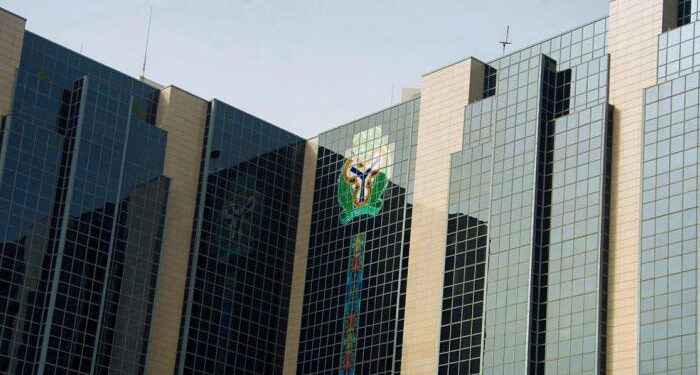
The Central Bank of Nigeria (CBN) on Tuesday announced the reduction of the interest rate, also known as Monetary Policy Rate (MPR) to 23 percent.
Briefing the media in Abuja, the Governor of the CBN, Mr. Olayemi Cardoso, said at the 307th MPC meeting held on September 22, 2026 agreed the resetting of the MPR and recaliberation of the monetary policy market.
According to Cardoso, the committe is satisfied with the disinflation progress, adding that members noted stable banking sector following successful recapitalisation.
READ ALSO: CBN Monetary Tightening Worsening Nigeria’s N50tn Development Finance Gap – Group
Meanwhile, according to Nigerian Tribune, reports that that the MPC, at its 306th meeting in July 2026, disclosed its resolution to retain the interets at 26.5 percent.
According to the Governor of the CBN, Olayemi Cardoso, “the Committee’s decision to maintain the current policy stance followed a thorough assessment of the balance of risks. Although headline inflation moderated marginally in June 2026, global uncertainties have heightened, due mainly to the renewed hostilities in the Middle East.
“In view of the evolving developments, maintaining a cautious monetary policy stance remains appropriate. In arriving at its decision, the Committee noted the recent resurgence of hostilities in the Middle East, with particular attention to its spillover effects on global energy prices and the potential pass-through to domestic inflation.”
News
NURTW: KWAM1 Settles Long-time Rift Between MC Oluomo, Tafa Sego
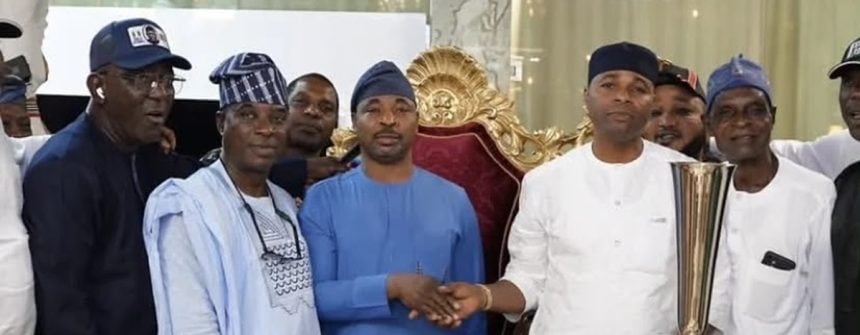
Nigerian Fuji musician, Wasiu Ayinde Marshal, popularly known as KWAM1, has brokered a peace deal between the National Union of Road Transport Workers (NURTW) National President, Musiliu Akinsanya, popularly known as MC Oluomo, and the Lagos State Chairman of the union, Mustapha Adekunle, aka Tafa Sego.
The reconciliation took place at Ojusagbola in Ijebu, Ogun State, where several NURTW chieftains gathered for the meeting.
The development was announced on Tuesday on KWAM1’s digital media page on Instagram, alongside photographs from the meeting.
According to the post, the two union leaders have resolved their differences after years of strained relations.
READ ALSO: Why FG Named KWAM 1 Aviation Security Ambassador — Keyamo
“After years of an age-long rift, MC Oluomo and Tafa Sego have finally settled their differences. And from what we know now, this is final,” the post said.
The musician was said to have intervened as the Mayegun of Yorubaland, with the aim of bringing an end to the longstanding disagreement between the two NURTW figures.
“K1 acted in his role as the Mayegun of Yorubaland by seeking an end to the long-standing rift, once and for all,” it said.
The post also described the meeting as a significant step beyond previous public displays of reconciliation.
READ ALSO: FG Gives KWAM 1 Aviation Appointment, After Airport Incident
“This time, it was not just another handshake for the cameras. The two old friends and colleagues came together at Ojusagbola, with King Wasiu Ayinde Marshal (K1) playing the peacemaker.”
Both MC Oluomo and Tafa Sego were reported to be pleased with the outcome of the intervention.
“Both parties are delighted about the new development,” the post said.
The two men had previously been allies and prominent figures within the Lagos NURTW before their relationship became strained amid disagreements linked to leadership of the union in the state.

 News2 days ago
BREAKING: Tinubu Extends Working Vacation
- News3 days ago
Six Hidden Health Benefits Of Unsweetened Zobo
- News5 days ago
Edo: Council Chairman Under Fire For Threatening Commercial Drivers Who Refuse To Wear APC Insignia
- News5 days ago
Edo: Ekpeson Redeems N20m Pledge To Family Of Fallen Soldier
- News5 days ago
OPINION: Nigerian Pastors, Imams And Their Sex Sermon Obsession
- News3 days ago
Jehovah’s Witnesses Announce New Position On Blood Transfusion Policy
- News3 days ago
2027: Step-by-step Guide To Applying For INEC Ad Hoc Staff Recruitment
- News3 days ago
How 36 Nigerian States Got Their Names
- Headline3 days ago
Nigerian Man Jailed After Masturbating In Front Of Woman On UK Train
- Headline2 days ago
How To Format An Academic CV For US Master’s, PhD Applications


