
News
OPINION: Obasa, Aláàfin Ṣàngó And The Capture Of Lagos

By Festus Adedayo
On Wednesday, February 25, 2025, a very toxic but innocuous advertorial was published in the Punch newspaper. It was authored by a group which called itself De Renaissance Patriots Foundation. Entitled Systematic Marginalization of Lagos State Indigenes, and signed by Major General Tajudeen Olanrewaju (rtd.) and Yomi Tokosi, the advertorial explains the legislative gangsterism currently going on in Lagos State, ex-Speaker Mudashiru Obasa’s impudent audacity and President Bola Tinubu’s nauseating silence on the civilian coup ongoing in the State of Aquatic Splendour.
The only fitting narrative that can explain the Obasa phenomenon and the Lagos godfather’s paternalism for Obasa and his ilk is the Osu caste system in Igboland. Among other obnoxious systems like the killing of twin babies, killing of children who grew first upper incisors, human sacrifices, among others, Osu caste is evergreen in its evil, and rooted in Igbo tradition and religion. Rev. George Thomas Basden’s book Among the Ibos of Southern Nigeria, (1921), a detailed account of the clergy’s experiences while living in Igbo land as a Christian missionary in the early 20th century, examines the people’s customs, beliefs, social structure and religious practices.
On page 109 of the book, Basden defined Osu as “a slave, but one distinct from an ordinary slave (ohu/oru) who in fact is the property of the god and when devoted to a god, he has no prospect of regaining freedom and he restricts his movements to the procuts of the shrine to which he was attached”. Centuries after the end of slavery and in spite of modernity, Osu caste’s poignant smell is rank in Igboland as Osu are still discriminated against, cannot marry a freeborn, their aspirations curtailed. They are thus forced to form an inter-group bond and alliance to press for their rights. A former minister under Olusegun Obasanjo, who is an Osu, is the rallying point of this caste against discrimination by “freeborn” Igbo. As I will argue presently, the Lagos parliament crisis, among other indicators, is fueled by the ancient indigene/settler dichotomy in Lagos. In this case, the Lagos godfather symbolizes the Obasanjo minister, hell-bent on protecting his fellow Lagos migrant-settlers.
General Olanrenwaju’s group which published the advertorial made several allegations against the godfather. They are encapsulated in the phrase, “persistent discrimination against the indigenous people of Lagos State.” Perhaps, the most insulting to the group was the temerity of the godfather’s choice of two non-indigenes of the state, Bisi Akande and Segun Osoba, ex-governors of Osun and Ogun States, to mediate in the crisis of the Lagos House of Assembly. Apart from the group’s total denunciation of this alien intervention, it specifically took Akande to the cleaners. Akande, it said, who “is struggling for political breath” in his home state, being unable to resolve the ongoing conflagration therein, feels entitled to poke-nose into Lagos matter “because his children, Akande Funmilayo (Chairman Apapa/Iganmu LCDA) and Yinka Akande are seriously benefiting from (sic) as Local Council Chairman and Director of Lekki Free Trade Zone respectively.”
As groups or individuals, Lagos indigenes have always stood up against the ruling establishment. A 1908 proposed water rate for Lagosians is an example. On July 20 of that year, Governor Walter Egerton proposed to charge Lagosians for them to access portable water. This was after his government constructed a #130,000 pipe borne water scheme, the precursor of the Iju waterworks built in 1916. Two indigenes of Lagos, John Randle and Orisadipe Obasa, medical doctors, under the banner of the People’s Union, arranged a rally of Lagosians at Enu Owa on November 26, 1908 where they took Egerton on. Randle and Obasa were themselves not autochthonous Lagosians. Randle, born in 1855 in Regent, Sierra Leone, originally from Oyo town, was son of Thomas, who settled in Aroloya part of Lagos, while Obasa, whose father descended from the Elekole of Ikole-Ekiti, was brought to Lagos in 1878. It must be borne in mind that Orisadipe Obasa has no ancestral connect with Mudashiru who is currently recreating an MC Oluomo motor-park hijack prototype in the Lagos parliament.
Indigene/settlers conflict in Lagos dates back to the 15th century. The Awori headsmen earliest settlers on Lagos Island, descendants of legendary Ogunfunminire, who hailed from Ile-Ife, had faced a Bini attempt to uproot them which was successful. A fierce battle that took place at Iddo had Olofin, who administered the area, being routed. Since then, the development of Lagos has attracted the influx of migrant-settlers Yoruba and other ethnicities laying claim to Lagos. The influence of migrant-settlers was so overwhelming that when in 1950, Dr I. Olorun-Nimbe emerged Mayor of the Lagos Council, only him and four others were Lagos indigenes while the rest 19 were migrant-settlers. The 1951 Constitution which placed Lagos under Ibadan, in a Western Region administration, further worsened Lagos’ fate, until the 1954 Constitution restored its place. In 1967, Lagos got a state of its own and federal capital status. So, when in the 1950s, the heartland of Lagos indigenes’ residence, the Isale Eko, was demolished, groups were formed to continually fight the interest of indigenous Lagosians. They included the Isale Eko Association (1955) and Egbe Eko Parapo (Lagos Citizens’ Rights Protection Council – LCRPC) 1962. The latter emerged from a merger of the Lagos Aborigines Society and the Egbe Omo Ibile Eko (Association of the Sons of Lagos State) which was led by Chief T. A. Doherty. Today, the most prominent of those associations is the Association of Lagos State Indigenes (ALSI) hitherto led by Justice Ishola Oluwa, a retired High Court Judge.
The role of identity in Nigeria’s migrant-settlers crisis shows its importance in Nigerian social life. It also shows that identity has negative potentials that can be deployed as a tool for mobilizing violence. In the year 2000, Lagos deployed identity for violence when Hausa and Yoruba indigene-settlers engaged one other in a fratricidal war in Ketu. That fight, which claimed lives, indicates the adversarial use that autocththony can be put to. Scholars have said that several of Nigeria’s worst conflicts occurred because original inhabitants, or indigenes, are pitted against migrant-settlers. The Obasa Lagos budding conflict, though appears political, may unravel the powers behind it.
MORE FROM THE AUTHOR: OPINION: Babangida’s Journey And His Service
In Yorubaland, the migrant-settlers dynamics is rich in literature. It is indeed an ancient phenomenon. Signified by the native markers of àjèjì or àjòjì (migrants) and onílé, (autocththony) the common phrase that defines that transaction is, no migrant-settler should duel with an indigene over ownership of land (àjòjì kìí b’ónílé du’lé). This is the meat of General Olanrewaju and his De Renaissance Patriots Foundation’s beef with Tinubu and why many autochthonous Lagosians, regardless of Tinubu’s behemoth political power in Nigeria, his talismanic influence and boundless wealth, are against his continued domination of Lagos. It also explains why a Tinubu, who today is carrying a monstrous elephant of Nigerian power and wealth on his head could be this needlessly bothered by the tiny cricket of being sidelined in the sack of Obasa as Lagos House of Assembly Speaker. The moment Tinubu loses this makeshift, badly-constructed Lagos identity in the battle with autochthonous Lagosians, he has lost all.
The above was recalled with the aim of stating that, though the àjèjì and onílée stranger politics in Lagos has always been on the front burner, it has been more pronounced in recent time. This specifically drew more Lagosians’ ire with the godfather, an àjèjì, becoming the Lord of Lagos and defender of the rights of fellow migrant settlers. In the above referenced advertorial, the De Renaissance Patriots Foundation claimed that since 1999, only one Lagos Omo-Onílé (son of the land) has been governor, ostensibly Raji Fashola. What this means is that Tinubu, Akinwumi Ambode and Babajide Sanwo-Olu, in the words of the advertorial, are àjòjì. The group also listed names of many àjòjì who it said have, unfairly, hoisted the banner of Lagos at the detriment of Lagosians.
Some extreme ones among the Lagos indigenes’ rights advocates have literally equalized their battle to an ancient Yoruba wise saying that no stranger can back a child like its mother (kò s’éni t’ó le mòó pòn bí olómo). Some others, in pursuit of this narrative, have claimed that the àjòjì at the helm of political affairs in and of Lagos, don’t appreciate Lagos enough, just like the domestic goat undervalues the prowess of a hunter and his gun; or one who inherits a huge agbada gown does not appreciate its value (ewúrẹ́ ilé kó mọ iyì odẹ, aj’ogún ẹwù kó mọ iyì agbádá nlá). It is on these twin premises that they derive their two conclusions. One is that, Lagos could have developed more than it does if the migrant-settlers had been autochtonous Lagosians. Second, that Lagos could have been greater but for the fact that the wealth accruable to the Ajoji from their leadership of Lagos are being funneled to the migrants’ original place of migration.
Prior to 1999, there did not seem to be anyone who held the jugular of Lagos like Tinubu. Before the ascendancy of his volcanic phenomenon, the last power outpost of Lagos was a group pejoratively called the ‘Ijebu Mafia’, disciples of Chief Obafemi Awolowo, operating as Afenifere leaders, living in Lagos. They determined the political geography of the aquatic state. Indeed, this group conducted the primary for the 1999 governorship which allegedly had Late Funsho Williams coming tops but which an internal abracadabra among the group tilted in favour of Tinubu. Immediately he grabbed political power, Tinubu, applying Law 33 of Robert Greene’s 48 Laws of Power which encourages the power holder to discover each man’s thumbscrew – their weaknesses – found out the Ijebu Mafia leaders’ thumbscrew and used it to prepare their political graveyards. He then succeeded in tearing them apart, deploying the Niccolo Machiavelli divide and rule tactics in the service of his ambition.
By 2007 when the godfather left office as Lagos governor, he had totally decimated their ranks, cloning a counter-group called Afenifere Renewal Group and leaving the Awo disciples licking their fatally bruised wounds. Abetted by Lagosians themselves, only a few, like the late Chief Ganiyu Dawodu, fought Tinubu to the hilt before his transition. By the time Lagos aborigines woke up to do a reconnaissance, it was too late. The godfather had captured Lagos and kept the lagoon and the sea inside his limitless-space pocket. Twenty five years after, not only does the godfather determine the political and economic barometer of Lagos, he determines when it will rain in the state or its time of drought.
MORE FROM THE AUTHOR: OPINION: Bisi Akande, Poverty And Ige’s Death
The godfather’s migrant-settler place in Lagos is discussed only in hushed tones. Those privy to his migration and the story of his settling in Lagos maintain sealed lips. While he was governor of Lagos State, some dissident groups made efforts to document his migrancy by writing a book to document the family tree of Lagos Tinubus. Some other analysts have said that if the Lagos autochthony is to be broken into brass-tacks, virtually all Lagosians will fail the litmus test. For instance, the ancestor of the Tinubus is himself a Kanuri. While some settlers chose the Lagos Island side of Lagos called Isale Eko, Sierra Leone returnees were known as Akus or Saros, and Brazilians and Cuban returnees known as Agudas. Many of them originally hailed from towns scattered round the southwest. Only the Aworis can be said to own the Lagos autochthony. Immediately Mudashiru Obasa began to recreate the MC Oluomo-style tactic in Lagos House of Assembly, some forces came out to assert the deposed Speaker’s àt’òhúnrìnwá (migrant) status in Lagos and that he was not linked in any way with Orisadipe Obasa.
The 2023 election witnessed a groundswell of push-backs by, especially non-Yoruba indigene-settlers in Lagos, against the godfather’s fiefdom hold on Lagos. The outcome of that election showed a gradual whittling of the corrosive hold of the godfather on Lagos politics. Apparently a rebellion, Lagos migrant-settlers encircled the Peter Obi Labour Party and succeeded in giving it 582,454 votes as against 572,606 for the godfather’s APC. The godfather must have been furious. Until then and since 1999 when he held court, no one dared peer naked fire to look at the fiery face of the leopard. In the process of scapegoating for this colossal rout, a source told me the godfather held his Ajélè (an appointed official who oversees an empire’s economic and political interests) responsible and has since not forgiven him. More importantly, he is cross with him for being his own man and having the guts to win re-election due to his personal effort. For any godfather, a la the precepts of the Forty-eight Laws of Power, the Ajélè had committed an unpardonable sin against the Leviathan. So, even though Obasa rode roughshod on the Ajélè as Speaker, especially during the 2025 budget speech presentation, keeping him waiting for hours, the godfather wasn’t fazed and probably wrote the script. The world has since seen that, as Obasa’s water bug (Ìròmi) dances on the stream surface with impunity and audacity, executed with sheer brigandage, as well as abetted by institutions of the Nigerian state, the danceable tune egging the poor little creature on comes from a godfather drummer living in Aso Rock whose ego was fatally bruised.
To buttress General Olanrewaju’s submission, today, Lagos political power echelon, from governor, deputy governor, commissioners to special advisers, ministers representing Lagos, to federal and state parliamentarians, is tilted in favour of àt’òhúnrìnwá (immigrants) as against autochthonous Lagosians. The most laughable was Senator Solomon Olamilekan Adeola who represented Lagos West from 2015 to 2023 and before then, from 2011 to 2015, was Lagos House of Representatives member. Today, the man, known as Yayi, has perfunctorily exchanged state of origin like a prostitute changes her liaisons. He now represents Ogun West.
The story of Lagos, its godfather and potential explosion is beginning to resemble the cataclysmic end of the Yoruba deity of thunder and lightning, Ṣàngó. Aláàfin Ṣàngó, the third monarch of the Oyo Empire, was about the most celebrated and one of the most controversial rulers of the Empire. He was fiery, ambitious, charismatic and was extremely powerful. Like the cap insignia with which the Lagos godfather is known by today and which his worshippers scramble to don, Ṣàngó’s motif was a staff called Ose Ṣàngó, an ornately carved symbol depicted by fire, lighting and thunder.
Ṣàngó, the third Aláàfin of Oyo, who reigned between the 15th and early 16th centuries, was a man of great ambition, fiery charisma, and immense power. His name is invoked today to reify awesome might and the mystery of power. He mirrors a complex interplay of leadership acumen, divinity, and eventually, a reference point of potential human vulnerability. Like the Lagos godfather, Aláàfin Ṣàngó had a talismanic and commanding presence and inspired widespread loyalty. He also had the magical and mystical ability to command fire from the sky in his fit of anger. Ultimately, though his strength , the endowment ultimately led to his downfall. One day, Ṣàngó, enraged, invoked fire which resulted in a conflagration that went out of control. It eventually led to the destruction of his palace as well as lives of its inhabitants. It was the beginning of his end. Stripped of all he had, Ṣàngó departed Oyo Kingdom and never returned. He eventually committed suicide at a place called Koso.
Apart from the power of Yoruba anecdotal retelling latent in that Sango narrative, the downfall of Oba Ṣàngó is a detailed illustration that even in a modern world, no ruler or godfather is immune from the vulnerabilities of power. It also illustrates the destruction immanent in human nature. The Obasa episode, though seemingly miniature, has the potential to implode and flush the Lagos godfather down the drain, replicating the Ṣàngó downfall in recent history.
Maybe we all should just watch while an end comes to this tyrannical hold, after all, in the words of Nawal El Saadawi in her A daughter of Isis, “Things that never end are only boring, and were it not for death, life would be an impossible burden.”
MORE FROM THE AUTHOR: OPINION: Nuhu Ribadu’s Hell And Other Hellish Stories
The Nigerian Senate erupted again last week. This time, it was not about allegation of its leadership being a cesspool of sleaze, a home of self-serving parliamentarians nor corruptible budget-padding that have become a boring refrain. Sequel to an earlier seemingly infantile squabble over sitting arrangement, the female anti-hero of that row, Natasha Akpoti-Uduaghan, came on air on Friday to allege that her continuous spats with Senate President Godswill Akpabio were due to a sexual harassment she rebuffed in the past. And the social space went bonkers.
First, the two issues that threw Akpoti-Uduaghan and Senate President Godswill Akpabio to centers of discourse have throwbacks to and possess symbolic bearing in American and biblical history. Many have berated her on why a trifling matter of space/seat allocation on the floor of the parliament should get her that worked up. They must however have forgotten that one of the issues that women who try to square up to men in a patriarchal society like ours face and fight is visibility. While in pursuit of the male dominance thesis, men try to hold women down, such women try to assert themselves and create visibility for themselves.
Akpoti-Uduaghan’s squabble over seating arrangement and Akpabio’s senate’s resistance and insistence on maintenance of status-quo remind me of the famous Montgomery bus altercation of 1955. On December 1 of that year in Montgomery, Alabama, a 42-year-old woman named Rosa Parks did what philosophers call against method. Paul Feyeraband, an Austrian philosopher, had in 1976 pioneered that thesis. In a racial American society of the time where blacks were inferior and expected to leave their bus seats for whites, Parks refused to give up hers for a white male passenger. Her refusal sparked off a boycott that changed the paradigm of racial relationship in America. It even shot the less-known Martin Luther King Jr to world recognition. At the risk of sanctions for her impudence, Parks had reportedly told the Montgomery bus driver, “My feet are tired.” Like Parks’ fight for the visibility of the black race, Akpoti-Uduaghan’s resistance was a fight for the visibility of women.
If other women in the senate like Ireti Kingibe had seen the fight as being beyond mere seat allocation into an underscore of their womanliness and fight against the irritant male-dominated status-quo, they probably would have given the Kogi senator more collective push. Like Bettina Aptheker wrote in her Foreword to Nawal El Saadawi’s A daughter of Isis, “women (daily) struggle for voice and human dignity and to overcome the binds of patriarchy…and are crushed under patriarchal conventions”. Women’s sexuality is constantly crushed in this struggle.
The second issue that flows from the first is Akpoti-Uduaghan’s allegation of sexual harassment. People have taken stands either on account of their stomachs, what lies between their thighs or their political affiliations. Again, the allegation is a symbolism. Many who cannot stand Akpoti-Uduaghan’s femininity or her boldness to underscore it in a patriarchal senate have likened her allegation to the biblical Portiphar’s wife who alleged that Joseph wanted to sexually assault her. Many have also brought out her alleged history which they claim feeds the trope of her usual allegations of blackmail against the male gender. If allegation is a typecast, Akpabio’s alleged history with women validates Akpoti-Uduaghan’s allegation. A couple of years ago, Joy Nunieh, a former NDDC MD, had alleged that she slapped the senate president when he attempted to sexualize her in his guest house at Apo, Abuja.
On an Arise News interview, Ireti had attempted to infantilize Akpoti-Uduaghan, the same way a huge percentage of the senate fatherlize Akpabio who is only first among equals in the parliament. This is due to the huge war-chest in the possession of his leadership and capability to substantially jerk up members’ personal finance through graft. The other day on the same television station, Peter Onyeka Nwebonyi, representing Ebonyi State, did this by claiming that Akpabio was “our father.” Last Friday, Kingibe did this, too by referring to Akpoti-Uduaghan as “my daughter”. She further fell into the argumentative pitfall of claiming that since Akpabio never assaulted her and the two other female senators, Akpoti-Uduaghan’s allegation must be concocted. I pray thee, do these elderly women still possess their colleague’s sultry disposition? And, isn’t it a rarity to see lascivious flesh-devouring vultures attempt to take grandmothers for supper?
We cannot suffer on all fronts by having a National Assembly that is allegedly a cesspit of Nigerian national patrimony-devourers, as well as home for devourers of the flesh of our women. Yes, it is almost an impossibility to prove sexual harassment by a woman, but Akpoti-Uduaghan’s boldness and the sheaves of evidence she claimed to possess to buttress her claim should be encouraged. No one must attempt a “family affair” settlement or else, one more rascally libido would be let loose.



News
Children’s Day: Chaos At Ogbe Stadium As Dozens Faint

Chaos erupted on Wednesday during the Children’s Day celebration as dozens of students reportedly collapsed following a stampede triggered by the use of pepper spray.
The event,
organised by the Edo State Ministry of Education at the Samuel Ogbemudia Stadium was disrupted after some male students of Ihogbe College allegedly made uncompromising advances towards female students at the venue.
A parent who identified himself as Oboh Emmanuel said, “the behaviour of those uncultured students attracted the attention of bouncers stationed at the stadium as they rebuked the male students.”
Oboh said the affected students later regrouped and attacked the bouncers, leading to a confrontation within the crowded arena.
READ ALSO:Children’s Day: Edo Commits To Child Protection
It was gathered that in the ensuing confusion, the bouncers were reported to have deployed pepper spray in an area occupied by a large number of students.
Several students, particularly female students, reportedly fainted after inhaling the substance, while others sustained injuries after being stepped on during the ensuing melee.
The panic was said to have spread across the stadium as students, teachers and parents scampered for safety.
Many of the affected students were reportedly rushed to the Edo Specialist Hospital for medical attention.
READ ALSO: Egor LG Chair, Ogbemudia, Vice, Osawe Impeached
Reacting to the incident, Chief Press Secretary to Governor Monday Okpebholo, Dr Patrick Ebojele, said the security personnel that fired the tear gas had been detained.
He said all the students, except two, that were rushed to the hospital have been discharged.
Ebojele stated that doctors wanted to observe the students till tomorrow before allowing them to go home.
“The two students are not seriously injured. Doctors want to observe them overnight. Permanent Secretary, Ministry of Education is still at the hospital. The man who used pepper spray has been detained.
“The incident did not happen the way it is being exaggerated. All modalities were put in place to ensure the children enjoyed their day.”
News
Okpebholo Salutes Edo Muslims, Seeks Continued Support, Prayers
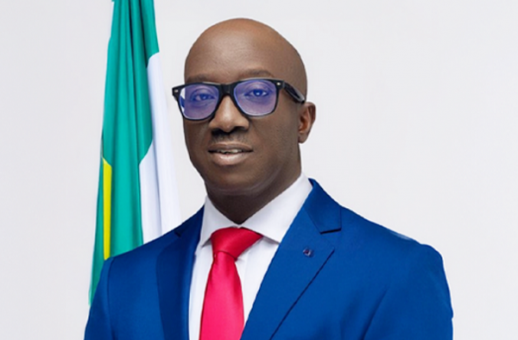
Governor Monday Okpebholo of Edo State has urged Muslims and all Nigerians to continue to pray for peace, unity and progress in the country even as they celebrate the annual Eid-al-Adha
The governor, who was represented by his deputy, Dennis Idahosa, stated this during the annual Eid-al-Adha celebration with Muslim faithfuls held at Government House in Benin City.
He reiterated his administration’s commitment to fairness, inclusivity and equal opportunities for all citizens irrespective of religion and tribe.
READ ALSO:ADC Penetrates Okpebholo’s District As Defections Strengthen Party in Edo Central
According to him, the present administration remains determined to building a government that reflects the diversity of Edo State, noting that competent and qualified Muslims have continued to play vital roles in his government because of their capacity, integrity and commitment to service.
“As a government, we remain committed to fairness, inclusivity and equal opportunity for every Edo citizen, irrespective of religion, ethnicity or political affiliation. This is why quality and competent Muslims are serving in key positions in our administration.”
Okpebholo appreciated the Muslim community in Edo State for their unwavering support and continuous prayers for his administration, noting that such prayers and support have contributed immensely to the peace and steady development being witnessed across the state.
READ ALSO:Okpebholo Felicitates Muslims On Eid-el-Fitr Celebration
He then called on all Nigerians to use the occasion of Eid-al-Adha to pray for the administration of President Bola Ahmed Tinubu, stressing that the country needs collective prayers, unity and cooperation to overcome its present economic and security challenges.
“I urge all Muslims and indeed all Nigerians to use this occasion to pray for our dear nation and for the administration of President Bola Ahmed Tinubu. Nigeria needs our collective prayers, unity and support as we strive to overcome our challenges and build a more prosperous future for all.”
In his remarks, the Chief Imam of Edo State, Abdulfatai Enabulele, applauded the governor for what he described as remarkable developmental strides recorded in less than two years in office.
The cleric commended the administration for ongoing infrastructural development and efforts geared towards improving governance in the state, but appealed to the government to revisit and complete some abandoned projects inherited from the previous administration for the benefit of the people.
News
Children’s Day: Edo Commits To Child Protection
The Edo State Government has reaffirmed its commitment to protecting the rights of children, promoting quality education, and strengthening sports development across the state.
This assurance was given by the governor of Edo State, Monday Okpebholo, during the 2026 Children’s Day Celebration and Governor’s Cup Finale held on Wednesday at the Samuel Ogbemudia Stadium, Benin City.
Addressing pupils, students and teachers,
the governor described children as the pride of Edo State and the future of the nation.
The governor, represented by his deputy, Dennis Idahosa,
noted that the annual celebration provides an opportunity to honour their dreams, talents, and limitless potential.
READ ALSO:Eid-el-Kabir: Edo Deputy Gov Solicits prayers For Okpebholo
Speaking on this year’s Children’s Day theme, “Choose Kindness, Reject Bullying,” the governor said the message was timely and significant, as it emphasizes the need to create safe, supportive, and inclusive environments for children both in schools and communities.
He stated that bullying in all forms — physical, verbal, emotional, or online — has no place in society, adding that the Edo State Government remains fully committed to protecting the rights and dignity of every child.
According to him, the administration will continue to strengthen policies and programmes that promote child protection, discipline, mutual respect, and positive learning environments across schools in the State.
The governor urged children to embrace kindness, compassion, teamwork, and respect for one another, stressing that true strength lies not in intimidation but in empathy, good character, and mutual understanding.

 Metro5 days ago
My Husband Abandoned Me On Our Wedding Night To Attend Political Meeting, I Want Our Marriage Dissolved
- Headline4 days ago
Woman Passes Out After Receiving 100 Strokes Of Cane
- Headline4 days ago
JUST IN: White House Locked Down Briefly As Gunman Opens Fire At Security Checkpoint
- Politics5 days ago
Warri Ijaw Hail INEC Delineation Report, Call For Additional Electoral Wards, Others
- Politics3 days ago
Two Masked Men Gun Down Politician In His Rivers State Hotel
- News5 days ago
Alleged Terrorism: Court Rejects Defendant’s Bid To Travel Abroad
- News3 days ago
More Pain For Nigerians As Cooking Gas Price Increases Nationwide
- Metro5 days ago
My Wife Stop Cooking My Food, Beats Me Black And Blue All the Time, Man Tells Court
- Politics5 days ago
What I’ll Do As President Of Nigeria — Amaechi
- Politics3 days ago
‘Tinubu’s Borrowing In 24 Months Surpasses 55 Years’ Debt Record’


