

News
OPINION: PDP, APC Are Mere Jerseys




By Lasisi Olagunju
Journalist arrived at the Government House with a proverb on his tongue.
“Your Excellency,” he began after the courtesies, notebook open, “in Yoruba, there is a word: Apanimáyọdà.”
The APC governor smiled faintly. “The one who kills without unsheathing a sword.”
“Exactly,” the journalist said. “A + pa + ni + má + yọ + idà—the agent who destroys without drawing blood. No blade flashes, yet the opponent falls. I remembered that word when the president said last Wednesday while breaking fast with senators that he was accused of killing opposition whereas he had no gun; that he was not coercing defections to the APC. Yet governors, senators, state lawmakers keep crossing over. No shots fired. Still, the opposition dissolves, like salt in the rain.”
The governor leaned back, untroubled. “You are suggesting invisible warfare?”
“I am asking,” the journalist replied carefully, “whether power sometimes operates without fingerprints.”
The governor folded his arms. “Power always operates without fingerprints. The visible hand is rarely the decisive one.”
“But isn’t that precisely the fear?” the journalist pressed. “That opposition parties are collapsing not by open contest but by quiet orchestration?”
“Huh.”
“Your Excellency,” the journalist continued, “governors are defecting one by one. Adamawa yesterday. Another rumoured tomorrow. It feels like that nursery rhyme: ‘ten green bottles hanging on the wall.’ Igo mewa l’ara ogiri…”
The governor smiled faintly. “And if one green bottle should accidentally fall…”
“There’ll be nine green bottles hanging on the wall,” the journalist completed.
Then continued: “Except in this case, the bottles are opposition governors. And they are all almost gone. One by one, they’re rolling into the ruling party.” The journalist pauses, then leaned closer. “It is like the children’s game. Ten green bottles hanging on a wall. Each time the verse says, ‘And if one green bottle should accidentally fall,’ the children point to the next one to drop. One by one, they fall, until none remains. Here, each defection triggers the next. The circle keeps spinning, hands linked, until the last green remains, unsure if it is safe.”
Governor smiled. Coughed gently. “Fortunately, this is not an interview. We are just having a conversation.”
“Yes.” The journalist responded, flipped a page in his notebook. “Still, Your Excellency, people are shocked at how easily politicians change parties like panties. Yesterday PDP. Today APC. Tomorrow, who knows?”
The governor’s lips curved. “My friend, you call it party, we call it platform. Besides, PDP and APC are mere jerseys.”
“Jerseys?”
“Yes. Colours. Emblems. In football, the striker kisses one badge today and another tomorrow. Their fans follow them. Jerseys change. The pitch remains. The league continues. The goalposts do not move.”
“That sounds cynical.”
“It sounds experienced,” the governor corrected. “Have you heard of Sebastián Abreu?”
“The Uruguayan who played everywhere?”
“Thirty-one clubs,” the governor nodded. “A world record. They called him El Loco, restless like crazy. He wore every colour imaginable, from Nacional to River Plate, San Lorenzo, Botafogo and beyond. Yet he remained a professional. Did the ball reject him because he changed shirts?”
“But football is commerce,” the journalist insisted. “Politics is trust.”
The governor smiled wider. “And you think football is only romance? Ask Neymar. Every transfer shattered a record, from Santos FC to FC Barcelona, then to Paris Saint-Germain, Al Hilal, and in 2025, he was back to Santos. As he moved, the fees rose. The loyalty followed valuation.”
“So, politicians are commodities?”
“Politicians,” the governor said evenly, “are survivors.”
He paused, then added, “In politics, rigidity is fatal. Ask Ayatollah Ali Khamenei of Iran. He woke up a human being on Saturday, before dusk, he had become a body, lifeless. If he was not rigid, he would not have died before his time. Flexible branches endure the storm.”
The journalist did not smile. “One moral philosophy also warns: What one uses to destroy a neighbour may return as an instrument of one’s undoing.”
The governor nodded slowly. “True. A roof strengthened with stolen thatch will leak.”
“Then doesn’t the Apanimáyọdà risk eventual unravelling?”
“Perhaps,” the governor conceded. “But that will be after the next meal. And, remember: not every bloodless victory is illegitimate. There is invisible power that preserves order, and there is invisible power that corrodes it. History decides which is which.”
“And the voters?”
“They care about the bucks, and maybe access,” he replied. “They cheer for the goal, not the colour of the boot. I know one guy in Ibadan who named his son Lampard, another named his Fabregas. They followed their favourites as they moved across the field of play.” The governor said, adjusted his cufflinks. “In any case, it looks like Ibadan has revived PDP’s Lazarus. I think the party may be on its way back. So, your fear may be premature. But, come. Politics is movement.”
MORE FROM THE AUTHOR:OPINION: Ramadan, Lent And A Trickster State
“So is gravity,” the journalist replied. “But when everyone gets packed into one vehicle, a simple accident imperils them all. Green bottles falling over green bottles makes shards of them all. We call what remains opalanba, danger to all.”
The governor looked at him sharply.
“You’ve been reading Achebe again.”
“Anthills of the Savannah,” the journalist nodded. “Chris is dying, he whispers ‘The Last Grin.’ But his girlfriend, Beatrice, puts the correct sound: ‘the last green.’ A private, homophone joke about ten green bottles. Three childhood friends—Sam, Chris, Ikem – who rose to power together. One by one, they fell. The last green was not a smile. It was a warning.”
“A warning against what?” the governor asked.
“Elitism. Isolation. Packing power too tightly at the top. When everyone important shares the same room, the same thinking, the same fear, the same ambition, one spark, or one crack cremates, or collapses the whole structure.”
The governor leaned back. “You assume unity equals fragility.”
“I’m suggesting concentration carries risk,” the journalist said. “If the Nigerian Governors Forum, for instance, becomes effectively of one party, where is the tension that keeps democracy elastic? Where is the internal friction that prevents complacency?”
“You speak as though opposition is a sacrament,” the governor replied calmly. “Governors move because they calculate interest, survival, alignment with federal power.”
“And if one green bottle should accidentally fall…”
“You make it sound like doom,” the governor interrupted. “Perhaps it is consolidation.”
“Consolidation for whom?” The journalist pressed. “The rhyme is playful, but Achebe turned it tragic. The ‘last green’ symbolised how a small ruling circle, detached from the people, became vulnerable to its own excess.”
The journalist cast a look at the governor and continued. “They move because they fear losing power, influence, maybe even freedom. People should live for something. During the First World War, the British wanted as many Africans as they could get to fight the Germans. Ibadan chiefs said no. The people backed them. But by August 1917, all the chiefs, except one, had defected to the British, betraying their leader, the Balogun. They were even made to write a petition calling their leader disloyal and seditious. The Balogun in the story did not defect, refused to, even under intense pressure from the government. He died with his honour intact. History is very kind to him. I read that in Toyin Falola’s ‘Ibadan’ on pages 562–564.” It is also in I.B. Akinyele’s ‘Iwe Itan Ibadan.’
“Was that chief the same person called Balogun Kobomoje?”
“No. Balogun Kobomoje’s real name was Balogun Ola Orowusi, a legendary warrior and leader in 19th-century Ibadan. He led Ibadan chiefs and people to resist colonial imposition and pressure. He also chose death instead of dishonour, and an appreciative people and history gave him the everlasting name, ‘Kobomoje’ – which roughly means ‘one who did not destroy his essence as a child of honour.’ The defecting governors today don’t care about honour, name, or legacy.”
“Today’s situation is different.”
“Really? And what makes it different?”
The governor was quiet for a moment.
MORE FROM THE AUTHOR:OPINION: Oshiomhole In Massage Hall Of Fame
“You fear a political monoculture,” he said at last.
“I fear a crowded vehicle crashing into a market,” the journalist answered. “When everyone squeezes into one bus because it seems fastest and safest, they forget that a single collision cracks the skulls of all passengers.”
“And what is the alternative? They have a vehicle, a bus, stuck on the highway. What is the alternative they have? To get stranded?” The governor asked.
“No,” the journalist said. “Repair, retrieve your own bus, fix it. Strong men reorganise their house when the storm gathers. Weak men run into another man’s house. Take King Shaka, the Zulu. At the height of his reign, he was surrounded by powerful neighbours and rising uncertainties. What did he do? He reorganised his house. He restructured authority. He forged discipline. History remembers him not because he fled into protection, but because he built protection.
The governor rose and walked toward the window. “You know,” he said softly, “defections are rarely about poetry. They are about budgets, influence, federal access.”
“And money, and power,” the journalist added.
“And power,” the governor conceded.
He turned back.
“But remember this,” he said. “Ten green bottles fall because they are hanging loosely. Perhaps those moving believe they are securing themselves.”
“Or clustering themselves into a tighter, combustible formation,” the journalist replied.
Silence lingered between them.
“So,” the governor asked, almost gently, “in your reading of Achebe, what happens to the last green?”
“The last green smiles,” the journalist said. “But only because it does not yet know it is next.”
Outside, the political map was still changing colour. One by one.
The governor studied him for a moment. “You see danger. I see opportunity.”
“Opportunity?”
“Yes.” he said calmly. “Opportunity for renewal. Politicians, like moulting snakes, shed old skins. When a structure weakens, its members begin to drift. No gun is required to leave a sinking ship.”
“That was the president’s metaphor,” the journalist said. “But who drilled the holes?”
The governor chuckled softly. “Ah. Now we are in the territory of àṣẹ.”
He leaned forward. “Yoruba metaphysics teaches that power need not be noisy to be effective. A throne may be safe without a battle. An opponent may dismantle himself while you merely stand firm, watching. That does not make you an assassin.”
“Unless you engineered the dismantling.”
“Engineering is not always coercion,” the governor replied. “Sometimes it is persuasion. Sometimes it is patience.”
“Your Excellency, at this rate, the Nigerian Governors Forum will soon become a one-party forum.”
The governor smiled. “You journalists enjoy dramatic forecasts.”
“Is it a drama?” the journalist pressed. “Adamawa’s governor moved last Friday. The few remaining ones are not finding it funny. The map has changed colour faster than harmattan grass. Soon, there may be no meaningful opposition among governors.”
MORE FROM THE AUTHOR:[OPINION] Idolatry: The Worship Of A President
The governor adjusted his glasses. “Must there be opposition? Politics is dynamic.”
“That is a polite word for defection,” the journalist replied. “People voted along party lines. Now the lines are dissolving.”
“People voted for leadership,” the governor countered. “Parties are vehicles. When a vehicle breaks down, you don’t sit inside it out of sentiment, or stand helpless by the roadside. You step into one that moves.”
“And if everyone crowds into one vehicle?” the journalist asked. “Doesn’t that weaken democracy and endanger you people?”
The governor paused, studying the ceiling as though the answer were written there. “Endanger who? Governors? No. Not at all. We are players. In Yoruba, players are osere. The word also means actor. You are too serious with Nigeria. Take it easy, bros. Democracy is not sustained by the number of parties alone. It is sustained by performance, by institutions.”
“But the symbolism matters,” the journalist insisted. “Governance risks becoming an echo chamber. One party. One chorus. No dissent.”
The governor’s smile thinned. “You assume dissent disappears when people share a platform. It does not. It simply changes tone.”
“Or becomes private,” the journalist said quietly.
Silence hovered.
“Very soon,” the journalist continued, “we may read what Chinua Achebe calls the last grin—or is it the last green?”
The governor laughed softly. “Ah, Achebe.”
“Yes,” the journalist said. “That haunting image; the smile that lingers after something has been fundamentally altered. Is this what we are witnessing? The last grin of multiparty competition? Or the last green before everything fades into one colour?”
The governor leaned forward. “Sometimes alliances form because interests converge. Sometimes because survival demands it.”
“And sometimes because power attracts,” the journalist replied.
“That too,” the governor conceded. “Power has gravity.”
“But gravity can collapse a system into a single mass,” the journalist said. “Is that healthy?”
The governor folded his hands. “You are worried about monopoly. We are focused on stability.”
“History shows,” the journalist said carefully, “that when opposition thins, accountability follows it into exile.”
The governor stood, signalling the conversation’s end.
“You see an ending,” he said. “I see a transition.”
“And the grin?” the journalist asked, rising as well.
The governor walked him toward the door.
“My friend,” he said quietly, “in politics, the grin and the green often sound alike from a distance. It is only with time that you know which one you were hearing.”
The journalist closed his notebook gently. “So there are no permanent enemies?”
“In this league?” he said quietly. “There are only permanent interests.”
Outside, the journalist glanced back at the Government House. Dusk gathered over the House. The governor’s final words lingered like a proverb released into the wind: “Jerseys change. The league continues.”




News
Shatta Wale Bailed Burna Boy From Ghana Prison After Arrest For Smoking Weed – Captan


Ghanian singer, Captan, has claimed that his former record label boss, Shatta Wale, once bailed Nigerian singer Burna Boy out of prison in Ghana after he was allegedly arrested for smoking weed.
Speaking in a recent podcast interview, Captan claimed that Shatta Wale sent him and others to free Burna Boy from police custody.
He also claimed that Shatta Wale and his group once accommodated Burna Boy when he was being hunted by some dangerous men.
READ ALSO: Wale Edun Opens Up After Sack
Captan said, “I once bailed Burna Boy out of prison in Ghana when he was arrested for smoking weed. Shatta Wale sent me and some guys to go and free him from police custody.
“There was a time we also accommodated him when some people were after his life. We helped him settle the case.”
He added that he and Burna Boy are no longer in good terms after the Nigerian artist’s fallout with his mentor, Shatta Wale.
He, however, said he and Shatta Wale are open to reconciling with Burna Boy if he asks for it.
Watch the video here
News
Children’s Day: Chaos At Ogbe Stadium As Dozens Faint


Chaos erupted on Wednesday during the Children’s Day celebration as dozens of students reportedly collapsed following a stampede triggered by the use of pepper spray.
The event,
organised by the Edo State Ministry of Education at the Samuel Ogbemudia Stadium was disrupted after some male students of Ihogbe College allegedly made uncompromising advances towards female students at the venue.
A parent who identified himself as Oboh Emmanuel said, “the behaviour of those uncultured students attracted the attention of bouncers stationed at the stadium as they rebuked the male students.”
Oboh said the affected students later regrouped and attacked the bouncers, leading to a confrontation within the crowded arena.
READ ALSO:Children’s Day: Edo Commits To Child Protection
It was gathered that in the ensuing confusion, the bouncers were reported to have deployed pepper spray in an area occupied by a large number of students.
Several students, particularly female students, reportedly fainted after inhaling the substance, while others sustained injuries after being stepped on during the ensuing melee.
The panic was said to have spread across the stadium as students, teachers and parents scampered for safety.
Many of the affected students were reportedly rushed to the Edo Specialist Hospital for medical attention.
READ ALSO: Egor LG Chair, Ogbemudia, Vice, Osawe Impeached
Reacting to the incident, Chief Press Secretary to Governor Monday Okpebholo, Dr Patrick Ebojele, said the security personnel that fired the tear gas had been detained.
He said all the students, except two, that were rushed to the hospital have been discharged.
Ebojele stated that doctors wanted to observe the students till tomorrow before allowing them to go home.
“The two students are not seriously injured. Doctors want to observe them overnight. Permanent Secretary, Ministry of Education is still at the hospital. The man who used pepper spray has been detained.
“The incident did not happen the way it is being exaggerated. All modalities were put in place to ensure the children enjoyed their day.”
News
Okpebholo Salutes Edo Muslims, Seeks Continued Support, Prayers

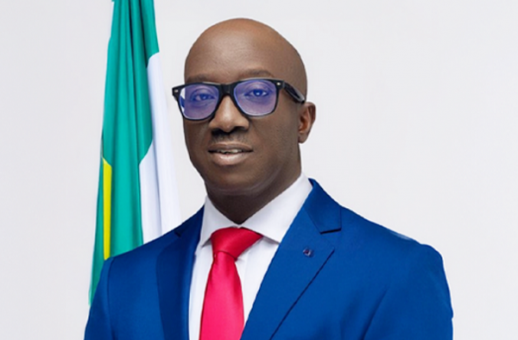
Governor Monday Okpebholo of Edo State has urged Muslims and all Nigerians to continue to pray for peace, unity and progress in the country even as they celebrate the annual Eid-al-Adha
The governor, who was represented by his deputy, Dennis Idahosa, stated this during the annual Eid-al-Adha celebration with Muslim faithfuls held at Government House in Benin City.
He reiterated his administration’s commitment to fairness, inclusivity and equal opportunities for all citizens irrespective of religion and tribe.
READ ALSO:ADC Penetrates Okpebholo’s District As Defections Strengthen Party in Edo Central
According to him, the present administration remains determined to building a government that reflects the diversity of Edo State, noting that competent and qualified Muslims have continued to play vital roles in his government because of their capacity, integrity and commitment to service.
“As a government, we remain committed to fairness, inclusivity and equal opportunity for every Edo citizen, irrespective of religion, ethnicity or political affiliation. This is why quality and competent Muslims are serving in key positions in our administration.”
Okpebholo appreciated the Muslim community in Edo State for their unwavering support and continuous prayers for his administration, noting that such prayers and support have contributed immensely to the peace and steady development being witnessed across the state.
READ ALSO:Okpebholo Felicitates Muslims On Eid-el-Fitr Celebration
He then called on all Nigerians to use the occasion of Eid-al-Adha to pray for the administration of President Bola Ahmed Tinubu, stressing that the country needs collective prayers, unity and cooperation to overcome its present economic and security challenges.
“I urge all Muslims and indeed all Nigerians to use this occasion to pray for our dear nation and for the administration of President Bola Ahmed Tinubu. Nigeria needs our collective prayers, unity and support as we strive to overcome our challenges and build a more prosperous future for all.”
In his remarks, the Chief Imam of Edo State, Abdulfatai Enabulele, applauded the governor for what he described as remarkable developmental strides recorded in less than two years in office.
The cleric commended the administration for ongoing infrastructural development and efforts geared towards improving governance in the state, but appealed to the government to revisit and complete some abandoned projects inherited from the previous administration for the benefit of the people.
-

 Metro5 days ago
My Husband Abandoned Me On Our Wedding Night To Attend Political Meeting, I Want Our Marriage Dissolved
-

 Headline4 days ago
Woman Passes Out After Receiving 100 Strokes Of Cane
-

 Politics5 days ago
Warri Ijaw Hail INEC Delineation Report, Call For Additional Electoral Wards, Others
-

 Headline4 days ago
JUST IN: White House Locked Down Briefly As Gunman Opens Fire At Security Checkpoint
-

 Politics3 days ago
Two Masked Men Gun Down Politician In His Rivers State Hotel
-

 News3 days ago
More Pain For Nigerians As Cooking Gas Price Increases Nationwide
-

 News5 days ago
Alleged Terrorism: Court Rejects Defendant’s Bid To Travel Abroad
-

 Metro5 days ago
My Wife Stop Cooking My Food, Beats Me Black And Blue All the Time, Man Tells Court
-

 Metro4 days ago
Police Reject N500m Bribe, Recover N7.8bn Illicit Drugs In Lagos
-

 Politics5 days ago
What I’ll Do As President Of Nigeria — Amaechi