
News
OPINION: Ted Cruz’s Genocide, Blasphemy And Ida The Slave Boy

Today, Nigerian leaders are busy playing the biblical couple, Ananias and Sapphira, on allegation that they abet genocide in Nigeria. They do this while being enveloped in how to rig the 2027 elections. As they do, Citizen Yahaya Sharif-Aminu is on a death row. On February 23, 2020, this then 22-year-old was arrested for posting blasphemous statements on WhatsApp against Prophet Muhammad. The Kano bigoted mob, renowned for its hyena-like thirst for flesh and blood, immediately burnt down Sharif-Aminu’s family home.
For context, Sharif-Aminu is an adherent of the Tijaniyya Sufi Islamic order. That WhatsApp message ostensibly elevated, in estimation, Ibrahim Niasse, a Tijaniyya Muslim brotherhood Imam, higher than Prophet Muhammad. Tijaniyya laud Niasse, a Senegalese cleric, for reviving the sect by spreading it across West Africa.
Under Section 382(b) of the Kano State Sharia Penal Code 2000 where he was domiciled, it is illegal for a self-professed Muslim to insult the Quran or any of the Islamic prophets. The Penal Code’s recompense for such infractions, upon conviction, is death. The twelve states of the north, predominantly Muslim, are under the suzerainty of the Sharia laws.
During trial in March 2020, Sharif-Aminu was denied legal representation and was held incommunicado. On August 10, 2020, the Hausawa Filin Hockey upper-Sharia Court sentenced him to death by hanging. His appeal for “leniency,” was spurned by the Sharia judge because, “a case of blasphemy against Prophet Muhammad (P.B.U.H.) is among the things that a person who made them shall not be excused.” After the sentencing, then Governor of Kano State, Abdulahi Ganduje, shocked a sane world when he said he would not hesitate to sign the execution order.
In August 2020, another boy, a minor by then, named Omar Farouq, was equally convicted for blasphemy. An allegation that he made derogatory statements to a colleague in a heated argument became his albatross. Immediately, like Sharif-Aminu, a heartless mob comprising Stone-Age-minded Almajiris, typical to Northern Nigeria, descended on his home and burnt it. Omar was eventually sentenced to a ten-year imprisonment on account of being a minor.
An appeal court ordered a retrial of Sharif-Aminu’s case which again returned a judgment of death penalty on the musician. Since January 18, 2023, the case has been before the Supreme Court. The world was riled to its nadir when, in reaction, Lamido Abba Sorondinki, counsel for the Kano State government, said, “This applicant made blasphemous statements against the Holy Prophet.. If the Supreme Court upholds the lower court’s decision, we will execute him publicly…Anybody that has uttered any word that touches the integrity of the holy prophet, we’ll punish him.”
MORE FROM THE AUTHOR:OPINION: Iyaloja-General At Oba Of Benin’s Palace
Ancient wisdom of my people says that no one needed to tell apart an àtànpàkò (thumb) from the omońdinrín, (little finger). Among fingers seated on the phalanges that make up the five fingers of the hand, the thumb and little finger stand out. Apart from these two, the phalanges also comprise the index, middle and the ring fingers. So, the Yoruba say, it is the àtànpàkò that points the way forward while omońdinrín describes where to go. In the last couple of weeks, like the àtànpàkò, US Senator for Texas, Ted Cruz, seems to be pointing Nigeria to Nigerians. In bursting the bubble of the Nigerian government’s appetite for its decades-old delicious broth of hypocrisy and duplicity, Cruz might just as well have been the àtànpàkò.
The Cruz’s bursting of the bubble reminds me of an ancient tale of Ida the slave boy. Not minding his years of servitude to him, Ida’s slaveholder once got him dressed in a resplendent attire, in preparation for a celebrities’ event he was invited to. So, on arrival, the organizers took Ida to where children of invited guests sat. Not long after, the celebrant, visibly perturbed, walked up to the slaveholder and asked, “Your son should have told us his specially-prepared meal was not enough. We found out he left the exalted group of children of guests and stepped into where slaves were having their meals”. Unfazed but matter-of-factly, the slaveholder told the celebrant, “You may have thought him my son but his behaviour has revealed that he is a slave.”
On his X account recently, Cruz, a Republican senator, revealed the systemic contradictions of the country we call ours. Government then began running, in the Nigerian parlance, from pillar to post, to deconstruct its age-long unsavoury profile. In his post, Cruz revealed how the rest of the world is aghast at Nigeria’s national disharmony. He also alerted the world of Nigeria’s Achilles’ heel and how its leaders’ hypocrisy constitutes the nation’s vulnerability. Cruz had written: “Officials in Nigeria are ignoring and even facilitating the mass murder of Christians by Islamist Jihadists.” He further remonstrated barbaric portions of the Nigerian blasphemy laws of northern Nigeria, especially provisions which “criminalize expression, behavior, or belief perceived as insulting religion.”
The statistics of Islamists’ killings in Nigeria are grim. The UN Development Programme (UNDP) estimated that Boko Haram had killed 350,000 Nigerians as at 2021. Ex-Chief of Defence Staff, Lucky Irabor, in a new book, also estimated that the insurgents had massacred “no fewer than 2,700 officers and soldiers” in over 12 years.
On September 9, 2025, Cruz doubled down on this allegation by sponsoring a bill requesting the U.S. Secretary of State “to designate the Federal Republic of Nigeria as a Country of Particular Concern, (CPC)” while demanding it to impose appropriate sanctions, with a caveat that, “It’s time to hold those responsible accountable.” Unfavourable and potentially unsettling for countries so tagged, the CPC is an acrid wage for countries found to have engaged in or abetted “particularly severe violations of religious freedom.”
Pronto, as Americans say, Nigeria drifted into a self-imposed dilemma which, again, can be summarized in an ancient wisdom of a man insistent on scouring the world for who owed his late father money. In the process of this stiff-necked attempt to demonstrate financial purity, he may stumble on one who his late father owed money. Today, like a rat struggling to free self from the choke-hold of a cobra, the Nigerian government is trapped in the center of the world’s anger. Like that man seeking who owed his father money, Nigeria’s government is choked by its own vomit.
MORE FROM THE AUTHOR:OPINION: The Madman Sermon On Mapo Hill
In May, 2022, Deborah Yakubu, a Christian student of Sokoto State College of Education, faced similar gruesome fate in the hands of the cadaver-seeking mob of northern Nigeria. Her crime was an alleged comment she made in aid of her Christian faith which allegedly disparaged Islam. The mob promptly stoned her to death and then incinerated her. The police were too scared of this murderous mob to intervene. They eventually arrested two student colleagues of Deborah’s but set them free subsequently. In northern Nigeria, it is a very rare spectacle to see murderers who kill in the name of religion arrested and prosecuted.
On account of Deborah’s killing in far away Bauchi State, Rhoda Jatau, a Christian, nurse, and mother of five, escaped death by the whiskers. Her crime was sharing the video created by someone else condemning the killing of Deborah. Immediately, a mob descended on her. It destroyed her store and injured so many people in the process. Arrested on May 20, 2022 and charged for blasphemy, Jatau’s reprieve only came after global outrage, leading to her acquittal in December, 2024.
In Northern Nigeria, many people have faced such persecution, resulting in death. In June 2023, during dispute with someone near his shop, a Muslim butcher living in Sokoto, Usman Buda, had a mob accuse him of blasphemy. He got an instant mob judgment of instant death. So also was Mubarak Bala. An ex-President of the Nigerian Humanist Association and an ex-Muslim, his charge for allegedly “blasphemous” Facebook posts got him convicted by the Kano State High Court on April 5, 2022. He was then sentenced to 24 years imprisonment. Recently in Bauchi State, an Islamic cleric, Idris Abdulaziz, was also charged for blasphemy. Realizing the fate that awaited him, Abdulaziz, as my people would say, immediately paid tribute to the hare. Also in 2016, Abdulazeez Inyass, during a secret trial in Kano, was sentenced to death for blaspheming Prophet Muhammad. Also of the Tijaniya sect, his crime was saying that Sheikh Niasse “was bigger than Prophet Muhammad”.
Of no less religious tyrannic proportion is a recent order by a Magistrate Court that two popular
creators, Idris Mai Wushirya and Basira Yar Guda, must, within 60 days, formalize a marriage relationship within 60 days. The two had posted series of viral videos wherein both engaged in romantic displays considered “indecent”. The Sharia courts in the north are notorious for handing down barbaric sentences of floggings, amputations and death penalty.
I went into details of all the blasphemy laws in northern Nigeria to be able to situate the fact that, let us even for a minute forget about the gauntlet of Boko Haram, the intense and barbaric censorship on freedom of religion in the north is Nigeria’s albatross. Unfortunately, Nigerian leaders abet it by their willing conscription into a tyranny of silence. Northern leaders can’t disclaim it for fear of not being rejected at the polls and Aso Rock is afraid to dabble in it for political expediency.
Blasphemy laws of northern Nigeria, which clearly violate the Nigerian constitution, are a legal relic in today’s modern world. Nigeria shares this untoward and disreputable space with six other countries – Afghanistan, Iran, Mauritania, Pakistan, Saudi Arabia, and Somalia – which still have the laws in their rule books. For instance, in Iran, Amir Hossein Maghsoudloo, professionally known as Amir Tataloo, faced the Sharif-Aminu hell. An Iranian singer, rapper and songwriter controversial for his full body tatoo, Tataloo was also sentenced to death on January 19, 2025 for blasphemy.
MORE FROM THE AUTHOR:OPINION: Amupitan’s Magical Marriage To A Buffalo
The most abhorrent in all this is that northern leaders, from the Sultan to the lowest person, approve of this antediluvian blasphemy laws. Most times, what can be termed a licence-to-kill pall of silence from northern leaders hovers over the land. Amnesty International corroborated this when it said, “government officials rarely publicly condemn mob violence for blasphemy.” Ex-VP Atiku Abubakar, for instance, was appalled when his social media handler excoriated the barbaric murder of Deborah and immediately ordered it deleted. In August 2020, as governor, Ganduje, ex-APC chair currently undergoing trial for corruption, vowed to “waste no time in signing the warrant for the execution of the man who blasphemed.”
The truth is that, there is a connect between the barbaric blasphemy laws of northern Nigeria and the allegation of genocide by Ted Cruz. Having profiled Nigeria as a country that is receptive to barbarism, it fits into the trope to submit that the animalism of genocide is a Nigerian way of life.
Now, let us come to the Ted Cruz allegation. In an interview with the Fox News Digital, Cruz alleged further that over 52,000 Christians had been killed in Nigeria since 2009, and over 20,000 churches and Christian schools got destroyed within this period. This rattled the Nigerian government which knew that if Cruz’s allegation carries the day, its pot of soup would go sour in America. Senate President Godswill Akpabio, House of Representatives Deputy Speaker, Benjamin Kalu and others defended this pot of soup. In his characteristic gruff, presidential spokesman, Bayo Onanuga, took the usual Bolekaja route. “Senator, stop these malicious, contrived lies against my country. We do not have a religious war in my country,” he blabbered at Cruz.
But, President of the Christian Association of Nigeria (CAN), Archbishop Daniel Okoh, said the church “affirms, without hesitation, that many Christian communities in parts of Nigeria, especially in the North, have suffered severe attacks, loss of life, and the destruction of places of worship.”
To diffuse and defuse the controversy, the Nigerian government instigated a fact-finding mission to engage the narrative. It led to a pulling off of shroud from the face of pretentious patriot, Reno Omokri, who, as it would be revealed, lives off a life of packaging and make-believe. Having packaged the fact-finding team to Nigeria, like the man insistent on scouring the world for who owed his late father money, both Omokri and his sponsors got deconstructed. Mike Arnold, an ex Mayor of Blanco, Texas, against the bid to pull wool over the world’s eyes, confirmed that there is indeed genocide against Christians in Nigeria.
MORE FROM THE AUTHOR:OPINION: Profiling Natasha As Segilola, Sweetheart Of 1001 Men
The controversy of whether there is genocide against Christians in Nigeria is not a new one. It dates back many years. For decades, many Christian communities in the North have been wiped out by terrorists, while churches and houses were razed. People were also beheaded by Jihadists. Under the Muhammadu Buhari government, the European Union gave incontrovertible evidence of the occurrence of these brutal killings. Doubtful that Buhari himself was not a member of the insurgents, he was surely acutely sympathetic to their cause.
Blaming Cruz for claiming that the Nigerian government ignores and “even (facilitates) the mass murder of Christians by Islamist Jihadists” runs against the grain of available facts. Like Ida the slave boy, Nigeria revealed to the world its true colour. Pushed to the wall to explode, in January 2012, then president Goodluck Jonathan admitted that there were Boko Haram sympathizers in his government. Earlier in November 2011, a Nigerian senator was charged for alleged links to the Boko Haram Islamist militants. Said Marilyn Ogar, DSS’ then spokeswoman, the organization’s arrest “confirms the service’s position that some of the Boko Haram extremists have political patronage and sponsorship”.
Also in May 2019, former president Olusegun Obasanjo admitted that the Boko Haram insurgency was religious in colour. Earlier in 2012, ex-Chairman of the Christian Association of Nigeria, Pastor Ayo Oritsejafor, also claimed that there was a “systematic ethnic and religious cleansing” in Nigeria.
While the Nigerian government has blindly remonstrated Cruz’s claim, Professor Ebenezer Obadare, Nigerian-American academic and Douglas Dillon Senior Fellow for Africa Studies at the American Council on Foreign Relations, in a piece entitled The government of Nigeria V Sen Ted Cruz, would seem to have successfully fitted together the jigsaw of why and who Boko Haram kills in its genocide. He asked the Nigerian government to first seek to understand the raison d’être of Boko Haram’s strikes. Once Aso Rock does this, he counsels, it would do less of this barren attempt to disclaim a globally known truth.
Rather than engage in driving away its own shadows, unveiling what Boko Haram represents would make the Tinubu government effectively face its reality. And the reality is that, though Boko Haram attacks Christians and Muslims too, its polytheist (the belief in or worship of more than one god) strikes make it look like it is religion-blind. The truth however is that the insurgents are after Christians and their “accomplices” in Islamic regalia.
“From Boko Haram’s perspective, there is no difference between mainstream Muslims and Christians: they are all ‘polytheists’ who suffer from a common affliction: ‘unbelief’” (of Islam) – my addition – Obadare wrote.
Instead of government spending Nigeria’s scarce resources on religious leaders and asking them to defend the indefensible, knowledge of the above fact could wake it up from its slumber. Government is also said to spend on foreign lobbyists, asking them to help it make the corpse of this genocide allegation walk. However, Prof Obadare’s take on the insurgency should get Aso Rock to be alive to the truth: Boko Haram’s genocide is against Nigerian Christians, even if its strikes stray to mainstream Islamic faith adherents.



News
Migration Agency Warns Migrants Against Irregular Travel Routes

The International Organisation for Migration (IOM), in collaboration with Giving is Healing Foundation, has sensitised residents of Ayobo in Alimosho Local Government Area of Lagos State on the dangers of irregular migration and the need to embrace legal travel procedures.
Speaking during a sensitisation programme held at Megida Ifelodu Community Development Association in Ayobo, the founder of Giving is Healing Foundation, Mr. Gbolahan Ayediran, warned intending migrants against using illegal travel routes.
Ayediran said many Nigerians desire to migrate abroad in search of better opportunities but often ignore proper procedures, thereby exposing themselves to several dangers.
“Lots of people want to migrate and most of them do it in the wrong direction. The reason for the programme is for us to advise people on how they can migrate in the right way. As much as migration is their right, they should do it correctly,” he said.
READ ALSO:How Wike Rescued Me From Political Oblivion — Oshiomhole
He advised intending travellers to obtain the necessary travel documents before embarking on any journey, noting that such documents include international passports, visas, flight tickets and yellow cards, depending on the destination country.
According to him, migrants should also gather adequate information about their destination countries to enable them make informed decisions before travelling.
Ayediran further highlighted some of the dangers associated with irregular migration, including abuse, exploitation, discrimination and forced labour.
Also speaking, the Chairman of Megida Ifelodu Community Development Association, Elder Mathews Amusan, commended the organisers for enlightening members of the community on safe migration practices.
READ ALSO: He Can’t Fix His Party Let Alone Nigeria – Oshiomhole Blasts Atiku
He urged residents planning to travel abroad to always follow legal migration procedures to avoid falling victim to human trafficking and other migration-related challenges.
One of the participants, Mr. Kolawole Adenoko, said the programme enlightened him on the dangers of irregular migration and the importance of travelling through the proper channels.
He added that he would also educate his relatives and friends on the risks associated with illegal migration.
News
Shatta Wale Bailed Burna Boy From Ghana Prison After Arrest For Smoking Weed – Captan
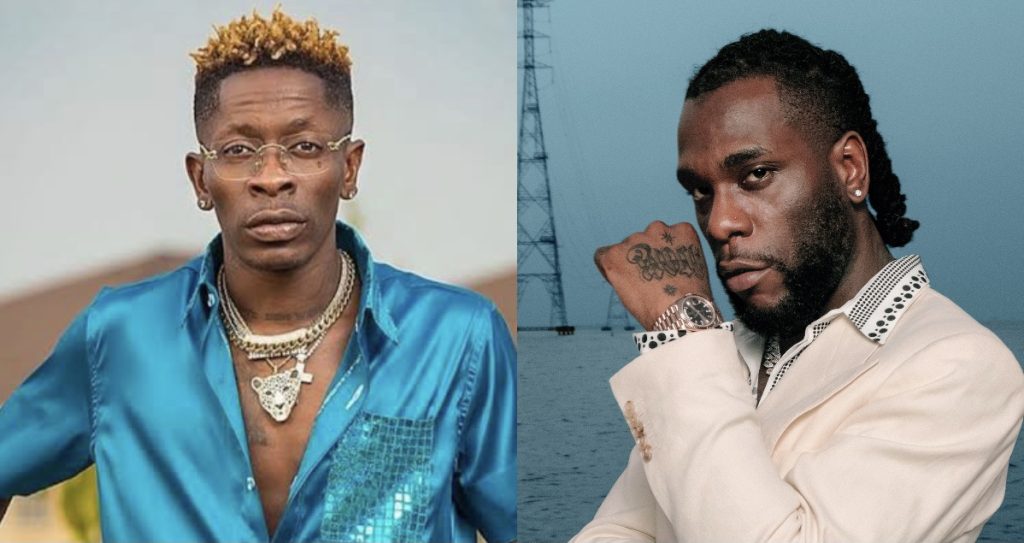
Ghanian singer, Captan, has claimed that his former record label boss, Shatta Wale, once bailed Nigerian singer Burna Boy out of prison in Ghana after he was allegedly arrested for smoking weed.
Speaking in a recent podcast interview, Captan claimed that Shatta Wale sent him and others to free Burna Boy from police custody.
He also claimed that Shatta Wale and his group once accommodated Burna Boy when he was being hunted by some dangerous men.
READ ALSO: Wale Edun Opens Up After Sack
Captan said, “I once bailed Burna Boy out of prison in Ghana when he was arrested for smoking weed. Shatta Wale sent me and some guys to go and free him from police custody.
“There was a time we also accommodated him when some people were after his life. We helped him settle the case.”
He added that he and Burna Boy are no longer in good terms after the Nigerian artist’s fallout with his mentor, Shatta Wale.
He, however, said he and Shatta Wale are open to reconciling with Burna Boy if he asks for it.
Watch the video here
News
Children’s Day: Chaos At Ogbe Stadium As Dozens Faint

Chaos erupted on Wednesday during the Children’s Day celebration as dozens of students reportedly collapsed following a stampede triggered by the use of pepper spray.
The event,
organised by the Edo State Ministry of Education at the Samuel Ogbemudia Stadium was disrupted after some male students of Ihogbe College allegedly made uncompromising advances towards female students at the venue.
A parent who identified himself as Oboh Emmanuel said, “the behaviour of those uncultured students attracted the attention of bouncers stationed at the stadium as they rebuked the male students.”
Oboh said the affected students later regrouped and attacked the bouncers, leading to a confrontation within the crowded arena.
READ ALSO:Children’s Day: Edo Commits To Child Protection
It was gathered that in the ensuing confusion, the bouncers were reported to have deployed pepper spray in an area occupied by a large number of students.
Several students, particularly female students, reportedly fainted after inhaling the substance, while others sustained injuries after being stepped on during the ensuing melee.
The panic was said to have spread across the stadium as students, teachers and parents scampered for safety.
Many of the affected students were reportedly rushed to the Edo Specialist Hospital for medical attention.
READ ALSO: Egor LG Chair, Ogbemudia, Vice, Osawe Impeached
Reacting to the incident, Chief Press Secretary to Governor Monday Okpebholo, Dr Patrick Ebojele, said the security personnel that fired the tear gas had been detained.
He said all the students, except two, that were rushed to the hospital have been discharged.
Ebojele stated that doctors wanted to observe the students till tomorrow before allowing them to go home.
“The two students are not seriously injured. Doctors want to observe them overnight. Permanent Secretary, Ministry of Education is still at the hospital. The man who used pepper spray has been detained.
“The incident did not happen the way it is being exaggerated. All modalities were put in place to ensure the children enjoyed their day.”

 Headline4 days ago
Woman Passes Out After Receiving 100 Strokes Of Cane
- Headline4 days ago
JUST IN: White House Locked Down Briefly As Gunman Opens Fire At Security Checkpoint
- News3 days ago
More Pain For Nigerians As Cooking Gas Price Increases Nationwide
- Politics3 days ago
Two Masked Men Gun Down Politician In His Rivers State Hotel
- Metro4 days ago
Police Reject N500m Bribe, Recover N7.8bn Illicit Drugs In Lagos
- News3 days ago
FG Declares Two Days Public Holiday For Eid-el Kabir Celebration
- Politics3 days ago
‘Tinubu’s Borrowing In 24 Months Surpasses 55 Years’ Debt Record’
- Politics2 days ago
Court Clears Goodluck Jonathan To Contest 2027 Presidential Election
- News3 days ago
OPINION: Boko Haram Comes South
 News2 days ago
OPINION: Like Oyedokun, We Are All Decapitated


