
News
OPINION: The Powerful Man And His Faeces
By Suyi Ayodele
This is a simple way to kill a man that is too powerful for the entire community to deal with. Simply splatter his faeces by his doorstep. Then allow him to do what all powerful men do to such audacity.
I do not lay claim to the ownership of the above theory. And it is not fiction either. There is a true-life story to it. The event happened less than 50 years ago. My generation witnessed it.
There was a powerful man in a community not too far from my hometown. He was the most esoteric man of his time and in his neighbourhood. He was a diviner, a wizard, a witch, a sorcerer and an inner member of the 16 esoteric club (Eléégbé Mérìndìnlógún). He was revered by many, feared by not a few and worshipped even by monarchs.
At one time, he held procreation to ransom in his town. Yes, you don’t have to believe me, but it happened. For three years running, monthly menstrual cycles ceased in women. Those who were pregnant could not deliver; the barren rubbed their camwood-stained fingers on the dry walls (àgàn f’owó osùn ra ògiri gbígbe) and men’s reproductive fluids dried up. All because the powerful man was angry.
Who offended him? Why did he have to punish the entire village? It was a simple matter. A married woman turned down the amorous advances of the powerful man towards her. She would rather die than warm the bed of the initiate. In anger, the man cast a spell on the entire community. He went further by withholding rain for almost a year. The draught was for all forms of productions and reproductions. He was wicked. He was unforgiving!
The town did not sleep over his matter. The elders gathered and took counsel. Enough is enough, they agreed. The powerful man must be eliminated for the community to breathe. Diviners were consulted, sorcerers were engaged, and the services of the owners of the day and night were not left out. But all amounted to nothing.
As many that were involved in the schemes did not live to tell the story. Many, who were sent on the mission to other lands over the matter did not return; they perished on the journey. In all this, the powerful man remained in his house, doing his normal things and feeding fat on the limbs of goats as accompaniment of his pounded yam and the torso of the ram to eat his yamflour mash (óhún fi ori ewúré je’yán, óhún fi àgbò mòmò je’ká). He was gaining weight while the town was getting dried up!
The matter came to a head and the oba of the town decided to take the supreme action. After all, it is said that it is better for a man not to ascend the throne than to say he has no control over his domain (àfàì joyè sàn ju enu mi ò ká ìlú). The king decided to open the ancient calabash; he opted to join his ancestors.
The king summoned the last Oba-in-Council meeting. He wanted to properly handover the affairs of what remained of his domain to the chiefs. That meeting was the worst ever. All attendees were sad. They knew what was to come, especially when the king requested that all attendees must come with their traditional paraphernalia of office.
A princess, the king’s favourite, in her teens, eavesdropped on the conversation. She waited till the last man spoke. Then she stepped into the chamber and announced, defiantly, that she had a solution to the problem.
Many of the chiefs were enraged. What audacity! How would a child step into the chamber uninvited to spew rubbish? What solution could a child have when those older than her father, the king, had died in the process of cracking the hard nut?
Wisdom however, prevailed as someone suggested that the council of elders should listen to the small girl. The chief who spoke in that direction reminded the elders that Ile Ife, the cradle of Yoruba race, was created through the wisdom of both the young and the old (Omodé gbón, àgbà gbón, òhun la fi dá Ilé Ifè). They asked the girl to speak up.
But rather than speak openly, the princess walked up to her father on his throne and whispered something to him for a few minutes. Done, she greeted the elders and went back to the inner parts of the palace to join her playmates.
The oba looked at his chiefs and announced that he would try what the princess suggested. If that failed, he would then take the last option of suicide. But what did the princess say, Kabiyesi? The chiefs asked their king. The oba merely looked at them and stood up. They chorused ‘Kabiyesi’ once more. The message was clear: mòsínú, mòsíkùn ni awo Ilé Ifè (the greatest diviner of Ilé Ifè is the one who keeps secrets in his stomach). The Oba-in Council rose.
Three days after the meeting, as the sun was setting, there was a great wailing from the powerful man’s house. At first, nobody responded. The old fox, the people said to themselves, had come out with another gimmick to kill people. Everybody stayed indoors.
The wailing continued and louder as more wailers joined. It was followed by sharp dirges. Then a man took the risk. He ventured out and tiptoed to the powerful man’s compound. What he saw shocked him. The lifeless body of the man was by his bag of charms. He wanted to be sure. He touched the body and found it cold like the nose of a dog!
The man leapt in joy. He ran to the palace to announce the good news. Sooner, the entire community was out. The news travelled far and near. The powerful man’s compound got filled up such that a needle thrown up had no space to land! The man died! But what killed him? Here is what the powerful man’s wife told the crowd.
Early that morning, as the powerful man stepped out of his house to offer the usual early morning invocation (Ìwúre òórò), he stepped on something. On a closer look, he discovered that it was faeces! Kaasa! He shouted, waking up the entire household. Who could have done this; who had the audacity to defecate by the doorstep of the wicked?
MORE FROM THE AUTHOR: OPINION: Federal Republic Of Loans
His wives knelt to beg him. An innocent child could have done that, they suggested. They asked him to have mercy all to know avail. He dashed into his room and brought out his bag of charms. Inside it were the most terrible of the charms one could find.
The powerful man brought out the gourd containing bójówò (die before sunset) and emptied the content on the faeces. He brought out àgbélépòtá (Kill-your-enemy-within the confines of your home) and recited the accompanying incantation. He used èpè (curse), he used àfòse (happen as I say) and he did not spare olúgbohùn (instant answer). He completed the process by dropping a good portion of àbùlé (powdery substance) that had no antidote! Done, he packed his bag, entered the house, instructing that nobody should wash off the faeces until the news of the death of the culprit was broken.
But as the sun was going down, the powerful man felt some sensation within him. Something he could not explain happened to him. He reached for his divination bags and consulted Ifa. Alas, Ifa revealed to him that the faeces by his door belonged to him. Págà! He lamented. His wives and children ran to him to ask what happened. The man ignored them and began incantations to reverse what he did in the morning. Then he realised that he used àbùlé! It was too late. The pain came down like torrents. His system changed. He knew that games are sold in carcasses (òkú ni eléran úntā).
Within the hours, the powerful man answered his creator! His family members wailed. The palace rejoiced. The princess who brought the solution was celebrated. The king caused the most expensive beads (Iyùn) to be put on her neck as she was decorated in camwood lotion.
The king told the chiefs what the princess whispered to him three days earlier. The girl advised that since the powerful man was too big for the community to handle, they should allow him to kill himself. She told the oba to find a way of getting the man’s faeces and splatter it by his door. Knowing that the powerful man was wicked, the girl posited that he would likely not spare the culprit.
And that was what the king did. He got his most trusted servant to trail the powerful man to the dunghill where he used to defecate. The servant did as he was instructed. When the powerful man was done defecating, the King’s servant packed the faeces and at the dead of the night, splattered it by the doorstep of the man. The rest is history. People of my generation and those older, know this fable as told around Egbeoba then! The theory here is the summary of the name of a friend, Aseniserare.
MORE FROM THE AUTHOR: OPINION: The Ɠhomid In The Tears Of JAMB
No man can be more powerful than his community. It is said in my place that while the swaddle of a man cannot go round the community, the swaddle of the community can suffocate a man. This is why the elders counsel that the powerful men of this world should tread gently. Why? The ground slips, our elders submit. And that is true, the ground slips. It does any season, rain or no rain.
President Bola Ahmed Tinubu is the most powerful man in town today. This is not debatable. He was a governor between 1999 and 2007. He had 35 other contemporaries then. Today, those other ex-governors of his era carry his bag. Especially in his South-West, President Tinubu has his fellow former governors who now eat the crumbs from his table. Even those who are old enough to be his father now serve him. Tinubu is a typical Orí àpésìn (the head that others must worship).
Before becoming the President in 2023, Tinubu had played the role of a successful kingmaker. Lagos State, his adopted state of origin, is under his armpit. From the councillor to the governor, he determines who gets what in Lagos. He appoints and removes governors of the state as he wishes.
From Lagos, Tinubu exports politicians to other states. He did it in Osun State by donating this now estranged political son Raufu Aregbesola, to the good people of Osun State as their governor. He supported Olusegun Mimiko in Ondo State. Ekiti and Oyo States had in the past ‘benefited’ from his political patronage. Ogun State is a ‘customer daada ni’ to the man called Jagaban! Tinubu told the Ogun State governor, Dapo Abiodun, to his face that without him, Tinubu, Governor Abiodun would not have smelled the Governor’s House. As far as Tinubu is concerned, the Ogun State governor is Dapo eleyi (this mere Dapo).
President Tinubu also registered his presence in the South-South, particularly Edo State. He made Comrade Adams Oshiomhole’s governorship dream come through. The Jagaban’s political signatures can also be seen in Cross River, Delta, partly in Bayelsa and lately in Akwa Ibom States. He has, completely, by proxy, annexed the oil-rich Rivers State!
The Lion of Bourdillon has also spread his tentacles to the North. He was in Kano and Kaduna States. He successfully dislodged the Sarakis from Kwara State. His shadow looms all over the northern political landscape and he is the èrùjèjè (the fearful one) of the South-East.
The people of Imo State for instance, will not forget how he supported the candidate who came fourth in the gubernatorial election to become the governor by the pronouncement of the Supreme Court. Today, if Tinubu sneezes in Aso Rock, Governor Hope Uzodimma is available to inhale the virus!
What about Anambra State? When Tinubu visited last month, Governor Charles Soludo forgot his professorship in Economics as he worshipped the man whose certificate from Chicago State University or University of Chicago is still a subject of debate. Soludo, from a different political party, did not just endorse Tinubu for a second term, he caused all the traditional rulers of the state to confer the chieftaincy title of Dike Si Mba (Warrior from the Diaspora), on the President. Today, again, Enugu quakes under the feet of Tinubu as Ebonyi and Abia States appear conquered by him.
To cap it all, everyone who is something or somebody in the political theatre is ready to endorse Tinubu for 2027. More intriguing, those who declared Tinubu as a “drug baron’ in 2022/2023 are fighting naked in defense of the President! The 2027 endorsement for Tinubu is suffocating. The drumbeat of support is loud enough for the congenitally deaf to hear. President Tinubu has every reason to be happy; he has every justification to roll out the drums in celebration. But like our elders are wont to caution: the ground slips!
The opposition is in disarray like the community in our introductory fable. Tinubu also appears to be steps ahead of the ‘Coalition’ being formed by some old friends and foes. But should the opposition give up? Should those who want Tinubu out by 2027 resign to fate because the man appears to be steps ahead of his adversaries? I will not answer for them!
But I know there is a prince eavesdropping the conversation in the political council chamber. All the people need to do is to allow him to whisper the solution to their ears. Tinubu is not totally impenetrable; he is not completely invincible! No man is! Otherwise, he would not have lost Lagos State to the Labour Party (LP) in 2023!
MORE FROM THE AUTHOR:Wike: Every Compound Needs A Tough Child [OPINION]
How did he lose that all-important election in Lagos of all places? The people were genuinely tired of his politics. I am not among those who believed that only the Igbo residents in Lagos did the 2023 magic No! What happened was a combination of all forces, what my people call ogun àpapò (concerted efforts). Everyone dissatisfied with Tinubu’s leadership style rose against him. The battle cut across all tribes. That was why it reverberated.
It is also a feat that I believe can be repeated; it can happen again. It is even more feasible now than then. The Lagos of today is more vulnerable than the Lagos of 2023. The crack is already there, the pretension to the contrary doesn’t matter! President Tinubu himself started it with his inúbíbí (anger) and èdòfùfù (fiery temper).
Like the powerful man, Tinubu’s faeces are fresh out there on the dunghill of Lagos. It is waiting for those who will pack it and splatter it at the Bourdillon palatial home of the President and wait for him to empty his bag of charms on his own faeces. He started the process penultimate Saturday when he openly snubbed Governor Babajide Sanwo-Olu.
Yes, Governor Sanwo-Olu has called us “people who cry more than the bereaved.” He added that we are “more Catholic than the Pope.” I saw the video of the governor’s visit to Tinubu’s private home over the weekend. Nobody needs any seer to know that Sanwo-Olu is a troubled man, a man in deep agony.
We should not waste time analysing his mien, his composure and utter lack of self-esteem in that video. I don’t want us to focus on his gaunt stature as he spoke to the microphone. A man who does not complain of body pain is not sympathised with for lack of sleep or slumber (Tí alâra bá ní ara ò ro òhun, a kii ki kú àìsùn, kú àìwo) He said Tinubu is his father. Yet he was “grateful that he has given us the audience today to come in and say hello to him.”. Some fathers, some sons!
I would have loved to delve into the way Tinubu’s faeces can be spattered at his doorstep. But I won’t do that lest someone, somewhere comes around to accuse me of being the ‘mouthpiece’ of the opposition or coalition. If those who want Tinubu out in 2027 are wise enough, they would know that they cannot be sleeping and snoring when their adversary, like the proverbial devourer, sleeps not, but goes up and down looking for who will defect next!
If the opposition cum coalition thinks that dislodging Tinubu in 2027 is by political rhetoric, conferences and academic appearances on television talk shows, the man they love to hate will continue to insult us all. He will continue to spend our money to construct a less than 30-kilometre road out of 700 kilometres and asked us to trek if we cannot afford the tolls.
That is not the language of a man who needs our votes for his second term. Only a man who is sure he has gotten 2027 in his pouch speaks in such an arrogant manner. Only a powerful man talks down that way on the citizenry because he knows that the opposition is too lazy, the coalition too colourless and his political enemies nauseatingly self-serving!
In his euphoria, may God allow President Tinubu the wisdom to know that there is no champion for life! May he also know that the masquerade tethered to the elder’s waist cannot afford to dance perilously at the arena. That when a man becomes too powerful for his community, he is given his faeces to lace with deadly charms.
Many empires have come and gone. No dynasty lasts forever! When the cord holding the skin becomes too tight, the Bàtá drum brings out louder sounds. What follows is a disaster: the Bàtá tears! I would have loved to say more here but our tradition forbids a young man to speak to an elder in parables. President Tinubu is an elder!



News
OPINION: Time For The Abachas To Rejoice
By Lasisi Olagunju
General Sani Abacha was a great teacher. He pioneered the doctrine of consensus candidacy in Nigeria. He founded a country of five political parties and when it was time for the parties to pick their candidates for the presidency, all the five reached a consensus that the man fit for the job was Abacha himself. Today, from party primaries to consensus candidacy; from setting the opposition on fire, to everything and every thing, Abacha’s students are showing exceptionally remarkable brilliance.
Anti-Abacha democrats of 28 years ago are orchestrating and celebrating the collapse of opposition parties today. They are rejoicing at the prospect of a one-party, one-candidate presidential election in 2027. Abacha did the same. So, what are we saying? Children who set out to resemble their parents almost always exceed their mark; they recreate the parents in perfect form and format. Abacha was a democrat; his pupils inherited his political estate and have, today, turned it into an academy. Its classes are bursting at the seams with students and scholars. Aristotle and his Lyceum will be green with envy, and very jealous of this busy academy.
Like it was under Abacha, the opposition suffers from a blaze ignited by the palace. But, and this is where I am going: fires, once started, rarely obey and respect their makers.
My friend, the storyteller, gave me an old folktale of a man who thought the world must revolve around him, alone. One cold night, the man set his neighbours’ huts on fire so he alone would stand as the ‘big man’ of the village. The man watched with satisfaction as the flames rose, dancing dangerously close to the skies. But the wind had a scheme of its own. It hijacked the fire, lifted it, and dropped it squarely on the arsonist’s own thatched roof. By dawn, all huts in the village had become small heaps of ash.
Fire, in all cultures, is a communal danger; whoever releases it cannot control its path. The Fulani warn that he who lights a fire in the savannah must not sleep among dry grass, a wisdom another African people echo by saying that the man who sets a field ablaze should not lie beside raffia in the same field. Yet our rulers strike anti-opposition matches with reckless confidence, believing fire is a loyal servant that burns only the huts of opponents. They forget that power is a strong wind, and wind has no party card and respects none.
When it is state policy to weaken institutions, criminalise dissent and have rivals crushed with the excuse of order, the blaze spreads quietly, patiently, until it reaches the bed of its maker. Fire does not negotiate; it does not remember or know who started it (iná ò mo eni ó dáa). In politics, as in the grassland, those who weaponise flames rarely die with unburnt roofs over their heads.
MORE FROM THE AUTHOR:OPINION: The Girls Of Chibok, Maga, Papiri And Our Frankenstein
The folktale above is the story of today’s ruling party. People in power think it is wisdom to weaken, scatter, or destroy opposition platforms outright. They have forgotten the ancient lesson of the village: When you burn every hut around you, you leave nothing to break the wind when it blows back. A democratic system that cannibalises opposition always ends up consuming itself. Our First Republic is a golden example to cite here. History is full of parties that dug graves for their rivals and ended up falling inside.
Literature is rich with warnings about the danger of lighting fires; they more often than not get out of control. In Duro Ladipo’s ‘Oba Koso’, Sango is the lord of fire and ultimately victim of his fire. In Shakespeare’s ‘Macbeth’, we see how a single spark of regicide grows into a blaze of paranoia and bloodshed that ultimately consumes Macbeth himself. In D. O. Fagunwa’s Adiitu Olodumare, we see how Èsù lé̟̟hìn ìbejì is consumed by the fire of his intrigues; Chinua Achebe’s ‘Things Fall Apart’ shows a similar pattern with Macbeth: Okonkwo’s role in Ikemefuna’s death ignites a chain of misfortunes that destroys his honour and his life. In ‘The Crucible’, Arthur Miller’s characters take turns to unleash hysteria through lies, only to be trapped by the inferno they created. Ola Rotimi’s ‘The Gods Are Not to Blame’ and even Mary Shelley’s ‘Frankenstein’ echo the same lesson. Again and again, literature insists that those who start dangerous fires whether of ambition, deceit, violence, or pride, should never expect to sleep safely. Always, the tongue of the flames turns and returns home.
Abacha must be very proud that the democrats who fought and hounded him to death have turned out his faithful students. From NADECO to labour unions and to the media, every snail that smeared Abacha with its slime is today rubbing its mouth on the hallowed hallways of his palace.
Under Abacha, to be in opposition was to toy with trouble. Under this democracy, all opposition parties suffer pains of fracture. Parallel excos here; factional groups there. Opposition figures are in greater trouble. It does not take much discernment before anyone knows that Tiger it is that is behind Oloruntowo’s troubles; Oloruntowo is not at all a bad dog. But how long in comfort can the troubler be?
In 1996, Professor Jeffrey Herbst of the Woodrow Wilson School, Princeton University, United States, asked: “Is Nigeria a Viable State?” He went on to assert – and predict – that “Nigeria does not work and probably cannot work.” He said the country was failing not from any other cause but “from a particular pattern of politics …that threatens to even further impoverish the population and to cause a catastrophic collapse…” That was Nigeria under Abacha. We struggled to avert that “catastrophic collapse”; with death’s help, we got Abacha off the cockpit, and birthed for ourselves this democracy. Now, we are not even sure of the definitions of ‘state’, ‘viable’ and ‘viability’. What is sure is that the “particular pattern of politics” that caught the attention of the American in 1996, is here in 2025. As it was under Sani Abacha, everyone today sings one song, the same song.
Abacha died in 1998; Abacha is alive in 2025. It is strange that his family members are not celebrating. How can you win a race and shut yourself up? My people say happiness is too sweet to be endured. The default response to joy is celebration but we are not seeing it in the family of the victorious Abacha. Because the man in dark goggles professed this democracy, this democracy and its democrats have apotheosised Abacha; he is their prophet. They take their lessons from his sacred texts; his shrine is their preferred place of worship.
MORE FROM THE AUTHOR:OPINION: Absurd Wars, Absurd Lords
“As surely as I live, says the Lord, every knee will bow before Me; every tongue will confess to God.” – Romans 14:11. Our political lords copied those words and, in profaned arrogance, read it to Nigeria and its terrorised people. Now, everyone, from governors to the governed, bows; their tongue confesses that the president is king, unqueriable and unquestionable.
When a man is truly blessed, all the world, big and small, will line up to bless him and the work of his hand. Governors of all parties are singing ‘Bola on Your Mandate We Shall Stand.’ In the whole of southern Nigeria, only one or two governors are not singing his anthem. Northern governors sing ‘Asiwaju’ better and with greater gusto than the owners of the word. In their obsessive love for the big man’s power and the largesse it dispenses, they assume that ‘Asiwaju’ is the president’s first name. They say “President Asiwaju.” The last time a leader was this blessed was 1998 – twenty-seven years ago.
Our thirst for disaster is unslaked. All that the man wanted was to be president; he became president and our progressive democrats are making a king out of him. And we watch them and what they do either in sheepish horror, complicit acquiescence or in criminal collusion. We should not blame the leader for seeing in himself Kabiyesi. That is the status we conferred on him. Even the humblest person begins to gallop once put on a horse. True. Humility or simplicity disappears the moment power unlimited is offered.
The chant of the president’s personal anthem is what Pawley and Müllensiefen call “Singing along.” It is never a stringless act. Worse than Abacha’s Two-Million-Man March, we see two hundred million people, crowds of crowds, move together in one voice, bound by an invisible script and spell. We feel a ‘terrorised’ democracy where citizens learn, through bowing, concurring and context rather than conviction, to sing the song of the kingly emperor. People who are not sure of anything again discover that synchronised voices create safety, and belonging. They proceed to stage it as a ritual for economic and political survival.
The popular Abacha badge decorated the left and right breasts of many fallen angels. Collective chanting signalled loyalty and reduced individual risk. Under this regime of democrats, the badge will soon come, but the chant is louder and wider cast. Unitarised voices have become instruments through which power is normalised, and by which dissent is dissolved.
MORE FROM THE AUTHOR:OPINION: Kukah And A Nation Of Marabouts
Two years into this democracy in 2001, Nigerian-American professor of African history and global studies, Raphael Chijioke Njoku, warned that “new democracies often revert to dictatorships.” He was a prophet and his scholarship prescient. We are there.
There are sorries to say and apologies to drop. On September 8, 1971, Nigeria killed Ishola Oyenusi and his armed robbery gang members because they stole a few thousands of Nigerian pounds. Why did the past have to shoot them when it knew it would stage greater heists in the future? It is the same with Sani Abacha and his politics. Why did we fight him so viciously if this grim harbour was our destination? I do not have to say it before you know that the spirit of the dead is out celebrating its vindication.
American political scientist, Samuel Huntington, in his ‘The Third Wave’, lists four typologies of authoritarian regimes: one-party, personal, military and racial oligarchy. The last on this list (racial) we may never experience in Nigeria but we’ve seen military rule and its unseemly possibilities. The emergence of the first two (one-party and personal dictatorship) was what we fought and quenched in the struggle with Abacha. Unfortunately, the evil we ran out of town has now walked in to assert its invincibility. What did Abacha’s sons do that today’s children of Eli are not doing ten-fold? Democracy is a scam, or, at best, an ambush.
Politicians have borrowed God’s language without His temperament. They have restructured the Presidential Villa into Nigeria’s Mount Sinai where commandments descend on tablets of gold bars. The whole country has become an endless Sunday service; the president sits on the altar, ministers and party chieftains swing incense burners, emitting smokes of deceit and self-righteousness; the masses kneel in reverence and awe of power. They look up to their Lord Bishop, the president, as he dispenses sweet holy communion to the converted – and dips the bottom of the stubborn into baptismal hot waters. We were not fair to Sani Abacha.
We cannot eat banana and have swollen cheek. But we can eat banana and have swollen cheeks. What will account for the difference is the sacrifice we offer to the mouth of the world. The words of the world rebuke absolute power. By choking the space for alternative voices, my Fulani friend said the ruling party is setting the whole political village ablaze, including the patch of ground on which its own structure stands. No parties or leaders survive the inferno they unleash on others. The flame of the fire the ruling party ignites and fans today will, inevitably, find its way home tomorrow.
News
Ex-Nigerian Amb., Igali, To Deliver Keynote Address As IPF Holds Ijaw Media Conference

…invites general public to grace event
A former Nigerian ambassador to Scandinavian countries, Amb (Dr.) Godknows Igali, is billed to deliver a keynote address at the second edition of the Ijaw Media Conference, scheduled for Wednesday, December 17, 2025, in Warri, Delta State.
In a statement jointly issued by Arex Akemotubo and Tare Magbei, chairman and secretary of the planning committee respectively, said the conference, with the theme: ‘Safeguarding Niger Delta’s Natural Resources for Future Generations,’ speaks to the urgent need for responsible stewardship of the region’s land and waterways.
According to the statement, the conference will feature
Dr Dennis Otuaro, Administrator of the Presidential Amnesty Programme, as the chairman while a former president of the Ijaw Youth Council, Engr Udengs Eradiri, will deliver the lead presentation.
READ ALSO:Otuaro: IPF Urges Reps To Take Caution Over Arrest Threat
The statement described Otuaro’s chairing the event as a reflection of the conference focus on policy, accountability and sustainable development in the Niger Delta.
According to the statement, both the keynote speaker and the lead presenter are expected to shape discussions on environmental protection, governance and the role of the media.
According to the statement, the Speaker of the Delta State House of Assembly, Hon. Emomotimi Guwor, is expected to attend as Special Guest of Honour.
The statement further list Pere of Akugbene-Mein Kingdom, HRM Pere Luke Kalanama VIII, first Vice Chairman of the Delta State Traditional Rulers Council, as Royal Father of the Day, while Chief Tunde Smooth, the Bolowei of the Niger Delta, as Father of the Day.
Others include: Mr Lethemsay Braboke Ineibagha, Managing Director of Vettel Mega Services Nigeria Limited; Prof Benjamin Okaba, President of the Ijaw National Congress; Sir Jonathan Lokpobiri, President of the Ijaw Youth Council; Hon. Spencer Okpoye of DESOPADEC; Dr Paul Bebenimibo, Registrar of the Nigerian Maritime University, Okerenkoko; Chief Boro Opudu, Chairman of Delta Waterways and Land Security; and Chief Promise Lawuru, President of the Egbema Brotherhood.
The organising committee said the conference is expected to bring together journalists, policymakers, community leaders, and researchers to promote informed dialogue and collective action toward protecting the Niger Delta for future generations.
News
Okpebholo Pledges To Clear Inherited Salary Arrears, Gratuities At AAU
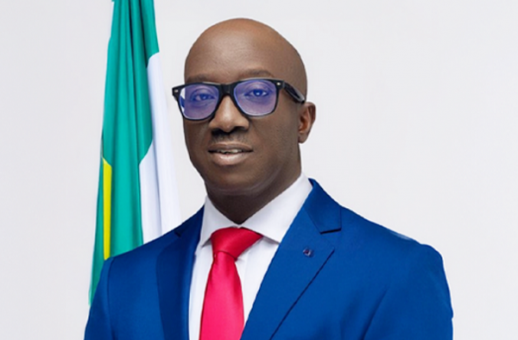
Edo State Governor, Monday Okpebholo, has assured the management of Ambrose Alli University (AAU), Ekpoma, of his administration’s commitment to addressing accumulated unpaid salaries, gratuities and other critical challenges inherited from past administrations.
In a statement, Chief Press Secretary to the governor, Dr. Patrick Ebojele, said the governor gave the assurance when he received the Vice-Chancellor of the university, Professor (Mrs.) Eunice Eboserehimen Omonzejie, and members of her management team on a courtesy visit to Government House, Benin City.
Okpebholo, who congratulated the Vice-Chancellor and her team on their appointments, noted that their presentation underscored the depth of challenges confronting the institution.
“From what you have outlined today, it is clear that Ambrose Alli University was on life support. I must commend the progress you have recorded so far since assuming the office,” the governor said.
READ ALSO:JUST IN: Okpehbolo Appoints New VC For AAU
“I am impressed by your efforts, and I want to assure you that in any way possible, this administration will support the university to reposition it and restore its lost glory.”
Addressing the issue of accumulated salary arrears, the governor described the non-payment of staff salaries over several years as unfair and unacceptable.
“It is not right for people to work and not be paid. The issue of unpaid salaries, pensions and gratuities running into billions of naira is something I will take as a project,” he said.
“These are issues inherited from the past government, and we will address them.”
Okpebholo also acknowledged other concerns raised by the university management, including hostel infrastructure, accreditation-related challenges and facilities required for programmes such as Medical Laboratory Science.
READ ALSO:JUST IN: Okpehbolo Recalls Suspended Edo Attorney General
“This year’s budget is already at an advanced stage, but I expect that these critical needs will be properly captured in your budget proposals. Once that is done, we will see how best to move the institution forward,” he added.
Earlier, the Vice-Chancellor, Professor Omonzejie, explained that the delay in paying a courtesy visit to the governor was due to a recently concluded accreditation exercise and the need to carry out a comprehensive assessment of the state of the university.
She noted that the university she inherited was in a moribund state, plagued by infrastructural decay, unpaid salaries and accreditation challenges, among others.
READ ALSO:Obaseki’s Media Aide Tackles Edo Information Commissioner Over Alleged ₦600bn Debt
Omonzejie expressed profound appreciation to Governor Okpebholo for what she described as “life-saving interventions” since his assumption of office.
According to her, the governor’s approval of an increased monthly subvention, restoration of affected staff to the payroll, support for graduating backlog medical students, improved security logistics, and the facilitation of road construction through the Niger Delta Development Commission have significantly revived the institution.
She also formally presented pressing needs requiring urgent attention, including accumulated unpaid salaries, pensions, gratuities and union deductions, as well as the construction of lecture theatres and hostels to enhance accreditation and expand student intake, particularly in the College of Medicine.

 News11 hours ago
I’m Not Distracted By Anti-Niger Delta Elements, Says PAP Boss, Otuaro
- Metro10 hours ago
Suspected Kidnappers Abduct 18 Passengers On Benin-Akure Road
- News19 hours ago
Edo Assembly Charges Contractor Handling Ekekhuan Road To Accelerate Work
- News9 hours ago
OPINION: Time For The Abachas To Rejoice
- News10 hours ago
Okpebholo Pledges To Clear Inherited Salary Arrears, Gratuities At AAU
- News10 hours ago
Ex-Nigerian Amb., Igali, To Deliver Keynote Address As IPF Holds Ijaw Media Conference
- Metro10 hours ago
NDLEA Seizes 457kg of Cannabis, Arrests Suspected Trafficker In Edo


