
News
OPINION: The Rotten Apples At Louis Edet House

By Festus Adedayo
Sometime in the early 2000s, at the cusp of Tafa Balogun’s glory as the Inspector General of Police, an oil magnate from a Southwest riverine area was arrested. He was travelling into the state capital from his riverine part of the country. It was at nocturne. The oil magnate, who moved like an Oba, was in a convoy of cars. Inside the car was a falange of private security persons. They were armed to the teeth with sophisticated weapons. It was obvious that this Oba-like man was into oil bunkering as well. At a checkpoint, the police stopped the convoy and subjected it to a needle-search scrutiny. Alarmed at the weaponry in transit at that unholy hour, the policemen promptly radioed the state headquarters which ordered that the oil magnate and his convoy be brought. From there, Abuja was contacted. Tafa Balogun then ordered that the oil magnate be flown to meet him at Louis Edet House. By the time the police finished wedging the fear of God into the magnate’s heart, he had turned into jelly. His face deadpan, the late IGP, who was notorious for his obsession for automobiles, made his demand. The latest BMW SUV was the atonement to set him free.
Left with no choice but to succumb to this extortionist gambit, the oil magnate promptly had the IGP’s choice car wheeled to Balogun’s secret Lagos automobile mart-looking car deposit center. Miffed by this extortion, my source told me the oil magnate immediately ordered same car for himself. Less than a year after, a state governor, who Balogun helped bury his rotten corpse, got a demand of two Mercedez Benz automobiles from the police top brass. His Secretary to the State Government got the order to take the newly purchased cars to the IGP’s vehicle assembly point. He later told his governor boss, “You would think you were in a car mart.”
I recommend to you a copy of Wale Adebanwi’s A Paradise for Maggots (2010) for details of how Tafa Balogun’s lustering police career ended in ignominy. Inside this epiphany, you will encounter how Balogun, not minding his elephant size, went on all fours to plead with rookie police officers to let him off the EFCC hook and how a low-rank police officer, Nuhu Ribadu, made a total mess of him. Balogun died almost unsung a few years after. You would imagine that successive IGPs would learn a huge lesson from Balogun’s fall and not wear such ignominious apparel in future Oro cult festivity. No, they haven’t. To underscore why man should outgrow the facts of his fall, Yoruba use the fire insect (Ìpìn) as illustration. Ìpìn singes the flesh and my people say no animal on earth should wear that same cloth it sheds (Kò s’éranko tó jé f’aso Ìpìn bo’ra.)
For almost an eternity, the rot in the Nigeria Police Force (NPF) has engaged Nigerians of diverse strata. Being the son of a policeman, I am a stakeholder and also a victim of the rotten system. Theories have been propounded to articulate the rot. Policing literature is replete with all sorts of explanations. The rotten-apple thesis seems to be the most dominant. Today, the police has this notorious acclaim of a hopelessly corrupt and abusive institution, an agent of violence that is manifestly evil. It is also said that the innumerable police roadblocks and checkpoints in Nigeria, rather than being crime clean-up centers, are more of enablers and instruments of corruption and barefaced human rights abuses. I once wrote about how, in the 1980s, at a police checkpoint in Ilesa, today’s Osun State, a police constable by the name Ifeanyi suggested to my late father that a vehicle owner, inside of whose car loads of cash were found, should be murdered. My father stylishly sidestepped Ifeanyi’s suggestion and got the man to leave urgently.
MORE FROM THE AUTHOR:[OPINION] ADC: Death, Onikoyi And A Hunter’s Pouch
The rotten-apple theory especially has been knocked severally as explanation for and antidote to the cancer-like metastasis of rot in the Nigerian police. Extortion through arbitrary detention and in some cases, arbitrary execution of detainees are rife in the Nigeria Police Force. Truth be said, police corruption in Nigeria today is so systemic and widespread that you could hardly get one percent of its workforce free from the huge viral load. In Nigeria, this even sounds true and also, alien. To control corruption and arbitrariness in the Nigerian police, we should look at the police as an organization and not the individual. In any case, finding a honest Nigerian policeman is akin to, in the words of Bongos Ikwue, searching for a virgin in a maternity ward.
Apart from the above theories, other factors have been adduced for the rot in the Nigerian police. First is the colonial legacy of Nigerian police. The second albatross of current decadent NPF and the rot within it is what is called the military legacy. The long years of military rule are seen as responsible for the marginalization and poor funding of the force. It is said to be responsible for the coercive psychology of the police, too.
Corruption seems to be the least of the vices in the Nigerian police. The vices range from brutality, coercion, to human rights abuses. It is the conclusion of most reports on the police in Nigeria that its impoverishment is a significant factor in the general climate of popular discontent in the police and is the parent of abuses and corruption in the force. The only means of survival for many of the policemen in Nigeria is extortion. It is a common way for its lower cadres to supplement their meagre incomes.
Some weeks ago, I was at the notorious and infamous Ibadan police station called Iyaganku. I was counsel to some persons accused of electricity theft. There, I confirmed that anyone judging the policemen we see outside by their outward manifestations is the proverbial man who accuses the knock-kneed of wobbly foot-dragging. The fault is actually from the foundation. The police station is the picture of the rot. At Iyaganku, I saw dirty, crumbling police residential houses which were probably built six decades ago. On ropes tied to balustrades were hung unpleasant-looking clothes. Broken glass panes were replaced with sooth-stained woods. Its roads, which apparently once bore tars, looked like bombed streets of Mogadishu. It was a terrible neighbourhood to behold. The whole place stank like the inside of Death’s hovel. When I moved closer to one of the residential houses, I couldn’t believe what I saw. Broken sewage and gutters had a tribe of maggots brimming out of them like traders in a night market. Police children ran over one another as they playfully encircled these ponds of rot, dead to the colony of germs and diseases lurking around.
MORE FROM THE AUTHOR:OPINION: Herdsmen And Crabs Swimming In Benue’s River Of Blood
Conversely, fat-stomached officers walked about Iyaganku police station. Their rotund, overfed bellies were apparently proceeds of illicit graft earnings. The officers looked like bloated bedbugs. They seemed to be scanning every entrant into the police station as a scientist scans an object just fallen from Mars. No one needed to tell you they were scanning for the next victim to drain their blood. Then compare them to junior officers dressed in multi-layered uniforms with shoes whose only resemblance to others’ is the black colour. Some had missing uniform buttons and torn breast pockets. It suddenly occurred to me: how can anyone expect a sane police from this tribe of frustrated persons who live in this place?
A recent interview which went viral, granted by ex-Lagos Commissioner of Police, Fatai Owoseni, eventually burst the bubble. So also did a viral video of a retired police officer, a Superintendent of Police, who after 35 years in service, was paid a pittance of N2m as retirement allowance.
“When I joined the Nigeria Police in 1984, my first posting in 1985 was Sagamu (Ogun State)” Owoseni began. According to him, in the station where he was posted, there were stationed there Land Rover vehicles and lorries belonging to the police. Any policeman being posted out would be conveyed by vehicles. There was a fuel dump, like a filling station and mechanic workshop belonging to the police. This was where all spare parts were kept. The DPO had a safe containing information money to give informants. Two pairs of uniforms and brand new shoes were given yearly to junior rank policemen while officers, though bought theirs, had them highly subsidized. They were imported from England. “It was such that soldiers befriended police officers and gave them money to purchase police shoes for them,” Owoseni said. “Policemen being posted out of their stations were given 28-days allowance money in lieu of notice. Hotels in the neighbourhood befriended DPOs so that they could let posted policemen lodge with them. There was money to feed inmates in the cells. It was the police with dignity that we met.”
Now, it is as if government is deliberately punishing the young policemen, Owoseni said. “It is from these paltry salaries that those policemen buy their own uniforms. If you gather ten policemen now, they will wear different uniforms and different standards. There is no standard again. As they are collecting their salaries, they are deducting money to buy fuel for police vehicles, if there are vehicles at all. There are no more rain-capes, nothing. How do you treat men like animals and expect those horrible behaviour associated with police to be absent? Today, if a policeman dies, his burden is left to his family. His police colleagues would gather money to bury him,” he lamented. Owoseni said a police DPO gets budgetary allocation of N30,000 for a quarter. As a retired Police Commissioner, Owoseni said his monthly retirement salary is N70,000. When you compare what Nigeria pays soldiers who also have the fortune of sitting atop the trillions of Naira budgeted for insurgency, you will weep for the Nigerian police.
MORE FROM THE AUTHOR:OPINION: Tinubu’s Chicago Certificate As Afó’kéèmù
It is no doubt that Kayode Egbetokun, the Inspector General of Police, is sitting on a house of rot. When you see the IGP, with his beautiful police uniform and shining shoes, know for a fact that under this facade is a tribe of maggots festooning him all over. After the retired Superintendent of Police in the viral video shook the country to its nadir with that shocking revelation, Egbetokun claimed he was not aware of the retirement payment fiasco. It was a lie from the pit of hell. He was. In fact, his volte-face revealed the underbelly of the force. It is said that the various billions of Naira voted for infrastructure upgrade of police stations and barracks get filched by an unholy trinity of federal legislators, police commission and police top brasses. Successive police IGPs have been content with corruptively enriching themselves from graft and extortion and retiring into wealth thereafter, rather than bothering about the rot inside of which the police institution is trapped. Unfortunately, any discussion of the issue of welfare by the police is considered as threat to national security.
As Yoruba say, it is how you present that is the measurement of reactions to you (Irinisi ni isonilojo). A people is appraised by the quality of their police. If the present government does not bypass the maggots-brimming police institution and carve a future, as well as a better image and look for Nigerian policemen, we should all be prepared to stand up to it. You may not queue on same political thoughts with Omoyele Sowore. You may even not like his brashness. However, Sowore’s call for protest on July 21 against Nigerian police deplorable state is protest for a good country. The El Dorado we all construct in our minds of a great Nigeria can never come to reality if we continue to be surrounded by a tribe of maggots. That is what the Nigeria Police Force is. The NPF collapse is a metaphor for Nigeria. This country cannot continue to sell sands as it does and not collect pebbles as payment.



News
Edo Targets 2.2 Million Children For Measles, Rubella Vaccination
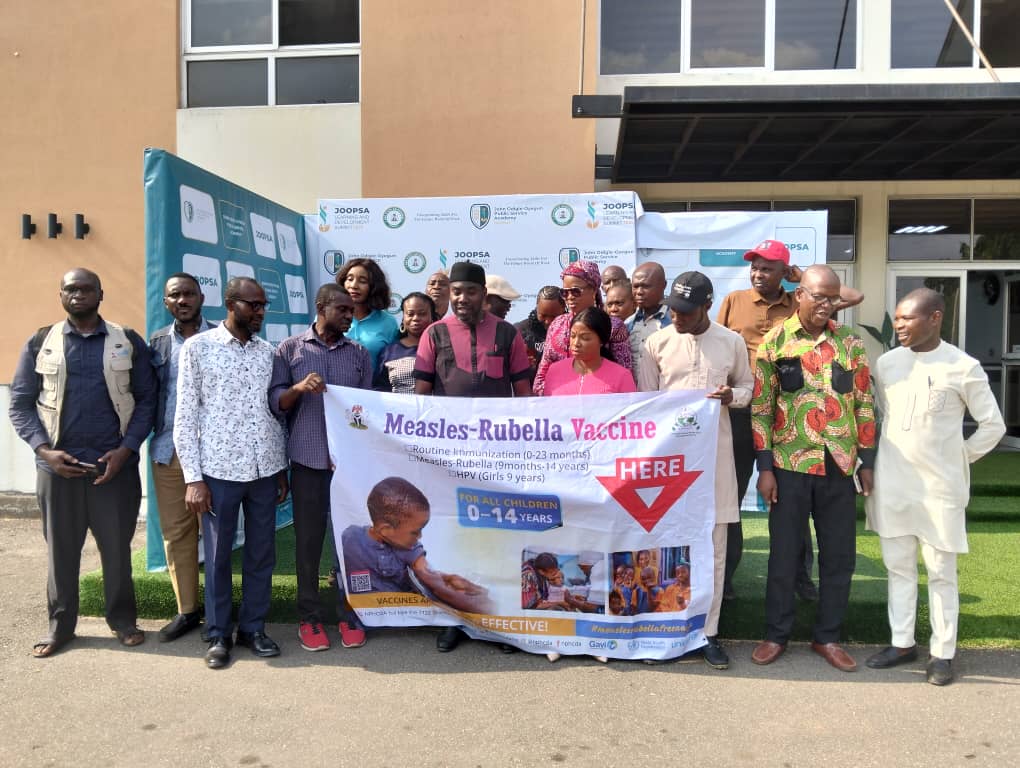
The Edo State Government says it is targeting about 2.2 million children aged between 0 and 14 years for measles and rubella vaccination across the state.
The Director of Disease Control and Immunization at the Edo State Primary Health Care Development Agency, Dr. Eseigbe Efeomon, who disclosed this during stakeholders’ sensitisation meeting in Benin City, said this would be done in collaboration with development partners.
Efeomon, while noting that the vaccination exercise scheduled to hold simultaneously from January 20 to January 30, 2026, across the 18 local government areas of Edo State at designated health facilities and temporary vaccination posts, said the campaign aims to contribute significantly to the reduction of measles and rubella in Nigeria.
He explained that achieving this target requires increased population immunity through sustained vaccination.
READ ALSO:Man Arrested In Edo For Alleged Abduction Of 4-year-old
Dr. Efeomon stressed that only qualified and certified health workers would be recruited as vaccinators because the vaccines are injectable.
According to him, the vaccination strategy would involve fixed posts and temporary fixed posts, and vaccination cards would be issued to all vaccinated children as proof, which parents and caregivers are advised to keep for future reference.
He added that vaccination teams would visit schools, churches, mosques, markets, motor parks, internally displaced persons’ camps and other public places, while children who receive the vaccine would be finger-marked to prevent double vaccination.
He reiterated that the overarching goal of the campaign is to drastically reduce rubella incidence nationwide and protect children from preventable diseases through effective immunisation coverage.
READ ALSO:Edo widow-lawyer Diabolically Blinded Over Contract Seeks Okpebholo’s Intervention
Also speaking, the World Health Organization Local Government Facilitator, Mr. Ajaero Paul, described measles and rubella as major causes of death and congenital abnormalities among children globally.
He said both diseases are preventable through the measles-rubella vaccine, which he described as safe and effective,
He added that sustained advocacy is critical to reducing child mortality and lifelong disabilities.
On his part, UNICEF Social and Behavioural Change Health Officer, Yakubu Suleiman, emphasised that the measles-rubella vaccine is safe and effective for all children aged nine months to 14 years.
READ ALSO:Edo: Suspected Kidnappers Kill Victim, Hold On To Elder Brother
He stated that the government has fully paid for the vaccines, making them available at no cost to all eligible children in government health facilities across the state.
Suleiman explained that vaccination not only protects individual children but also safeguards communities from deadly vaccine-preventable diseases such as measles and rubella.
He added that even children who had previously received the measles vaccine should still be given the measles-rubella vaccine and appealed to schools and other key stakeholders to support the campaign to ensure that no child is left behind.
News
Togo, Niger, Benin Owe Nigeria Over $17.8m For Supplied Electricity – NERC

Nigeria’s electricity regulator has disclosed that three neighbouring countries, Togo, Niger and Benin, are indebted to Nigeria to the tune of $17.8 million, equivalent to more than N25 billion at prevailing exchange rates, for power supplied under bilateral electricity agreements.
The Nigerian Electricity Regulatory Commission, NERC, made this known in its Third Quarter 2025 report, which reviewed market performance within the Nigerian Electricity Supply Industry, NESI.
According to the report, the international customers were billed a total of $18.69 million by the Market Operator for electricity supplied during the third quarter of 2025. However, only $7.125 million was paid, leaving an unpaid balance of $11.56 million for the period under review.
NERC also revealed that the same international offtakers had outstanding legacy debts amounting to $14.7 million from previous quarters. Of this amount, $7.84 million was settled, leaving a residual balance of $6.23 million.
READ ALSO:Expert Identify Foods That Increase Hypertension Medication’s Effectiveness
When combined with the Q3 2025 shortfall, the total outstanding debt stood at $17.8 million, which translates to about N25.36 billion at an exchange rate of N1,425 to one US dollar.
The regulator identified the international electricity customers as Compagnie Énergie Électrique du Togo, Société Béninoise d’Énergie Électrique of Benin Republic, and Société Nigérienne d’Électricité of Niger Republic.
NERC stated that the three utilities collectively paid just $7.125 million against the $18.69 million invoice issued for electricity supplied in the third quarter, resulting in a remittance performance of 38.09 per cent.
This meant that more than half of the billed amount remained unpaid at the close of the quarter.
READ ALSO:Electricity Workers Threatens Shutdown Over Staff Brutality
The commission explained that the electricity exported to the three countries was generated by grid-connected Nigerian generation companies and delivered through cross-border bilateral power supply arrangements.
By contrast, NERC reported a stronger payment performance among domestic bilateral customers. According to the report, local customers paid N3.19 billion out of the N3.64 billion invoiced for the same quarter, representing a remittance rate of 87.61 per cent.
The regulator further noted that some bilateral customers, both international and domestic, made additional payments to offset outstanding invoices from earlier quarters.
READ ALSO:Reps Ask NERC, DISCOs To Reverse Band A Tariff Hike
Specifically, the Market Operator received $7.84 million from international customers and N1.3 billion from domestic customers in settlement of previous obligations.
Beyond bilateral transactions, NERC disclosed that Nigeria’s 11 electricity distribution companies remitted a total of N381.29 billion to the Nigerian Bulk Electricity Trading Plc and the Market Operator in the third quarter of 2025. This was out of a cumulative invoice of N400.48 billion, translating to an overall remittance performance of 95.21 per cent.
The commission said the figures were derived from reconciled market settlement data submitted as of December 18, 2025, as part of its statutory evaluation of the commercial health and performance of the electricity market.
News
Expert Identify Foods That Increase Hypertension Medication’s Effectiveness

Hypertension remains one of the leading causes of premature death worldwide, contributing significantly to heart disease, stroke, and kidney failure. Despite the availability of effective antihypertensive drugs, long-term control of high blood pressure is often challenging because of drug resistance, side effects, and poor adherence.
This has fueled growing scientific interest in complementary strategies that can enhance drug efficacy while minimising toxicity. One promising approach is the combination of conventional antihypertensive medications with herbs and spices in many kitchens.
Recent evidence suggests that augmenting modern antihypertensive drugs with foods rich in p-coumaric acid, a naturally occurring phenolic acid, may offer a novel and effective strategy for blood pressure control.
Phenolic compounds, commonly found in fruits, vegetables, whole grains, and legumes, are known for their antioxidant, anti-inflammatory, and blood vessel–protective properties.
READ ALSO:Russia, China Afraid Of US Under My Administration — Trump
In a study, researchers investigated the combined effects of lisinopril, a widely used antihypertensive drugs and p-coumaric acid on hypertension.
They reported in the Comparative Clinical Pathology that p-coumaric acid enhance the antihypertensive action of lisinopril, potentially allowing for improved blood pressure control without increasing drug dosage.
The study used an established animal model in which hypertension was induced in rats through oral administration of L-NAME, a compound known to suppress nitric oxide production and raise blood pressure.
Following the induction of hypertension, the animals were treated for 14 days with p-coumaric acid (at two different doses), lisinopril alone, or a combination of both.
READ ALSO:Man Suffers Hypertension As Daughter, Grand-daughter Disappear For 10 Years
Untreated hypertensive rats showed significantly elevated activities of key enzymes linked to high blood pressure such as ACE, arginase, acetylcholinesterase, and phosphodiesterase-5 along with increased lipid peroxidation, an indicator of oxidative stress. At the same time, levels of nitric oxide, a critical molecule for blood vessel relaxation, were markedly reduced.
By contrast, rats treated with a combination of lisinopril and p-coumaric acid experienced notable improvements. Blood pressure was better controlled; harmful enzyme activities were reduced, oxidative stress declined, and nitric oxide levels increased. These improvements were mirrored in the tissues the heart compared with untreated hypertensive animals.
They said that the findings suggest that p-coumaric acid may enhance the antihypertensive action of lisinopril, potentially allowing for improved blood pressure control without increasing drug dosage.
This drug–food interaction model is particularly important in the circumstance of long-term hypertension management. Many patients rely on lifelong medication, and strategies that can improve treatment outcomes while reducing side effects are highly desirable.
READ ALSO:Delta Unveils Free Hypertension, Diabetes Screening
The study also reinforces the growing recognition that diet is not merely supportive but can be biologically active in disease control.
The use of medicinal plants and plant-based therapies in the management of hypertension is deeply rooted in traditional medicine across many cultures. While such practices have often existed outside conventional healthcare systems, modern scientific research is now providing evidence-based explanations for their effectiveness.
While these findings are based on animal studies and cannot yet be directly translated into clinical recommendations for humans, they open the door to future research on dietary strategies that can safely complement antihypertensive drugs.
READ ALSO:Why West African Troops Overturned Benin’s Coup But Watched Others Pass
Further clinical studies are needed to determine appropriate dosages, safety profiles, and real-world effectiveness.
In the fight against hypertension, the future may lie not only in new drugs, but also in smarter combinations, where medicine and nutrition work together to deliver better, safer outcomes for patients.
Such nutrition to help maintain healthy blood pressure includes garlic, potatoes, walnuts,tomato and tomato products, legumes and citrus fruits (grapefruits and oranges).
(TRIBUNE)

 News4 days ago
What I Saw After A Lady Undressed Herself — Pastor Adeboye
- Headline4 days ago
PROPHECY: Primate Ayodele Reveals Trump’s Plot Against Tinubu
- Metro4 days ago
Armed Robbers Shot PoS Operator To Death In Edo
- Business3 days ago
NNPCL Reduces Fuel Price Again
- Metro3 days ago
AAU Disowns Students Over Protest
- Metro4 days ago
Joint Task Force Kills 23 Bandits Fleeing Kano After Attacks
- Politics4 days ago
2027: Rivers APC Pledges To Follow Wike’s Instructions
- Metro3 days ago
Edo: Suspected Kidnappers Kill Victim, Hold On To Elder Brother
- Metro3 days ago
Nine Soldiers Feared Dead In Borno IED Explosion
- Entertainment4 days ago
Anthony Joshua Returns To UK In Private Jet


