

News
OPINION: Tinubu’s Lifejacket And A Deer’s Sacred Skin


By Festus Adedayo
What hunters see in the forest is enough to make children of men without balls blind. Ọláníyì Ọládèj̣ọ Yáwóọ̣ré had gone hunting one day and came face to face with a deer breastfeeding her young. Stupefied by this weird sight, an unusual dizziness pounced upon the hunter. But «an animal is pursuing me» is a disgraceful song that must never be sung by a man born to hunt. Yáwóọ̣ré quickly picked himself up and fought back with a dose of potent Ọfọ (incantation), one of the priceless assets he inherited from his father: “The ladybird beetle does not suffer from sight impairment…”
Hunter dipped his hand into his cloak and brought out a phial, the content of which he then used to wipe his face. Now he can see! Now that he could see, he had very little difficulty making sumptuous meat of the deer. At home, hunter skinned his game and hung its hide to dry in the open. This is where the story starts to be sweet like a soup of deer meat.
The second day, a mysterious woman visited Yáwóọ̣ré and a conversation ensued. The above was the product of an ethnographic study of hunters in a wild called Ìgbẹ Alágogo conducted by Ayo Adeduntan, a scholar at the University of Ibadan. Adeduntan’s research gave birth to the above narrative. The mysterious woman then told the hunter: “I know you killed a deer. But you did because we wanted you to. Now, why do you show off with its skin? Why did you spread it out, pegged to the ground outside? You sure want to show the whole world that it was you that killed the animal. Were you the one who actually killed the animal or we gave it to you? Don’t you know spreading out the hide in the open that way is exposing our clothing to the mundane world?” Yawoore got the message. He made amends.
At the APC Renewed Hope Agenda Summit held at the State House last Thursday, Tinubu was Yáwóọ̣ré, the ostentatious hunter. The sniper had just killed a sacred deer with his sharp-shooting skills. Like the hunter, it was time for Tinubu to gloat. Trust our president, he was at his best turf. Armed with his ancient Cockney, the president, who had just killed an elephantine game, said “nothing (is) wrong with a one party state.” He asked his people to «wipe them clean.» You would think that he was talking about a bowl of pounded yam accompanied by a plate of Ileya ram meat.
I looked at his face. The whole world was like a colony of ants before the president. APC, he boasted, was “one party ruling and carrying on with the aspirations of Nigerians,” in what actually came in an incoherent waffle. “You don’t expect people to remain in a sinking ship without a life jacket. I am happy with what we have accomplished and expecting more people to come; that’s the game.”
MORE FROM THE AUTHOR: OPINION: Oloyede’s Tears And Nigeria’s Horror Scenes
Yáwóọ̣ré then told the Old Woman, “Old one, it was Ògún (the god of iron) that killed it.” The mysterious woman would not have that claim and promptly interjected. “Not Ògún, we allowed you to kill it.” Sobered, the hunter accepted his guilt, soberly retorting that, “I did not know that it (the skin) is your cloth.” Yáwóọ̣ré then reported the encounter to Ọlaifa Adigun, the Olúòdẹ, head of hunters, proceeded home and removed the deer skin. His open advertisement of conquest against the unseen forces was going to be his nemesis. The hunter must have known that, to dare Witches by counting their nine-finger arm in their presence had repercussions. It was a declaration of war with women Yoruba call Ẹlẹyẹ.
Unlike Yáwóọ̣ré, on Thursday, Tinubu was not sober. He had similarly spread a sacred deer hide in the open to dry. He was even unconscionable. In what appeared an account of his 730 days in office as the Nigerian president, Tinubu gloated about what he called his government’s economic reforms. Echoing musician, Bongos Ikwue’s line in his evergreen track, ‘Searching for True Love,’ the president hid behind the ancient wisdom of “Nothing good comes easy” in life to justify the people’s suffering under his government. He maintained that, “sometimes, only hard decisions can make things easy in the future.” Leading an administration which, while campaigning for Nigerians’ votes in 2023, carried the heftiest baggage of anticipated elasticity of corruption, Tinubu’s testimony on Thursday of fighting corruption in 730 days was the imponderous, “You could see EFCC recover over seven hundred and fifty-something houses from one person”. He also claimed that life had become better and the future assured for the people of Nigeria. But, is it?
At that State House gathering, a picture was raised for all to see. It was that of Tinubu and his coterie of palace jesters, having written a national qualification examination, marking their own scripts and awarding themselves pass marks. Take the National Security Adviser (NSA) Nuhu Ribadu for example. Ribadu regaled Nigerians with statistics of a Nigerian security Eldorado under Tinubu. A few days earlier, Babagana Zulum, governor of Borno State, had punctured his deceptively inflated balloon. Persuaded that Ribadu’s fawning statistics of securing Nigeria was an embarrassing fallacy that cannot save his people, Zulum asked Borno to look heavenwards for salvation. He declared last Monday a fasting period to seek God’s intervention. This came on the heels of another revelation by the Chief Whip of the Senate, Mohammed Tahir Monguno who, last Wednesday, disclosed that 63 residents of two communities in Borno North were killed in a clash between Boko Haram insurgents and ISWAP insurgents. So, what was Ribadu blabbing about?
MORE FROM THE AUTHOR: OPINION: Aso Rock, Voodoo Statistics And My friend, Al Venter
Like one watching a surreal film, then slid Secretary to the Government of the Federation (SGF), George Akume, unto the stage. Borrowing from Godswill Akpabio who asked a female legislator if she thought the parliament was a nightclub, I was tempted to ask if everyone at the State House that Thursday was drunk. Akume’s words sounded bombastic, high sounding but lacking grounding in reality. “Mr President’s leadership reminds us of the legendary Lee Kuan Yew of Singapore — the man whose foresight, discipline, and tenacity transformed a small nation into a global model of prosperity and order. This is the quality of leadership Nigeria is privileged to have today,” Akume waffled shamelessly. I had to race for my book of history. Were there two Yews? Did Akume truly liken this same Tinubu to the father of modern Singapore or he was on a junket of figures of speech? The Yew of Singapore transformed his country from a struggling port city into about the most prosperous and efficient worldwide. His countrymen were not recorded to have died in droves during this period. I have heard of the words, ‘bootlicking,’ ‘sycophancy’ and ‘grovelling before power’ before now but I had never felt its coarse texture as this. Akume brought its feel and colour to me vividly.
Then entered Akpabio, a major cast at the State House circus. In the last two years as Nigeria’s Senate President, Godswill will seem to have triumphed more in wordplay and legislative buffoonery than lawmaking. Like one primed to play in an orchestra, Akpabio was at it again last Thursday. He lauded what he called “Tinubu’s political sagacity,” submitting that “Nigerians are grassroots people, they are very excited” basing this on “the fact that even the members of the national assembly and senators said they have never had it this good.” Why won’t they, legislators who now collect N1billion and N2billion for constituency projects? After this stellar buffoonery, Akpabio now mimicked the same uncritical legislative showmanship for which the Nigerian parliament has a notorious renown. He then “move(d), and let it be moved, that not only President Bola Ahmed Tinubu will be a sole candidate for the presidency in 2027, but he will also be a sole candidate for the whole Nigerian population.” That is a recipe for disaster.
Nigerians will know that Akpabio doesn’t disappoint. He didn’t last Thursday. He is a known serial groveler by the feet of power. In 2015 as Chairman of PDP Governors’ Forum and governor of Akwa-Ibom State, this same Akpabio, on July 15, 2024, announced his endorsement of Goodluck Jonathan and projected victory for him in 2015. He preceded his endorsement with same longish hogwash as this. Like they do at the bioscope, everything for Akpabio is in the superlatives, garnished with theatrics. Both collided at that State House event, as he said, “other political parties have been turned into shreds.. and (he saw) the umbrella of the PDP (with) over 100 holes” and “everything in the south-south has collapsed for you (Tinubu)… same thing that is happening in the nation.”
I am sure Mr. President enjoyed the circus. But I know he is too steeped in the waters of Nigerian politics not to know that the likes of Akume, Akpabio and Uzodinma were merely playing the politics of the stomach and recycling the usual Nigeria’s tree-falls-bird-flies politics.
MORE FROM THE AUTHOR: OPINION: Tinubu’s Àjàntálá Son
We are the only ones who can tell our president the naked truth. If the president can look out through the windows, he will see how Nigerians deride him. Not because of his tribe but because he has allowed himself to be captive of unrealistic statistics. Yes, apart from the Ibrahim Babangida military government, there doesn’t seem to be any other government that has midwifed policies as much as the present administration. The reality however is that those policies fall face flat on their faces, without corresponding positive effect on the people. Nigerians are hurting; they have been since May, 2023. Halfway through his first term, I stand to be corrected, Tinubu is the most hated Nigerian today.
Rather than the PDP being a faulty aircraft and passengers stranded with no life-jacket, Nigerians under Tinubu are the ones marooned in the cloudy sky of Tinubu administration’s malfunctioning leadership. They have no life-jacket. It is simply because they are not better of than they were almost two years ago. Electricity tariffs keep castrating the people. Cost of fuel is prohibitive. Nigerians are dying because they cannot afford drugs. Insecurity is sending hundreds of Nigerians to their deaths. Joblessness has become a pestilence while our young ones still find it a comparatively better succour to perish in the Mediterranean. In the last two years of being in office, the president, his family and political lackeys have quadrupled their wealth and comfort, at the expense of the Nigerian state. Like Yáwóọ̣ré, they now flauntingly spread the sacred deer’s skin in the glare of the public.
Forget Tinubu and his cohorts’ misleading doublespeak, the prospect of a de facto one-party state is possible. This is so especially when you realize that funny legislative characters like Akpabio are Tinubu’s consorts. While Akpabio won’t have any qualms about licking the president’s spittle and stamping APC as Nigeria’s constitutionally recognized sole party and Tinubu, sole candidate, in exchange for a life tenancy in the senate, Nigerians will make this impossible. A de jure one-party state is however possible. Its prospect is ripe in an APC where all Nigerian forces and absolute powers are fusing inside one party under Tinubu’s “sweep them clean” triumphalism. In a de jure one-party state, other parties would exist but the APC and the president will certainly be so lawlessly authoritarian that they would criminalize public smile.
Yes, as Tinubu said, “freedom of movement and association is not a criminally punishable, (sic).” However, with this gale of defection sweeping all and sundry inside his party’s pouch, it may be a recipe for tyranny of the majority. By either hook or crook, the president has killed the sacred deer. His audacity of choosing to spread the deer skin for all to see may eventually court the disaffection of the Old One, the Nigerian people. Like the urchin who cursed the Iroko tree and persistently looked backwards in fear of immediate repercussion, does the president think the Oluwere ghormid resident inside the bowel of the Iroko strikes with immediacy?




News
Shatta Wale Bailed Burna Boy From Ghana Prison After Arrest For Smoking Weed – Captan


Ghanian singer, Captan, has claimed that his former record label boss, Shatta Wale, once bailed Nigerian singer Burna Boy out of prison in Ghana after he was allegedly arrested for smoking weed.
Speaking in a recent podcast interview, Captan claimed that Shatta Wale sent him and others to free Burna Boy from police custody.
He also claimed that Shatta Wale and his group once accommodated Burna Boy when he was being hunted by some dangerous men.
READ ALSO: Wale Edun Opens Up After Sack
Captan said, “I once bailed Burna Boy out of prison in Ghana when he was arrested for smoking weed. Shatta Wale sent me and some guys to go and free him from police custody.
“There was a time we also accommodated him when some people were after his life. We helped him settle the case.”
He added that he and Burna Boy are no longer in good terms after the Nigerian artist’s fallout with his mentor, Shatta Wale.
He, however, said he and Shatta Wale are open to reconciling with Burna Boy if he asks for it.
Watch the video here
News
Children’s Day: Chaos At Ogbe Stadium As Dozens Faint


Chaos erupted on Wednesday during the Children’s Day celebration as dozens of students reportedly collapsed following a stampede triggered by the use of pepper spray.
The event,
organised by the Edo State Ministry of Education at the Samuel Ogbemudia Stadium was disrupted after some male students of Ihogbe College allegedly made uncompromising advances towards female students at the venue.
A parent who identified himself as Oboh Emmanuel said, “the behaviour of those uncultured students attracted the attention of bouncers stationed at the stadium as they rebuked the male students.”
Oboh said the affected students later regrouped and attacked the bouncers, leading to a confrontation within the crowded arena.
READ ALSO:Children’s Day: Edo Commits To Child Protection
It was gathered that in the ensuing confusion, the bouncers were reported to have deployed pepper spray in an area occupied by a large number of students.
Several students, particularly female students, reportedly fainted after inhaling the substance, while others sustained injuries after being stepped on during the ensuing melee.
The panic was said to have spread across the stadium as students, teachers and parents scampered for safety.
Many of the affected students were reportedly rushed to the Edo Specialist Hospital for medical attention.
READ ALSO: Egor LG Chair, Ogbemudia, Vice, Osawe Impeached
Reacting to the incident, Chief Press Secretary to Governor Monday Okpebholo, Dr Patrick Ebojele, said the security personnel that fired the tear gas had been detained.
He said all the students, except two, that were rushed to the hospital have been discharged.
Ebojele stated that doctors wanted to observe the students till tomorrow before allowing them to go home.
“The two students are not seriously injured. Doctors want to observe them overnight. Permanent Secretary, Ministry of Education is still at the hospital. The man who used pepper spray has been detained.
“The incident did not happen the way it is being exaggerated. All modalities were put in place to ensure the children enjoyed their day.”
News
Okpebholo Salutes Edo Muslims, Seeks Continued Support, Prayers

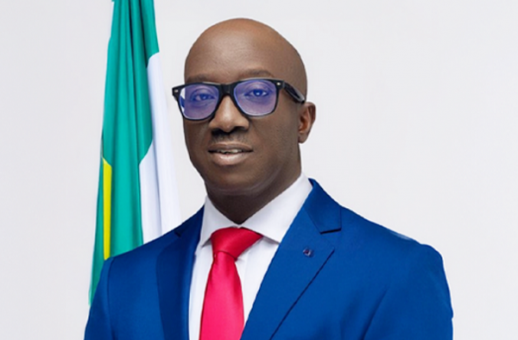
Governor Monday Okpebholo of Edo State has urged Muslims and all Nigerians to continue to pray for peace, unity and progress in the country even as they celebrate the annual Eid-al-Adha
The governor, who was represented by his deputy, Dennis Idahosa, stated this during the annual Eid-al-Adha celebration with Muslim faithfuls held at Government House in Benin City.
He reiterated his administration’s commitment to fairness, inclusivity and equal opportunities for all citizens irrespective of religion and tribe.
READ ALSO:ADC Penetrates Okpebholo’s District As Defections Strengthen Party in Edo Central
According to him, the present administration remains determined to building a government that reflects the diversity of Edo State, noting that competent and qualified Muslims have continued to play vital roles in his government because of their capacity, integrity and commitment to service.
“As a government, we remain committed to fairness, inclusivity and equal opportunity for every Edo citizen, irrespective of religion, ethnicity or political affiliation. This is why quality and competent Muslims are serving in key positions in our administration.”
Okpebholo appreciated the Muslim community in Edo State for their unwavering support and continuous prayers for his administration, noting that such prayers and support have contributed immensely to the peace and steady development being witnessed across the state.
READ ALSO:Okpebholo Felicitates Muslims On Eid-el-Fitr Celebration
He then called on all Nigerians to use the occasion of Eid-al-Adha to pray for the administration of President Bola Ahmed Tinubu, stressing that the country needs collective prayers, unity and cooperation to overcome its present economic and security challenges.
“I urge all Muslims and indeed all Nigerians to use this occasion to pray for our dear nation and for the administration of President Bola Ahmed Tinubu. Nigeria needs our collective prayers, unity and support as we strive to overcome our challenges and build a more prosperous future for all.”
In his remarks, the Chief Imam of Edo State, Abdulfatai Enabulele, applauded the governor for what he described as remarkable developmental strides recorded in less than two years in office.
The cleric commended the administration for ongoing infrastructural development and efforts geared towards improving governance in the state, but appealed to the government to revisit and complete some abandoned projects inherited from the previous administration for the benefit of the people.
-

 Metro5 days ago
My Husband Abandoned Me On Our Wedding Night To Attend Political Meeting, I Want Our Marriage Dissolved
-

 Headline4 days ago
Woman Passes Out After Receiving 100 Strokes Of Cane
-

 Politics5 days ago
Warri Ijaw Hail INEC Delineation Report, Call For Additional Electoral Wards, Others
-

 Headline4 days ago
JUST IN: White House Locked Down Briefly As Gunman Opens Fire At Security Checkpoint
-

 News3 days ago
More Pain For Nigerians As Cooking Gas Price Increases Nationwide
-

 Politics3 days ago
Two Masked Men Gun Down Politician In His Rivers State Hotel
-

 Metro4 days ago
Police Reject N500m Bribe, Recover N7.8bn Illicit Drugs In Lagos
-

 Metro5 days ago
My Wife Stop Cooking My Food, Beats Me Black And Blue All the Time, Man Tells Court
-

 News5 days ago
Alleged Terrorism: Court Rejects Defendant’s Bid To Travel Abroad
-

 Politics5 days ago
What I’ll Do As President Of Nigeria — Amaechi