
Politics
VIDEO: Akpabio, Oshiomhole Clash Amid 2027 Intrigues
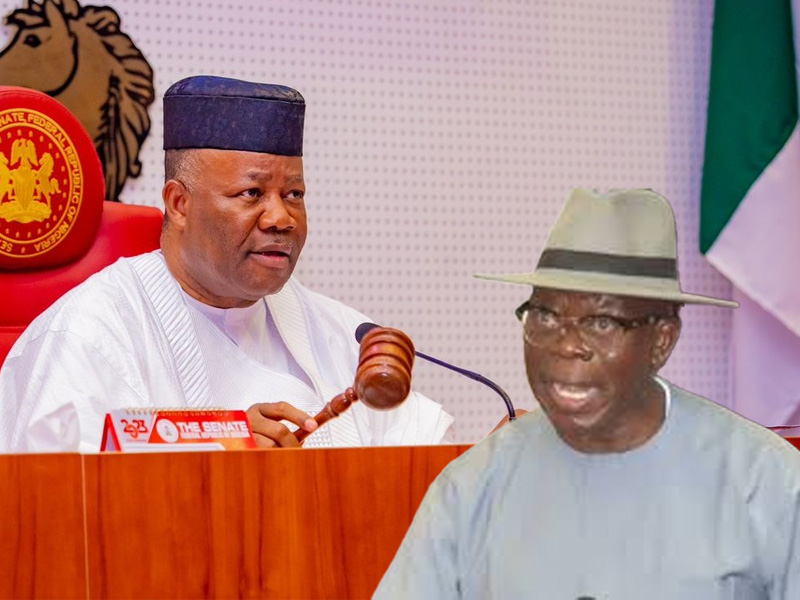
What began as a routine legislative procedure on Wednesday spiralled into a high-voltage confrontation in the Senate, as Senate President Godswill Akpabio and Senator Adams Oshiomhole engaged in a dramatic face-off that exposed simmering political tensions tied to the 2027 power game.
The immediate trigger was procedural: Oshiomhole attempted to raise a point of order just as Akpabio moved to confirm the Votes and Proceedings of the previous sitting.
But the refusal of the Senate President to recognise him—despite repeated shouts of “point of order!”—quickly transformed the moment into a charged standoff.
Oshiomhole appeared determined to be heard, repeatedly interrupting proceedings in a manner that unsettled the chamber.
Attempts by Chief Whip Mohammed Monguno to restore calm failed, as the Edo North senator pressed on.
In a stern and calculated response, Akpabio asserted his authority, invoking the Senate Standing Orders and reading out provisions that underline his sweeping powers to control debate, interpret rules, and discipline erring lawmakers.
READ ALSO:Xenophobic Attacks: Oshiomhole Tells FG To Retaliate Against South African Companies In Nigeria
“The rules and laws governing the Senate Chamber… are clearly defined,” he said, before reeling off his constitutional and procedural powers.
He did not stop there.
“Let me be clear… many people may not have seen this order,” Akpabio added pointedly, in remarks that drew murmurs across the chamber.
As the exchange intensified, he issued a direct warning: any senator who becomes unruly would be asked to leave.
“This is the final warning,” he declared but beneath the surface, the clash carried deeper political undertones.
Multiple sources within the National Assembly suggest Oshiomhole’s insistence on raising a point of order may not have been merely procedural.
The former Edo State Governor is widely believed to be nursing ambitions for the Senate Presidency in 2027 and Wednesday’s confrontation is being interpreted in some quarters as an early signal of discontent with the current power structure.
READ ALSO:SERAP Drags Akpabio, Tajudeen To Court Over Alleged Missing N18.6bn NASS Complex Project Funds
At the heart of the tension is a controversial amendment to Senate rules, which critics say has effectively narrowed the 2027 Senate Presidency race to a select circle of insiders—years before the first vote is cast.
For figures like Oshiomhole, the development is said to be deeply unsettling.
Insiders claim the amendments are part of a broader political calculation to shape the leadership of the next National Assembly.
According to multiple accounts, the move is allegedly backed by powerful interests within the ruling establishment seeking to ensure that the Senate leadership remains firmly aligned with the executive arm.
Critics argue that the strategy is designed to shut out independent or unpredictable contenders, preempt internal rebellion, and ultimately shield the executive from robust legislative scrutiny.
READ ALSO:Ex-Rivers Rep Drags Tinubu, Akpabio, Others To Court Over Fubara’s Suspension
Within this context, Wednesday’s drama is being viewed less as a spontaneous breakdown of order and more as a clash rooted in control, ambition, and the future leadership of the Senate.
To some observers, Akpabio’s firm handling of the situation was a necessary assertion of order.
To others, it signalled the use of institutional authority to silence dissent at a politically sensitive moment.
Either way, the explosive exchange has laid bare a Senate increasingly defined not just by lawmaking—but by high-stakes maneuvering ahead of 2027.
Watch the video here

Politics
Crisis Rocks NDC Over Obi-Kwankwaso Campaign Council
A fresh crisis appears to be brewing within the Nigeria Democratic Congress (NDC) following a sharp disagreement between the party’s National Chairman, Senator Cleopas Moses, and the OK Movement over the latter’s role and independence ahead of the 2027 general elections.
The OK Movement, in a statement signed by its National Secretary, Saadatu Sani, accused the NDC National Chairman of making statements it described as defamatory and reflective of a misunderstanding of the movement’s structure, independence and constitutional foundation.
The statement followed a recent publication attributed to Moses concerning the movement and the involvement of its National Director General, Hon. John Ughulu, in the Lagos State primaries.
The OK Movement had, on Thursday, unveiled a 59-member presidential campaign council ahead of the 2027 general elections. Cleopas, however, on Saturday, dissociated itself from the porported campaign council.
READ ALSO: 2027: NDC Demands Lagos CP’s Suspension Over Alleged Pro-Tinubu Action
The OK Movement urged the NDC chairman to familiarise himself with the party’s constitution before making assertions about the rights, responsibilities and independence of political movements associated with the party.
“Leadership is ultimately measured by knowledge, restraint, integrity and respect for established rules, not by insults, personal attacks or defamatory assertions,” the statement said.
The movement stressed that its support for the NDC and its candidates did not make it subject to the personal approval of any individual within the party.
According to the statement, the OK Movement recognises the supremacy of political parties within their constitutional and statutory sphere and intends to campaign for the NDC’s presidential and vice-presidential candidates, as well as other party candidates across the country in areas where it has resolved to support them.
READ ALSO: 2027: I Will Lead NDC To Defeat Federal Might – Seriake Dickson
However, it maintained that it remained an independent political organisation with its own leadership, organisational structure, ideology and internal processes.
“We will campaign for the presidential and vice presidential candidates of the party,” the statement said.
“We will campaign for candidates of the NDC Party across the country where the movement has resolved to support them. But we do not require the personal validation or approval of any individual before exercising our legitimate organisational functions,” it added.
READ ALSO: 2027: Court Denies Ordering Deregistration Of NDC
The movement further rejected suggestions that its activities were driven by the pursuit of political appointments or positions within the party.
It said the organisation was built from the grassroots and did not depend on the sponsorship of any individual or political office holder.
The OK Movement also claimed to have approximately 2.5 million registered members and coordinators in its internal database, describing itself as a long-term political movement rather than a temporary support group established for an election cycle.
The organisation said its objective was to mobilise Nigerians around demands for improved governance, economic opportunity, accountability and citizen-centred development.
Politics
Why I Lent Peter Obi My Vehicle During Benue Visit — Ortom
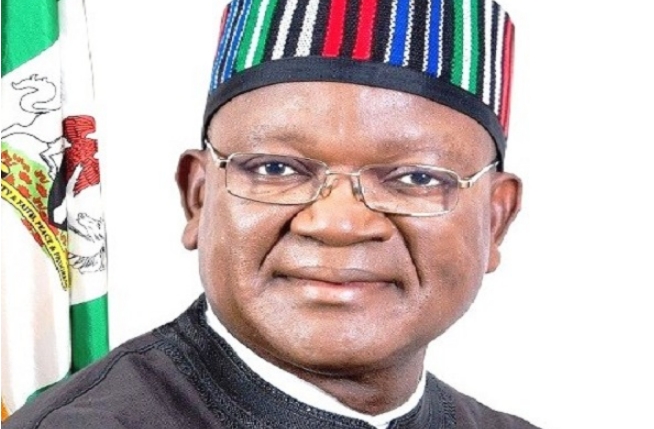
Former Benue Governor, Samuel Ortom, has explained why he lent his vehicle to the presidential candidate of the Nigeria Democratic Congress (NDC), Peter Obi, during the latter’s recent visit to the state.
Ortom, through his media aide, Terver Akase, said he decided to assist Obi with transportation as a matter of courtesy, stressing that refusing to help a former governor and presidential candidate would have been “petty” and unbecoming of a former governor.
Obi had visited Benue last Tuesday as part of plans to meet victims and families affected by the June 2025 massacre in Yelewata.
However, his planned movement from Makurdi to Yelewata was disrupted after youths reportedly blocked his convoy around Gyado Villa, a few kilometres from the airport.
READ ALSO: Peter Obi Reveals Strategy To Protect Votes During 2027 Election
Following the incident, Governor Hyacinth Alia’s Chief Press Secretary, Kula Tersoo, alleged that Ortom was involved in facilitating Obi’s visit.
Tersoo said a state government investigation traced the vehicle used to convey Obi from Makurdi Airport to Ortom.
He identified the vehicle as a Toyota Land Cruiser with registration number GWA 608 BT, claiming that Federal Road Safety Corps records showed it was registered in Ortom’s name and linked to his Judges Quarters address in Makurdi.
The governor’s aide also questioned why Ortom, who has declared support for President Bola Tinubu ahead of the 2027 presidential election, would provide his vehicle to Obi.
READ ALSO: Trump Suggests Renaming Strait Of Hormuz As ‘Trump Strait’
But Ortom dismissed the suggestion that lending his vehicle to Peter Obi amounted to political collaboration.
He said Obi, as a former governor and presidential candidate, deserved basic courtesy while visiting the state on what he described as a humanitarian mission.
“Peter Obi is a former governor, a presidential candidate and one of the most prominent political figures in the country,” he said.
READ ALSO: US Secret Service Reacts To Iran’s Alleged Threat To Trump’s Son Life
Ortom added that refusing to assist Obi would have been viewed as “petty, inhospitable and beneath the dignity of a former governor.”
He described attempts to politicise the gesture as “ridiculous and shameful”, accusing the Alia administration of creating controversy around what he called a “humane, courteous and statesmanlike gesture.”
Ortom also rejected claims that his action made him “double-faced”, noting that although he supported Obi in 2023, he had since publicly declared his support for Tinubu in the 2027 presidential election.
Politics
2027: Tinubu Edges Peter Obi By 1.55% In Oxford-Metro Poll
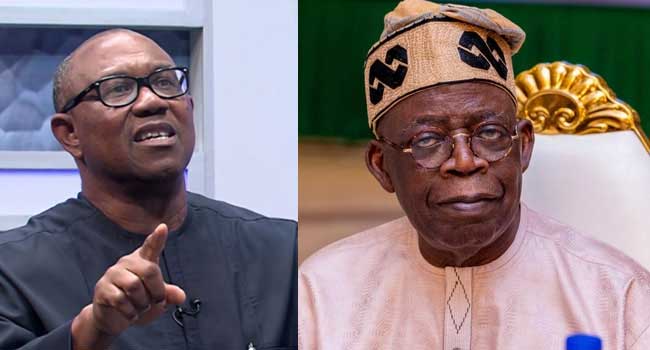
President Bola Tinubu has edged Peter Obi by 1,067 responses, representing 1.55% points in the Oxford-Metro Analytics’ National Trust Poll ahead of the 2027 presidential election.
The Oxford-Metro poll, which closed on September 7, recorded 69,110 approved and unflagged responses in its final analytical dataset.
Tinubu polled 24,469 responses, representing 35.41 per cent of the total, while Obi received 23,402 responses, accounting for 33.86 per cent.
The figures placed Tinubu 1.55 percentage points ahead of Obi.
Former Vice-President Atiku Abubakar came third with 18,430 responses, representing 26.67 per cent of the total participation.
READ ALSO: Peter Obi Reveals Strategy To Protect Votes During 2027 Election
The poll’s regional breakdown, however, showed a different picture from the outcome of the 2023 presidential election, with Tinubu recording leads in 20 states and the Federal Capital Territory.
Obi and Atiku, meanwhile, recorded the highest number of responses in eight states each.
Tinubu’s strongest gains were recorded in parts of Northern Nigeria, where he led in Kaduna, Katsina and Gombe, states won by Atiku in the 2023 presidential election.
He also led in Kano, where New Nigeria Peoples Party (NNPP) presidential candidate Rabiu Kwankwaso won the 2023 presidential election.
At the geopolitical zone level, Tinubu led in the South-West, North-West and North-Central, while Obi dominated the South-East and South-South. Atiku recorded his strongest showing in the North-East.
In the South-West, Tinubu polled 10,968 responses, representing 43.53 per cent of the zone’s total participation.
READ ALSO: VIDEO: 10 Things My Marriage Taught Me — Korra Obidi
He also led in the North-West with 4,129 responses, accounting for 43.10 per cent, while his 6,370 responses in the North-Central represented 36.97 per cent of the zone’s participation.
Obi recorded his strongest regional performance in the South-East, where he secured 5,796 responses, representing 63.97 per cent.
He also led in the South-South with 2,389 responses, accounting for 41.48 per cent of the region’s total.
Atiku dominated the North-East with 1,235 responses, representing 55.46 per cent of participation in the zone.
Despite Tinubu’s wider geographical spread, the national figures showed a close contest between the three leading candidates.
Some state-level results also recorded narrow margins. In Kogi, for instance, Tinubu received 39 responses, compared with 38 for Atiku and 33 for Obi, out of 110 responses recorded.
READ ALSO: 2027: Why Peter Obi, Atiku Can’t Form Coalition Against Tinubu – Umar Ardo
In the FCT, Tinubu polled 5,599 responses against Obi’s 5,278, giving him a margin of 321 responses, while Atiku received 3,954.
Tinubu also led Obi in Rivers, where he received 975 responses against Obi’s 892, while Atiku polled 568.
Beyond the three leading contenders, Omoyele Sowore received 1,016 responses, followed by Seyi Makinde with 519 and former President Goodluck Jonathan with 284.
Anita Zugwai-Chukwu received 18 responses, Sandy Onor six, and Prince Kennedy Ahanotu two.
A total of 638 participants selected “I Do Not Trust Any Candidate Yet”, while 204 were undecided and 122 selected “Other Candidate”.
The poll also showed significant geographical concentration in participation, with Lagos and the FCT accounting for 54.44 per cent of all responses.
The final dataset contained 56 diaspora responses, which were excluded from the six domestic geopolitical-zone tallies.

 News4 days ago
BREAKING: Tinubu Extends Working Vacation
- News5 days ago
2027: Step-by-step Guide To Applying For INEC Ad Hoc Staff Recruitment
- Headline4 days ago
How To Format An Academic CV For US Master’s, PhD Applications
- Headline5 days ago
Nigerian Man Jailed After Masturbating In Front Of Woman On UK Train
 News3 days ago
OPINION: The Stranger In APC’s Kitchen
- News4 days ago
Benue Govt Suspends Muslim Pilgrims Welfare Board Chairman, Secretary
- Entertainment4 days ago
Why Funke Akindele Was Not At My Movie Premiere – Kamo State
- Politics4 days ago
Crisis Rocks NDC Over Obi-Kwankwaso Campaign Council
- Sports4 days ago
5 Football Players Who Excelled In Multiple Positions
- Headline5 days ago
Mother Admits To Having Sex With Son ‘Only 100 Times’


