
Headline
We Don’t Know Exact Daily Fuel Consumption – FG
…Petrol still smuggled out of this country, marketers say
As a country, we still cannot tell the exact volume of Premium Motor Spirit, popularly called petrol, which we consume on a daily basis, the Federal Government has said.
It stated this just as oil marketers explained that Nigeria’s inability to give a definite figure on the amount of petrol it consumes daily was due to the continued smuggling of PMS out of the country.
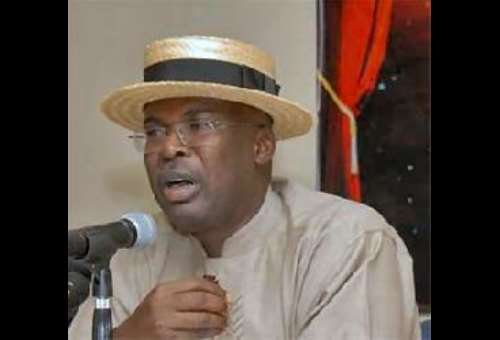
The Minister of State for Petroleum Resources, Chief Timipre Sylva, stated that the Nigerian National Petroleum Company Limited had also agreed that Nigeria could not tell the exact amount of petrol consumed across the country daily.
He disclosed this in an interview with his media team, led by his Senior Adviser, Media and Communications, Horatius Egua, which was made available to our correspondent in Abuja on Friday.
READ ALSO: How Police Foiled Attempt By Hoodlums To Hijack APC National Convention In Abuja
Asked to react to the N3tn fuel subsidy proposal by NNPC, amid concerns about the country’s PMS consumption figure, Sylva replied, “I would have preferred that this question be directed to the NNPC.
“I have made my views known about this issue in the past. NNPC has agreed with me that they are not certain about the exact consumption figure.”
He said the truth was that if the country’s petroleum products were smuggled outside the country, nobody could say what volume was involved today, tomorrow or next week, adding that NNPC could not say they know these figures.
“It’s more or less fueling a criminal economy. The NNPC imports the products, and nobody knows the exact destination of the products at the end of the day,” Sylva stated.
He added, “The imported products come to Nigeria, and from there filters out of our borders to neighbouring countries.
“So, as a country, we cannot tell the exact volume of petroleum products that we consume on a daily basis. All we have been doing is to assume the level of consumption over a period and work with that.”
He, however, expressed belief that the NNPC probably had a better answer to this, stressing that “personally, I dont.
“I have said this publicly before that I don’t know the figure. When I assumed office, initially I was told that our daily consumption was 66 million litres.
“Then, when fuel prices increased from N145 to N162, the consumption figure temporarily fell to about 40 something million litres per day, because the arbitrage opportunity reduced,” Sylva stated.
He added, “Then the value of the naira dropped again, and the number went up again to over 60 million litres. I am told the figure sometimes rise to as high as 90 or over 100 million litres. I don’t know how that happens.
“At this rate, I have said if anyone is looking at a criminal enterprise, look no further than the fuel subsidy.”
This, the minister said, was why he had continued to advocate the removal of fuel subsidy from the country’s PMS pricing template and deregulate.
He said the President, Major General Muhammadu Buhari (retd.), had done everything to resolve the issue, including the closure of the country’s borders with neighbouring countries, yet the criminality was not stopped.
READ ALSO: Petrol Import Jumps By 88% In 12 Months, Hits N3.97tn –Report
“The truth is that what the President could do was to close the ‘formal’ borders. What about the illegal routes?,” Sylva asked.
On what could be done, the minister said if the subsidy component was taken out through deregulation, smuggling of PMS to neighbouring nations would cease.
“Of course, we need the market from there. But now we are punishing ourselves because every litre we import at our expense will always find its way outside the country,” he stated.
He added, “Now, the government is trying to subsidise our citizens so that our people will at least get the benefit of the subsidy on petroleum products.
“But, now because of how our borders are, it is very difficult. Now, we are inadvertently subsidising the whole of Africa. This is the thing we cannot handle.”
Also speaking on the matter, the Executive Secretary of the Major Oil Marketers of Nigeria, Clement Isong, told our correspondent that the cheap fuel in the country had remained an incentive to smugglers.
He said, “The higher the price (of petrol) is outside the country and you see prices where they are in the country, the natural response is that normal people such as farmers, okada drivers, transporters, etc, will leave their jobs to go and sell petrol.
“This is because of the mark-up. This is why, particularly in Abuja, you see many people carrying jerrycans of fuel selling them on major roads. This also plays along our borders.
“For as long as the international price continues to rise and we keep our own prices where they are, what will happen is that those countries will suck the products out of Nigeria and you simply will not find the product in Nigeria.”
Isong added, “If you go to those countries, the marketers there will tell you that they are unable to sell because of the product coming from Nigeria is killing their market. This happens in all the countries around Nigeria.”
He stated that the normal supply chain volumes would continue to go down because the products were leaving Nigeria, describing those smuggling out PMS as ordinary everyday citizens.
“This is because they simply make more money buying from here at N162-N165/litre and going across the border to sell at N500/litre. It is more money for them and it is simply the law of economics, called arbitrage, which is a market distortion,” Isong stated.
He added, “And it is what the subsidy on petrol does on Nigeria, a market distortion. Something is worth N500 and you’re selling at N200. Now where you’re supposed to find it at N200 you will not see it because it has moved to where the actual value of N500 is.
“This can also contribute to the scarcity we see in parts of Nigeria. That is why NNPC if it is meant to normally supply 60 million litres per day, for it to keep queues out of filling stations, it will have to increase its supply to 90 to 100 million litres. That’s the problem.”
READ ALSO: Fuel Souvenir: Lagos Socialite Jailed Two Years
The MOMAN official said Nigeria must wean itself of fuel subsidy, “because we are killing both our present and future.
“We simply cannot afford it. We are borrowing money for it.”
PUNCH.



Headline
Indian Court Denies Bail To Nigerian Man Over Drug Charges
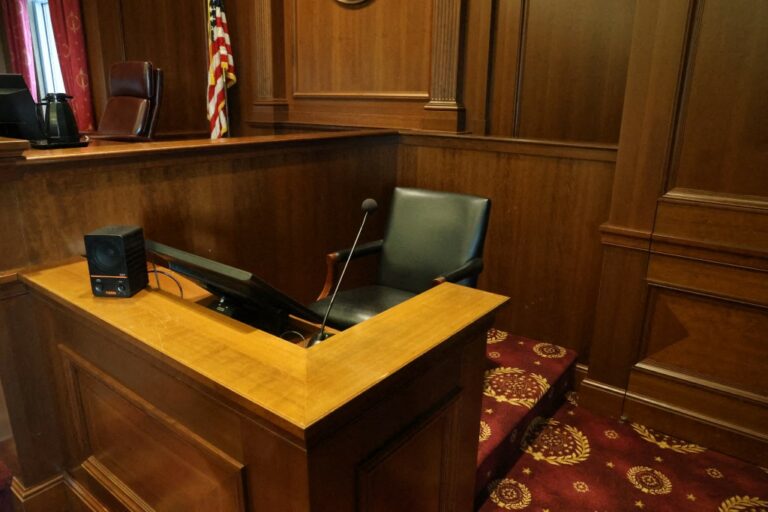
A court in India has denied bail to a 44-year-old Nigerian national, Cristian Soporuchukwu, who is currently facing drug trafficking charges in the country.
Cristian Soporuchukwu initially entered India on a business visa but was later arrested over allegations of involvement in the sale of hard drugs.
Reports indicated that after arriving in India, Soporuchukwu travelled through Goa, Delhi, and Mumbai, where he allegedly established links with suspected drug traffickers.
READ ALSO:Indian National Arraigned In Lagos Over Alleged N22m Supermarket Fraud
He was accused of purchasing MDMA crystals and distributing them to college students and information technology workers.
According to reports, operatives of the Beguru Police arrested Cristian Soporuchukwu in April 2025 for allegedly selling MDMA crystals around Begur Lake and the AECS Layout Road area.
The New Indian Express reported that the High Court of Karnataka subsequently dismissed the Nigerian’s bail application.
READ ALSO:NDLEA Intercepts Indian Lady With 72 Parcels Of Heroin ON n Chocolate Wraps
“The anti-narcotics wing seized about 1 kg of MDMA crystals, a pocket weighing machine, 10 zip-lock covers, a mobile phone and a scooter from him,” the report stated.
Justice V. Srishananda, while ruling on the bail application, reportedly held that errors relating to the grounds of arrest could not automatically justify bail in serious narcotics-related offences under the Narcotic Drugs and Psychotropic Substances, NDPS, Act.
The court further noted that Cristian Soporuchukwu had allegedly overstayed his visa in India, according to the report.
Headline
Strait Of Hormuz: US Announces Sanctions Against Iran
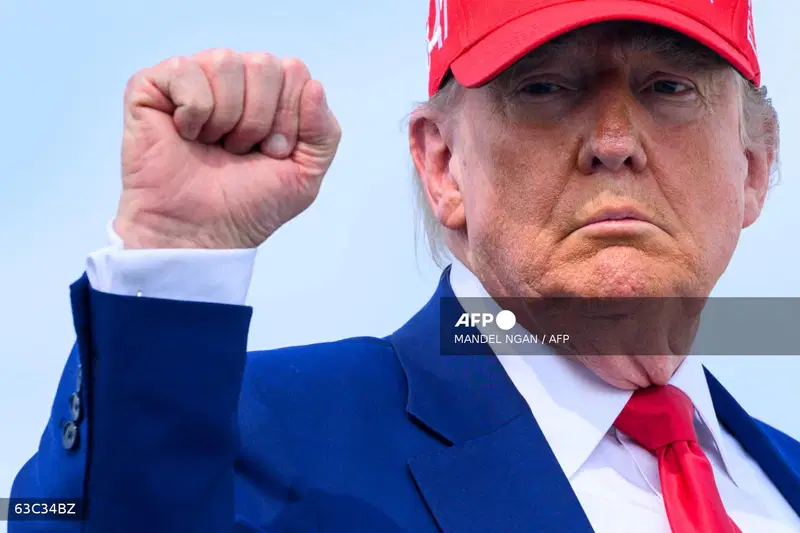
The United States Treasury has announced sanctions against Iran’s Persian Gulf Strait Authority.
Treasury Secretary, Scott Bessent, said this in a statement on Wednesday.
The statement extended the threat of sanctions to anyone paying the fees, saying they may be providing support to and receiving services from Iran’s Revolutionary Guards, and therefore may be exposed to sanctions risk.
READ ALSO:Strait Of Hormuz: Pakistan Thanks Trump For Pausing ‘Project Freedom’
“The Iranian military’s latest attempt to extort global maritime trade is proof that Economic Fury has left the regime desperate for cash.
“Treasury has deprived the Iranian regime of revenue for their weapons programs, terrorist proxies, and nuclear ambitions,” Bessent said.
Bessent added that the US has succeeded in disrupting tens of billions of dollars’ worth of revenue from being accessible to Tehran.
Headline
US Launches New Airstrikes On Iran
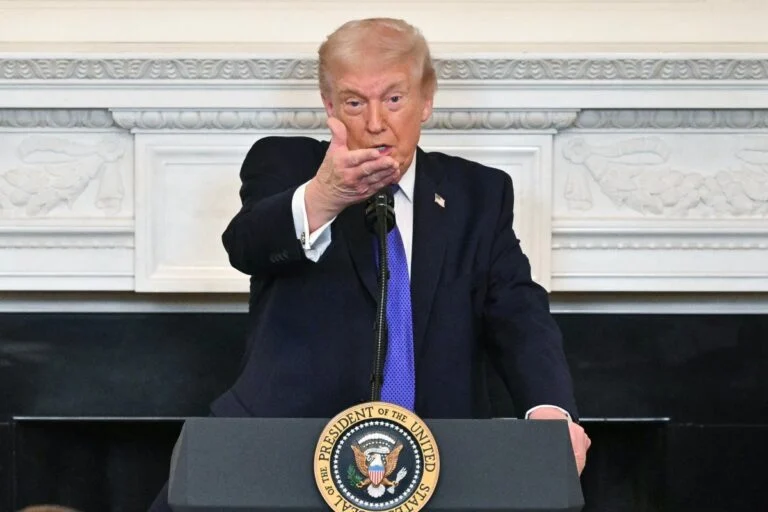
The United States has launched new airstrikes in southern Iran.
The strike shot down four one-way attack drones that posed a threat around the Strait of Hormuz and then a ground control site.
A US official revealed that American forces struck an Iranian ground control station in Bandar Abbas that was about to launch a fifth drone.
READ ALSO:US Restricts Entry Routes For Travellers From DRC, Uganda, South Sudan Over Ebola Outbreak
The official described the strikes as purely defensive, saying the US intended to maintain the ceasefire.
Report says this is the second time in three days that the US has carried out self-defense strikes against Iranian military targets in southern Iran.
Recall that on Monday the US carried out airstrikes against Iranian missile locations and boats that US Central Command said were preparing to launch mines in the Strait of Hormuz.

 Headline4 days ago
Woman Passes Out After Receiving 100 Strokes Of Cane
- Headline4 days ago
JUST IN: White House Locked Down Briefly As Gunman Opens Fire At Security Checkpoint
- News3 days ago
More Pain For Nigerians As Cooking Gas Price Increases Nationwide
- Politics3 days ago
Two Masked Men Gun Down Politician In His Rivers State Hotel
- Metro4 days ago
Police Reject N500m Bribe, Recover N7.8bn Illicit Drugs In Lagos
- News3 days ago
FG Declares Two Days Public Holiday For Eid-el Kabir Celebration
- Politics3 days ago
‘Tinubu’s Borrowing In 24 Months Surpasses 55 Years’ Debt Record’
- Politics2 days ago
Court Clears Goodluck Jonathan To Contest 2027 Presidential Election
- News3 days ago
OPINION: Boko Haram Comes South
 News2 days ago
OPINION: Like Oyedokun, We Are All Decapitated


