
News
Why Virtual Dollar Card Gets Declined Online

Trying to pay for a subscription, make an online purchase, or run ads on international websites can quickly turn into a headache when you keep seeing the message “Transaction Declined”. Many Nigerians rely on digital dollar cards provided by fintech platforms to pay for platforms like Netflix, Apple, Amazon, and Spotify. However, payment failures still happen regularly, leaving many users confused about what went wrong.
Most payment failures are not caused by broken cards, but by simple miscommunications between the merchant’s payment processor and the card provider.
In this article, Nigerian Tribune examined four main reasons your virtual dollar card gets declined and how you can fix each one:
Insufficient funds for temporary card verification
Many users fund their virtual card with the exact amount required for a purchase. For example, if a monthly subscription costs $10, a user might fund the card with exactly $10. This practice often leads to immediate payment failure.
When you attempt to make a payment on sites like Apple, Google, or Amazon, the platform sends a small test charge, usually between $1 and $2, to check if the card is active. This initial hold temporarily reduces your total balance.
When the platform attempts to charge the full subscription fee right after, the remaining funds become insufficient, causing the bank system to drop the transaction.
READ ALSO: CBN Announces $3.5bn Gold Reserves Despite Naira’s Freefall Against US Dollar
Furthermore, some fintech apps charge penalty fees for failed attempts due to insufficient funds, which can eventually lead to card suspension.
How to Fix: Always keep an extra buffer of $3 to $5 above your intended purchase amount in your virtual card balance. This extra cushion covers hidden verification holds and processing fees without failing your main transaction.
Mismatched billing address information
International checkout pages use an automated system called the Address Verification System (AVS) to verify that the person using the card is the actual owner. When details do not match, security systems flag the payment as a potential fraud attempt.
A common mistake among online shoppers is entering their home address in Lagos, Abuja, or Ibadan on checkout forms that require a United States billing address.
READ ALSO: FX Crisis: Dollar May Exchange For N4000 By End Of 2024 — Ozekhome Warns
Virtual card issuers usually assign a specific US billing address to each card. If the address, city, or ZIP code typed on the website differs from the details registered inside your card dashboard, the transaction will be declined automatically.
How to Fix: Open your fintech application, navigate to your card settings, and copy the exact billing address provided for your virtual card. Paste this address word-for-word into the checkout form instead of your Nigerian residential address.
Account region and location mismatches
Global platforms like Apple, Google Play, Spotify, and Steam restrict service offerings based on geographical regions. Mismatches between account settings and payment sources frequently trigger automatic rejections.
If your virtual dollar card is issued by a United States bank rail, but your Apple ID or Google Play Store account region is set to Nigeria, the platform detects a cross-border conflict. Security algorithms flag these location differences to prevent unauthorised account access or regional price abuse, resulting in instant payment declines.
How to Fix: Change your account store region in the app settings to match the origin country of your virtual card. Alternatively, select alternative global payment options, such as linking your dollar card through PayPal, to bridge regional account restrictions successfully.
READ ALSO: How Mexican Drug Cartels Have Outsourced Meth Labs To Nigeria
Merchant restrictions on prepaid or virtual card identification numbers
Not all online platforms accept prepaid digital cards. Certain merchant categories completely block payments coming from specific virtual card ranges.
Every payment card features a Bank Identification Number (BIN), which consists of the first six digits on the card face. Merchant platforms analyze these numbers to identify whether a card is a physical credit card, debit card, or prepaid virtual card.
Platforms offering recurring trials, high-value web hosting, or financial services often block prepaid card BIN ranges to prevent fraudulent account creation. When this occurs, the card will fail regardless of how much money is loaded on it.
How to Fix: If your card details and balance are correct but payment fails on a specific website, switch to a provider that uses high-tier bank rails. Creating a virtual card on a different platform gives you access to a fresh BIN range that international merchants accept.



News
FEC Approves N594.49bn For Eight Highway Projects
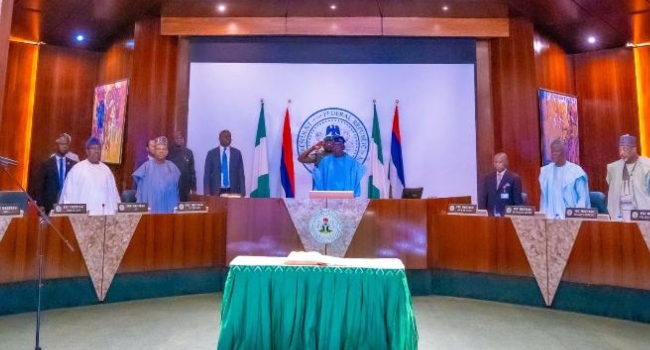
Eight federal highway projects with a combined estimated cost of over N594.49 billion were approved by the Federal Executive Council (FEC), chaired by President Bola Tinubu, on Wednesday.
The Minister of Works, Senator Dave Umahi, disclosed this to State House correspondents after the FEC meeting.
One of the projects is the 18-kilometre Amaseri Road, from Ishagu to Otakot on the Enugu Expressway, awarded at N20.257 billion.
The FEC also approved N11.33 billion for the third phase of the Umuahia-Bende-Afikpo Road in Abia State.
READ ALSO: FULL LIST: US Judge Blocks Trump Visa Ban Affecting Nigeria, 74 Other Countries
Umahi recalled that the project, which traverses Abia State, had previously been funded under the NNPC tax-credit scheme, but work stalled. He said it was subsequently rescoped, while the Abia State Government undertook to construct the remaining 43 kilometres.
The Works Minister said the FEC also approved the reconstruction of the 95-kilometre E2K-Okey-Ampa-Otopa Road in Kogi State at N160 billion.
“It also approved N209 billion for the 81.1-kilometre Ado-Ekiti-Ijan-Ilumoba-Ikole Road in Ekiti State, including a bridge. The contract was awarded to CBC.
“Other approvals include the 17-kilometre Sokoto-Illela Road, Route A1, at N28.218 billion, awarded to Kespeko Global Limited, and a 30-kilometre road linking Adamawa and Taraba states, with five bridges, at N62 billion, awarded to WeChina Nigeria Limited.”
READ ALSO: FEC Approves N610bn Road Projects, 600 Housing Units For Armed Forces
Other approvals included N89.2 billion for the 47-kilometre Bichi Ring Road, including a flyover, and N14.486 billion for the eight-kilometre Dikko-Maje link road connecting to the Suleja-Minna Road.
Umahi also disclosed that Nigeria would partner with four other West African countries to construct the 1,028-kilometre Lagos-Abidjan Highway, with funding expected from the African Development Bank (AfDB).
The minister said he would meet with his counterparts from Benin Republic, Togo, Ghana and Côte d’Ivoire on Friday to discuss financing arrangements for the regional highway.
Explaining the proposed funding arrangement, he said the AfDB would provide financing to participating countries to develop their respective sections of the transnational corridor.
READ ALSO: ‘My Husband Urinates, Defecates In His Clothes When He’s Drunk’
He, however, maintained that the proposed financing arrangement was subject to the outcome of the discussions and the bank’s arrangements.
Nigeria’s section, stretching from Tincan Island in Lagos to the Seme border with Benin Republic, covers 79 kilometres. The other sections comprise 89 kilometres in Togo, 576 kilometres in Ghana, 155 kilometres in Côte d’Ivoire and 128 kilometres in Benin Republic.
Umahi said the proposed highway was expected to strengthen cross-border connectivity, facilitate the movement of goods, and support trade and economic integration across West Africa.
News
Why We Need Fresh $21.7bn Loan — Finance Minister

Minister of Finance and Coordinating Minister of the Economy, Taiwo Oyedele, on Wednesday defended President Bola Tinubu’s request for the National Assembly’s approval of a $20.52bn and €1.045bn external borrowing plan, saying the funds would be invested in critical sectors of the economy.
President of the Senate, Godswill Akpabio, had read a letter from Tinubu on the floor of the Senate on Tuesday, seeking approval for the supplementary external borrowing plan to finance projects and programmes across critical sectors.
Amid criticism over the Federal Government’s failure to specify the projects the proposed borrowing would fund, Oyedele listed the priority areas during a briefing with State House correspondents shortly after the Federal Executive Council meeting chaired by Tinubu.
The minister described the proposed financing as an investment rather than a conventional loan, identifying transportation, defence and security, health, agriculture, energy and power, digital infrastructure, finance and micro, small and medium enterprises (MSMEs), social protection, the environment and education as the priority sectors.
He also listed the ongoing Lagos-Calabar Coastal Highway and Sokoto-Badagry Superhighway, as well as the Kano-Kaduna railway project, among the infrastructure projects expected to benefit from the proposed financing.
Oyedele said, “Altogether, if you convert the euro amount and add it to the dollar amount, it will come up to $21.7bn. And we’ve seen some people with commentary saying that we are borrowing X, Y, Z. I’m pleased and excited to inform you that actually, this does not qualify as borrowing.
READ ALSO: FG Reacts To World Bank Flagging $12.4bn Gap In Nigeria’s External Accounts
“This qualifies as investment, and I will explain that to you in the next few minutes.
“Now, so what is this all about? This is an amount or a plan. First and foremost, this is a plan. It doesn’t mean that we have borrowed. It doesn’t even mean that we will borrow all of it. So, it’s a plan. The average lifespan of the projects under this plan is five years, by the way.
“But this country needs to plan ahead. You can’t be doing everything based on spontaneity and randomness.
“Now, this amount, about $10.6bn out of it, is for investment in transportation infrastructure, from highways and superhighways to rail and other important infrastructure, including Sokoto-Badagry and Lagos-Calabar highways and the Kano-Kaduna rail project.
“The top 10 projects or classifications of where we are investing are, in order: transportation, defence and security, health, agriculture, energy and power, digital infrastructure, finance and MSMEs, social protection, the environment and education.”
The minister argued that the proposed financing would create assets and wealth for the country, saying the value generated would exceed the amount invested.
He said, “Every single naira of these is an investment, and the way this works is that if you borrow $20bn and it is used to create assets and wealth and benefits worth more than $20bn, what you’ve actually done is create a net asset. So, it means that the country is better off as a result of that investment.
READ ALSO: FG Begins Payment Of Additional Exit Benefits To Retiring Civil Servants
“You know, anybody and everybody today will agree that if Aliko Dangote was going to save money to build the refinery, it would not be built in his lifetime. So, he had to take the financing, the investment, to make it happen.
“$20bn is listed now in less than four years, and the value has more than doubled. This is exactly what we are doing for our country. So, this $21.7bn investment would more than double in a few years down the line, and the beneficiaries will certainly be the Nigerian people.”
Oyedele also disclosed that part of the proposed financing would support investments in the social sector, including health, education, agriculture, climate initiatives, energy and social protection.
He said the social sector component would be financed through concessional loans with an average interest rate of about two per cent.
“Now, the other point is that in this $21.7bn, this is very good to note. At least for me, it’s good news. The social sector within all these investments is being funded or planned to be funded by concessional loans with interest rates of just about two per cent on average.
“This is the world saying we want to invest in Nigeria. So, that will cut across investments in energy, social protection, agriculture, climate, education and health.
“And then there is strong development partner support, with about $7.9bn of that coming from multilateral and bilateral partners, led by the World Bank, with $5bn at concessional rates, averaging 2.1 per cent.
READ ALSO: FG Announces Closure Of First River Niger Bridge For One Week
“In addition to that, we have regional development finance institutions, export credit agencies and banks. And even for the commercial components of this borrowing, just wait for it. The average indicative rate is 7.8 per cent, which is even below the rates for our Eurobonds, which means you’re getting a deal as a country, even on the commercial investment.”
Oyedele further clarified that the proposed $21.7bn financing plan was not exclusively for the Federal Government, noting that some state governments had approached multilateral financial institutions for funding for projects in their respective states.
He said, “It’s important to note, the last point, that this amount is not for the Federal Government alone. The Federal Government has the responsibility and the constitutional duty to be the interface for all external borrowing.
“So, I’ll give you the data: $3.3bn of this amount is actually for states and the FCT projects, $1.5bn. So, states plus FCT, that is $4.8bn, is for subnational projects and some agencies and development finance institutions.”
The minister urged Nigerians to consider the economic benefits of borrowing when assessing the proposed financing plan, arguing that loans used to create value could strengthen the country’s economic position.
He said, “I took the pain to put this analysis together, and I have copies for you because this is one area where we have to be honest with ourselves as Nigerians. There are people who will tell you borrowing is bad, and you just need to ask them: in which country on this planet do you run the economy without borrowing?
“To the extent that you borrow one naira to create value of more than one naira, you should please borrow more. And to have a president who understands these issues and thinks big for our country, investing in transformative infrastructure, human development and the digital economy, I think we should all be very excited at what is ahead of us as a people and a nation.”
News
FG Approves N70,000 Monthly Transport Allowance For Workers
…agrees to begin minimum wage negotiations immediately
The Federal Government has agreed to commence minimum wage negotiations immediately and approved a N70,000 transport intervention for workers for six months, beginning from November 2026, following a conciliation meeting with the leadership of the Nigeria Labour Congress (NLC).
The agregreement came amid demands by organised labour for urgent government action on workers’ welfare, including a reduction in petrol pump prices, improved wages, tax relief and the resolution of outstanding allowances affecting public servants.
The resolutions were reached at a meeting convened by the Federal Ministry of Labour and Employment in Abuja on Tuesday, October 27, 2026, as a follow-up to an earlier conciliation meeting held on October 22 to address issues raised by the NLC over the deteriorating economic conditions facing Nigerian workers.
Under the agreement, the Minimum Wage Negotiation Committee is to be constituted and commence meetings immediately. However, the parties acknowledged that they had yet to agree on the effective date of implementation of a new minimum wage.
READ ALSO: FG Reacts To World Bank Flagging $12.4bn Gap In Nigeria’s External Accounts
The communiqué stated: “It was agreed that the Minimum Wage Negotiation Committee would be constituted and commence meeting immediately. It should, however, be noted that there is a disagreement on the effective date of implementation.”
The N70,000 transport intervention is among the measures agreed upon to cushion the effects of prevailing economic challenges on workers. The intervention is scheduled to run for six months from November 2026.
However, the payment terms, including confirmation that the N70,000 is payable monthly to each eligible worker, require further clarification to establish the precise scope of the intervention.
The parties also agreed on the payment of arrears of peculiar allowances, which the Federal Government had approved with effect from May 1, 2026. Payment of the outstanding amounts is to commence in November and be made in three equal monthly instalments.
READ ALSO: BREAKING: FG Confirms Ebola Disease Case In FCT, Activates Public Health Response
In another commitment to public-sector workers, the government agreed to redeem 19 months of outstanding allowances owed to health workers within three months, beginning from December 2026.
The resolutions also addressed the long-standing demand for an adjustment of the Consolidated Health Salary Structure (CONHESS), which affects health-sector workers under the Joint Health Sector Unions (JOHESU).
On the issue, the National Salaries, Incomes and Wages Commission (NSIWC) undertook to complete an updated assessment of the cost implications of the proposed CONHESS adjustment within three weeks.
The assessment is expected to enable the Presidential Committee on Salaries to consider and take a decision on the adjustment.
READ ALSO: Nigerian Students To Get Free Daily Data From October 1 — FG
For agricultural workers seeking hazard allowances, the meeting was informed that the Federal Ministry of Agriculture and Food Security had submitted the list of beneficiaries and the associated cost implications to NSIWC for verification.
The verification is expected to be completed within two weeks, after which the commission is to issue an implementation template.
The demand for tax relief for workers, however, remains unresolved. The meeting agreed that the matter should be referred to the National Executive Council (NEC), noting that taxation is a statutory matter.
The conciliation followed concerns expressed by the NLC leadership over the Federal Government’s handling of the issues raised by organised labour.
READ ALSO: FG Releases New Operational Guidelines For WAEC, NECO Students’ Assessment Records
In response, the Federal Government reaffirmed its respect for the right of the Congress to advocate improved working conditions for Nigerian workers, stating that it was making efforts to address the issues through structured interventions.
The parties urged state and local governments to participate in the intervention process, while unions were encouraged to sustain efforts towards securing the implementation of the resolutions.
They further agreed to reconvene after one month to assess the level of implementation of the commitments.
The reconciliation agreement was signed on behalf of the Federal Government by the Director-General of the Budget Office, Tanimu Yakubu; the Permanent Secretary, Service Welfare Office, Office of the Head of the Civil Service of the Federation, Dr. Garba Abdul S.U.; and the Minister of Labour and Employment, Dr. Muhammad Maigari Dingyadi, CON.
On the labour side, the signatories were the NLC President, Comrade Joe Ajaero, and the National Secretary of the Joint National Public Service Negotiating Council (JNPSNC), Comrade Olowoye Gbenga.

 News5 days ago
FULL LIST: 24 States That Have Approved State Police
- News3 days ago
High Chief Ben Bowei: Celebrating A Fearless Voice Of Ijaw Nation On Birth Anniversary
- Headline5 days ago
Iran Puts Trump Behind Bars In Provocative New Art Installation
- Headline5 days ago
Why US Ordered Embassy Staff, Families To Leave Saudi Arabia
- Metro5 days ago
My Best Friend Is Having An Affair With My Wife — Man
- News5 days ago
5 Ways To Prevent Home Accidents
- Metro3 days ago
Mother, Child Crushed To Death As Container Trucks Overturn In Lagos
- News5 days ago
Nigeria May Record 31,400 Heat-related Deaths By February 2027 — Report
- Headline5 days ago
Meta Hit With $25bn Fine For ‘Lying’ To Facebook Users About Privacy
- News4 days ago
NSE Charges Newly Inducted Engineers On National Development, Professional Ethics


