

Business
2024 Budget: What Average Nigerian Wants?




By Richard Asoge
In line with one of his statutory obligations, President Bola Ahmed Tinubu on Wednesday, 30th November 2023, laid before the joint session of National Assembly the budget for year 2024, indicating his intention to spend N27.5 trillion, given priorities to defence & security, education and infrastructure. From the receipt side, N18.3 trillion is expected from oil, non-oil, tax and other revenue creating a deficit gap of N9.18 trillion which is to be financed by new borrowing and drawdown on multilateral and bilateral loans.
For a very long time, the gap between recurrent expenditure and capital expenditure was always far apart. Sometimes, allocation to the recurrent expenditure will double that of capital. This accounts for a serious and accumulated deficit of basic infrastructures over the years. So, having more in the side of capital expenditure will bring a relative relief if the budget is faithfully implemented without given excuse for non-performance.
FROM THE AUTHOR: Subsidy Removal: A Measure To Re-Jig The Economy [OPINION]
Reflecting on 2023 budget of 24.8 trillion (including supplementary), only 13.7trillion (55.2%) had been spent so far as at September ending, leaving only 3 months for the implementation to be over. The performance was not all that cheering. Various sources of borrowing had been implored and becoming uncertain to get more loans. This is unconnected to the attention given to taxes in 2024 budget as a prominent source of revenue. Agreed that tax is a good source of revenue anchored on production. Tax itself is derived from production. Given so much attention on tax rather than production first may not give desire result at long run. The desire of every serious economy is to keep inflation rate at single digit, unemployment at barest minimum, embarking on policies that would positively influence macroeconomic variables. Most of the advance economies of the world which we copy have robust production system which makes it easy for them to generate much revenue via taxation. Out there, sizeable number of people were engaged in one activity or the other that adds values to the GDP.
Current inflation rate of 27.3% is more of cost push than demand pull. Cost of operation to the businesses and surviving manufacturing firms had gone up exponentially, which made the outputs extremely expensive for a common man to afford. Cost of transportation of items or persons from one point to the other, cost of energy, cost of credit and others drive the inflation. Plans to moderate inflation rate to 21.4% as planned in 2024 budget is attainable, and even surpass it if structural factors that brought about the challenges are holistically tackled. Given domestic refineries and modular refineries the necessary support for production without further delay to meet local demand substantially will bring succor to the citizens and as well beneficial to the nation’s economy. Even if the price of petroleum motor spirit is not all that reduced significantly as being expected by some, whatever reduction will have, will be beneficial and as well add value to us as a nation. Employment generation along the chain of production and the bye products will be an advantage.
Waiting till the third quarter of the year before evaluating the performance of the budget to see if it is tilting toward desire result seems not the best approach but time to time check to deal with any challenge in early stage.
FROM THE AUTHOR: OPINION: The Alarming Naira Depreciation And Way Forward
Allocation of 8% (N2.18 trillion) to education may not up to the recommendation of UNESCO, but there is significant improvement compared to what obtained in the time past. N50 billion student loan is a good move to assist indigent ones but government should not see it as an opportunity to take its hands off subvention or reduce subvention to various institutions of learning. Otherwise, schools will load various charges under school fees to keep their heads above the sea level thereby defeating the principal purpose behind the establishment of such loan.
If data released by NBS is anything to go by, GDP was observed to move up to 2.54% (year on year) in real terms in the third quarter of 2023 from 2.25% in 2022. The growth was driven by service sector. Contribution from agriculture and industry sectors is less which is why agricultural outputs are becoming scarce in the market. Of course, any item short of supply to the demand, price will dictate who get such item. Making agriculture at the forefront of economic drivers toward achieving the 3.75% economic growth in 2024 will not only put an end to hunger but ensures food security. Security of lives and properties propels economic growth. When people can sleep with both eyes closed, economic growth is assured. So, allocation of N3.25trillion to defence and security, making it the sector that got most in the budget seems justified considering the period we are as a nation. However, all those that are concerned in the defence and security of the country must all strive to ensure total security on the land, on the sea and on the air.
An average man on the street is no longer interested in mathematics of budget or various statistics been churned out. He is after a bag of rice coming down to N30,000 from the current suicidal price of N60,000. An average housewife wants N5,000 in her purse to be enough for a pot of soup for a family of four for at least two days. Everyone is not just interested in the price of basic items to come down but stability in prices. In the past six months or thereabout, nothing harms the economy like price instability. Prices of goods and services were ticking upward every minute as if it were clock causing naira to lose its worth.
Richard Asoge
Clappahouse Analytics
chards001@gmail.com
08081492614




Business
Naira Appreciates Against Dollar At Official FX Market

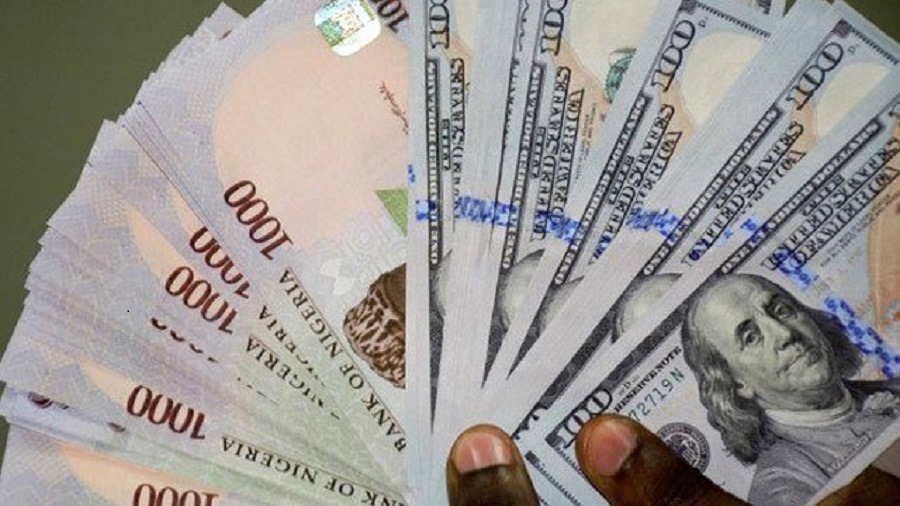
…Black market (Buying and selling rates): N1,385— N1,390
The Nigerian naira appreciated against the United States (US) dollar, trading at N1,331.2027 at the Central Bank of Nigeria (CBN) official foreign exchange (FX) window on Friday, September 18, 2026.
The data shared on the CBN’s official platform shows that the naira traded at the Nigerian Foreign Exchange Market (NFEM) rate of N1,331.2027 per dollar and closed at N1,329.9900 per dollar.
The currency, which traded at an NFEM rate of N1,331.2812 on September 17, 2026, appreciated by at least N0.08 after trading activities on Friday.
READ ALSO: Naira To Dollar Exchange Rate At Official FX Market
At the parallel market, both the buying and selling rate decreased by N5, when compared to the previous trading rate on Thursday, September 17, 2026.
According to Aboki FX , the Naira-to-dollar exchange rate at the black market on Friday, September 18, 2026, was N1,385 and N1,390 per dollar for buying and selling rates, respectively.
Business
Again, Naira Depreciates Against Dollar At Official FX Market
…Black market (Buying and selling rates): N1,380— N1,385
The Nigerian naira depreciated against the United States (US) dollar, trading at N1,329.8568 at the Central Bank of Nigeria (CBN) official foreign exchange (FX) window on Wednesday, September 16, 2026.
The data shared on the CBN’s official platform shows that the naira traded at the Nigerian Foreign Exchange Market (NFEM) rate of N1,329.8568 per dollar and closed at N1,329.5600 per dollar.
The currency, which traded at an NFEM rate of N1,329.1485 on September 15, 2026, depreciated by at least N0.71 after trading activities on Wednesday.
READ ALSO: Naira To Dollar Exchange Rate At Official FX Market
At the parallel market, both the buying and selling rate remained the same, when compared to the previous trading rate on Tuesday, September 15, 2026.
According to Aboki FX , the Naira-to-dollar exchange rate at the black market on Wednesday, September 16, 2026, was N1,380 and N1,385 per dollar for buying and selling rates, respectively.
Business
How To Buy Dangote Refinery Shares As IPO Opens September 14


Investors seeking to own a stake in the Dangote Petroleum Refinery and Petrochemicals FZE will be able to subscribe to its initial public offering (IPO) from September 14, 2026.
The ₦2.15 trillion offer by Dangote, valued at about $1.6 billion, involves 4.1 billion ordinary shares priced at an indicative ₦525 per share.
The offer, which is expected to become Nigeria’s largest-ever public share sale, will remain open until October 13, 2026.
The development gives Nigerians and other eligible investors an opportunity to acquire shares in the refinery as the Dangote Group moves to broaden ownership of the business.
At the signing of the IPO documents in Lagos on September 7, President of Dangote Group, Aliko Dangote, said the offer was designed to enable ordinary Nigerians to become shareholders in the refinery.
“What we are trying to achieve is to make sure our drivers, cooks, servants, and everybody have the opportunity of having stakes in the refinery,” Dangote said.
READ ALSO: BREAKING: Dangote Refinery Reduces Petrol, Diesel Prices
How to subscribe
According to the Managing Director, Investment Banking, Chapel Hill Denham, Mr Lanre Buluro, prospective investors can subscribe digitally using a bank account, Bank Verification Number (BVN) and a mobile phone or laptop.
He said an investor can complete the process within two to three minutes, with the minimum subscription set at 10 shares.
At ₦525 per share, the minimum subscription of 10 shares will cost ₦5,250.
Buluro said investors could access the offer through platforms including Moniepoint, MTN MoMo, Airtel, Payaza, Piggyvest, Paga, Bamboo and Chapel Hill Denham’s Invest Naija platform.
Do I need a CSCS account?
Buluro said prospective investors do not necessarily need an existing Central Securities Clearing System (CSCS) identity number before subscribing.
READ ALSO: Dangote Refinery Reduces Petrol Gantry Price
According to him, a CSCS account can be created for a new investor during the subscription process after the investor’s BVN and bank account details have been verified.
He explained that stockbrokers are behind the participating platforms and would contact subscribers after the transaction to provide their CSCS and Clearing House Number (CHN).
The allotted shares will subsequently be domiciled in the investor’s CSCS account.
What happens after subscription?
Investors can subscribe throughout the offer period, which runs from September 14 to October 13.
At the close of the offer, the advisers and the Securities and Exchange Commission (SEC) will assess the total subscriptions and determine the final allotment.
This means investors may not necessarily receive all the shares they apply for if the offer is oversubscribed.
READ ALSO: Dangote Unveils 10-day Credit Facility For Petrol Station Owners
Buluro disclosed that the offer has a provision to accommodate additional subscriptions in the event of oversubscription.
He said up to about 30 per cent additional shares could be issued under the oversubscription provision, potentially increasing the number of shares available from 4.1 billion to about 5.3 billion.
Before you invest
Buluro advised prospective investors, particularly first-time investors, to read the IPO prospectus carefully and seek guidance from a qualified financial adviser before committing their funds.
Investors should also understand that subscribing to an IPO does not guarantee a profit. The value of shares can rise or fall after allotment, depending on the company’s performance and market conditions.
The Dangote Refinery IPO is expected to significantly deepen public participation in the Nigerian capital market by allowing more individuals to take direct equity positions in one of the country’s largest industrial projects.
(TRIBUNE)
-

 News4 days ago
BREAKING: Tinubu Extends Working Vacation
-

 Headline4 days ago
How To Format An Academic CV For US Master’s, PhD Applications
-

 News4 days ago
Benue Govt Suspends Muslim Pilgrims Welfare Board Chairman, Secretary
-

 News3 days ago
OPINION: The Stranger In APC’s Kitchen
-

 Entertainment4 days ago
Why Funke Akindele Was Not At My Movie Premiere – Kamo State
-

 Politics4 days ago
Crisis Rocks NDC Over Obi-Kwankwaso Campaign Council
-

 Sports4 days ago
5 Football Players Who Excelled In Multiple Positions
-

 News5 days ago
[OPINION] Wike-APC: Fights Always End Adultery
-

 News4 days ago
FULL LIST: Names Of 37 Illegal Miners Who Died In NSCDC Custody
-

 Headline4 days ago
Italy PM Meloni Announces Plan To Ban Niqabs, Burqas In Schools