

Headline
Economic Reforms: Nigerians Under Poverty Line Rise To 104m — World Bank



A World Bank report has indicated that Nigeria’s poverty level has taken a notch higher, at the backdrop of the recent economic and fiscal reforms.
The key reforms include the removal of petrol subsidy and the foreign exchange market rate restructuring.
The bank, however, commended the Federal Government for what it considered ‘bold reforms’ necessary to rescue Nigeria from fiscal cliff, describing the current pains as temporary.
But it also said the policies have created intense pressures on cost of living, which have pushed more Nigerians into hardship, with 104 million now living below the poverty line.
The World Bank report also indicated that the number of poor people in Nigeria had grown from 95 million in 2021 to 100 million in 2022, while the Nigerian Bureau of Statistics, NBS, indicated that the figure was 82.9 million in 2019 and 85.2 million in 2020.
In its World Bank Nigeria Development Update, NDP, entitled ‘Turning the Corner: Time to Move From Reforms to Results’, the bank stresses the need to continue with the reform momentum to complete the reforms and to address the costs of the reforms.
It further stated: ‘‘Inflation remains at record high levels for Nigeria, 27.3 per cent Year-on-Year, YoY, in October 2023, partly driven by the one-off price impacts of the removal of the gasoline subsidy.
READ ALSO: We Have Enough Cash In Circulation, Says CBN
‘‘The impact of this is especially hard on poor and vulnerable citizens. The FX market has remained volatile and in a period of continuing adjustment to the new policy approach, with significant fluctuations in the exchange rate in both the official and the parallel markets. Revenue gains from the FX reform are visible.
‘‘However, there is a need for more clarity on oil revenues, especially the financial gains of Nigeria National Petroleum Corporation Limited, NNPCL, from the subsidy removal, the subsidy arrears that are still being deducted, and the impact of this on Federation revenues.”
In his appraisal of the country’s reforms, Shubham Chaudhuri, World Bank Country Director for Nigeria, stated: “The petrol subsidy and FX management reforms are critical steps in the right direction towards improving Nigeria’s economic outlook. Now is the time to truly turn the corner by ensuring coordinated fiscal and monetary policy actions in the short to medium term.
“Continued reform implementation can ensure that Nigeria benefits from the difficult adjustments underway. This includes ensuring that improved oil revenues following the sharply increased PMS price accrue to the Federation.
‘‘In the medium-term, the economy will then begin to benefit from increasing fiscal space for development spending, including on power and transport infrastructure, as well as on human capital.”
He further said that between N300 billion –N400 billion was expended on fuel subsidy monthly, before the subsidy removal and that the expectation was that the NNPCL should have been paying such amount to the Federation Account, but which has not been the case.
World Bank’s recommendations
The latest NDU report recommended specific actions required to further sustain and achieve the full benefits of reforms already embarked on by the Government.
READ ALSO: Rivers Lawmakers That Defected Have Lost Their Seats – Lawyer
These include: controlling inflation and improving the stability of the FX market; achieving fiscal consolidation by sustaining savings from the PMS subsidy reform and improving non-oil revenues; addressing structural barriers to growth, such as removing trade barriers.
It stated further: “With the continued implementation of macroeconomic stabilization reforms, Nigeria’s economy is expected to grow at an average annual rate of 3.5 per cent in 2023-2026, or 0.5 per centage points higher than in a scenario where the reforms had not been implemented.”
Alex Sienaert, World Bank Lead Economist for Nigeria and co-author of the Report, also stated: ‘‘In 2024, Nigeria has an opportunity to turn the corner to a more stable and predictable macroeconomic environment, and easier access to foreign exchange (FX) and imported inputs, which is critical to creating new jobs and lifting people out of poverty”.
The NDU report indicated that Nigeria was not yet out of the woods but on the path to full recovery, as a result of the various policies being implemented by both fiscal and monetary authorities.
The World Bank called on the Nigerian National Petroleum Company Limited (NNPCL) to make public its Statement of Accounts and transparently disclose its revenue inflows.
The report read in part, “The removal of the subsidy was announced on May 29 and pump prices were adjusted on June1.
“This results in expected fiscal savings of around N2 trillion in 2023 or 0.9 per cent of GDP.
“Between 2023 and 2025, the expected gains are over N11 trillion, against a scenario in which the subsidy had continued’’.
READ ALSO: JUST IN: FG Exempts Universities, Polytechnics, Others From IPPIS
NNPCL’s account for scrutiny —Edun
The Minister of Finance and Coordinating Minister for the Economy, Mr. Wale Edun, also insisted that NNPCL’s account must be audited.
His words, “There will be earnest scrutiny and I am sure NNPC is getting ready for that. We want revenue to come into the government coffers from NNPC and all other revenue agencies.”
The last two Minister of Finance, namely, Mrs. Kemi Adeosun and Mrs. Zainab Ahmed had publicly said that the accounts of the NNPCL would be looked into, but there has been no report of such audit made public.
Mr. Edun also revealed that the federal government would come up with a new structure of salaries in 2024.
He did not give details, other than that it was statutory to review salaries every five years, according to the Salaries and Wages Commission Act and that all stakeholders including labour leadership would be involved.
Huge FX in Domiciliary Accounts
The Minister of Finance revealed that wealthy Nigerians were holding huge sums of dollars and other foreign currencies in their Domiciliary bank accounts in the country.
According to him, there was a lot of FX liquidity in Nigeria and the Federal Government would take steps to make holders of such accounts release the money.
Mr. Edun said that the government would not force holders of such accounts to give them up but would provide incentives to enable them invest in attractive instruments, going forward.
READ ALSO: FG Plans Mortgage Scheme For Nigerians In US, Canada, UK
I‘m not against quasi-fiscal interventions but —Cardoso
The Governor of the Central bank of Nigeria, Mr. Olayemi Cardoso, who was a panelist at the NDU presentation said that he was not against quasi fiscal interventions by the CBN but that his focus would remain how to reduce inflation through price stability.
On the controversy around his failure to convene a Monetary Policy Meeting since coming into office, the governor said that the past frequent MPCs did not achieve their objectives and that he would not continue along that line.
His words, “To what extent did the meetings achieve their objectives? The answer is no. That is why we have chosen to do it differently. Holding these meetings take a lot of time and energy.”
According to him, his team holds Liquidity Management meetings every 8.00 am to review the liquidity situation in the system and that he would take every necessary action to mop up excess liquidity in the system, adding, “we have increase OMO (Open Market Operations) both in value and volume.”
Industry Minister counters W/Bank on power subsidy
In her contribution, the Minister of Industry, Doris Uzoka-Anite, disagreed with the position of the World bank on Power subsidy.
The bank had advocated a power regime without subsidy in order to boost investor confidence and ensure a cost- reflective tariff.
However, the minister insisted, “there is nothing wrong with power sector subsidy. Subsidy in the power sector is subsidy that supports production. Countries everywhere support production and export.”
VANGUARD




Headline
Oil Prices Drop After Iran Reopens Strait Of Hormuz

Global oil prices dropped sharply on Friday after Iran signalled that the Strait of Hormuz would remain open to commercial shipping during a temporary ceasefire in the Middle East.
Benchmark crude prices fell by more than 10 per cent, with West Texas Intermediate (WTI) slipping below $85 per barrel, while Brent crude declined to about $89 per barrel.
The decline follows comments by Iran’s Foreign Minister, Abbas Araghchi, who said commercial vessels would be allowed to transit the strait for the duration of a 10-day ceasefire involving Israel and Lebanon.
The truce, which began on Thursday, is reported to include the Iran-backed group Hezbollah.
READ ALSO:Crude Oil Prices Jump As Fear Mounts On Fresh Domestic Petrol Hike In Nigeria
Oil prices had surged above $100 per barrel in recent weeks amid heightened tensions in the region, with WTI reaching nearly $113 per barrel earlier this month and Brent climbing above $119 in late March.
Analysts say the reopening of the key shipping route has eased supply concerns in global energy markets.
Brian Therien, a senior investment strategist at Edward Jones, noted that oil futures are now trending lower, with projections suggesting prices could fall to the low $70 range by the end of the year. He added that a sustained drop in prices could help reduce inflationary pressures globally.
The Strait of Hormuz, which links the Persian Gulf to the Arabian Sea, is one of the world’s most critical oil transit routes, accounting for roughly one-fifth of global oil and liquefied natural gas shipments.
READ ALSO:JUST IN: Trump Orders US Naval Blockade Of Strait Of Hormuz
Shipping through the passage had been disrupted during the conflict due to security concerns, including threats of attacks and the presence of naval mines.
An Iranian official told Reuters that vessels moving through the strait during the ceasefire would be required to use designated safe lanes approved by Iranian authorities, while military ships would not be permitted to pass.
Despite the announcement, some shipping firms remain cautious. German carrier Hapag-Lloyd said it is still reviewing the situation before resuming operations in the area.
Meanwhile, Knut Arild Hareide of the Norwegian Shipowners’ Association welcomed the development but warned that uncertainties remain, particularly regarding maritime safety, operational guidelines, and the potential risks posed by unexploded sea mines.
Headline
You Can’t Go To US With Good Feelings Since Trump Returned To Power – Sports Legend


Germany legend, Oliver Kahn, has insisted that one cannot go to the United States with ‘good feelings’ since President Donald Trump returned to the Presidency.
Kahn stated this while speaking to Sky Sport Germany about the upcoming World Cup, which is to be held in the US, Mexico and Canada.
According to the former Bayern Munich goalkeeper, there are so many things happening in the US at the moment that are no longer compatible with ‘values’.
READ ALSO:Trump Tired Of War In Iran – Shehu Sani
“There are simply so many things happening in the USA right now that are no longer compatible with our understanding of values,” Kahn said.
“One example was the war, but I don’t want to list everything Donald Trump has been doing there since he returned to the presidency.
“You can’t go there with a good feeling at the moment.”
Headline
Trump Bows To Pressure, Deletes Post Depicting Self As Jesus

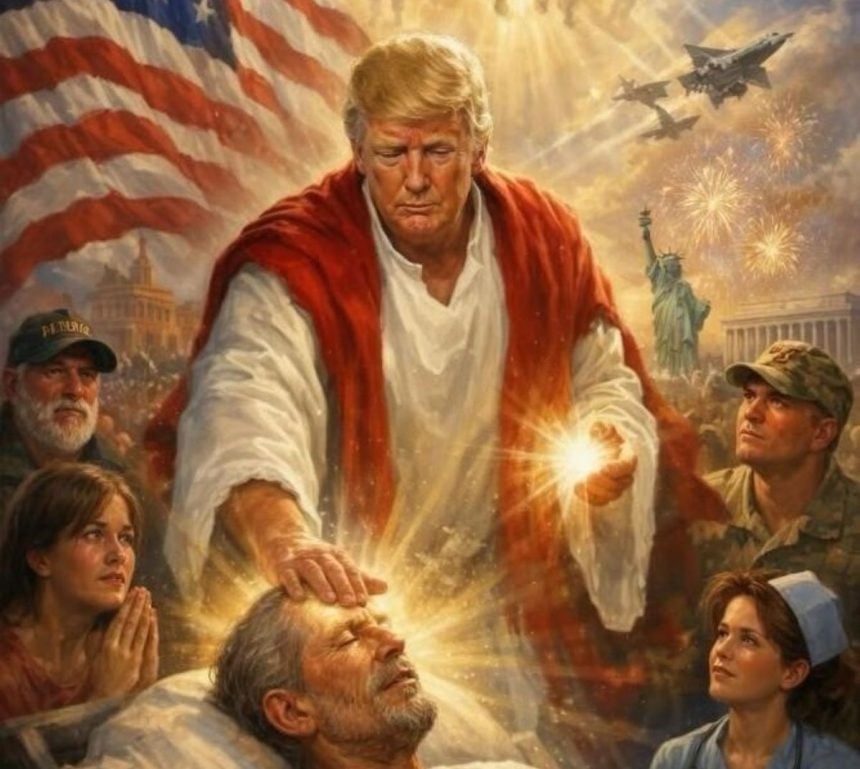
United States President, Donald Trump, has deleted a social media post that appeared to portray him as Jesus, following backlash and rising tensions with Pope Leo XIV over the Iran war.
The image, shared on Truth Social late Sunday, showed Trump as a Christ-like figure healing the sick, surrounded by American flags and eagles.
The post came shortly after the president criticised the pope for opposing the war with Iran.
By Monday morning, the image had been removed from his account. A previous link to the post now leads to a notice stating the “content is no longer available.”
READ ALSO:JUST IN: Trump Orders US Naval Blockade Of Strait Of Hormuz
Speaking later at the White House, Trump denied the interpretation of the image and said he believed it depicted him differently.
“I did post it, and I thought it was me as a doctor, and had to do with the Red Cross,” he told reporters at the White House.
He dismissed claims that the image portrayed him as Jesus, blaming the media for the narrative.
“Only the fake news” could come up with the idea that it depicted him as Jesus.
READ ALSO:I Have To Be Involved In Choosing Iran’s Next Leader – Trump
“I just heard about it, and I said, ‘How did they come up with that?’ It’s supposed to be me as a doctor making people better. And I do make people better,” he said.
The development comes amid an ongoing public disagreement between Trump and Pope Leo XIV over the Iran war.
The pope said Monday he has “no fear of the Trump administration” and would continue to speak out, despite criticism from the president, who described his stance as “terrible for foreign policy.”
Leo, the first American pope, has intensified his criticism of the war in recent days, condemning Trump’s remarks about the Iranian people as “truly unacceptable.”
(CNN)
-

 News5 days ago
BREAKING: JAMB To Release First Batch Of 2026 UTME Results Midnight
-

 News4 days ago
World Bank Flags ‘Hidden Spending System’ Diverting Over N34.53tn Of Nigeria’s Revenue
-

 News5 days ago
Popular Nigerian Broadcast Journalist Is Dead
-

 News5 days ago
FG Bans Unauthorized Use Of Ambassador Title
-

 News4 days ago
VIDEO: I Took Over Leadership From Myself; The Late Buhari Is Me — Tinubu
-

 Metro5 days ago
Police Inspector Arrested For Armed Robbery Dies From Bullet Wounds
-
News3 days ago
FG Slams Import Ban On 17 Items In New Fiscal Policy
-

 Politics5 days ago
2027: Why Tinubu Should Be Scared – ADC
-

 News4 days ago
Guard Your Admission Carefully – Registrar Urges Newly Matriculated Students
-

 Headline5 days ago
Oil Prices Drop After Iran Reopens Strait Of Hormuz
