
Business
Fuel Subsidy Removal Cripples 90% Of Nigerian Businesses – Report
The fuel subsidy removal policy of President Bola Tinubu’s government, which took off in June 2023, negatively affected 90 per cent of businesses in Nigeria.
This is according to a recent report by Fate Foundation, titled “State of Entrepreneurship,” which surveyed over 10,000 businesses across the 36 states of the country and the FCT.
According to the report, smaller businesses were affected more than big businesses, and the policy resulted in high operating costs and lower profits due to weak demand and the loss of customers.
READ ALSO: Why I Gave Davido My Song ‘Blow My Mind’ – Wurld
The report further stated: “Entrepreneurs in the South East were the most affected, while those in the South South were the least affected, relative to other regions. The impact of the policy was even for both male and female entrepreneurs.”
The report also revealed that around 89 per cent of businesses in the country were negatively affected by the naira scarcity experienced in the first quarter of 2023, with the agricultural sector being the most affected.
It further explained that the impact of the naira scarcity on farmers led to the contraction of the agricultural sector’s output by 0.9 per cent in the GDP report for Q1. The decline was the first in over three decades.
READ ALSO: VIDEO: I Was Paid N5m, I Must Perform At Celestial Church, Portable Insists
Regarding Nigerian entrepreneurs’ outlook towards business opportunities, around 86 per cent reported being optimistic about the future. However, the figure is less than the 93 per cent who affirmed their positive outlook in 2022.
According to the report, service sector businesses accounted for the country’s major share of businesses.
“While 35 per cent of businesses offer services, 22 per cent sell goods, and another 42 per cent trade in both goods and services. At the sectoral level, 18.8 per cent of total businesses operate in the wholesale and retail trade sector,” the report stated.



Business
JUST IN: CBN Removes Cash Deposit Limits, Raises Weekly Withdrawal To N500,000
The Central Bank of Nigeria (CBN) has removed cash deposit limits and also increased the weekly cash withdrawal limit from N100,000 to N500,000.
The CBN made this known in a circular to all banks and other financial institutions, signed by Dr Rita Sike, Director, Financial Policy and Regulation Department.
Sike said that the revisions formed part of ongoing efforts to moderate the rising cost of cash management and address security concerns.
According to her, it will also curb money laundering risks associated with heavy reliance on cash.
She said that the cash-related policies previously issued in response to evolving circumstances were aimed at reducing cash usage and promoting the adoption of electronic payment channels.
READ ALSO:CBN Directs Nigerian Banks To Withdraw Misleading Advertisement
“However, with time, the need to streamline and update these provisions to reflect present-day realities became necessary,” she said.
She said that with effect from Jan. 1, 2026, the cumulative deposit limit would be removed and the fee previously charged on excess deposits would no longer apply.
The director said that the cumulative weekly withdrawal limit across all channels has been reviewed to N500,000 for individuals and five million Naira for corporates.
READ ALSO:CBN Issues Directive Clarifying Holding Companies’ Minimum Capital
“Withdrawals above these thresholds will attract excess withdrawal charges as specified,” she said. “The special monthly authorisation that allowed individuals to withdraw five million Naira and corporates N10 million once a month has been abolished.”
She said that for Automated Teller Machines (ATMs), daily withdrawal remains capped at N100,000 per customer, with a maximum of N500,000 weekly.
She said that this formed part of the overall weekly withdrawal limit applicable to all channels, including point-of-sale (POS) transactions.
Sike said that excess withdrawals above the stipulated limits would attract three per cent for individuals and five per cent for corporate customers.
READ ALSO:Court Convicts Two National Assembly Staff Over CBN, FIRS Job Scam
According to her, this will be shared in the ratio of 40 per cent to the CBN and 60 per cent to the operating bank or financial institution.
She directed banks to load all currency denominations in ATMs, while the existing limit on over-the-counter encashment of third-party cheques remains pegged at N100,000.
Sike said that such withdrawals would be counted as part of the cumulative weekly limit.
The director said that banks were also required to render monthly returns to the relevant supervisory departments.
READ ALSO:CBN Sets POS Maximum Transactions In Fresh Guidelines
She listed the departments to include the Banking Supervision Department, Other Financial Institutions Supervision Department, and the Payments System Supervision Department.
Sike said that revenue-generating accounts of federal, state, and local governments were exempted from the new withdrawal rules.
She said that accounts of microfinance banks and primary mortgage banks held with commercial and non-interest banks are also exempted from the new rules.
She, however, said that the long-standing exemption previously enjoyed by embassies, diplomatic missions, and aid-donor agencies had been removed.
Business
Naira Records Depreciation Against US Dollar Across Official, Black Markets
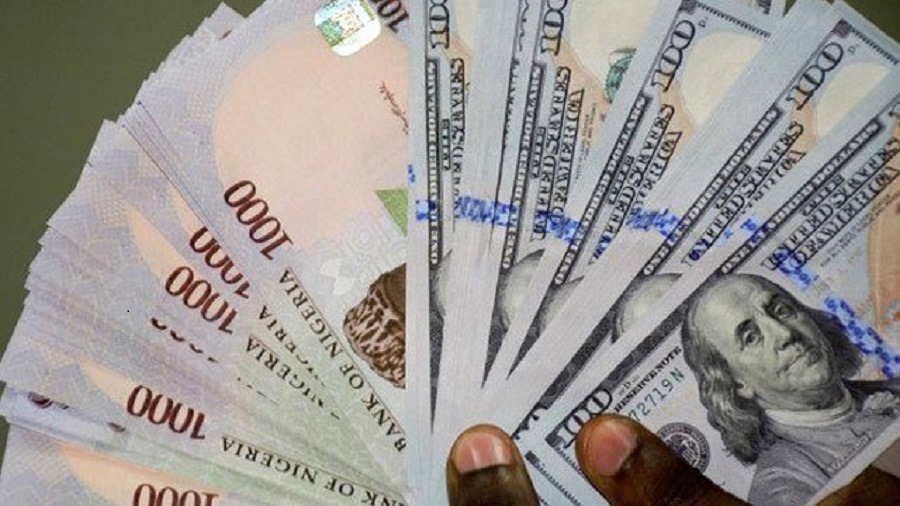
The naira depreciated against the dollar at the official and parallel foreign exchange markets on Monday to begin the new month on a bearish note.
Central Bank of Nigeria’s data showed that the Naira weakened to N1,448.44 on Monday, down from N1,446.74 traded on Friday last week.
READ ALSO:Naira Records First Depreciation Against US Dollar Across Official, Black FX Markets
This means that the naira dropped by N1.7 against the dollar on Monday when compared to Friday.
Similarly, at the black market, the Naira declined by N5 to N1,475 on Monday from N1,470 at the close of work last week.
The development comes as Nigeria’s foreign reserves stood at $44.61 billion as of November 27th, 2025.
Business
NNPCL Revenue, Profit Soar To N5.08tn, N447bn In October

The Nigerian National Petroleum Company Limited has announced a significant revenue increase to N5.078 trillion for October 2025.
The state-owned firm disclosed this in its monthly financial report released on Saturday.
According to the financial report, from N5.078 revenue in October, the company posted a N447 profit after tax.
READ ALSO:N5bn Damage: NNPCL Secures Appeal Court Victory Against Ararume
The figure represents a significant 19.2 percent increase in revenue from N4.26 trillion and a 106 percent rise in PAT from N216 billion in September 2025.
The report stated that from January to September, NNPCL paid N11.150 trillion in statutory payments to the federation.
Four days ago, NNPCL posted a total of N45.1 trillion as total revenue for the 2024 financial year.

 News4 days ago
Insecurity: What Sheikh Gumi Told Me After Visiting Bandits Hideouts — Obasanjo
- News3 days ago
BREAKING: Ex-CDS Musa meets Tinubu At Aso Villa
- Politics5 days ago
Tinubu Sends Ex-INEC Chair, Former Oyo First Lady, 30 Additional Ambassadorial Nominees To Senate
- News4 days ago
FULL LIST: Wike revokes land belonging to Ilorin Emir, Lamido, Fayose, Iyabo Obasanjo, Others In Abuja
- Entertainment5 days ago
Organizers Cancel Burna Boy’s US Shows After Fans Refused To Buy Tickets
- News3 days ago
MOWAA: Why I Will Not Appear Before Edo Assembly Panel — Obaseki
- Headline4 days ago
US: Four Killed, 10 Others Wounded In California Shooting
- Metro5 days ago
Army, Air Force Crush ISWAP Fighters After Failed Chibok Attack
- Metro3 days ago
Osun Monarch’s Burial Rites Turn Bloody
- Entertainment3 days ago
Facebook, Instagram Suspend Idris Abdulkareem’s Accounts After New Song, Open Letter To Donald Trump


