
News
FULL TEXT: JAMB Registrar Explains 2025 UTME Result Glitches, Says ‘Man Proposes, God Disposes’
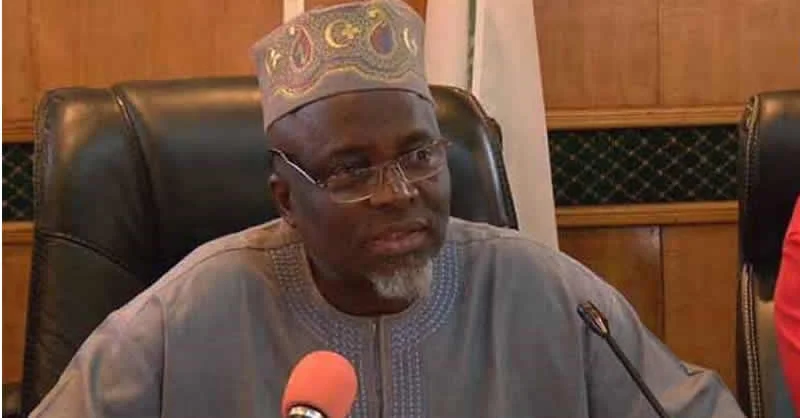
The Registrar of the Joint Admissions and Matriculation Board, Prof. Is-haq Oloyede, on Wednesday addressed widespread complaints over the 2025 UTME results, admitting that technical errors had affected some candidates’ scores.
Below is the full text of his press conference:
MAN PROPOSES, GOD DISPOSES
Press Conference Address on the Complaints about the 2025 Unified Tertiary Matriculation Examinations (UTME) Results by the Registrar, Joint Admissions and Matriculation Board (JAMB), Prof. Is-haq Olanrewaju Oloyede, CON, FNAL, at the Boardroom of JAMB National Headquarters, Bwari, Abuja, on Wednesday, May 14, 2025.
1.0 First of All
Gentlemen of the press, it is with deep feelings and a high sense of responsibility that I address you today on the subject of the 2025 Unified Tertiary Matriculation Examination (UTME) results, which has generated some traction in public discourse and social space. I want to begin by appreciating you for gathering here today, especially to the press, whose extensive coverage has highlighted the release of the 2025 Unified Tertiary Matriculation Examination (UTME) results, formally announced on Friday, 9th May 2025. Similarly, we appreciate all those who have lent their voices to the strident complaints on the results we released because you all did so out of concern. I appreciate our critics immensely because they could have chosen to be indifferent. I agree with the person who said that the opposite of love isn’t hate, it is indifference; the opposite of art is not ugliness, it is indifference; the opposite of faith is not heresy, it is indifference; and the opposite of life is not death, it is indifference. By not being indifferent to JAMB, we are grateful.
Today marks a moment we shall not soon forget – a day that should have been filled with celebration for what was, until recently, regarded as our most successful UTME exercise. Regrettably, this joy has been overshadowed by an easily avoidable error by one or two persons.
Without equivocation, there has been a lot of hoopla since the results of 2025 UTME were released last Friday, 9th May 2025. Despite the fact that JAMB is a responsive organisation, the unusual level of public concerns and loud complaints has prompted us to do an immediate audit or review of what happened, which we ordinarily would have done in June. I want to make it clear that our review and investigation reveal that there are grounds for the complaints about our 2025 UTME results and this press conference is convened with a view to unveiling the bitter truth of our findings openly and objectively.
We are all human afterall but before any other thing, it is imperative that I shed light on the extent that JAMB goes to ensure quality in its processes and activities.
2.0 JAMB and Quality Assurance
Gentlemen of the press, quality assurance is cardinal to the operations of JAMB. I can assure you that we scale all heights, fathom all depths and traverse all horizons to ascertain that quality assurance mechanisms permeate all our operations from the take off point to the finish line. We burn the midnight oil and we set our standards high. This is why we have guidelines, checklists and protocol guiding our activities right from the time of registration to the points of monitoring and supervision to the processing of results.
As we know we cannot clap with our sole hand as a single entity, we have several committees in place that are part of our quality assurance system. There are Peace Monitors, of 41 women of substance who are or have been Principal Officers of Nigerian universities; we have Chief External Examiners (CEEs), who are Vice-Chancellors, Rectors and Provosts of universities, polytechnics and Colleges of Education. Each state also has Chief Technical Adviser, a reputable professor who is an expert in computing and cybersecurity. We have Peace Monitors, Civil Society Group, Equal Opportunity Group, the General Monitors Group, High-powered Opinion Leaders, the Roving Group, Technical Advisors Group and the Virtues Vanguards. All of these groups play critical roles and complement our staff in ensuring quality and troubleshooting challenges.
READ ALSO:ASUU Threatens To Due JAMB Over UTME Mass Failure
Furthermore, we also have an in-house consultant and expert in software development and cybersecurity. Besides, we have introduced mock examinations since 2017 as primarily a quality assurance measure to test our systems and intervene where necessary prior to the time of our examinations, knowing the nature of technology. Our Technical Officers annually take tests before the successful ones are deployed to the field so that at no point would incompetence set in. All our examination officials are profiled with their NINs to ensure efficiency and accountability. We also have a robust team of in-house electronic testing experts led by a renowned professor of Software Engineering.
We deploy our systems to the use of high-profile organisations within and outside Nigeria as part of the broader strategy of ensuring that everything works well when we need it to work. As part of our preparations for this year, we upgraded our system from form-based to the single item-based examination, the latter of which is the international standard now. We simulated this system, streamlined our Autobot and Autotest systems and still went ahead to develop our own JAMBTEST, a software innovated in-house by a small team led by own staff, Dubem. We improved on the examination system, simulated everything end-to-end before the examinations and we thought everything was perfect. All the layers, including using dummies, were deployed this year but despite that, an error happened. It is a classical manifestation of the axiom that man proposes but God disposes.
3.0 Between KAD and LAG
Let me disclose part of how we operate in JAMB for the first time in public. Conscious of the fault-lines of Nigeria, we use two operational ‘vehicles’ to traverse Nigeria under the code names of KAD and LAG. The KAD vehicle contains the Northern states excluding Kano, Katsina, Jigawa, Niger, Kogi and FCT but it includes the six South South states. The LAG vehicle, on the other hand, consists of Southern states excluding the 6SouthSouth states but it includes Kano, Katsina, Jigawa, Niger, Kogi and FCT. These ‘vehicles’ are deployed to serve Nigerians as a whole, the South being part of the North and the North being part of the South. So, there is no distinct North or South.
After the mock examinations this year, we reviewed our LAG (which includes South West and South East states as earlier indicated) and KAD examination engines. We realised that in the LAG category, options to the items of our examinations were not shuffled. We insisted that the shuffling must be effected. After this was done, we tested the update as usual and we were satisfied. We thereafter still did what we call dummy, a simulation, a day before the examinations and everything seemed to be okay. In other words, we believed we were ready to deploy the items after some layers of testing the processes.
However, on the second day of the examinations this year, which was Friday April 25, 2025, we discovered that there was some omission in the items within the LAG category. An update for correction and grading adjustment was instantly made and it was tested on Saturday, Sunday and Monday. The update was applied after 12 a.m. on Tuesday morning and it was successful. That was why all the examinations from Tuesday till the end of UTME had no problem. To correct and re-upload the responses(i.e. results) from LAG for the pre-Tuesday glitch, the service providers concerned with LAG were deployed to effect the patch but there were patch errors in some center’s (servers) for the first three or four days in only two locations. In simple terms, while 65 centers (206,610 candidates) were affected in Lagos zone (comprising only Lagos state), 92 centers (173,387 candidates) were affected in Owerri zone, which includes the South East states. In clear terms, in the process of rectifying the issue, the technical personnel deployed by the Service Provider for LAG (Lagos and South-East zones) inadvertently failed to update some of the delivery servers. Regrettably, this oversight went undetected prior to the release of the results.
READ ALSO:ASUU Threatens To Due JAMB Over UTME Mass Failure
Recall that last year, we overhauled our reporting system, which made obvious what has not caught much public attention and thus sparked significant backlash from the Nigerian public. In response to widespread concerns about what many referred to as a “failure rate,” we made adjustments this year. Only professional educators who know the difference between achievement test and selection test (which UTME ranking test is) were not concerned, we felt with adjustment made during the preparation, better performance of statistics will emerge. We were therefore not surprised when the best score in 2025 (374) was the best highest in the last one and half decades as shown below.
List of Best UTME Candidates for the Past Twelve (12)Year
S/N YEAR REGISTRATION NUMBER NAME SCORE
1.2024
-202440343695GA Olowu Joseph Oluwasijibomi -367
-202440097040EF Alayande David – 367
-202440089418GA Orukpe Joel Ehijele – 367
2.2023202330325356GA Umeh Kamsiyochukwu Nkechinyere – 360
3.2022202211075576JA Adebayo Eyimofe Oluwatofunmi – 362
4.202110054281ID Monwuba Chibuzo Chibuikem – 358
5.202021398306DF Maduafokwa Egoagwuagwu Agnes – 365
6.201996630270JC Ezeunala Ekene Franklin – 347
7.201886034528DA Galadima Israel Zakari – 364
8.201775902784CB Akingbulugbe Precious Ayomide – 353
9.201665290500BI Akenbor Adesuwa Osarugue – 359
10.201665740193BF Anonye Victory Emenike – 359
11.201555395199EB Ilukwe Lottachukwu Geraldine – 332
12.201447049891HB Onomejoh Princewill – 299
13.201337207292AB Olise Israel Chukwunalu – 299
Between Friday and Monday, the uproar could be said to have reached the highest decibel and it was coming from some respected voices in the society. Though JAMB usually responds to every complaint based on its merit, the nature of the clam our this time made us to fast-track the review process, a post-mortem analysis of the results that we would have done next month. that of last year; yet everything fell within the range of the existing pattern.
COMPARISON OF UTME RESULTS SINCE INCEPTION (2013)
Between Friday and Monday, the uproar could be said to have reached the highest decibel and it was coming from some respected voices in the society. Though JAMB usually responds to every complaint based on its merit, the nature of the clamourthis time made us to fast-track the review process, a post-mortem analysis of the results that we would have done next month.
4.0 A Meeting of Minds
On the morning of Monday, May 12 2025, we issued a tentative press statement which includes “… If it is determined that there were indeed glitches, we will implement appropriate remedial measures promptly, as we do in the case of the examinations themselves.” Apart from officials of JAMB and other Government agencies, such as, Nigeria Education and Research Development Council (NERDC), we also summoned some experts and professionals who graciously responded to us, including a renowned professor of psychometrics and esteemed expert in Test and Measurement, who is from Imo state, Prof. Boniface Nworgu; a technical advisor and expert from the Computer Professionals Council of Nigeria (CPN), Prof. Adenike Osofisan;a CPN Representative, Mr Bayo Onimode; the President of the Nigerian Academy of Education, Prof. KabiruIsyaku; the National Parent-Teacher Association of Nigeria, the National Association of Nigerian Students, among others. We immensely appreciate them for heeding our distress call.
READ ALSO:
Within 24 hours of rigorous work, we were able to isolate where the problem emanated from. It happened in 65 centres in Lagos and 92 centres in Owerri zone. In these centres, the patch was not properly applied in some centre servers by the service provider and that failure disrupted the upload of the candidates’ responses within the first three or four days, as applicable to Lagos and Owerri zones. The 2025 UTME that could have been our finest yet, were it not for the carelessness, negligence, and lack of concern exhibited by the agents entrusted with this crucial yet straightforward function. Immediately we realised this, we summoned the Chief External Examiners of Lagos, Imo, Anambra, Oyo, Abia and Ebonyi, the six states affected. Fortunately, they all swiftly responded to join the group. We also invited Prof. Bashir Galadanchi, a leading expert in Computer Science; the National Association of Proprietors of Private Schools (NAPSS), which was represented by a leadingvoice in public advocacy, Dr. (Mrs) BukolaDosumu. A number of our vocal critics were also invited to the interaction such that we could jointly and sincerely examine the situation.
Despite being able to identify the source of the problem and the affected centres, we are conscious of the painful damage it has inflicted on the reputation of JAMB. As Registrar of JAMB, I hold myself personally responsible, including for the negligence of the service provider, and I unreservedly apologise for it and the trauma that it has subjected affected Nigerians to, directly and indirectly. Once again, we apologise and assure you that this incident represents a significant setback for the Board’s reputation. We remain committed to emerging stronger in our core values of transparency, fairness, and equity. It is our culture to admit error because we know that in spite of the best of our efforts, we are human, we are not perfect. The only consolation we have in this case is that it is just one of the two service providers that did not do well by uploading improperly but it was not a case of glitches nor sabotage.
By Tuesday morning, with the CEEs, the experts and Mr Osita Chidoka (a former Minister of Aviation) of Athena Centre, we selected samples of responses and reviewed. We compared the results and we are finding interesting correlations except in the 157 centers where distortions had occurred.
We unanimously agreed that each state of the Federation be sampled. No sign of any abnormality so far has been detected in any centre outside the ones mentioned and the laborious exercise is ongoing.
5.0 No Problem without a Solution
We have decided that all the candidates affected in the 157 centres out of 882 centres will be contacted to retake their examinations starting from Friday, May 16, 2025.These candidates are to be contacted through text messages addressed to their registered phone numbers, their email addresses, their profiles and phone calls by JAMB. They are directed to reprint their Examination Slips for the rescheduled examination dates.
While not oblivious of the fact that WAEC examinations are ongoing, we have contacted WAEC and in an unprecedented show of solidarity, the Council has graciously decided to as much as possible accommodate us within the WAEC time-slot. Any candidate with a clash of timetable, particularly for Agricultural Science on Friday, would be rescheduled. However, we have endeavored to ensure that no such exist. Most, if not all, such candidates are scheduled for Saturday. Fortunately, the prescribed texts for SSCE are also the prescribed texts for UTME apart from the reading text of the UTME, which carries just 10 marks in our Use of English test.
6.0 Appeal, Appreciation and Apology
I understand that there are three powerful expressions which contain one word, two words and three words respectively. They are please, thank you and I am sorry. So, I appeal to the candidates and those affected by the error of our system to accept this explanation as the truth of the matter without embellishment, PLEASE. I apologise and take full responsibility not just in words.
Then, I want to say a big THANK YOU to the Honourable Minister of Education for his unwavering belief in JAMB and what the Board stands for. I also appreciate all officers and officials who believe in us for their goodwill in the face of this challenge. We have vowed to uphold integrity as the abiding philosophy of JAMB and we won’t waver or depart from it despite the fact that we are not infallible. I am equally grateful to all stakeholders who have lent us their support and expertise in arriving at a logical conclusion that we have arrived at. And for the inconveniencies, once again, on behalf of JAMB, I say, I AM SORRY to all Nigerians.
Thank you



News
Out-of-school: Group To Enroll Adolescent Mothers In Bauchi
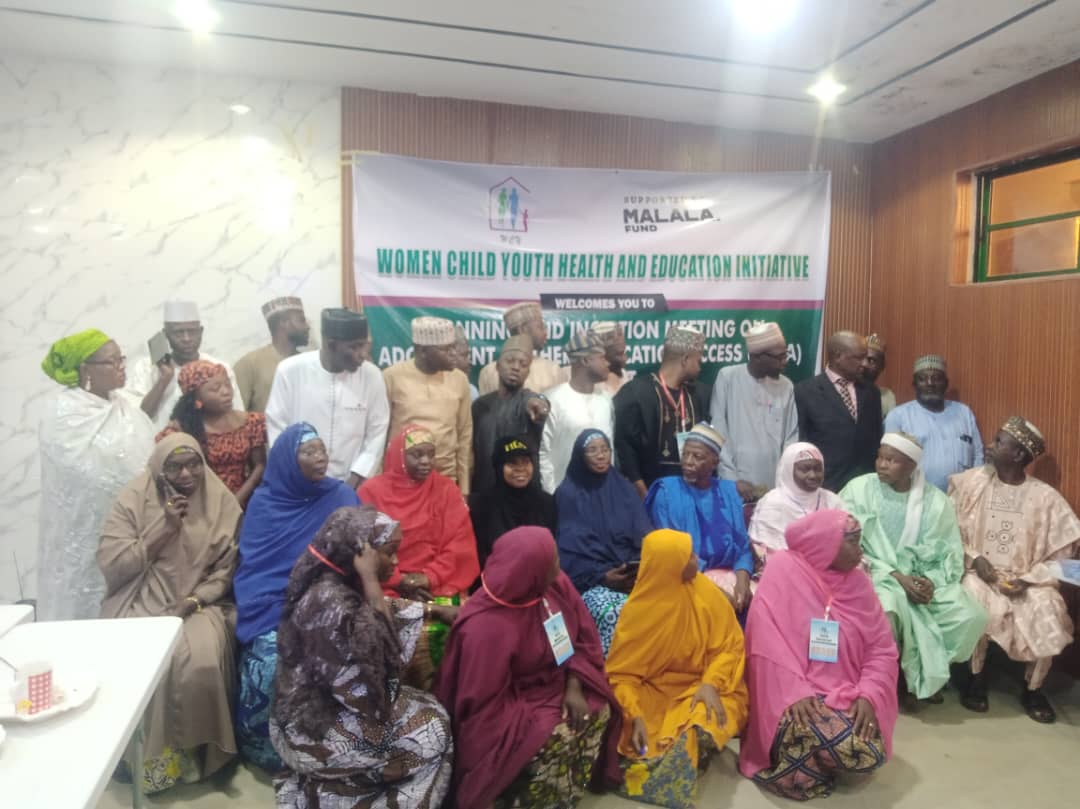
Women Child Youth Health and Education Initiative (WCY) with support from Malala Education Champion Network, have charted a way to enroll adolescent mothers to access education in Bauchi schools.
Rashida Mukaddas, the Executive Director, WCY stated this in Bauchi on Wednesday during a one-day planning and inception meeting with education stakeholders on Adolescent Mothers Education Access (AMEA) project of the organisation.
According to her, the project targeted three Local Government Areas of Bauchi, Misau and Katagum for implementation in the three years project.
She explained that all stakeholders in advancing education in the state would be engaged by the organisation to advocate for Girl-Child education.
READ ALSO:Maternal Mortality: MMS Tackling Scourge —Bauchi Women Testify
The target, she added, was to ensure that as many as married adolescent mothers and girls were enrolled back in school in the state.
“Today marks an important step in our collective commitment to ensuring that every girl in Bauchi state, especially adolescent who are married, pregnant, or young mothers has the right, opportunity, and support to continue and complete her education.
“This project has been designed to address the real and persistent barriers that prevent too many adolescent mothers from returning to school or staying enrolled.
“It is to address the barriers preventing adolescent mothers from continuing and completing their education and adopting strategies that will create an enabling environment that safeguard girls’ rights to education while removing socio-cultural and economic obstacles,” said Mukaddas.
READ ALSO:Bauchi: Auto Crash Claimed 432, Injured 2,070 Persons In 1 Months — FRSC
She further explained to the stakeholders that the success of the project depended on the strength of their collaboration, the alignment of their actions, and the commitments they forge toward the implementation of the project.
Also speaking, Mr Kamal Bello, the Project Officer of WCY, said that the collaboration of all the education stakeholders in the state with the organisation could ensure stronger enforcement of the Child Rights Law.
This, he said, could further ensure effective re-entry and retention policies for adolescent girls, increased community support for girls’ education and a Bauchi state where no girl was left behind because of marriage, pregnancy, or motherhood.
“It is observed that early marriage is one of the problems hindering girls’ access to education.
READ ALSO:Bauchi: Auto Crash Claimed 432, Injured 2,070 Persons In 1 Months — FRSC
“This organisation is working toward ensuring that girls that have dropped out of school due to early marriage are re-enrolled back in school,” he said.
Education stakeholders present at the event included representatives from the state Ministry of Education, Justice, Budget and Economic Planning and Multilateral Coordination.
Others were representatives from International Federation of Women Lawyers, Adolescent Girls Initiative for Learning and Empowerment (AGILE), Bauchi state Agency for Mass Education, Civil Society Organization, Religious and Traditional institutions, among others.
They all welcomed and promised to support the project so as to ensure its effective implementation and achieve its set objectives in the state.
News
OPINION: Fubara, Adeleke And The Survival Dance

By Israel Adebiyi
You should be aware by now that the dancing governor, Ademola Adeleke has danced his last dance in the colours of the Peoples Democratic Party. His counterpart in Rivers, Siminalayi Fubara has elected to follow some of his persecutors to the All Progressive Congress, after all “if you can’t beat them, you can join them.”
Politics in Nigeria has always been dramatic, but every now and then a pattern emerges that forces us to pause and think again about where our democracy is heading. This week on The Nation’s Pulse, that pattern is what I call the politics of survival. Two events in two different states have brought this into sharp focus. In both cases, sitting governors elected on the platform of the same party have found new homes elsewhere. Their decisions may look sudden, but they reveal deeper issues that have been growing under the surface for years.
In Rivers, Governor Siminalayi Fubara has crossed into the All Progressives Congress. In Osun, Governor Ademola Adeleke has moved to the Accord Party. These are not small shifts. These are moves by people at the top of their political careers, people who ordinarily should be the ones holding their parties together. When those at the highest levels start fleeing, it means the ground beneath them has become too shaky to stand on. It means something has broken.
A Yoruba proverb captures it perfectly: Iku to n pa oju gba eni, owe lo n pa fun ni. The death that visits your neighbour is sending you a message. The crisis that has engulfed the Peoples Democratic Party did not start today. It has been building like an untreated infection. Adeleke saw the signs early. He watched senior figures fight openly. He watched the party fail to resolve its zoning battles. He watched leaders undermine their own candidates. At some point, you begin to ask yourself a simple question: if this house collapses today, what happens to me? In Osun, where the competition between the two major parties has always been fierce, Adeleke was not going to sit back and become another casualty of a party that refused to heal itself. Survival became the most reasonable option.
His case makes sense when you consider the political temperature in Osun. This is a state where the opposition does not sleep. Every misstep is amplified. Every weakness is exploited. Adeleke has spent his time in office under constant scrutiny. Add that to the fact that the national structure of his party is wobbly, divided and uncertain about its future, and the move begins to look less like betrayal and more like self-preservation.
MORE FROM THE AUTHOR:OPINION: Wike’s Verbal Diarrhea And Military Might
Rivers, however, tells a slightly different story. Fubara’s journey has been a long lesson in endurance. From the moment he emerged as governor, it became clear he was stepping into an environment loaded with expectations that had nothing to do with governance. His political godfather was not content with being a supporter. He wanted control. He wanted influence. He wanted obedience. Every decision was interpreted through the lens of loyalty. From the assembly crisis to the endless reconciliation meetings, to the barely hidden power struggles, Fubara spent more time fighting shadows than building the state he was elected to lead.
It soon became clear that he was governing through a maze of minefields. Those who should have been allies began to treat him like an accidental visitor in the Government House. The same legislators who were meant to be partners in governance suddenly became instruments of pressure. Orders came from places outside the official structure. Courtrooms turned into battlegrounds. At some point, even the national leadership of his party seemed unsure how to tame the situation. These storms did not come in seasons, they came in waves. One misunderstanding today. Another in two weeks. Another by the end of the month. Anyone watching closely could see that the governor was in a permanent state of emergency.
So when the winds started shifting again and lawmakers began to realign, those who understood the undercurrents knew exactly what was coming. Fubara knew too. A man can only take so much. After months of attacks, humiliations and attempts to cage his authority, the move to another party was not just political. It was personal. He had given the reconciliation process more chances than most would. He had swallowed more insults than any governor should. He had watched institutions bend and twist under the weight of private interests. In many ways, his defection is a declaration that he has finally chosen to protect himself.
But the bigger question is how we got here. How did two governors in two different parts of the country end up taking the same decision for different but related reasons? The answer goes back to the state of internal democracy in our parties. No party in Nigeria today fully practices the constitution it claims to follow. They have elaborate rules on paper but very loose habits in reality. They talk about fairness, but their primaries are often messy. They preach unity, but their caucuses are usually divided into rival camps. They call themselves democratic institutions, yet dissent is treated as disloyalty.
MORE FROM THE AUTHOR:OPINION: Nigerian Leaders And The Tragedy Of Sudden Riches
Political parties are supposed to be the engine rooms of democracy. They are the homes where ideas are debated, leaders are groomed, and future candidates are shaped. In Nigeria, they increasingly look like fighting arenas where the loudest voices drown out everyone else. When leaders ignore their own constitutions, the structure begins to crack. When factions begin to run parallel meetings, the foundation gets weaker. When decisions are forced down the throats of members, people begin making private plans for their future.
No governor wants to govern in chaos. No politician wants to be the last one standing in a sinking ship. This is why defections are becoming more common. A party that cannot manage itself cannot manage its members. And members who feel exposed will always look for safer ground.
But while these moves make sense for Adeleke and Fubara personally, the people they govern often become the ones left in confusion. Voters choose candidates partly because of party ideology, even if our ideologies are weak. They expect stability. They expect continuity. They expect that the mandate they gave will remain intact. So when a governor shifts political camp without prior consultation, the people feel blindsided. They begin to wonder whether their votes carry weight in a system where elected officials can switch platforms in the blink of an eye.
This is where the politics of survival becomes dangerous for democracy. If leaders keep prioritizing their personal safety over party stability, the system begins to lose coherence. Parties lose their identity. Elections lose their meaning. Governance becomes a game of musical chairs. Today you are here. Tomorrow you are there. Next week you may be somewhere else. The people become bystanders in a democracy that is supposed to revolve around them.
Rivers and Osun should serve as reminders that political parties need urgent restructuring. They need to rebuild trust internally. They need to enforce their constitutions consistently. They need to treat members as stakeholders, not spectators. When members feel protected, they stay. When they feel targeted, they run. This pattern will continue until parties learn the simple truth that power is not built by intimidation, but by inclusion.
MORE FROM THE AUTHOR:The Audacity Of Hope: Super Eagles And Our Faltering Political Class
There is also the question of what these defections mean for governance. When governors are dragged into endless party drama, service delivery suffers. Time that should be spent on roads, schools, hospitals, water projects and job creation ends up being spent in meetings, reconciliations and press briefings. Resources that should strengthen the state end up funding political battles. The public loses twice. First as witnesses to the drama. Then as victims of delayed or abandoned development.
In Rivers, the months of tension slowed down the government. Initiatives were stalled because the governor was busy trying to survive political ambush. In Osun, Adeleke had to juggle governance with internal fights in a crumbling party structure. Imagine what they could have achieved if they were not constantly looking over their shoulders.
Now, as both men settle into new political homes, the final question is whether these new homes will provide stability or merely temporary shelter. Nigeria’s politics teaches one consistent lesson. New alliances often come with new expectations. New platforms often come with new demands. And new godfathers often come with new conditions. Whether Adeleke and Fubara have truly found peace or simply bought time is something only time will tell.
But as citizens, what we must insist on is simple. The politics of survival should not become the politics of abandonment. Our leaders can fight for their political life, but they must not forget that they hold the people’s mandate. The hunger, poverty, insecurity and infrastructural decay that Nigerians face will not be solved by defection. It will be solved by steady leadership and functional governance.
The bigger lesson from Rivers and Osun is clear. If political parties in Nigeria continue on this path of disunity and internal sabotage, they will keep losing their brightest and most strategic figures. And if leaders keep running instead of reforming the system, then we will wake up one day to a democracy where the people are treated as an afterthought.
Governors may survive the storms. Parties may adjust to new alignments. But the people cannot keep paying the price. Nigeria deserves a democracy that works for the many, not the few. That is the real pulse of the nation.
News
Human Rights Day: Stakeholders Call For More Campaigns Against GBV
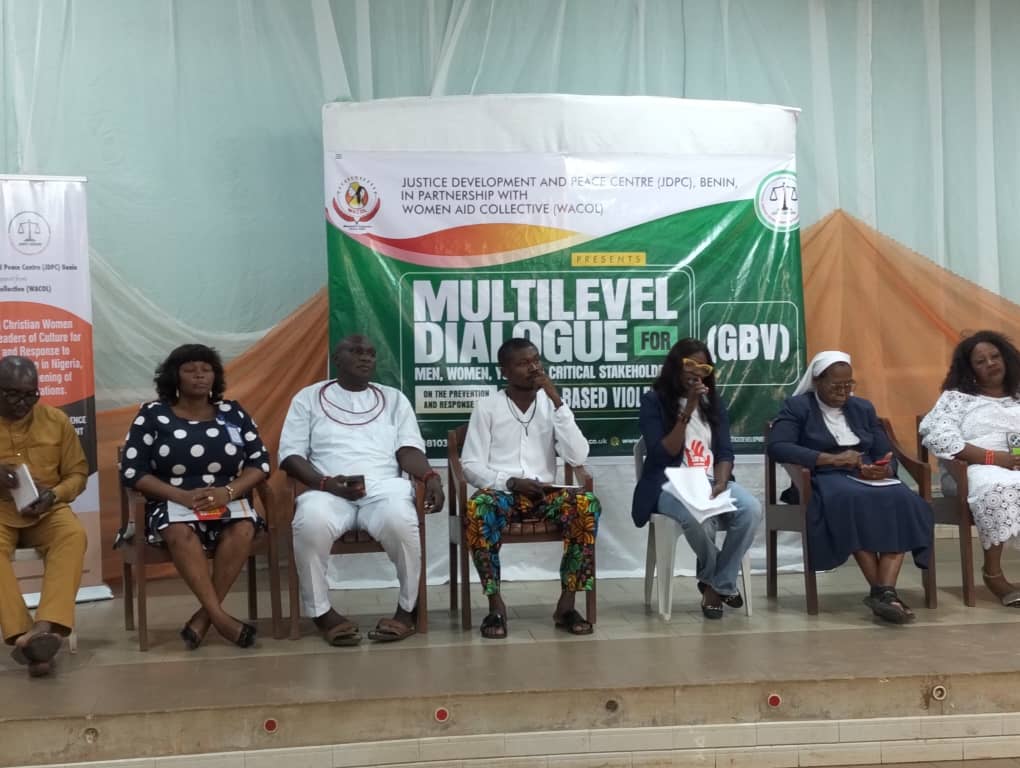
Panel of discussants at an event to commemorate the International Human Rights Day, 2025 on Wednesday called for more campaigns against Gender-Based Violence, adding that it must start from the family.
The panel of discussants drawn from religious and community leaders, security agents, members of the civil society community, chiefs, etc, made the call in Benin in an event organised by Justice Development & Peace Centre (JDPC), Benin, in collaboration with Women Aid Collective (WACOL) with the theme: Multilevel Dialogue for Men, Women, Youth and Critical Take holders on the Prevention and Response to Gender-Based Violence (GBV).
The stakeholders, who said causes of GBV are enormous, called for more enlightenment and education in the family, community and the religious circle.
Security agents in the panel charged members of the public to report GBV cases to security agents regardless of the sex Involved, adding: “When GBV happens, it should be reported to the appropriate quarters. It doesn’t matter if the woman or the man is the victim. GBV perpetrators should not be covered up, they must be exposed. We are there to carry out the prosecution after carrying out the necessary investigation.”
READ ALSO:World Human Rights Day: CSO Tasks Govt On Protection Of Lives
Earlier in his opening remarks, Executive Director, JDPC, Rev. Fr. Benedicta Onwugbenu, lamented that (GBV) remains the most prevalent in the society yet hidden because of silence from victims.
According to him, GBV knows no age, gender or race, adding that “It affects people of all ages, whether man or woman, boy or girl.”
“It affects people from different backgrounds and communities, yet it remains hidden because of silence, stigma, and fear. Victims of GBV are suffering in silence.”
On her part, Programme Director, WACOL, Mrs. Francisca Nweke, who said “women are more affected, and that is why we are emphasising on them,” stressed “we are empowering Christian women and women leaders of culture for prevention and response to Gender-Based Violence in Nigeria through the strengthening of grassroots organisations.”

 Metro5 days ago
My Husband Felt Insecure After I Got A Job, Accused Me Of Infidelity —Wife
- Headline4 days ago
JUST IN: Soldiers Announce Military Takeover Of Govt In Benin Republic
- News4 days ago
Rufai Oseni Breaks Silence On Alleged Suspension From Arise TV
- News5 days ago
Malami Breaks Silence On Alleged Terrorism Financing
- News3 days ago
OAU Unveils Seven-foot Bronze Statue Of Chief Obafemi Awolowo
- News5 days ago
FULL TEXT: Gen Musa’s Inaugural Speech As Defence Minister
- Politics2 days ago
JUST IN: Tinubu Holds Closed-door Meeting With Rivers, Ebonyi Govs
- Metro4 days ago
JUST IN: Military Jet Crashes In Niger Community
- News2 days ago
Why My Lineage Qualifies Me For Awujale Throne — K1 De-Ultimate
- Politics2 days ago
Tinubu, Six APC Governors Hold Closed-door Meeting At Aso Villa


