
News
[INVESTIGATION] The Story Behind The Abandonment, Diversion Of Obajare-Ebijaw NDDC Road Project
By Joseph Kanjo
The people of Ebijaw community and its environs in Odigbo Local Government Area of Ondo State may continue to pass through the proverbial hell whenever they travel out of their communities to urban areas if the road linking these communities, which was approved for construction by the Niger Delta Development Commission (NDDC) since 2017 remains in its present state of abandonment.
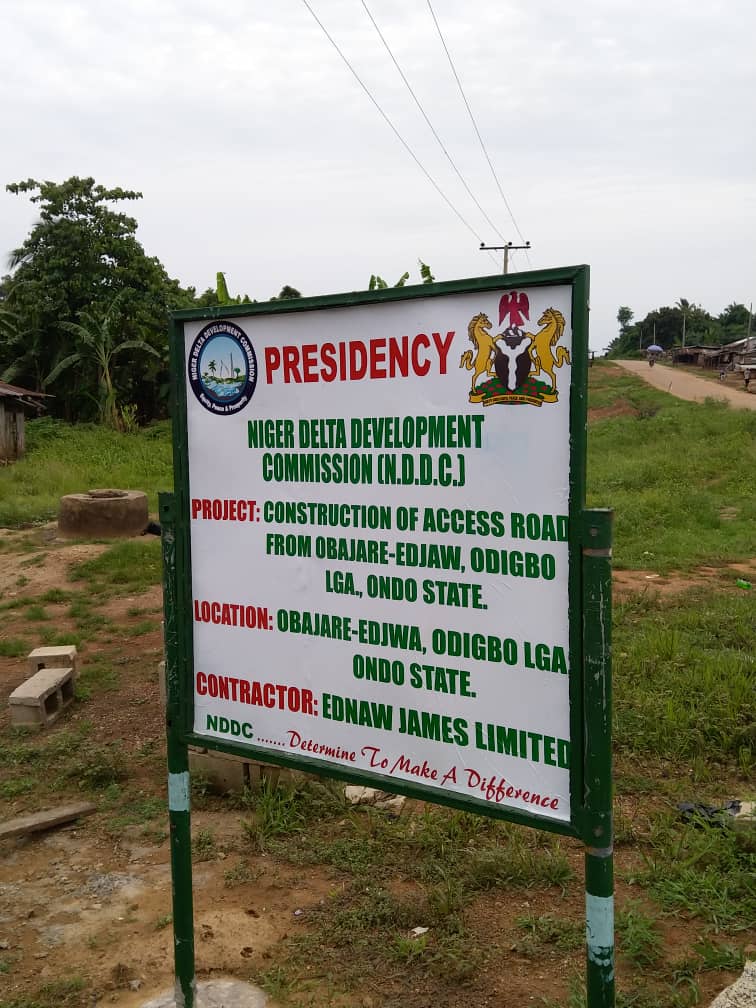
The road, whose Invitation to Tender was published on Vanguard newspaper of March 15, 2017 (page 54) was consequently awarded to EDNAW James Limited on September 22, 2017 in the sum of 199,750, 000 (One hundred and ninety nine million, seven hundred and fifty thousand naira).
Investigation reveals that ENDAW James Ltd actually commenced work April 2019 as expected but stopped after few months. The contractor was said to have commenced work at a wrong site (Asejire) rather than Obajare as awarded by the NDDC, which led to protest and resistance from the concerned communities. Following this outrage, the contractor abandoned the project in August 2019, and has not returned to site even as at the time of filing this report.
Speaking to our reporter on his trip to the area, Chief Amusa Ojo, Bale of Obajare and its environs said their joy knew no bound when one Engineer Alabi came to meet him and his people and told them he has been awarded the contract to construct road and bridges from Obajare to Ebijaw, adding that he (Alabi) thereafter requested to know the Ebijaw ward boundary so as to commence work immediately.
The nonagenarian, further speaking on the circumstances surrounding the abandonment of the project through Fatai Olasehinde, a former supervising councilor of Ebijaw ward, added that after supervising the site, Engineer Alabi left with the promise of getting back to them after eleven days to kick start work but later came to commence work at Asejire, a far distance from Obajare, and a different ward from Ebijaw ward. Chief Ojo noted that when he (Alabi) was confronted on the sudden change, the contractor said a politician directed him to commence work at that location.
The irony, however, is that the signpost bearing the contractor’s names and nature of the contract is mounted at the wrong site (Asejire) and still bears ‘construction of access road from Obajare-Edjaw’, even though the name ‘Ebijaw’ was wrongly spelt on the signpost. It must be noted that Asejire is under another ward, Onisere ward, and not Ebijaw ward.

Oladosa plank-bridge. when it rains the river overflows this bridge and consequently makes the road impassable.
“One day I was traveling to Ore, I discovered they have brought equipment to commence work but from Asejire. And this was after one month when Engineer Alabi came to visit. Meanwhile, when I saw they were starting work from Asejire, I had to come down from the vehicle and enquired what happened that what the contractor told us was meant for Obajare has been changed to Asejire, and he told me some politicians directed him to commence work from there.
READ ALSO: Ijaw Youths Block East-West Road In Protest, Demand Appointment Of Substantive NDDC Board
“I told him this was meant for us, so he ought to commence work from our place that was awarded to him. I told him it was given to us and reminded him that he was the one that categorically told us that it’s because of the oil deposit that NDDC enlisted Ebijaw ward under its coverage area.
“But not too long, natives of the land (the Ijaw) got very angry and they stopped the contract from progressing. They asked how come that which was meant for them was diverted. They said they were not going to accept that, so they went to stop the work and directed him to go and start work where they awarded the contract, but since then we have not seen the contractor,” he said.
He lamented that due to the oil deposit in the area their cocoa, kolanut and other farm produce are not surviving but dying, just as he added that the only project allocated to them from government has been diverted.
Chief Ojo, a farmer, further lamented: “Our cocoa is dying; our kolanut is dying, all our farm produce is dying, this is the only benefit we want to get from the government and it is being diverted.”
Shedding more light on the abandoned project, Mr. Karinate Odushu, a native of Ebijaw community accused Akinfolarin Mayowa, member representing Ileluji-Okeigbo/Odigbo federal constituency at House of Representatives of diverting the project, stressing that all pleas to him to allow the project commence at the approved site fell on deaf ears.

Tail end of the Eleriko plank-bridge along the Obajare-Ebijaw road.
He added that the lawmaker said ‘if they (Ebijaw people) refuse the project to start at Asejire then they should forget about it.’
He added that several meetings held with Mayowa to plead with him to direct the contractors to move to the approved site were not fruitful; adding that the legislator insisted it should be Asejire or nowhere else.
READ ALSO: NDDC Contract: Akpabio, Senator Nwaoboshi Trade Words
He said, “No work commenced at proposed site. To our greatest surprise, in 2019, we saw NDDC signpost bearing our community name in a different community (Asejire) along Lagos-Benin expressway, over 100km from project site in Ebijaw. From our investigation, we were told that it was Hon. Mayowa that instructed the diversion of the contract.
“We placed a stop on the work and asked the contractor to move to the approved site but he refused and he demobilized. The contract meant for us the Ijaw speaking people was diverted by Hon. Akinfolarin to his kinsmen,” Odushu lamented.
Efforts made to reach Hon. Akinfolarin were unfruitful, as several calls put across to him were not picked, likewise sms and WhatsApp messages sent to him were not replied.
Our reporter called Akinfolarin three times on November 9, 2020, but he did not pick.He also did not respond to sms and WhatsApps messages sent to him at the time.
Also, November 29, 2020, calls were put across to the lawmaker several times with no response. This made our reporter to send sms and WhatsApp messages to him about the same time but no reply. In the messages, the journalist asked him to clarify allegations against him “of masterminding the abandonment of Ebijaw to Obajare road project of the NDDC.”
Akinfolarin is not reachable neither is he traceable even in the constituency as efforts to reach him through his constituency office proved abortive. Findings in the major towns of Ore, Odigbo, Okeigbo and Ileoluji, all under his constituency show he has no constituency office in any of the major towns under his constituency,
The contractor handling the road project can be likened to ghost because the firm has no traceable office address either online or offline. It has no website, neither could anyone states where the contractor has office or where his office is located.

deplorable condition of the Oladosa bridge along the Ebijaw-Obajare road.
How Obajere-Ebijaw road project was approved by the NDDC
Narrating how the road project got approval of the House of Representatives and its consequent award by the NDDC, Mr. Odushu said the sudden and untimely death of residents occasioned by lack of healthcare facilities and the bad road linking them to where they could get such healthcare made them to approach Mayowa for assistance.
He further narrated a pathetic story of how a young lady bled to death due to lack of healthcare services and their inability to rush her to a nearby hospital in Ore owing to the bad road.
“On January 1st, 2016, a young lady from one of our communities, Gbenewei to be precise, under Ebijaw ward, bled to death with a baby in the course of giving birth to twins. This pathetic incident prompted some of us in the Ijaw-language speaking communities to approach the member representing our constituency (Ileluji-Okeigbo/Odigbo) at the federal House of Representatives, Hon. Akinfolarin Samuel Mayowa in an appeal for an access road to our area. We believe that had there been an access road, the lady would have been rushed to a nearby hospital at Ore and that could have saved her and the remaining unborn baby from untimely death,” Odushu narrated.
READ ALSO: House Of Reps Insists Threats, Blackmail Won’t Stop NDDC Probe
He said Mayowa, while sympathising with them on the demise of their loved one, however, said he was not ready to spend his personal fund on grading of any road or putting any road in shape but promised to present their plights before the House committee chairman on NDDC, Nicholas Ebomo Mutu, who happens to be an Ijaw man.
According to Odushu, who also facilitated the visit to Mayowa, he (Mayowa) told them the NDDC Committee does not believe there are Ijaw people in his constituency; hence he gave Ebijaw people Mutu’s contact so as to facilitate approval of the project, and on December 2016, after speaking with the NDDC committee chairman, an engineer from the NDDC visited the place, taking coordinates of the area.
Consequently, March 15, 2017, invitation to tender for the construction of access road/bridges from Obajare to Ebijaw was published in the newspaper. It is worth noting that these two communities and others are under the same ward: Ebijaw ward.
Odushu’s words, “He sympathised with us and promised to present our case before the House committee chairman on NDDC, Nicholas Ebomo Mutu. He also gave us Mutu’s phone number to contact being an Ijaw man, and that they do not believe him when he told them that there are Ijaw in his constituency. We called and spoke with Mutu, in the Ijaw language, and he promised to have further discussion with Akinfolarin. On December 30, 2016, an Engr. from NDDC came to access the said road, taking coordinates.
“It was approved and was published on page 54 Vanguard newspaper of Wednesday, March 15, 2017 for invitation to tender. Hon. Akinfolarin called me that our road has been approved; he advised that we write a letter of appreciation to Hon. Nicholas Ebomo Mutu. We did that and also sent a copy to Hon. Akinfolarin for pursuing our course. Those letters were written on March 27th, 2017 and dispatched.”
Findings show that, Ebijaw, a riverine community and headquarters of Ebijaw ward 6 with oil deposit (not yet extracted) qualifies Odigbo Local Government to be enlisted in the NDDC franchise area. Ebijaw is an Ijaw community dominated by fishermen and women, peasant farmers and petty traders, while Obajare is dominated by Yoruba from Osun, Oyo and Kwara states who are into peasant farming and petty trading.
The deplorable state of the road
Due to the deplorable condition of the road, it took several efforts and extra charges to convince motorcyclist to convene our reporter to the approved site and other locations. The road, which according to findings, was first opened in 1991, is abandoned by motorcyclists during raining season. Anyone travelling to some of the communities in this area has to follow other routes because of the pitiable state of the road.
For instance, to access Ebijaw and other communities through Ore, the headquarters of Odigbo LGA, one either goes through Irele-Ajagba route under Irele Local Government, very far journey of about 500 km when compared to the Ebijaw-Obajare route, or through waterways by wooden engine boat or canoe, through Edo State.
More so, these people who lack social amenities ranging from drinkable water, electricity, healthcare, schools, etc. have to wake up as early as 1:00am or 2:00am, whenever there is need for them to travel to Ore particularly the Ore market, and join the only waiting Hiace Bus in order to travel.
Oladosa and Eleriko bridges have made Ebijaw and communities under it to be cut off as far as this road is concerned. Any downpour in raining season covers these plank-bridges up making the road impassable.
READ ALSO: IYC, NDDC Disagree Over N3.8bn Non-existing Contracts
Speaking to our reporter, Seyi Akinsuyi, a motorcyclist who plies the road said he never ventures that route in rainy season. “There is no amount offered me that will make me to take that road in raining season,” he said after our reporter had already climbed his bike to take off to Ebijaw. When he was told the route to take was Obajare axis, rather than the alternative Irele-Ajagba, at this point, the motorcyclist discontinued the journey, wondering why the reporter would prefer to take such an abandoned route when there was an alternative. However, Irele-Ajagba to Ebijaw is also a bad road barely passable even in raining season and a much longer stressful route to take.
* This report is done with support from The International Centre for Investigative Reporting (ICIR) and McArthur Foundation.



News
NAF Launches Attack On Terrorists In Borno

The Nigerian Air Force, NAF, operating as part of the joint task force of Operation Hadin Kai, has carried out a coordinated air interdiction at AbbagaJiri in the Timbuktu Triangle, Borno State.
According to Air Commodore Ehimen Ejodame, Director of Public Relations and Information of NAF, the air strikes successfully paved the way for ground troops.
He explained that the operation was based on actionable intelligence from multiple sources, which confirmed the presence of terrorists, their structures, and concealed logistics facilities in the area.
Ejodame stated that NAF air assets were deployed in integrated surveillance and precision strike roles to target identified threats.
READ ALSO:NAF Hits Bandit Logistics Hub, Neutralises Many In Zamfara
The operation aimed to degrade terrorist capabilities, deny them sanctuary, and shape the battlefield for ground forces, all while strictly adhering to rules of engagement and protecting civilians.
He added, “The Identified terrorist structures were decisively engaged and destroyed, denying the terrorists freedom of action, while a follow-up engagement neutralised armed elements observed converging on the location.”
“Subsequent advances by ground troops into the area confirmed the effectiveness of the air strikes and validated the success of the joint air–land operation.”
Speaking on the mission, Chief of the Air Staff (CAS), Air Marshal Sunday Aneke, said, “The success of the mission reflects the NAF’s resolve to dominate the air domain in support of joint operations.”
READ ALSO:NAF Hits Bandit Logistics Hub, Neutralises Many In Zamfara
Aneke further emphasized that the operation highlighted the service’s commitment to providing precise and decisive air power in support of ground forces.
In his words, “We will continue to deny terrorists freedom of movement, sanctuary, and logistics wherever they seek to hide. Air operations will remain relentless and intelligence-driven.”
“Our operations are carefully planned and intelligence-led, ensuring maximum effect on hostile elements while safeguarding innocent civilians.”
READ ALSO:NAF Announces Two-hour Road Closure In Abuja For 10km Walk
“The Nigerian Air Force will sustain pressure until terrorist networks are completely dismantled.”
He further noted that the operation showcased NAF’s aggressive stance, precision employment of airpower, and dedication to sustained joint operations.
Aneke added that such missions play a crucial role in enabling ground troops to maintain momentum and deliver decisive outcomes against terrorist networks threatening lives, property, and Nigeria’s national security.
News
Lagos Parks To Close For Maintenance – State Govt
The Lagos State Parks and Gardens Agency, LASPARK, has announced that all public parks under its management across the state will be temporarily closed for routine maintenance and upgrades.
In a statement released on January 9 and shared via its official platforms early Saturday, LASPARK said, “All parks under our management will be closed to the public from January 12 to January 31, 2026.
“This follows increased visitor activity during the recent festive season.”
The agency listed several popular recreational spots that will be affected, including “Ndubisi Kanu Park, Alausa JJT Park, Dr. Finnih Abayomi Park in Oregun, and all other LASPARK-managed parks across Lagos State.”
READ ALSO:
Explaining the reason for the closure, LASPARK added, “The temporary shutdown is necessary to carry out essential landscaping, facility repairs, and general upgrades to ensure that our parks remain safe, clean, and enjoyable for residents and visitors.”
The agency also stressed that the exercise aligns with its broader mandate, noting, “This maintenance programme is part of our commitment to providing well-maintained green spaces that promote relaxation, wellness, and environmental sustainability.”
LASPARK assured residents that “all parks will reopen at the end of the maintenance period.”
News
PAP Sends Additional 34 Foreign Post-graduate Scholarship Beneficiaries To UK Varsities

The Presidential Amnesty Programme (PAP) has deployed an additional 34 foreign post-graduate scholarship beneficiaries to various universities in the United Kingdom for the 2025-2026 academic year.
This was contained in a statement made available to newsmen in Warri by Mr Igoniko Oduma, Special Assistant on Media to Dr. Dennis Otuaro, the Administrator, PAP.
According to the statement, the scholars’ programmes include data science, fintech analytics, cyber security, international energy law and policy, construction project management, public health, agri-food technology, electrical and petroleum engineering, among others.
The statement added that more foreign post-graduate scholars will be sent to UK universities in the current academic session.
“In December 2025, nine students, who were the first set of offshore post-graduate scholarship developments by the PAP Administrator, Dr Dennis Otuaro, for the 2024-2025 academic year, graduated from their various programmes in UK universities.
READ ALSO:PAP Scholarship Scheme Vehicle For Better Future For Niger Delta —Otuaro
“Otuaro has deployed over 9000 students to universities within and outside Nigeria for different industry-relevant programmes since he assumed office in March 2024,” the statement partly reads.
Speaking at the pre-departure orientation programme for the scholars at the PAP headquarters in Abuja, on Thursday, Otuaro said that the large-scale deployment was aimed at making the Niger Delta a knowledge-driven region.
He said that his leadership reinvigorated the programme to give it a new momentum in service delivery to the people of the region based on the mandate of President Bola Tinubu.
Otuaro said, “We are sending all of you for post-graduate studies in various universities in the United Kingdom.
“The PAP now has a new momentum and direction because of the repositioning and broad reforms that we carried out in line with the mandate of His Excellency, President Bola Ahmed Tinubu GCFR.
READ ALSO:Otuaro Tasks Media On Objective Reportage
“The objective behind the huge scholarships deployment is to ensure that we develop the needed human capital to transform the Niger Delta and generate knowledge-wealth.
“We want to develop relevant manpower in critical disciplines for our region and by extension, the country, because you are expected to contribute your quota to national development after successful graduation.”
The PAP boss, who was represented at the event by his Technical Assistant, Mr Edgar Biu, advised the scholars to study hard to achieve academic excellence in their various fields of research.
According to him, the scholars have an obligation to justify the Federal Government’s investment in their education and future.
READ ALSO:I’m Not Distracted By Anti-Niger Delta Elements, Says PAP Boss, Otuaro
He reiterated his warning that beneficiaries should not take for granted the opportunity to further their academic pursuits in the interest of the Niger Delta and indeed the country.
Otuaro expressed appreciation to President Tinubu for his “enormous interest and support for the Programme”, particularly the approval of an upward review of the programme’s budget from N65billion to N150billion.
He also expressed gratitude to the National Security Adviser, Mallam Nuhu Ribadu, for his impeccable guidance and supervision of the programme’s initiatives.
Otuaro, therefore, cautioned the scholars to obey their host country’s laws and the rules and regulations of their various institutions, stressing that they are ambassadors of Nigeria, the Niger Delta and their communities and families.
Highpoint of the orientation programme was the presentation of laptops to the scholars to help them in their studies.

 News4 days ago
How To Calculate Your Taxable Income
- Metro4 days ago
Edo widow-lawyer Diabolically Blinded Over Contract Seeks Okpebholo’s Intervention
- News3 days ago
Expert Identify Foods That Increase Hypertension Medication’s Effectiveness
- Headline4 days ago
Russia Deploys Navy To Guard Venezuelan Oil Tanker Chased By US In Atlantic
- Entertainment4 days ago
VIDEO: ‘Baba Oko Bournvita,’ Portable Drags His Father, Alleges Bad Parenting, Extortion
- Politics3 days ago
APC Leaders, Tinubu/Shettima Group Call For Wike’s Removal As FCT Minister
- Metro4 days ago
JUST IN: Court Grants Malami, Wife, Son N500m Bail Each
- Politics4 days ago
2027: Details Of PDP Leaders, Jonathan’s Meeting Emerge
- Headline2 days ago
Science Discovers Why Hungry, Broke Men Prefer Bigger Breasts
- Politics2 days ago
Wike A ‘Pestilence’ On Rivers, I Resigned Because Of It – Ex-Commissioner


