
News
OPINION: Aso Rock And Kitoye Ajasa’s Lickspittle Press

By Festus Adedayo
President Bola Tinubu did the unexpected last Wednesday. He attended the Nigerian Guild of Editors (NGE) Conference 2025. It was the very first for any Nigerian president. Quite absurdly, the watchdog, the Nigerian press, willingly moved into the tiger’s buba – the lair – for deliberation on its welfare. Ayinla Ade-Gaitor, the Iganna, Ìwájòwà LGA of Oyo State-born Apala musician of the 1970s/80s fame, equally wondered at this quixotic equation. My compatriots, can a tiger and a dog cohabitate in the same lair? – “K’ájá ó dúró, k’ékùn ó dúró, ńjé yíó seé se, èyin alárá wa?” Ade-Gaitor asked in his melodious Iganna-flavoured voice.
But at the 21st NGE Annual Conference (ANEC) 2025 held in its lair – the Aso Rock State House Conference Centre in Abuja – the tiger and the dog became so giddy after clinking wine glasses, so much that they both shared titivating embraces. They had both been soused to their eyeballs. When it was time for the tiger to speak, clanking its incisors menacingly and magisterially, with recent blood dripping from its lips and caked blood stuck round its nose, this strange incest reminded me of Sir Kitoye Ajasa.
Ajasa (1866 – 1937) was a Nigerian lawyer from the Saro family migrants of Dahomey, present-day Benin Republic. He was however conservative, pacifist and a lackey of the colonial authorities. While the likes of Herbert Macaulay fell out with the British rulers over their insistence that British rule was self-serving and a little in the interest of the natives, Ajasa thought otherwise. He believed that national progress could only be made if Africans were subservient to and cloned European ideas and institutions. He was an apologist of the British government, believing that criticising it was counter-productive. His reasoning was that, grovelling before white-haired, long-nosed, pink-skinned men who called themselves salvationists, was the guarantee for development.
To achieve this persuasion, Ajasa became a newspaper founder. Of course, his Nigerian Pioneer newspaper, founded in 1914, the year of Nigeria’s birth, invited so much reproach. He deliberately founded it as counterpoise to the radical Lagos Weekly Record newspaper of John Payne Jackson that was a thorn in the flesh of the colonialists. Ajasa’s brand of journalism frowned upon anti-government polemics as other papers of the time did. In return, the people of Lagos extremely distrusted it. In 1923, Ajasa wrote that his newspaper “existed in order to interpret thoroughly and accurately the Government to the people and the people to the Government”. In fact, he was a known confidant of Sir Frederick Lugard, the colonial Governor-General, and the general belief was that the Lugard government funded his Nigerian Pioneer newspaper. In its stories and editorial comments, the newspaper provided staunch support for the colonial government’s measures and cynically attacked people and organizations that were thorns in the flesh of government.
MORE FROM THE AUTHOR:[OPINION] Trump: Kurunmi’s Lessons For Tinubu
To demonstrate their opprobrium for Ajasa’s leaflet, the Nigerian Pioneer newspaper, the people scoffed at it on the newsstand. To Ajasa’s contemporaries, his lickspittling was bothersome. They could not fathom his boot-licking attitude and openly disdained his Nigerian Pioneer as “the guardian angel of an oligarchy of reactionaries”.
Ajasa’s newspaper itself became more or less the unofficial bulletin of the colonial government. It publicly mocked nationalists who fought for development and in a particular case, in the 1916 Lagos water rate protest against the colonial government, Ajasa labeled agitators like Macaulay ‘radicals.’ In 1921, with the help of Alimotu Pelewura, leader of Lagos Women’s Association, the powerful market women’s group, who at her death in 1951, was succeeded by Abibatu Mogaji, Macaulay again led a major protest on this agitation. To Ajasa, the colonized natives must fully adopt European ideas and institutions as expressway to national progress. He was in the Nigerian parliament till 1933 and shortly after 1937 when he died, the Nigerian Pioneer died.
So, when on Wednesday, President Tinubu urged the Nigerian media to “report boldly, but do so truthfully; critique government policy but do so with knowledge and fairness. Your aim must never be to tear down, but to help build a better society,” my mind told me that that fluid and racy speech was for the klieg. In actual fact, the president wanted Kitoye Ajasa-reincarnates for journalists, an Ajitóoba-phlegm-eater – media conscripts who would blind their eyes to government’s wobbly feet at national parade. Just as Kitoye Ajasa did for Frederick Lugard and the British colonial lords.
Since Lugard, the Kitoye Adisa-kind press had always been the preference of governments thereafter. Ever since the establishment of the Nigerian Daily Times on June 1, 1926 and even prior, the Nigerian press and Nigerians themselves had always been thirsty for adversarial journalism as a weapon of combating the colonial government. Since then, the Nigerian media’s treatment of news became binary: it was either they were for the people against government, or against the people, but in romance with government, like Kitoye Ajasa’s.
Since the Muhammadu Buhari government, the Nigerian media has operated under a very precarious situation. Its first blow was economic. As Eze Anaba, the editors’ president said, the Nigerian democracy, resilient through the ages, is currently under the bayonet of “insecurity, economic hardship, misinformation, and declining public trust in institutions, (as well as) government officials’ intolerance, sometimes, to freedom of the press.” The gravamen of Anaba’s speech can be found in his quip that “editors must therefore defend the sanctity of truth, insist on transparency, and hold power to account — not as adversaries of government, but as constructive partners in the pursuit of national progress.”
MORE FROM THE AUTHOR:OPINION: Abulu, The Prophetic Madman, At Akure Summit
In what would look like a systematic but gradual decimation of the Nigerian press, governments have since 1999 corroded its powers. The ostensible aim is to ensure that the Nigerian press barks but bites seldom. For those who can recall, the battle to wean Nigeria of military rule was largely fought on the pages of its newspapers. The press literally yielded its space for democracy activists to make use of it for their campaign for democracy. In the process, many journalists were sacrificed. Many were jailed and maimed. Bagauda Kaltho of The News signposted the clan of journalists who paid the ultimate price, in anticipation of liberty for Nigerians today. The newspaper press was so formidable that both Generals Ibrahim Babangida and Sani Abacha had to roll out tanks to extinguish its irritating flame. At the end of the day, the Nigerian press was largely responsible for the rout of military rule in Nigeria and its replacement with civil rule.
By 1999 when Nigeria returned power to civilians, the Nigerian newspaper press was still blistering. Its armaments were still potent and practitioners retained their energy which seemed to be bursting at its seams. Not long after the commencement of the Fourth Republic, the newspaper press made public examples of the carried-over rots of Nigeria’s governmental dysfunctionality. One after the other, even at a time when its tools were analogue, the press made mincemeat of public officers who, as it was later revealed, were evil doppelgängers of what they claimed to be in public. Salisu Buhari, the young Kano State legislator, who became Speaker of the House of Representatives, had his bubble burst. So also did Evan Enwerem. But for his street craftiness, the man who is the Nigerian president today would have been drowned by that hyper-ventilating press energy of the early 4th Republic.
The press of this period’s investigative acumen was top-notch and it could compete with any newspaper press anywhere in the world. My haunch is that, alarmed by the enormous power at its disposal and the system-purifying but dirty people-destroying powers within its grips, governments since 1999, either deliberately or otherwise, perfected plans to castrate the deadly watchdog of the Nigerian press. Today, they have made a huge success of this engagement. The success is such that, the wily politicians in agbada, babariga and Ishiagu can thump their individual chests that the battle to rid the Nigerian governance space of the irritancy of the Nigerian press, which the military, with their tanks and artillery, couldn’t achieve in decades, were effortlessly executed by them.
Today, the Nigerian newspaper press has been so mercilessly drubbed that it is barely existing. Gradually, an underground and sustained shellacking was waged on it and what is left is its decimated carcass. Many of Nigeria’s erstwhile matador press houses, where the warriors who fought military rule to a standstill operated from, are desecrated and abandoned. Their print-runs are caricatures of those noble eras when they proudly bore the tag “mass” in their media operations. Governments after governments since 1999 would seem to have deliberately jerked up costs of running newspapers to the league of what you needed to procure nukes. The newsroom has emaciated so terribly that you would imagine it was afflicted by a weight-pining cancer.
MORE FROM THE AUTHOR:OPINION: Ted Cruz’s Genocide, Blasphemy And Ida The Slave Boy
Last Wednesday, I reckon that the tiger was happy that the watchdog had been finally castrated, can bark and cannot bite. It lay prostrate by its feet with a begging bowl. All those ills that plague the Nigerian media today, itemized by Anaba, the League’s president, are physical manifestations of a conquered press whose conquest is a product of gradual decimation. The graveyard of the print media is luxuriant with lofty memories.
Thanks to the broadcast and social media which have both taken over the “mass” in print journalism’s erstwhile “mass media” pedigree. But for them, the Nigerian press would have today been a totally conquered battlefield. The watchdog must have entered the tiger’s lair last Wednesday, believing that the tiger’s smiles approximated its love for it. Truth be told, in the eyes of its newly acquired tiger friend, the press is a gourmet meal it has prepared for the dining table. Odolaye Aremu, Ilorin’s talented bard, once explained the danger in that emergency dalliance. “Adìye òpìpí” is the Yoruba name for a featherless hen which, in stature and outlook, bears striking resemblance to a hawk. The bard warned this hawk-lookalike hen to be wary of its newfound friendship with this carnivore, lest its entrails end in the belly of the raptor. Perhaps deceived that, being a media owner himself, like Odolaye’s òpìpí hen, the president is one of them, the Nigerian press, like this mistaken hen, would realize its folly too late when its flesh ends inside the hawk’s belly.
Any country of the world where the press and government are cosseted in such an amorous and adulterous relationship as we saw in Aso Rock last Wednesday has unilaterally tossed good governance out of its window. It reminds me of a paraphrase of a famous quote by US Supreme Court Justice, Hugo Black. Black wrote: “The press was protected so that it could bare the secrets of the government and inform the people. Only a free and unrestrained press can effectively expose deception in government. And paramount among the responsibilities of a free press is the duty to prevent any part of the government from deceiving the people.” But, when the press deliberately hands itself over to government, what then happens?
The Nigerian press today lives in The Wailers’ archetypal concrete jungle. In this jungle, though there are no physical chains around its feet, it is not free. Three young Jamaican boys, which included Bob Marley, had in 1973, in their ‘Catch A Fire’ album, sang about the melancholic life of a wanderer which the Nigerian press found itself living today. Glory lost, barely living and now captive in the hands of the state, those young Jamaican boys’ melancholy is a fitting description of today›s press.
The only way the Nigerian media can play its rightful role in the success of democracy, especially the success of the Tinubu government, isn’t by sucking up to people in power or being their lapdog. A century after Kitoye Ajasa played his groveling role to Lugard and British colonialists, history hasn’t forgotten him. It reserves a place for him till today. What will it say about us tomorrow?



News
Children’s Day: Chaos At Ogbe Stadium As Dozens Faint

Chaos erupted on Wednesday during the Children’s Day celebration as dozens of students reportedly collapsed following a stampede triggered by the use of pepper spray.
The event,
organised by the Edo State Ministry of Education at the Samuel Ogbemudia Stadium was disrupted after some male students of Ihogbe College allegedly made uncompromising advances towards female students at the venue.
A parent who identified himself as Oboh Emmanuel said, “the behaviour of those uncultured students attracted the attention of bouncers stationed at the stadium as they rebuked the male students.”
Oboh said the affected students later regrouped and attacked the bouncers, leading to a confrontation within the crowded arena.
READ ALSO:Children’s Day: Edo Commits To Child Protection
It was gathered that in the ensuing confusion, the bouncers were reported to have deployed pepper spray in an area occupied by a large number of students.
Several students, particularly female students, reportedly fainted after inhaling the substance, while others sustained injuries after being stepped on during the ensuing melee.
The panic was said to have spread across the stadium as students, teachers and parents scampered for safety.
Many of the affected students were reportedly rushed to the Edo Specialist Hospital for medical attention.
READ ALSO: Egor LG Chair, Ogbemudia, Vice, Osawe Impeached
Reacting to the incident, Chief Press Secretary to Governor Monday Okpebholo, Dr Patrick Ebojele, said the security personnel that fired the tear gas had been detained.
He said all the students, except two, that were rushed to the hospital have been discharged.
Ebojele stated that doctors wanted to observe the students till tomorrow before allowing them to go home.
“The two students are not seriously injured. Doctors want to observe them overnight. Permanent Secretary, Ministry of Education is still at the hospital. The man who used pepper spray has been detained.
“The incident did not happen the way it is being exaggerated. All modalities were put in place to ensure the children enjoyed their day.”
News
Okpebholo Salutes Edo Muslims, Seeks Continued Support, Prayers
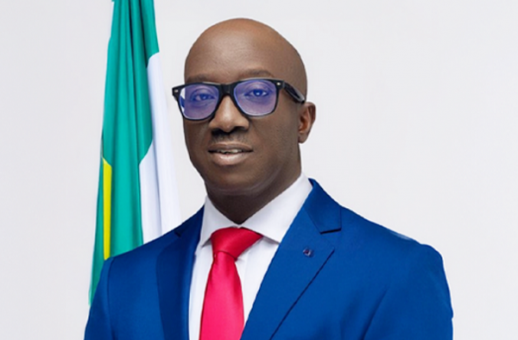
Governor Monday Okpebholo of Edo State has urged Muslims and all Nigerians to continue to pray for peace, unity and progress in the country even as they celebrate the annual Eid-al-Adha
The governor, who was represented by his deputy, Dennis Idahosa, stated this during the annual Eid-al-Adha celebration with Muslim faithfuls held at Government House in Benin City.
He reiterated his administration’s commitment to fairness, inclusivity and equal opportunities for all citizens irrespective of religion and tribe.
READ ALSO:ADC Penetrates Okpebholo’s District As Defections Strengthen Party in Edo Central
According to him, the present administration remains determined to building a government that reflects the diversity of Edo State, noting that competent and qualified Muslims have continued to play vital roles in his government because of their capacity, integrity and commitment to service.
“As a government, we remain committed to fairness, inclusivity and equal opportunity for every Edo citizen, irrespective of religion, ethnicity or political affiliation. This is why quality and competent Muslims are serving in key positions in our administration.”
Okpebholo appreciated the Muslim community in Edo State for their unwavering support and continuous prayers for his administration, noting that such prayers and support have contributed immensely to the peace and steady development being witnessed across the state.
READ ALSO:Okpebholo Felicitates Muslims On Eid-el-Fitr Celebration
He then called on all Nigerians to use the occasion of Eid-al-Adha to pray for the administration of President Bola Ahmed Tinubu, stressing that the country needs collective prayers, unity and cooperation to overcome its present economic and security challenges.
“I urge all Muslims and indeed all Nigerians to use this occasion to pray for our dear nation and for the administration of President Bola Ahmed Tinubu. Nigeria needs our collective prayers, unity and support as we strive to overcome our challenges and build a more prosperous future for all.”
In his remarks, the Chief Imam of Edo State, Abdulfatai Enabulele, applauded the governor for what he described as remarkable developmental strides recorded in less than two years in office.
The cleric commended the administration for ongoing infrastructural development and efforts geared towards improving governance in the state, but appealed to the government to revisit and complete some abandoned projects inherited from the previous administration for the benefit of the people.
News
Children’s Day: Edo Commits To Child Protection
The Edo State Government has reaffirmed its commitment to protecting the rights of children, promoting quality education, and strengthening sports development across the state.
This assurance was given by the governor of Edo State, Monday Okpebholo, during the 2026 Children’s Day Celebration and Governor’s Cup Finale held on Wednesday at the Samuel Ogbemudia Stadium, Benin City.
Addressing pupils, students and teachers,
the governor described children as the pride of Edo State and the future of the nation.
The governor, represented by his deputy, Dennis Idahosa,
noted that the annual celebration provides an opportunity to honour their dreams, talents, and limitless potential.
READ ALSO:Eid-el-Kabir: Edo Deputy Gov Solicits prayers For Okpebholo
Speaking on this year’s Children’s Day theme, “Choose Kindness, Reject Bullying,” the governor said the message was timely and significant, as it emphasizes the need to create safe, supportive, and inclusive environments for children both in schools and communities.
He stated that bullying in all forms — physical, verbal, emotional, or online — has no place in society, adding that the Edo State Government remains fully committed to protecting the rights and dignity of every child.
According to him, the administration will continue to strengthen policies and programmes that promote child protection, discipline, mutual respect, and positive learning environments across schools in the State.
The governor urged children to embrace kindness, compassion, teamwork, and respect for one another, stressing that true strength lies not in intimidation but in empathy, good character, and mutual understanding.

 Metro5 days ago
My Husband Abandoned Me On Our Wedding Night To Attend Political Meeting, I Want Our Marriage Dissolved
- Headline4 days ago
Woman Passes Out After Receiving 100 Strokes Of Cane
- Headline4 days ago
JUST IN: White House Locked Down Briefly As Gunman Opens Fire At Security Checkpoint
- Politics3 days ago
Two Masked Men Gun Down Politician In His Rivers State Hotel
- Politics5 days ago
Warri Ijaw Hail INEC Delineation Report, Call For Additional Electoral Wards, Others
- News5 days ago
Alleged Terrorism: Court Rejects Defendant’s Bid To Travel Abroad
- News3 days ago
More Pain For Nigerians As Cooking Gas Price Increases Nationwide
- Metro5 days ago
My Wife Stop Cooking My Food, Beats Me Black And Blue All the Time, Man Tells Court
- Politics5 days ago
What I’ll Do As President Of Nigeria — Amaechi
- Politics3 days ago
‘Tinubu’s Borrowing In 24 Months Surpasses 55 Years’ Debt Record’


