
News
OPINION: Brother Goddy And 753-duplex Estates

Tunde Odesola
Four eyes lock in combat. Two belong to a snake. The other two belong to a former President, whose lipless mouth, pointed nose and slit eyes are snakelike, too. In a swift reversal of roles, the hunter has become the hunted, both locked in the ultimate battle.
Measuring over two meters, the king cobra regularly visits Bubu Farms in Katsina to gobble up eggs and devour chickens. On this fateful day, the ex-president, Bubu, himself is on a secret inspection of his farm when he sees the cobra slithering into the poultry section.
“Damboro ba shege! So, na you, dis snake, dey chop my eggs and chickens? You will die today,” Bubu swears at the snake.
But the king cobra will not go down without a fight; a cornered cobra is deadlier than death. The snake hisses loudly and flares his neck muscles into a hood, raising one-third of its body off the ground, warning: steer clear!
But Bubu grew up in the village hunting snakes, lizards, birds and rodents. He flung off his babanriga, together with his cap and Rolex wristwatch in one fell swoop on the floor. “You’ve been chopping my eggs and chicken. Today, I will chop you,” Bubu vows.
The ex-president fetches a machete as the cobra coils up, swinging its hooded head left-right, right-left like a flame in the harmattan wind. Neither foe looked away from the other.
MORE FROM THE AUTHOR: OPINION: From Warmongering To Lie-peddling, Alapomu Go Explain Taya
As a retired soldier, Bubu considers his options quickly; he knows it is suicidal to move near the reptile with his short-range machete. Eyes fixed on the snake, which begins to uncoil, Bubu tears off a long branch from a cashew tree beside the poultry and lunges forward.
Seeing the stick in Bubu’s hand, the snake raises its head higher and spits twice at his face – twaaah, twaaah – missing the eyes narrowly as Bubu, even though old and gaunt, smartly ducks his head but the venom lands on his neck, leaving him with a burning sensation.
Bubu throws down the stick, momentarily scratching his neck, picks the stick up again, and runs after the fleeing snake heading towards the nearby iroko tree. Bubu shouts, “I go kill me today! I go kill me today!”
A herdsman and farmer, Bubu had just cleared and tilled his farm, so there was no debris or hay to harbour the snake. It was plain hectares of farmland and cattle and poultry. The snake flees. Bubu is in hot chase.
Suddenly, the assailant stumbles, o-u-c-h, but he falls not. The assailed snake doesn’t look back, gaining some distance; the iroko tree is within reach, and the serpent raises its head to ascend the tree to safety.
“You cannot escape, you serpent, you cannot! Ba zu ku iya tserewa ba, ku maciji,” Bubu screams. He runs faster, raising his stick in the air, and takes a whack at the snake as it begins to climb the iroko, aiming for the head. But the serpent is wiser. It wraps its body around the tree and keeps its head on the other side away from Bubu’s view and reach, moving on unseen legs upwards.
MORE FROM THE AUTHOR: OPINION: Apomu King Turns Warmonger For PDP
Bubu moves round the tree to aim at the head of the snake but the snake moves its head away to the side where Bubu was before. Bubu runs around the tree to aim at the snake’s head, the snake, in turn, moves its head away from Bubu’s view, climbing higher, both Bubu and the snake swirling in opposite directions around the iroko until the snake disappears to the top of the tree. You duck my spit, I duck your stick.
As Bubu watches the snake snaking up the tree, he sees a load tumbling down from the iroko, he ducks just in time by stepping away from the crushing weight of the load. The load crashes to the ground gboooah. Bubu’s jaws drop when the load turns into a human being! It is Amboke, the former factory worker, who lost his wife, three children and job about six months ago.
Bubu: Amboke, so its you? It’s you who has been entering my farm to steal my eggs and chickens?
Amboke: No, old soldier. I’m sorry, sir. I’ve never stolen anything from your farm, though I came here today looking for food. I climbed the tree when I suddenly saw you, I didn’t know the snake was going to climb the tree.
Bubu: Sorry for yua sef! You’ll be prosecuted for premeditated trespass and acts bordering on banditry, terrorism and kidnap of farm produce and livestock. You’re one of the useless youths I was talking about.
Amboke: No, sir. I’m a graduate but I lost my parents and young family to the boat tragedy on River Niger after losing my job when the Indians that own the textile factory where I worked relocated to Ghana.
(Security operatives swooped on the scene, rough-handling Amboke.)
Bubu: I caught this thief by myself, using my military expertise. I want him charged to Sharia court immediately. Me, I have forgiven Amboke’s body but his legs will go and tell the Sharia court why they trespassed on my farm. Jangebe’s hand was cut off for stealing a cow in the year 2000. I shall leave the judiciary to do their job diligently.
(A great noise builds up outside the gate of Bubu Farms)
Bubu: What noise am I hearing? Can’t I retire in peace? I will relocate to Niger Republic o!
(Head of the guards, Adalu, steps forward, and gives a salute)
Adalu: It’s the masses, Your Excellency. They are protesting the arrest of Amboke. They’re saying your wife, children, friends and lackeys are the ones responsible for the collapse of the farm, and not youths like Amboke.
MORE FROM THE AUTHOR: OPINION: I Will Make You Disappear!
Bubu: Go and give them the Lekki treatment.
Adalu: We can’t, sir. We need to clear that with your successor, sir.
Bubu: Give me my phone, I’ll call Bourdillon myself.
(Outside the farm, youths have made bonfires and barricaded the roads. Their leader, Gani, was making a speech)
Gani: (Sings) Soli, soli, soli….Solidarity forever, solidarity forever…, we shall always fight for our rights!
(The crowd screams as another comrade, Pius Adesanmi, arrives and bursts into another song)
Pius: (Sings Fela Anikulapo’s song) Many leaders as you see dem, na different disguise dem dey o, animal in human skin, animal wear agbada, animal put suit…
Gani: Wake up, Nigerian youths! You must begin to ask questions and challenge these charlatans who have eaten your destinies! They have taken you for idiots. They said a former god of the national treasury, Goddy Emefiole, stole billions of dollars and cornered 753-duplex apartments, under whose government did he steal it? How can you investigate Emefiole without investigating Bubu and his righteous deputy?
Pius: The anti-corruption fight of the Boudillon administration is all a ruse. All na scam! Why hasn’t the EFCC named the cronies who own some of the apartment 753-duplex apartments with Emefiole but they are quick to name only Emefiole?
Gani: Yes, Emefiole’s crime was trying to stop Bourdillon’s emergence as president, nothing more. America jailed R Kelly, Mike Tyson and other world-renowned citizens, including billionaires who ran foul of the law. Can that ever happen in Nigeria? Many former governors, senators, ministers etc have been on trial since 1999 to date. A holier-than-thou former president and his Ori o gbade deputy spent billions of dollars to import darkness from an American firm, yet they are walking free today. This is the country where the wife of a clueless leader, Mama Peace, had to do plea bargaining and pay back illegal proceeds.
Pius: Amboke must be freed! Amboke symbolises the tragedy of the Nigerian masses. Say no to gluttons in power. Say no to Next-of-Kin Nigerian Democracy Plc! All their children are billionaires. Nigerian masses, fight for your rights! God will never come down to build Nigeria. He never came down to build any country. Nigerians will build the Nigeria they want.
Email: tundeodes2003@yahoo.com
Facebook: @Tunde Odesola
X: @Tunde_Odesola



News
NAF Launches Attack On Terrorists In Borno
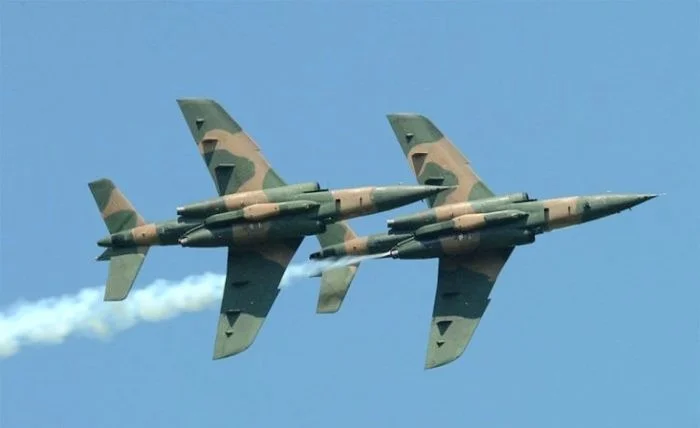
The Nigerian Air Force, NAF, operating as part of the joint task force of Operation Hadin Kai, has carried out a coordinated air interdiction at AbbagaJiri in the Timbuktu Triangle, Borno State.
According to Air Commodore Ehimen Ejodame, Director of Public Relations and Information of NAF, the air strikes successfully paved the way for ground troops.
He explained that the operation was based on actionable intelligence from multiple sources, which confirmed the presence of terrorists, their structures, and concealed logistics facilities in the area.
Ejodame stated that NAF air assets were deployed in integrated surveillance and precision strike roles to target identified threats.
READ ALSO:NAF Hits Bandit Logistics Hub, Neutralises Many In Zamfara
The operation aimed to degrade terrorist capabilities, deny them sanctuary, and shape the battlefield for ground forces, all while strictly adhering to rules of engagement and protecting civilians.
He added, “The Identified terrorist structures were decisively engaged and destroyed, denying the terrorists freedom of action, while a follow-up engagement neutralised armed elements observed converging on the location.”
“Subsequent advances by ground troops into the area confirmed the effectiveness of the air strikes and validated the success of the joint air–land operation.”
Speaking on the mission, Chief of the Air Staff (CAS), Air Marshal Sunday Aneke, said, “The success of the mission reflects the NAF’s resolve to dominate the air domain in support of joint operations.”
READ ALSO:NAF Hits Bandit Logistics Hub, Neutralises Many In Zamfara
Aneke further emphasized that the operation highlighted the service’s commitment to providing precise and decisive air power in support of ground forces.
In his words, “We will continue to deny terrorists freedom of movement, sanctuary, and logistics wherever they seek to hide. Air operations will remain relentless and intelligence-driven.”
“Our operations are carefully planned and intelligence-led, ensuring maximum effect on hostile elements while safeguarding innocent civilians.”
READ ALSO:NAF Announces Two-hour Road Closure In Abuja For 10km Walk
“The Nigerian Air Force will sustain pressure until terrorist networks are completely dismantled.”
He further noted that the operation showcased NAF’s aggressive stance, precision employment of airpower, and dedication to sustained joint operations.
Aneke added that such missions play a crucial role in enabling ground troops to maintain momentum and deliver decisive outcomes against terrorist networks threatening lives, property, and Nigeria’s national security.
News
Lagos Parks To Close For Maintenance – State Govt

The Lagos State Parks and Gardens Agency, LASPARK, has announced that all public parks under its management across the state will be temporarily closed for routine maintenance and upgrades.
In a statement released on January 9 and shared via its official platforms early Saturday, LASPARK said, “All parks under our management will be closed to the public from January 12 to January 31, 2026.
“This follows increased visitor activity during the recent festive season.”
The agency listed several popular recreational spots that will be affected, including “Ndubisi Kanu Park, Alausa JJT Park, Dr. Finnih Abayomi Park in Oregun, and all other LASPARK-managed parks across Lagos State.”
READ ALSO:
Explaining the reason for the closure, LASPARK added, “The temporary shutdown is necessary to carry out essential landscaping, facility repairs, and general upgrades to ensure that our parks remain safe, clean, and enjoyable for residents and visitors.”
The agency also stressed that the exercise aligns with its broader mandate, noting, “This maintenance programme is part of our commitment to providing well-maintained green spaces that promote relaxation, wellness, and environmental sustainability.”
LASPARK assured residents that “all parks will reopen at the end of the maintenance period.”
News
PAP Sends Additional 34 Foreign Post-graduate Scholarship Beneficiaries To UK Varsities

The Presidential Amnesty Programme (PAP) has deployed an additional 34 foreign post-graduate scholarship beneficiaries to various universities in the United Kingdom for the 2025-2026 academic year.
This was contained in a statement made available to newsmen in Warri by Mr Igoniko Oduma, Special Assistant on Media to Dr. Dennis Otuaro, the Administrator, PAP.
According to the statement, the scholars’ programmes include data science, fintech analytics, cyber security, international energy law and policy, construction project management, public health, agri-food technology, electrical and petroleum engineering, among others.
The statement added that more foreign post-graduate scholars will be sent to UK universities in the current academic session.
“In December 2025, nine students, who were the first set of offshore post-graduate scholarship developments by the PAP Administrator, Dr Dennis Otuaro, for the 2024-2025 academic year, graduated from their various programmes in UK universities.
READ ALSO:PAP Scholarship Scheme Vehicle For Better Future For Niger Delta —Otuaro
“Otuaro has deployed over 9000 students to universities within and outside Nigeria for different industry-relevant programmes since he assumed office in March 2024,” the statement partly reads.
Speaking at the pre-departure orientation programme for the scholars at the PAP headquarters in Abuja, on Thursday, Otuaro said that the large-scale deployment was aimed at making the Niger Delta a knowledge-driven region.
He said that his leadership reinvigorated the programme to give it a new momentum in service delivery to the people of the region based on the mandate of President Bola Tinubu.
Otuaro said, “We are sending all of you for post-graduate studies in various universities in the United Kingdom.
“The PAP now has a new momentum and direction because of the repositioning and broad reforms that we carried out in line with the mandate of His Excellency, President Bola Ahmed Tinubu GCFR.
READ ALSO:Otuaro Tasks Media On Objective Reportage
“The objective behind the huge scholarships deployment is to ensure that we develop the needed human capital to transform the Niger Delta and generate knowledge-wealth.
“We want to develop relevant manpower in critical disciplines for our region and by extension, the country, because you are expected to contribute your quota to national development after successful graduation.”
The PAP boss, who was represented at the event by his Technical Assistant, Mr Edgar Biu, advised the scholars to study hard to achieve academic excellence in their various fields of research.
According to him, the scholars have an obligation to justify the Federal Government’s investment in their education and future.
READ ALSO:I’m Not Distracted By Anti-Niger Delta Elements, Says PAP Boss, Otuaro
He reiterated his warning that beneficiaries should not take for granted the opportunity to further their academic pursuits in the interest of the Niger Delta and indeed the country.
Otuaro expressed appreciation to President Tinubu for his “enormous interest and support for the Programme”, particularly the approval of an upward review of the programme’s budget from N65billion to N150billion.
He also expressed gratitude to the National Security Adviser, Mallam Nuhu Ribadu, for his impeccable guidance and supervision of the programme’s initiatives.
Otuaro, therefore, cautioned the scholars to obey their host country’s laws and the rules and regulations of their various institutions, stressing that they are ambassadors of Nigeria, the Niger Delta and their communities and families.
Highpoint of the orientation programme was the presentation of laptops to the scholars to help them in their studies.

 News4 days ago
How To Calculate Your Taxable Income
- Metro4 days ago
Edo widow-lawyer Diabolically Blinded Over Contract Seeks Okpebholo’s Intervention
- News3 days ago
Expert Identify Foods That Increase Hypertension Medication’s Effectiveness
- Headline4 days ago
Russia Deploys Navy To Guard Venezuelan Oil Tanker Chased By US In Atlantic
- Politics3 days ago
APC Leaders, Tinubu/Shettima Group Call For Wike’s Removal As FCT Minister
- Entertainment4 days ago
VIDEO: ‘Baba Oko Bournvita,’ Portable Drags His Father, Alleges Bad Parenting, Extortion
- Metro4 days ago
JUST IN: Court Grants Malami, Wife, Son N500m Bail Each
- Politics4 days ago
2027: Details Of PDP Leaders, Jonathan’s Meeting Emerge
- Headline2 days ago
Science Discovers Why Hungry, Broke Men Prefer Bigger Breasts
- Politics3 days ago
Wike A ‘Pestilence’ On Rivers, I Resigned Because Of It – Ex-Commissioner


