

News
OPINION: El-Rufai Arrives Abuja




By Lasisi Olagunju
It is either Nasir El-Rufai is a very lucky man, or he is a very strong man. He was arrested by his friends, charged variously for multiple offences, none of the various courts has yet ruled on his bail application, but he arrived home in Abuja on Saturday. His jailers mourned with him and said he needed to arrive home early enough to bury his mother who died the previous day.
“But, the court is already seized of the matter. How did he do it outside the courtroom?” An exasperated lawyer asked me.
“That is the practical definition of power; you can’t find it in any dictionary,” I told him.
A disciple of Confucius asked him: “Is there any one word that could guide a person throughout life?” Confucius replied: “How about ‘reciprocity’! Never impose on others what you would not choose for yourself?” So, here, one question lingers: if Nasir were president, would a former friend in his custody be allowed to go home and mourn such a loss? It is a question he owes the public an answer to.
While we wait for his answer, let me add, quickly, that his arrest and prosecution illustrate a deeper contest between reason and unreason. Arrested on February 16, 2026, detained, released two days later, and rearrested immediately on February 18, the sequence reads less like a coherent legal process and more like a struggle for control of the levers of power. The situation raises an unsettling question: should process itself become punishment? If an offence is bailable, must the system wait for personal tragedy before conceding a right already guaranteed by law? In this drama, the court emerges diminished, reduced to learning, from social media, what it had deferred to pronounce.
One only wishes Nigeria could extend the ‘right’ enjoyed by El Rufai to all detainees in similar situations. But that is not the way of the world. When a slave falls sick, the household rebukes him as a habitual invalid; but when the master’s child complains of fever, medicine and delicacies compete for his lips.
Chief Ebenezer Babatope was the Director of Organisation of Chief Obafemi Awolowo’s Unity Party of Nigeria (UPN) in 1983 when General Muhammadu Buhari axed the second republic. Babatope was detained without trial by Buhari throughout his 20 months in power. His father fell ill while he was in Buhari’s jail. When Babatope’s father died, he pleaded with Buhari to let him go home to bury and mourn his father. The reply he got from Buhari was a query on how he knew that his father died. Ebino Topsy was supposed to be incommunicado in detention.
You’ve heard repeatedly that there is something called karma, a concept of moral cause and effect. Rooted in Hindu philosophy, karma slithered its way into English language and became a moral weapon against the wicked. Roman statesman, Cicero, uttered it his elegant way: “ut sementem feceris, ita metes” (literally: “as you have sown, so shall you reap”). Others said it in a shorter form: “quod severis metes.” The translation is the same.
MORE FROM THE AUTHOR:OPINION: PDP, APC Are Mere Jerseys
Beyond Roman philosophy, most religions affirm the principle of sowing and reaping as an inevitability in human life. Yet, it does not operate evenly for all.
If you are strong and lucky, every force on earth, including karma, will worship you and stand on your mandate. I cite the luckiest Nigerian ever, Muhammadu Buhari. Buhari’s autumn came in August 1985, he lost power and was detained by his friend and successor, Ibrahim Babangida. Then his mother died. How was he treated? Because he was not Babatope, the General did not get the same treatment he gave the UPN man.
Buhari’s biographer, John Parden, wrote in the book ‘Muhammadu Buhari: The Challenges of Leadership in Nigeria’ that “after the death of his mother in December 1988, Buhari was released and (he) travelled to Daura for the mourning.”
Different strokes. Detained Nasir El-Rufai was back in Abuja on Saturday, released outside the formal processes of the court, to mourn and bury his mother who died the previous day.
I have nothing against Bola Tinubu releasing his destiny helper from where he kept him. After all, as the Yoruba remind us, “bí a bá ńjà, bí i ti ikú kọ”—our quarrels are not meant to be fatal. Besides, in this season, every birth, every death is political and will be so treated. Someone said if the president did not release the man on time to bury his mother, the sun would have risen in the west and set in the east. They said the president’s politics would have suffered the fatwa of the mallam(s). I don’t know if I should believe that.
MORE FROM THE AUTHOR:OPINION: Nigeria, Iran And The Next Election
The lesson here (if it is a lesson) is that if you are strong enough, it is possible to sin against the powerful, get arrested by a motley of agencies, have your lawyers file your bail application, have the matter adjourned till March 31, and yet secure freedom on March 28 without any formal pronouncement from the court.
Literature has long anticipated this tense drama. I consult the master here, William Shakespeare. In ‘Measure for Measure’, power bends justice even as it preaches morality; authority manipulates outcomes while cloaked in virtue, and the law becomes theatre. In ‘King Lear’, power detaches from moral legitimacy: authority remains, but justice collapses. In ‘Macbeth’, ambition overrides order, hollowing out legitimacy and turning institutions into mere instruments. Across these works, the pattern is constant: when power escapes restraint, process becomes performance, and justice, an afterthought.
Beyond Shakespeare’s theatre of power, Jonathan Swift’s satire speaks with unvarnished contempt for its duplicities. In ‘Gulliver’s Travels’, he exposes the absurdity and arbitrariness of legal and political systems that hide behind the façade of rules. Consider the tiny officials of Lilliput, quarrelling over trivialities while exercising immense authority. Their pettiness is not comic relief alone; it is a mirror showing how institutions often cloak arbitrariness in the language and ritual of procedure.
Dig deeper into literature and you encounter Franz Kafka’s ‘The Trial’: the protagonist here was arrested and prosecuted by a system he cannot comprehend.
“I don’t know this law…It probably exists only in your heads,” he told those keeping him.
“You’ll find out when it affects you,” a policeman replied the detainee.
MORE FROM THE AUTHOR:OPINION: My President Visits Our King
Kafka’s enduring insight is stark: a legal system that cannot explain itself has already abandoned justice. The quintessential nightmare of opaque authority.
Then comes George Orwell, the great anatomist of political power. In ‘Animal Farm’, rules shift with the convenience of those in control; in ‘Nineteen Eighty-Four’, authority goes further still, defining reality itself. In Orwell’s world, power bends process, rewrites it, works hard on it until truth becomes whatever power says it is.
At the burial of his mum on Sunday, those who jailed El Rufai were fully there. They sat with him as co-mourners.
“Will he go back to jail now that the burial is over?”, a ‘wicked’ professor-friend asked me.
I didn’t know what answer to give her.
What, then, are the implications of El-Rufai’s ordeal and reprieve for democracy?
The episode raises profound questions about institutional integrity. Judicial supremacy is eroded when outcomes of trials appear to originate from outside the courtroom. The court, in such circumstances, risks becoming symbolic rather than decisive. Citizens are left to ask: where does authority truly reside?
When a justice system begins to operate with two courts, one visible, the other invisible, democracy is already in a kidnappers’ den. If bail and other legal reprieves are granted without transparent legal grounding, they invite a deeper anxiety: that the same unseen authority that grants relief can, with equal arbitrariness, impose punishment.
In all of this, the real losers are the courts: arbiters turned onlookers, spectators in their own game.




News
UNIMAID, Federal Polytechnic Matriculate 82 Degree Students

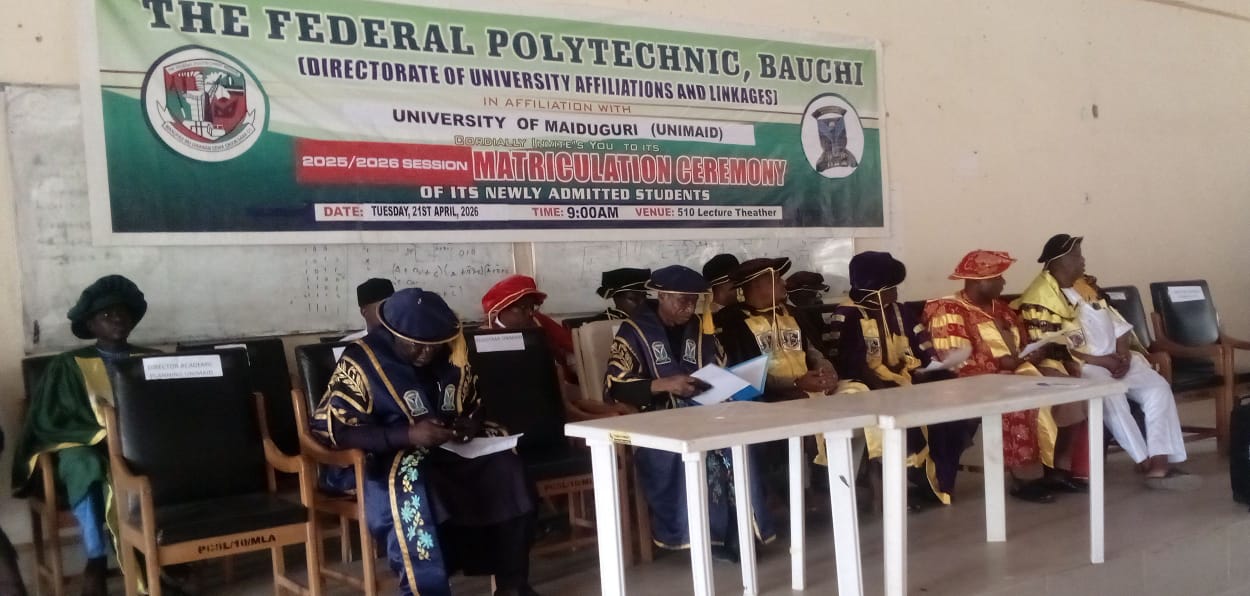
University of Maiduguri (UNIMAID) in affiliation with the Federal Polytechnic, Bauchi has matriculated 82 students into the degree programmes across five courses.
Speaking during the matriculation ceremony at the Federal Polytechnic Bauchi on Tuesday, Professor Muhammad Laminu Mele, the Vice chancellor, University of Maiduguri, charged the matriculated students to strictly adhere to the rules and regulations guiding the two institutions to enable them achieve the set objectives.
The VC, who was represented by Professor Muhammad Ahmad Waziri, Deputy Vice Chancellor Academic Services, warned that any student or group of students trying to breach the peace of the two institutions would face the full wrath of the law.
READ ALSO:NEDC Hands Over Mega School To Bauchi Govt
The Don further assured that the University and its affiliated institutions would continue to make easy access to higher quality education to the teeming population across the country.
In a remark, the Rector of the Polytechnic, Alhaji Sani Usman, said they were affiliated with the university to pursue academic excellence, describing the affiliation as a huge pillar in the education reforms.
READ ALSO:Bauchi Govt, UNICEF Strengthen Education Platforms To Improve Learning Outcomes
The Rector, who was also represented by Dr. Dalhatu Saidu, the Deputy Rector of the Polymeric, commended the university of Maiduguri for not only improving the UNIMAID’s conducive learning environment but expanding the horizon to different higher institutions of learning across Nigeria.
He therefore advised the newly matriculated students to pursue knowledge, to interact freely with the Polytechnic staff, be vigilant and be a brother’s keeper, adding that this would help to achieve the desired objectives.
The affiliated courses included BSc Mass Communication, BSc Accountancy, BSc Public Administration, BSc Business Administration and BSc Banking and Finance respectively.
News
Trouble Looms As Egbesu Group Drags FG To Court Over Resource Control, Others

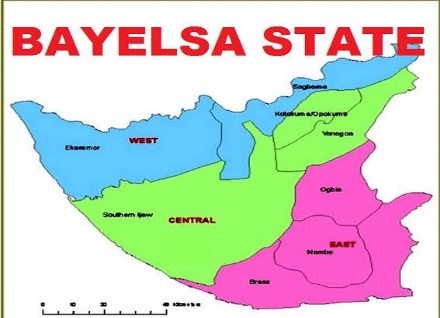
Group known as Supreme Egbesu Assembly (SEA) has dragged the Federal Government and the National Assembly to a Federal High Court, Yenagoa, over failure to create additional 24 Local government councils in Bayelsa State as the need for Ijaw to control natural resources in its territory.
The Originating Summons marked: FHC/YNA/CS/63/2026 was filed on Tuesday April 21, 2026 by the plaintiffs including; Felix Tuodolo, Weri Digifa, Ebi Waribigha, Kabowei Akamade, Rosebella Jackson, Thomas Jacklloyd, Primrose Kpokposei, David Imole and Welman Warri at the Federal High Court Yenagoa.
Joined as defendants in the suit are the National Assembly, the Clerk of the National Assembly and the Attorney General of the Federation.
In the court documents, the Egbesu Assembly premised their action on the alleged failure of the federal government particularly the National Assembly to deliberate, approve and amend the relevant provisions of the 1999 Constitution (as amended).
This, according to them, is to allow for resource control as well as the creation of additional LGAs in the state to fulfil the requirements in line with the Constitution.
READ ALSO:FG Bans Unauthorized Use Of Ambassador Title
The group is therefore seeking, among others, the amendment of the constitution by the National Assembly to allow for the right to resource control.
The Supreme Egbesu Assembly described the suit action as a promise kept.
Mranwh, In a press statement announcing the institution of the lawsuit on Tuesday, the Egbesu Assembly recalled that, on 12th February 2026, it wrote to both the Federal Government and the National Assembly wherein its gave a 21-Day ultimatum for the duo to respond to the age-long demands for resource control and creation of additional LGAs or face a lawsuit.
The statement partly reads: “Recall that on 12th February 2026, we did inform you that we have written to the National Assembly and the federal government on the need for the creation of an additional 24 Local Government Areas in Bayelsa State as well as the control of our God-given natural resources in Ijaw territory.
“We promised that if the National Assembly and or federal government did not respond to these age-long demands, we were going to seek legal actions to address our demands.
READ ALSO:
“We gave a time frame of twenty-one days for them to respond to us—we got no response!
“Today the Supreme Egbesu Assembly (SEA) has kept to its promise.
“We instituted an action at the Federal High Court Yenagoa against the National Assembly and the Federal Government after the expiration of the 21 days. Today we were in court for the first hearing of both cases.”
According to the group, creation of additional local government areas for Bayelsa is as old as the creation of the State itself.
The SEA maintained that “there is nowhere in any democracy where a state is limited to just 8 LGAs: more pathetic is the fact that Bayelsa State is an oil bearing State.
“Bayelsa State presently has twenty four Rural Development Authorities (RDA) which can be easily converted to Local Government areas thereby making the State eligible to participate in the sharing of allocation and the development of their areas for the purpose of justice and equity.
READ ALSO:
“Gentlemen, we wish to inform you that our suit on Resource Control is a revival of our age long agitation.”
The group further stated that Nigeria can no longer operate a system where contributors to the national coffers are not in charge of their resources.
The group added that the lawsuit is therefore for the Ijaw people.
“The Ijaw Nation must be free from all economic strangulation carried out against them by successive Governments,” they added.
The SEA called on all Ijaws to be steadfast and resolute, and continue to support the process by attending all court sessions, stating that “your solidarity is very vital at this point of time in our history. “
The group also called on other Ijaw organizations, communities, Niger Delta people, organizations and all people of goodwill “to join in the march to control and manage our despoiled and mismanaged natural resources.”
News
BREAKING: Tinubu Sacks Wale Edun, Dangiwa As Ministers

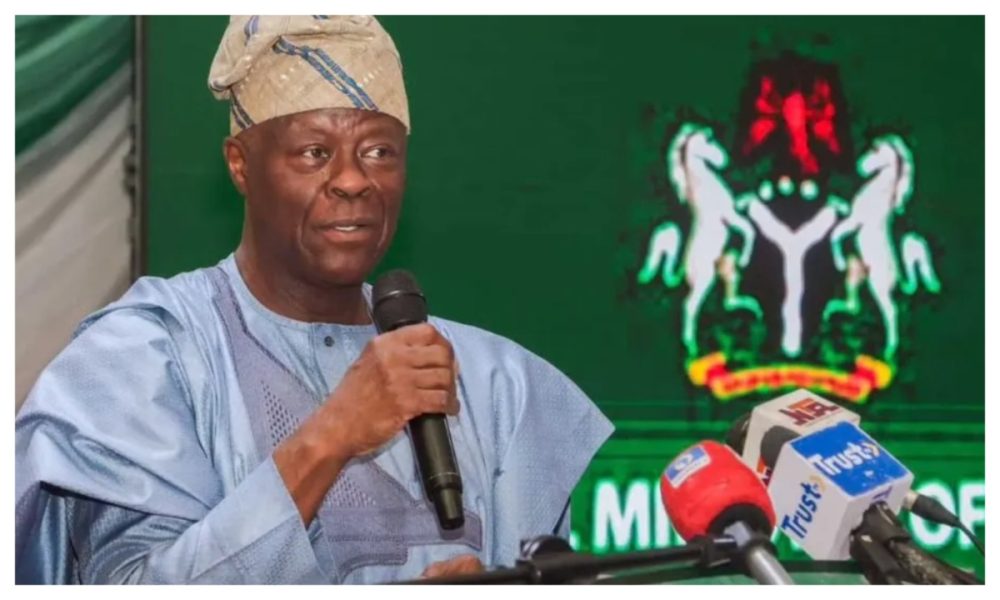
President Bola Tinubu has approved a minor reshuffle of the Federal Executive Council, removing the Minister of Finance and Coordinating Minister of the Economy, Wale Edun, and the Minister of Housing and Urban Development, Ahmed Dangiwa, from their cabinet positions.
Special Adviser, Media and Publicity to the Secretary to the Government of the Federation, Yomi Odunuga, said the development was contained in a memo signed by the
Secretary to the Government of the Federation, George Akume.
According to the memo, Taiwo Oyedele has been appointed as the new Minister of Finance and Coordinating Minister of the Economy.
Also appointed is Dr. Muttaqha Darma as Minister-designate for Housing and Urban Development.
READ ALSO:VIDEO: I Took Over Leadership From Myself; The Late Buhari Is Me — Tinubu
The memo directed the outgoing ministers to complete handover processes to their respective successors or supervising officials.
It stated that all handing over and taking over activities must be concluded on or before the close of business on Thursday, 23rd April, 2026.
Explaining the decision, Akume said the changes were aimed at improving coordination and strengthening delivery across key sectors of the economy under the Renewed Hope Agenda.
“These changes are aimed at strengthening cohesion, synergy in governance as well as achieving more impactful delivery on the economy to Nigerians, through the Renewed Hope Agenda,” Akume stated.
READ ALSO:VIDEO: Tinubu Till 2031, City Boy Movement Members Declare At Bayelsa Rally
He added that President Tinubu acted in line with his constitutional powers as provided under Sections 147 and 148 of the 1999 Constitution (as amended).
The SGF also conveyed the President’s appreciation to the outgoing ministers for their service to the nation and wished them well in their future endeavours, noting that the process of cabinet reinvigoration would remain continuous.
The statement further noted that Taiwo Oyedele was appointed as Minister of State for Finance in March 2026, while Edun was among the ministers appointed on August 16, 2023.
-

 News5 days ago
BREAKING: JAMB To Release First Batch Of 2026 UTME Results Midnight
-

 News4 days ago
World Bank Flags ‘Hidden Spending System’ Diverting Over N34.53tn Of Nigeria’s Revenue
-

 News5 days ago
Popular Nigerian Broadcast Journalist Is Dead
-

 News5 days ago
FG Bans Unauthorized Use Of Ambassador Title
-

 News4 days ago
VIDEO: I Took Over Leadership From Myself; The Late Buhari Is Me — Tinubu
-

 Metro5 days ago
Police Inspector Arrested For Armed Robbery Dies From Bullet Wounds
-
News3 days ago
FG Slams Import Ban On 17 Items In New Fiscal Policy
-

 News5 days ago
OPINION: Nigerian Military: Death On Battlefield, Crumbs On Payroll
-

 Politics5 days ago
2027: Why Tinubu Should Be Scared – ADC
-

 Headline5 days ago
Oil Prices Drop After Iran Reopens Strait Of Hormuz
