
News
OPINION: Every democracy ‘Murders Itself’

By Lasisi Olagunju
In ‘Jokes and Targets’ by Christie Davies, a Soviet journalist interviews a Chukchi man:
“Could you tell us briefly how you lived before the October revolution?”
“Hungry and cold.”
“How do you live now?”
“Hungry, cold, and with a feeling of deep gratitude.”
This sounds like Nigeria’s malaria victims thanking mosquitoes for their love and care. Between democracy and its opposite, reality has blurred the lines.
Last week, a group of White House pool reporters travelled with President Donald Trump on Air Force One as he returned from his U.K. state visit. At the beginning of the journey, actor Trump sauntered into the rear section of the plane, the traditional part for the press. He granted an interview and ended it with a morbid wish: “Fly safely. You know why I say that? Because I’m on the flight. I want to get home. Otherwise I wouldn’t care.”
Ten years ago, if a US president said what Trump told those poor reporters, his presidency would suffer immediate cardiac arrest. But this is Colin Crouch’s post-democracy era: the leader, whether in the US or in Nigeria, in Africa or elsewhere, is the law; whatever he does or says, we bow in gratitude.
I live in a Nigeria of gratitude and surrender. In the North-West and the North-East, traumatised communities are grateful to bandits and their enablers. They invite them to the negotiation table and thank the murderous gunmen for honouring the invitation. A grateful nation anoints and weeps at the feet of terrorists. In emergency-weaned Rivers State, its remorseful governor is effusive in appreciation of a second chance. The reinstated is ever thankful for the favours of a six-month suspension. From the North to the South, on bad roads and in death-wracked hospital wards, sonorous hymns of appreciation for big mercies ooze. The legislature and the judiciary, even the fourth estate, are all in congregation, singing songs of praise of the benevolent executive. Is this still a democracy?
American political scientists, Suzanne Mettler and Robert C. Lieberman in 2020 wrote ‘The Fragile Republic’ for The Foreign Affairs. In that essay, they list four symptoms of democratic backsliding. Prime among the four are economic inequality and excessive executive power. “Excessive executive power” is a three-word synonym for autocratization of democracy. It is a by-word for a democracy hanging itself.
The second president of the United States of America, John Adams, saw today; he warned of democracy decaying and dying: “Remember, democracy never lasts long. It soon wastes, exhausts, and murders itself. There never was a democracy yet that did not commit suicide.” Adams was not alone. There was also William Blake, 18th/19th century English poet, who said “if men were wise, the most arbitrary princes could not hurt them. If they are not wise, the freest government is compelled to be a tyranny.” This reads like it was written today and here. If you disagree, I ask: Is it wise (and normal) for the tormented to thank the tormentor?
MORE FROM THE AUTHOR:OPINION: A Minister’s Message To Me
Listening to what Trump wished the reporters, we could see that big brother America now leads in democratic ‘erantship’, the Third World merely follows. An enormous country, strong enough to appropriate the name of an entire continent, America, in 2025, is blessed with a strongman that is armed with a licence to rule as it pleases his whim; a president who does what he likes and says what he likes or ‘jokes’ about it without consequences. The result is an imperial presidency that has redefined democracy across the world.
We say here that the yam of the one who is vigilant never gets burnt. The American system used to be very resilient in providing a leash on presidential excesses. It still does, although under a very difficult situation. Donald Trump, in his first term between 2017 and 2021, signed 220 Executive Orders. In his ongoing second term that began in January 2025, he has, as of September 18, 2025, already signed 204 Executive Orders upturning this balance, rupturing that tendon. An American friend told me that he could no longer recognise his country. But the good news is that those who should talk and act are not surrendering their country to Trump and his faction of the populace. Because it is America (and not Nigeria), there are over 300 lawsuits challenging Trump’s executive orders or policies in his second term.
The active legal challenges view the Trump orders either as unconstitutional, exceeding statutory power, or violating rights. And the courts are also doing their job as they should. A 2025 study found some 150 judicial decisions concerning these orders. Some are preliminary injunctions, others are full rulings. President Bola Tinubu last week acknowledged the existence of “over 40 cases in the courts in Abuja, Port Harcourt, and Yenagoa, to invalidate” his Rivers State emergency order. Our courts, especially the Supreme Court, are yet to acknowledge any of the cases with trials, rulings and orders.
It is easy for presidents with unrestrained executive powers to assume imperial airs. In the past, when they did, they feared losing their link with the people and a fall from power. Today, they are on very solid ground, no matter what they do with their people. Midway into his term as US president, an increasingly unpopular Jimmy Carter reassessed himself, and in lamentation told Washington Post’s David Broder that he (Carter) had “fallen into the trap of being ‘head of the government’ rather than ‘leader of the people.’” Today is not that yesterday of sin and punishment. We have surrendered to the point of giving ourselves away. Today’s leaders know that what they need is the government, its power and privileges, certainly not the people. And they keep working hard at it such that America has Trump, and is not the only country that has a Trump. There are Trumps everywhere. We have them in Africa, from the north to the coast.
What democracy suffers in America it suffers more in Africa. Former President Goodluck Jonathan said at the weekend that “democracy in the African continent is going through a period of strain and risk of collapse unless stakeholders come together to rethink and reform it.” He said politicians manipulate the electoral system to perpetuate themselves in office even when the people don’t want them. “Our people want to enjoy their freedom. They want their votes to count during elections. They want equitable representation and inclusivity. They want good education. Our people want security. They want access to good healthcare. They want jobs. They want dignity. When leaders fail to meet these basic needs, the people become disillusioned.” That is from Jonathan who was our president for six years. Did he say these new things because he wants to come back?
Democracy is like water; a wrong dose turns it to poison. If disillusionment has a home, it is in Africa. It is the reason why the youths of the continent are bailing out for succour, and the reason for Trump’s $100,000 fee on work visas.
In The North American Review of November 1910, Samuel J. Kornhauser reproduced a quotation that contains warnings of what threat a people could constitute to their own freedom: “The same tendencies to wanton abuse of power which exist in a despot or a ruling oligarchy may be expected in a democracy from the ruling majority, because they are tendencies incidental to human nature.” The solution was “a free people setting limitations upon the exercise of their own will” so that they would not “turn democracy into a curse instead of a blessing.”
MORE FROM THE THE AUTHOR:OPINION: HID Awolowo And The Yoruba Woman
In his 1904 essay, ‘The Relation of the Executive to the Legislative Power’, James T. Young, observed a dramatic shift in American governance: while Woodrow Wilson had earlier warned of “Congressional supremacy,” Young argued that “we now live under a system of executive supremacy,” showing how the traditional checks and balances had failed to maintain equilibrium among the branches. That was in 1904, a hundred and twenty one years ago.
Someone said a leader’s ability to lead a society successfully is dependent on their capacity to govern themselves. It is that self-governing capacity that is lacking in our power circles. Plus the leaders don’t think they owe history anything. “From the errors of others, a wise man corrects himself…The wise man sees in the misfortune of others what he should avoid.” Publilius Syrus (85–43 BC), the Roman writer credited with uttering those nuggets, was a master of proverbs and apophthegm. We don’t listen to such words; we don’t mind being tripped by the same stone, and it does not matter falling into the same pit.
A democracy can enthrone emperors and kings but it is not that easy to ask them to dismount the high horse of the state without huge costs. We elect leaders and for unsalutory reasons, we let them roam freely with our lives, our safety and our comfort. We promote and defend them with our freedom. I hope we know the full import (and consequences) of the seed we are planting today. A Pharaoh will come who won’t remember that there was ever a Joseph.
A Roman emperor called Caligula reigned from 16 March, 37 AD until he was put to sleep on 24 January, 41 AD. ‘Caligula’ was not the name his parents gave him; it was an alias, “a joke of the troops” which trumped his real identity: He was named after popular Julius Caesar.
Roman historian, Claudius Suetonius, records in his ‘The Lives of the Caesars’ that Caligula became emperor after his father’s death and then “full and absolute power was at once put into his hands by the unanimous consent of the senate and of the mob, which forced its way into the House.” The new leader came popular with a lot of the people’s hope invested in him. Suetonius says the young man “assumed various surnames (for he was called ‘Pious,’ ‘Child of the Camp,’ ‘Father of the Armies,’ and ‘Greatest and Best of Caesars’). Soon the fawning appellations entered his head and he became the opposite of what his people wanted in their leader. One day, Emperor Caligula chanced “to overhear some kings who had come to Rome to pay their respects to him” doing what Yoruba kings love doing: He found them arguing at dinner about whose throne, among them, was the greatest and the highest in nobility. The emperor heard them and cried: “Let there be one Lord, one King.” He called them to order and from that point, it was clear to everyone that republican Rome now had one Lord, one king, and that was Caligula.
The man said and did things that frightened even the heartless. At a point during his reign, Caligula saw a mass of Roman people, the rabble, applauding some nobles whom he detested. He voiced his hatred for what the people did and said what he thought should be their punishment: “I wish the Roman people had but a single neck so I could cut it through at one blow.” That statement became a quote which has, through centuries, defined his place in history.
It would appear that 79-year old Donald Trump defined himself for history last week with his “fly safely…because I’m on the flight” statement. A leader, a father and grandfather said he did not care if a plane-load of young men and women perished (without him) in a crash. And he told them so.
MORE FROM THE AUTHOR:OPINION: On El-Rufai, Aláròká And Terrorists
A Twi proverb suggests that “the chief feels the heat only when his own roof is on fire.” Trump’s unfortunate remark is said to be a joke. Even as a joke, what the US president said sits in a long tradition of expensive jokes. Trump’s cruel ‘jest’ couldn’t be funny to any people even if they were under the spell of the leader. History and literature are full of such costly quips that come light from the tongue but which reveal something raw about power and rulers: power does not agree that all human beings possess equal worth, equal dignity, and equal rights. Power talks, and whenever it talks, it sets itself apart.
King Louis XV of France is remembered for uttering the line: “Après moi, le déluge (After me, the flood).” Some commentators say it was a joke, some others say it was a shrug. History interpreted what Louis XV said as the king not caring a hoot whatever might happen to France after he was gone. That statement is a sound bite that has clung to him forever as Abraham Lincoln’s mother’s prayer clung to her son.
When Louis XV said it, no one saw what the king said as a prophecy, grim and ghastly. I am not sure he also knew the full import of what he said. But it was prescient; fifteen years after his reign, the “flood” came furious with the 1789 revolution culminating in the effective abolition of the French monarchy by the proclamation of the First Republic on September 21, 1792.
Emperor Nero of Rome is remembered forever for playing the fiddle while Rome was burning. In William Shakespeare’s Henry VI, we read a verse that ends with “Nero, Play(ing) on the lute, beholding the towns burn.” What is remembered of Nero is the image of a leader who ‘enjoyed the life of his head’ while his empire got destroyed by fire set at it by the enemy. But did the emperor really do that? Read this from the Encyclopaedia Britannica: “So, did Nero fiddle while Rome burned? No. Sort of. Maybe. More likely, he strummed a proto-guitar while dreaming of the new city that he hoped would arise in the fire’s ashes. That isn’t quite the same thing as doing nothing, but it isn’t the sort of decisive leadership one might hope for either.”
I have roamed from imperial Rome to medieval France, to democratic America and its Nigerian side-kick. What is next here is to go back, and salute John Adams with this his dispraise of democracy: “It is in vain to say that democracy is less vain, less proud, less selfish, less ambitious, or less avaricious than aristocracy or monarchy.” A system or a country becomes a joke when its leaders toy with its destiny; when they make light of the fears of their people.
The Akan of Ghana warn that if you sit on comfortable rotten wood to eat pawpaw, your bottom gets wet and your mouth also gets wet. This is to say that there are consequences for choices made. A kabiyesi democracy is an autocratic monarchy. And what does that feel like? I read of a king who joked to his courtiers during famine: “Hunger has no teeth sharp enough to bite me in my palace.” It was a careless statement of a monarchy that has found its way into the mouth of our democracy. I saw it where I read it that the ‘joke’ “was remembered bitterly by the starving commoners who later sang satirical songs about the unfeeling king.” Some jokes outlive their laughter.



News
Otuaro: Baseless Allegations, Disregard Them, Group Urges Public
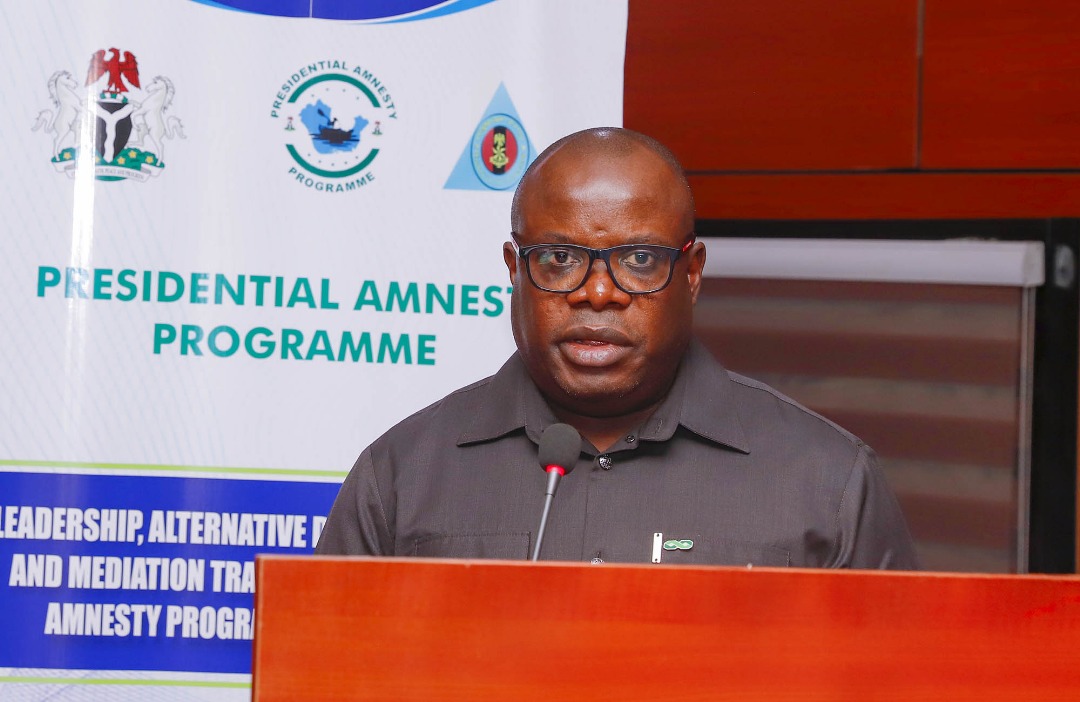
The Ijaw People’s Development Initiative, IPDI has reacted to a statement circulating online regarding the Presidential Amnesty Programme (PAP), describing it as baseless.
The statement under the disguise ‘Niger Delta Stakeholders Forum and Niger Delta Ethnic Nationalities,’ had demanded accountability regarding the management of the Programme and its administrator, Dr Dennis Otuaro.
Reacting to the statement, National President, IPDI, Comrade Austin Ozobo, said: “We consider it necessary to respond point by point to correct misconceptions, reject unsubstantiated claims, and keep the record straight in the interest of PAP beneficiaries, stakeholders, and the general public.
“It is worthy of note that the PAP operates under strict federal financial regulations and is subject to routine audits by the Office of the Auditor-General of the Federation, the Ministry of Finance, and other oversight bodies.
“All disbursements, including stipends, vocational training, education support, and third-party contracts, are processed through the Treasury Single Account, TSA, with verifiable records”, the statement read.
READ ALSO:PAP Sends Additional 15 Scholarship Beneficiaries For Post-Graduate Studies In UK
According to the IPDI, the Programme welcomes lawful criticism and scrutiny at any time. However, linking such a call to specific individuals without evidence amounts to trial by the media and undermines due process.
“Dr Dennis Otuaro, administrator of the Presidential Amnesty Programme has maintained a good record of financial management, hence no formal petition with verifiable evidence has been submitted to any anti-graft agency till date”.
“It may interest you to know that the N65,000 monthly stipend is fixed by the Appropriation Act and can only be reviewed through a budgetary process approved by the National Assembly and the Presidency.
‘The PAP management has consistently conveyed beneficiaries’ concerns on cost of living to relevant authorities”.
“Again, claims that allocations to the Programme have risen significantly while stipends remain unchanged misrepresents the budget structure.
READ ALSO:PAP: N’Delta Stakeholders Laud Otuaro’s 2 Years Of Strategic Reforms
“Note, increased allocations in recent years have been tied to expanded reintegration programs, education sponsorships, skills acquisition, and infrastructure support for training centers, not solely to stipend payments”.
The group reiterated that the allegation that the Amnesty Programme Office “kidnaps and detains delegates” is false, reckless, and defamatory, adding that the PAP has no paramilitary or law enforcement mandate, nor does it operate detention facilities and that any incident involving law enforcement is outside the control and purview of the Programme.
“We challenge the authors to provide verifiable details of time, place, and persons involved so the matter can be addressed through appropriate legal channels,” the group said
On Claims of Selective Empowerment and 500% Payment Increases, the group maintained that payments to contractors, ex-agitator leaders, and service providers were governed by existing contracts and agreements predating the current administration.
“No individual or camp has received unilateral increases without contractual basis or due process. Allegations of 500% increases are unsubstantiated and designed to stoke division among beneficiaries,” it added.
READ ALSO:Otuaro Links Increase In PAP Scholarship Beneficiaries To Tinubu
“The current administration has maintained a policy of transparency in engagement with leaders and has expanded inclusion by verifying and capturing previously omitted beneficiaries where due“, IPDI added.
The group further said, “The PAP remains a neutral, peace-building institution established under the 2009 Amnesty Declaration. Its mandate is to coordinate disarmament, demobilization, and reintegration. The Office does not engage in political victimization, intimidation, or exclusion of stakeholders. Engagement with ex-agitator leaders and community structures is conducted based on their role in maintaining peace and facilitating reintegration, not political alignment”.
“The PAP under Chief Denis Otuaro’s leadership remains committed to transparency, fairness, and the original mandate of the Amnesty Programme. Constructive criticism is welcome and has informed policy adjustments in the past. However, campaigns of calumny, unverified allegations, and attempts to drag the Programme into commercial or political disputes do not serve the interest of peace in the Niger Delta”, IPDI said.
“We urge all stakeholders to channel grievances through the established engagement channels of the Programme and to avoid statements that threaten the fragile stability we have worked to sustain”.
Consequently, the IPDI urges members of the public to disregard what its described as “flimsy and unsubstantiated allegations, misconception, and missives by faceless groups above“.
News
[OPINION] Olukoyede’s EFCC: Taming The ‘Fantastically-Corrupt’

Since its creation 23 years ago, by Chief Olusegun Obasanjo, as president of Nigeria, Africa’s most populous and influential country, the Economic and Financial Crimes Commission (EFCC), had apparently not gotten a head, who had piloted the affairs of the commission, like Mr. Olanipekun Olukoyede, its Executive Chairman, a chief-operations-officer of the Commission.
It could be said that Olukoyede, the Czar thief catcher and arrestor of economic saboteurs, has given the EFCC’s enemies such a tough time as he has taking the anti-graft fight to the doorsteps of the high-profile individuals across the country. These range from former state governors, serving and former ministers, retired and serving civil servants, businessmen, clergies, traditional rulers, cyber-influencer, entertainers, professionals and numerous others.
Olukoyede brings years of experience in law, fraud management, and business intelligence to bear on the position. Before him, Mallam Nuhu Ribadu was EFCC’s inaugural chair; succeeded by the first and only female, Mrs. Farida Waziri; Ibrahim Lamorde, Ibrahim Magu, and Abdul Rasheed Bawa.
The anti-graft agency has its hands full with massive financial fraud and money laundering cases. In the clause of “physicians, look at thyself”, EFCC in its resolve is known to have been flushing out officers within the body, who run foul to the law.
In the past, before Olukoyede’s appointment, it was widely believed that it was only the “fries and not the big fishes”, who the Commission could summon the courage to prosecute; and that most culprits were also left from the hook, because of compromise by some corrupt officers of the Commission, and feeble litigation processes.
Mr. Godwin Emefiele, former Governor of the Central Bank of Nigeria (CBN), happened to have opened to Olukoyede’s a deluge of “big-men and women”, who have been arrested, investigated and cooling their feet in detention or those bailed, that are facing severe court trials. There is the biggest 19-count charge at the Ikeja Special Offences Court, involving an alleged $4.5 billion fraud.
Immediate-paste governor of Kogi State, Yahaya Bello, faces two massive, but separate legal battles totalling over N190 billion on fraud allegation. EFCC secured from the Court of Appeal, forfeiture of 14 properties and huge money linked to him.
Abubakar Malami (former Attorney-General of the Federation), with his son, Abdulaziz and his wife, is currently charged on a-16-count of money laundering. The court has stayed interim forfeiture of 57 properties valued at over N213 billion.
MORE FROM THE AUTHOR:OPINION: Contesting The Portable Vs Carter Efe’s Cruel Ring-fight
EFCC had also secured the arrest of Sadiya Umar-Farouq, a female former Minister of Humanitarian Affairs, and a former Permanent Secretary, through a Federal High Court, on a 21-point alleged fraud and corruption charge, involving $1.3 million and N746.6m and others amounting to 37.1 billion.
Uju Kennedy-Ohanenye, also female and former Minister of Women Affairs, was removed from office by President Bola Tinubu, over alleged misappropriation and diversion of N138.4 million, and had been under EFCC questioning.
A recent discovery, which startled Nigerians and the world, the Commission (EFCC) had reportedly arrested a serving Director-General of the Energy Commission of Nigeria, Dr. Mustapha Abdullahi, over alleged money laundering involving about ₦500 billion.
Somewhat, this had deflated the claim that those arrested and persecuted are political opponents and not serving officers of the Tinubu’s government.
EFCC is a “Nigerian law enforcement and anti-graft agency that investigates financial crimes, such as advance fee fraud (419 Fraud) and money laundering. It was also set up to fight against corruption and to protect the country from economic saboteurs”.
The Commission, whilst responding to pressures from the Financial Action Task Force on Money Laundering (FATF), that named Nigeria as one of 23 countries not cooperating in the international community’s efforts to fight money laundering, had revved in performance, in a bid to roll back the blights.
And so, it is a strenuous goal for EFCC, as entrenched in the ‘EFCC Establishment Act 2004’, which gives it specialist jurisdiction against severe financial and commercial crime – covering multiple high and lower levels.
MORE FROM THE AUTHOR:OPINION: Tenebe Could Deprive Tinubu From Winning Edo Election
Born on 14 October 1969, Olukoyede, a civil servant, has had a clear break from past, where past executive chairmen of the Commission had left the Commission, where all serving officers were drafted from the Nigerian Police Force (NPF). However, President Bola Ahmed Tinubu is widely commended for Olukoyede’s appointment to the position, with the Senate also eulogized for screening him.
Whilst briefing the Press in Abuja, on his two-year activities in office, on October 23, 2025, the Commission’s boss certainly made unprecedented progress in the fight against economic and financial crimes. He spoke through the Director of Public Affairs of the Commission, Wilson Uwujaren, as he listed the recovery of N566 billion, alongside other currencies and assets, among the achievements of the Commission.
He further revealed that the Commission received over 19,000 petitions, conducted 29,240 investigations, filed 10,525 cases in court, and secured 7,503 convictions.
Olukoyede asserted that the Commission recovered ₦566,319,820,343.40, $411,566,192.32, £71,306.25, €182,877.10, and other foreign currencies from proceeds of financial and economic crimes. Added to this was the recovery of 1,502 non-monetary assets, comprising 402 properties in 2023, 975 in 2024, and 125 so far in 2025.
“Among these recovered assets are two notable landmarks: the final forfeiture of 753 units of duplexes in Lokogoma, Abuja, and the forfeiture of Nok University, now the Federal University of Applied Sciences, Kachia, Kaduna State,” he said.
He listed several high-profile cases prosecuted within the period, including those involving former governors Willie Obiano, Abdulfatah Ahmed, Darius Ishaku, Theodore Orji, and Yahaya Bello. Others are former ministers Olu Agunloye, Mamman Saleh, Hadi Sirika, Charles Ugwu, and former Central Bank Governor, Godwin Emefiele.
EFCC was also said to have reentered and invigorated some longstanding fraud cases, such as ones linking Fred Ajudua, former People Democratic Party, PDP National Chairman Haliru Bello Mohammed, ex-National Security Adviser Sambo Dasuki, and former Nigerian Social Insurance Trust Fund, NSITF boss, Ngozi Olojeme.
MORE FROM THE AUTHOR:OPINION: The Rough Games Arewa Bourgeoisies Play With The Talakawas
The EFCC said it arrested 792 suspects involved in asset and cryptocurrency frauds in Lagos, among who were 192 foreigners who were prosecuted and deported.
A Task Force on Naira Abuse and Dollarisation of the Economy was established by EFCC, which accordingly, had notable impacts in sanitizing money actions countrywide. “The campaign against naira abuse, racketeering, and speculative currency trading has helped reduce pressure on the naira and complemented the Central Bank’s efforts in stabilizing the economy,” he said.
Olukoyede also spoke on the Commission’s strengthened partnerships with foreign law enforcement agencies, including the Korean Police, Royal Canadian Mounted Police, Spanish Police, and German Police.
He also mention benefitting synergy with the FBI, the UK’s National Crime Agency (NCA), INTERPOL, and Japan’s JICA, in subsequent joint investigations and the repatriation of stolen assets to victims from Spain, Canada, and the United States.
Strengthening EFFC’s mandate at the regional level, and in Africa, Olukoyede and the Commission are said to be up and doing. For instance, a thing that had never happened to EFFC, he had been twice elected as President of the Network of National Anti-Corruption Institutions in West Africa (NACIWA), which led to the founding of a permanent secretariat in Abuja.
A strong media presence is needed to successfully inform the public of the ideals of EFCC and its update activities. And so, ‘EFCC Radio 97.3FM’, Nigeria’s first anti-corruption radio station, was established Olukoyede. EFCC should count itself very lucky for having in its fold, tested, diligent and veteran journalists who are ostensibly seasoned in the ideals and watchdog principles of the Commission.
News
APC Primaries: Johnny Rallies Support For Senator Thomas’ Re-election Bid
A chieftain of the All Progressives Congress in Delta State, Chief Michael Johnny, has called on Delta South Senatorial District’s party faithful to come out in large tomorrow and vote for Senator Joel-Onowakpo Thomas (JOT) in the party senatorial primary election.
Johnny, widely regarded as a leader par excellence within the APC, described the primary election as a critical moment that will determine the political stability, unity, and future direction of Delta South.
According to him, Delta South needs a detribalized leader with the capacity to unite people beyond ethnic sentiments and political divisions.
He warned against leaders whose style of politics promotes ethnic division and unnecessary tension within the region.
READ ALSO:Violence Rocks APC Reps Primary In Ekiti Ward, Exercise Declared Inconclusive
Chief Johnny stated that Senator Thomas has continued to distinguish himself as a leader who carries everyone along, irrespective of tribe, political background, or local government affiliation.
He noted that JOT’s leadership style has strengthened cooperation, peace, fairness, and political inclusion across Delta South.
Speaking further, Chief Johnny declared that the Ijaw people have resolved to stand firmly behind Thomas because fairness, justice, and political balance must prevail in Delta South.
“As Ijaw people, we have decided to support Senator Joel because this is the turn of the Isoko nation, and Ijaw stands for truth. That is our position,” he stated.
READ ALSO:APC Clears Wike Loyalists, Disqualifies All Fubara-aligned Aspirants For State Assembly
He also appreciated what he described as “genuine Itsekiri sons and daughters” who believe in fairness, equity, and peaceful coexistence, adding that Delta South can only move forward when the various ethnic nationalities work together in unity and mutual respect.
Chief Johnny maintained that the senatorial district must not be dragged backward by divisive politics or ethnic interests capable of weakening the collective strength of the region.
He stressed that all APC members in Delta South must remain united in their support for Senator Joel-Onowakpo Thomas.
“Delta South is bigger than personal interests. This election is about unity, stability, fairness, and the future of our people. Senator JOT represents continuity, experience, and inclusive leadership for all ethnic groups in Delta South,” Chief Johnny added.

 Politics5 days ago
Fubara Clears Air On ‘Defection’ To NDC [VIDEO]
- News4 days ago
Gun Battle In Oyo Forest As Police Disrupt ₦10m Ransom Collection Plot
- Politics3 days ago
Four Fubara Loyalists Disqualified As APC Clears 21 For Rivers Reps Primaries
- News3 days ago
Lagos Sanctions 15 Money Lending Companies For Sharp Practices
 Metro4 days ago
Drama As Teenagers Stage Secret Wedding With N3,000 Bride Price
- Politics3 days ago
2027: Court Rebukes Plaintiff, Lawyer In Suit Against Jonathan, Awards N1m Fine
- Politics5 days ago
2027: Daniel-Abiodun Feud Deepens Over Senatorial Ticket For Ogun East
- News4 days ago
PAP Sends Additional 15 Scholarship Beneficiaries For Post-Graduate Studies In UK
- Sports4 days ago
CAF Introduces New Laws After Chaotic AFCON Final In Morocco
- Entertainment5 days ago
Grammy Announces Date For 2027 Awards Nominations


