
News
OPINION: More Water For Tinubu’s Desert

By Lasisi Olagunju
The headline came quietly, harmlessly on Thursday: ‘Senate wants more revenues for FG, moves to alter allocation formula.’ The report said the Senate is considering a bill sponsored by Senator Sunday Karimi (Kogi West) which seeks to “rescue” the Federal Government by increasing its share of the federation account. A week earlier, I had discussed with a respected Yoruba statesman the unusual energy with which the Bola Tinubu Federal Government was pursuing its march on the opposite lane of decentralisation.
Fishing for an informed opinion on the new headline, I sent it to the statesman. His response was immediate:
“Absolutely embarrassing!!! I hope the Senator’s proposition does not reflect the thinking at the presidency.”
“Do they initiate big things like this in the Senate without directives from the presidency?” I replied him.
“So embarrassing. I am sure it will be killed at the state level but the very thought of it is mind-boggling.” I laughed at this. There are no states to kill any bill; there is no legislature, no judiciary. What we have is the presidency.
If I would trivialise the whole thing, I would say that Senator Karimi was merely doing what the Yoruba call ‘se kárími’- eye service, name-driven opportunism. But, no. This is no trivial matter. The proposal bears all the fingerprints of executive tele-guidance. Having passed first reading, it stands as a bold, audacious assault on federalism and on every honest attempt to rebuild Nigeria’s fissured structure.
The tragedy is that today’s masquerades act as if they no longer know that every Egúngún festival has a tenure. When the drums go silent, and the chief priest’s children go hungry, they will pay for their next meals. The payment bills will come because seasons end and advantages expire.
That was the spirit of Chief Wole Olanipekun’s warning last week to the Yoruba political class. Speaking at Ondo State’s 50th anniversary lecture in Akure, the Senior Advocate cautioned that the advantage of having a South-West president is temporary and will end after Tinubu’s second term in 2031. He urged South-West governors and political leaders to use President Tinubu’s presidency to fast-track regional infrastructure, industrialisation, and economic growth. But the things the respected legal icon urged the governors to do cannot be done while their brother’s government in Abuja is busy hauling everything toward its centre. Power, money, responsibility—nothing is spared the centripetal pull of the centre. You cannot demand initiative from the states while systematically emptying them of the authority and means to act.
More galling is that this is a government headed and dominated by the Yoruba, Nigeria’s ‘super’ race, intellectually restless and politically demanding people. For decades, they were the nemesis of every regime that failed to make the country work, unforgiving of incompetence at the centre and relentless in policing power from the outside. Now they wield that power and are reproducing its worst habits. The puritan has become the pollutant; the watchdog has become the problem. If this era collapses under its own weight, how will Nigeria address them, or how will they address the next government?
MORE FROM THE AUTHOR:OPINION: Ibadan Is Oyo
The vocal Yoruba political elite are enjoying this sumptuous season. Yet history has a way of reserving its harshest questions for moments of self-inflicted misfortune. Ta là bá rí báwí bí ẹni f’ọmọ f’ọ́kọ lóru, tí ò jẹ́ kílẹ̀ mọ́?—whom should we blame if not the one who gave out a child in marriage at midnight, refusing to wait for daylight? We did this to ourselves. We had a marriage in the dark. And on every promise made about remaking Nigeria and making it work, the husband has dug in and done the exact opposite.
When I read that this Federal Government needs more money than it currently receives, my first reaction was a simple question: why? The answer came swiftly from the Senate as it mooted the idea: Federal roads are in ruins, bandits are killing hundreds and abducting thousands, and these problems, we are told, require more money to fix. The centre’s current fifty-two-point-something percent share of the federation account, they argue, is inadequate.
If roads are collapsing and security threats are overwhelming, shouldn’t the rational federalist response be to devolve control over roads, policing, and revenue generation to the states? Instead, the Senate has this proposal rooted in the familiar but flawed assumption that Nigeria’s problems arise from insufficient funds at the centre. Yet, it requires no privileged access to the bed chambers of power to see that the real problem lies in an inefficient, bloated, and overburdened central government—one that insists on doing everything and, too often, doing it poorly.
Under the existing revenue formula, the Federal Government already takes 52.68 percent of federation revenue. The 36 states share 26.72 percent, while the 774 local governments make do with 20.60 percent. That the centre, already the largest beneficiary, now seeks an upward review is a repudiation of the very logic of federalism.
Hypocrisy is borrowed virtue, nothing smells worse than it. A federal government that fetishises local government autonomy is the same government now actively seeking to divest the councils of their miserable 20 percent revenue share. People of knowledge say federalism rests on subsidiarity, decentralisation, and shared sovereignty. They say federalism was never designed to fatten a failing centre, but to push authority and responsibility downwards, closer to the people. Pouring more money into the obese centre will not make a dead federal horse rise.
Give this Federal Government all the trillions in the federation account and nothing will fundamentally change. Roads will continue their steady collapse and abandonment, bandits will still roam and kill with impunity. It will not be the administrative fault of whoever occupies Aso Rock; it will be the failure of a structure that centralises power and then pretends it can deliver safety, efficiency, or progress to a country this geographically vast and ethnically complex.
Take last week’s mass murder in Kwara. It exposes, in chilling detail, the limits of a wholly federal security architecture.
Listen to the chairman of Kaiama Local Government, Abubakar Abdullahi Danladi, speaking in an interview with Saturday Tribune, the newspaper I edit: A letter—written in Hausa—had been sent ahead of the attack, announcing the murderous group’s intention to “preach” in Woro and Luku. The village head received the letter and forwarded it. The local government received it. The Emir received it. The DSS received it. The security agencies met, mobilised, and moved in. Soldiers even prayed at the Woro mosque on Friday. The “preachers” did not come. By evening, the forces withdrew—to Kaiama, to routine. They had to leave, Federal forces can’t stay rooted in one place forever, waiting for Godot. Days later, the terror group surfaced in Niger State, boasting and threatening openly that they had been blocked from Woro. Their mission, it was revealed, was not mere preaching but indoctrination: recruitment, radicalisation. Alarm bells rang again. Fear settled in. It had all the trappings of Ogun Awitele (war foretold). About a month later, they came as promised, and that was last Tuesday evening. They came just before dusk, went straight to the palace of the village head and began a campaign of death. The rest is history written in the innocent blood of the young and the defenceless blood of the old. We are still counting the corpses.
The Kwara account lays bare the limits of federal power. The danger was known, but not its timing. The response was episodic: guess, deploy, withdraw. Intelligence was received, processed, and then allowed to ferment. A properly structured, well-funded local security system, rooted in place, memory, and continuity, would not have missed that signal, or abandoned the ground.
In Kwara, what failed was centralisation. Security did not fail for lack of warning; it failed because it cannot be everywhere, all the time, where danger actually lives.
MORE FROM THE AUTHOR:OPINION: Yakubu Mohammed: 1950 – 2026
My argument is that the justifications offered by the Senate bill for demanding more money for the federal government: decaying federal roads, rising insecurity, mounting national obligations, are precisely the reasons the centre should be shedding responsibilities, not grasping, grabbing, and accumulating more revenue. It cannot work.
Nigeria is structurally impotent; in its present form, it cannot beget progress, peace, or development. No amount of cash infusions, no accumulation of new “wives” at the centre, can compensate for a body whose nerves no longer carry command and whose limbs no longer obey. What is required is not more fluid but surgery: a careful, courageous opening-up of institutions weakened by enervation and held stiff by paralysis. The sooner we wheel this ailing giant into the theatre, the better the odds that the patient will rise again—whole, responsive, and alive to its own possibilities.
A centre that already controls policing, defence, mineral resources, ports, railways, and most major taxes forfeits all federalist credibility when it asks for more money rather than fewer powers.
Federalism is not measured by how much the centre can seize, but by how much it is willing to release. A centre that insists on owning everything will eventually discover that no amount of water can quench the thirst of the desert. Abuja is a loss centre, a desert, arid and proud and grasping.
“Not one spring, not thirty, not a thousand springs will change the desert.
The desert remains; the spring runs dry.” I rushed for this quote as I read the proposal before the Senate. It is from a familiar refuge in moments like this: Ayi Kwei Armah’s ‘Two Thousand Seasons’.
Armah has more warnings for those who think that what money cannot do at the centre, more money will do. If the states consent and amend the constitution, they will soon discover that the throat of the thirsty is never satisfied; it demands water without end. “Springwater flowing to the desert, where you flow there is no regeneration. The desert takes. The desert knows no giving. To the giving water of your flowing, it is not in the nature of the desert to return anything but destruction. Springwater flowing to the desert, your future is extinction… People headed after the setting sun, in that direction even the possibility of regeneration is dead…” (Armah). Abuja is a desert; nothing it has will fundamentally make a difference. “The desert takes. The desert knows no giving…”.
The desert metaphor captures perfectly the logic now being advanced by our Senate. More water for the desert. More resources for a centre that already consumes without regenerating, a centre that absorbs without replenishing, that takes without giving back proportionately.
Armah divides our history into two long arcs: one thousand seasons of “wasting and straying” from “the way,” and another thousand seasons of struggling to return to it. From what Nigeria has shown since the beginning of this season, it is hard to avoid the conclusion that we have chosen to linger indefinitely in the first half of that tragedy; we are determined to stray and waste away for a million more seasons.
A total overhaul of our perverse federation, leading to a leaner centre, is the way forward. Yet the Federal Government is too bloated with power to agree to shed weight. Like a roaming lunatic, it keeps grasping until the load becomes too heavy for its neck to bear. Still, it wants more, squeezing those already in need. This path can only hasten the collapse of a flawed federation.
The Senate’s move lays bare the weak federalist instincts of those who currently inhabit the presidency, the ruling party, and the National Assembly. Particularly in the presidency are persons who built their democratic resume with federalist rhetoric. They got power less than three years ago and have done more to centralise everything than even the military with all its atrocities.
MORE FROM THE AUTHOR:OPINION: Fela’s Wizkid
It is a tragedy for those who claim to be Yoruba progressives that under their watch, a country that already runs one of the most over-centralised federations in the world has as its reflexive answer to crises: grab more power, seize more money, tighten the grip. Will they be in power forever? They won’t.
Chief Wole Olanipekun is a friend of the president. Hopefully, he will tell the big man that where his policy vehicle faces is the very wrong route that took us to where we are. Armah again: “Woe the race, too generous in the giving of itself, that finds a road not of regeneration but a highway to its own extinction. Woe the race, woe the spring. Woe the headwaters, woe the seers, the hearers, woe the utterers. Woe the flowing water, people hustling to our death.”
When we hear the Senate say the centre needs more money because of insecurity, should we not pause and ask: Who really funds policing in the states? Who in Nigeria does not know that states and local governments provide the bulk of the vehicles and logistics used by the police? When last did anyone hear of the Federal Government supplying vehicles to state police commands? Yet, our senators want to take money from states and local governments for the federal government to finance its fancies.
Are abandoned federal roads not already being built by state governments? Why should I support the Federal Government grabbing more money when, in the states where I live and work, so-called federal roads would be death traps without state intervention? The Oyo–Iseyin Road was built by the Oyo State government; the Osogbo–Kwara road is being built by the Osun State government. They are federal roads. Yet the Federal Government still clings to a long list of other roads that should never have been classified as federal—roads that have been decrepit since creation and may remain so forever. Why not hand them over, instead of using them as excuses to demand more funds that will further fund the centre’s excesses? Besides, is the federal share of the federation account not already excessive for a government which three years ago vowed to invoke the Orosanye Report to have a lean government at the centre?
Nigeria will not be rescued by a stronger centre feeding on the weakness of its parts, but by a federation bold enough to trust its constituent units and govern through shared burdens rather than clenched fists. Until Nigeria’s leaders understand that federalism is about letting go, not holding tighter, the country will continue to suffer the contradictions of a federation in name and a unitary state in practice.
What makes this moment particularly troubling is its ideological hypocrisy. The same political actors led by Tinubu, who used to loudly mouth commitments to restructuring and “true federalism” are now championing a constitutional amendment that moves Nigeria further away from both. Their philosophy appears to be: when governance fails, centralise more; when the centre struggles, take from the subnational units.
Over-concentration breeds fatigue, inefficiency, and resentment. It breeds tragedy – like what we saw in Kwara last week.
Armah warns again:
“Whatever cannot give, whatever is ignorant even of receiving, knowing only taking, that thing is past its own mere death. It is a carrier of death….”
While Abuja sees nothing bad in making endless demands, it is our duty to make resistance to the pull an obligation. The result of inaction and surrender is tragedy, our Ghanaian writer says so: “Woe the race, too generous in the giving of itself, that finds a road not of regeneration but a highway to its own extinction…Woe the spring that keeps flowing toward the desert.” Woe the people who mistake endless giving for survival. Woe the federation that believes salvation lies in feeding the very structure that drains it dry. Abuja, Nigeria’s grasping centre cannot redeem Nigeria. It is “a carrier of death.”



News
Migration Agency Warns Migrants Against Irregular Travel Routes
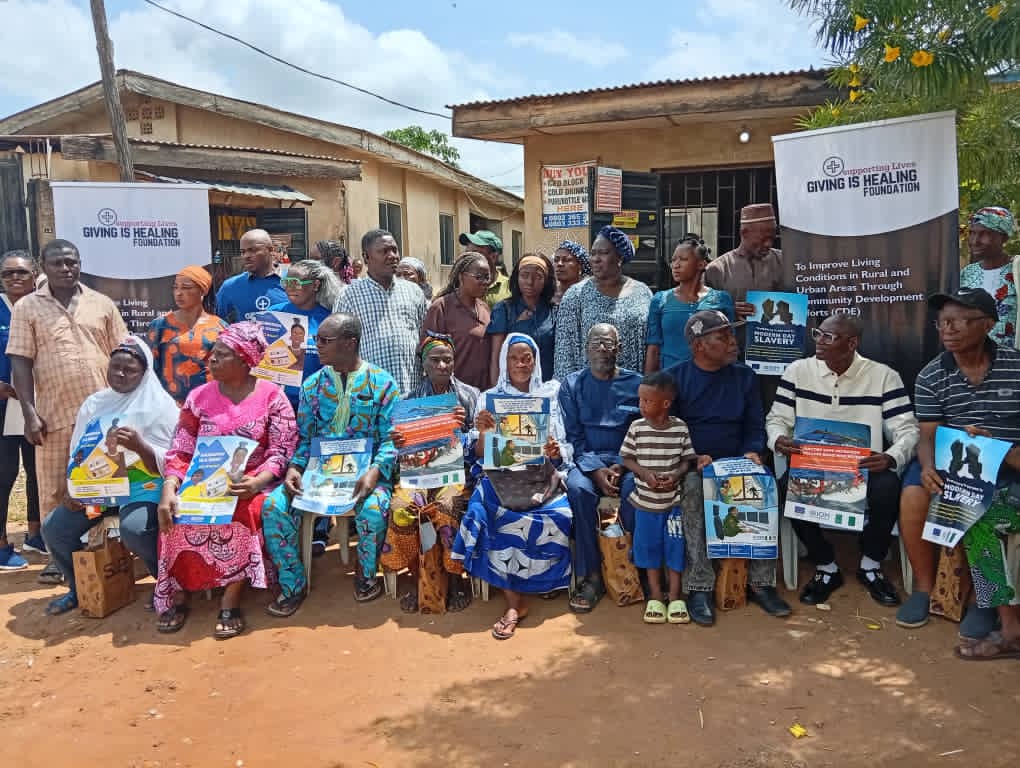
The International Organisation for Migration (IOM), in collaboration with Giving is Healing Foundation, has sensitised residents of Ayobo in Alimosho Local Government Area of Lagos State on the dangers of irregular migration and the need to embrace legal travel procedures.
Speaking during a sensitisation programme held at Megida Ifelodu Community Development Association in Ayobo, the founder of Giving is Healing Foundation, Mr. Gbolahan Ayediran, warned intending migrants against using illegal travel routes.
Ayediran said many Nigerians desire to migrate abroad in search of better opportunities but often ignore proper procedures, thereby exposing themselves to several dangers.
“Lots of people want to migrate and most of them do it in the wrong direction. The reason for the programme is for us to advise people on how they can migrate in the right way. As much as migration is their right, they should do it correctly,” he said.
READ ALSO:How Wike Rescued Me From Political Oblivion — Oshiomhole
He advised intending travellers to obtain the necessary travel documents before embarking on any journey, noting that such documents include international passports, visas, flight tickets and yellow cards, depending on the destination country.
According to him, migrants should also gather adequate information about their destination countries to enable them make informed decisions before travelling.
Ayediran further highlighted some of the dangers associated with irregular migration, including abuse, exploitation, discrimination and forced labour.
Also speaking, the Chairman of Megida Ifelodu Community Development Association, Elder Mathews Amusan, commended the organisers for enlightening members of the community on safe migration practices.
READ ALSO: He Can’t Fix His Party Let Alone Nigeria – Oshiomhole Blasts Atiku
He urged residents planning to travel abroad to always follow legal migration procedures to avoid falling victim to human trafficking and other migration-related challenges.
One of the participants, Mr. Kolawole Adenoko, said the programme enlightened him on the dangers of irregular migration and the importance of travelling through the proper channels.
He added that he would also educate his relatives and friends on the risks associated with illegal migration.
News
Shatta Wale Bailed Burna Boy From Ghana Prison After Arrest For Smoking Weed – Captan

Ghanian singer, Captan, has claimed that his former record label boss, Shatta Wale, once bailed Nigerian singer Burna Boy out of prison in Ghana after he was allegedly arrested for smoking weed.
Speaking in a recent podcast interview, Captan claimed that Shatta Wale sent him and others to free Burna Boy from police custody.
He also claimed that Shatta Wale and his group once accommodated Burna Boy when he was being hunted by some dangerous men.
READ ALSO: Wale Edun Opens Up After Sack
Captan said, “I once bailed Burna Boy out of prison in Ghana when he was arrested for smoking weed. Shatta Wale sent me and some guys to go and free him from police custody.
“There was a time we also accommodated him when some people were after his life. We helped him settle the case.”
He added that he and Burna Boy are no longer in good terms after the Nigerian artist’s fallout with his mentor, Shatta Wale.
He, however, said he and Shatta Wale are open to reconciling with Burna Boy if he asks for it.
Watch the video here
News
Children’s Day: Chaos At Ogbe Stadium As Dozens Faint
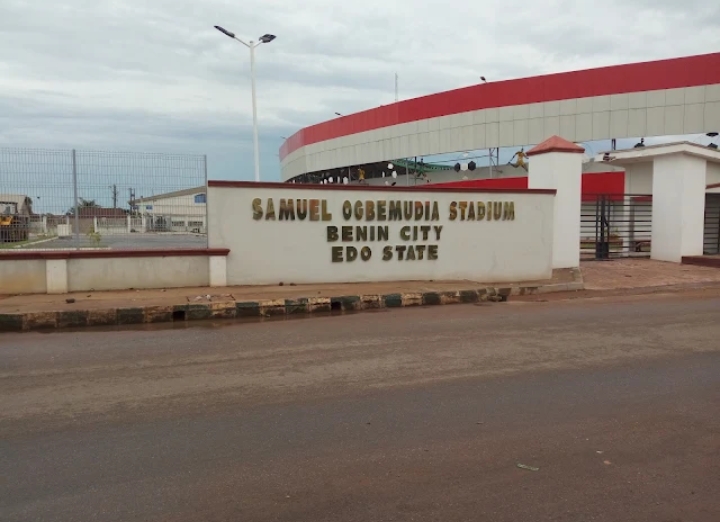
Chaos erupted on Wednesday during the Children’s Day celebration as dozens of students reportedly collapsed following a stampede triggered by the use of pepper spray.
The event,
organised by the Edo State Ministry of Education at the Samuel Ogbemudia Stadium was disrupted after some male students of Ihogbe College allegedly made uncompromising advances towards female students at the venue.
A parent who identified himself as Oboh Emmanuel said, “the behaviour of those uncultured students attracted the attention of bouncers stationed at the stadium as they rebuked the male students.”
Oboh said the affected students later regrouped and attacked the bouncers, leading to a confrontation within the crowded arena.
READ ALSO:Children’s Day: Edo Commits To Child Protection
It was gathered that in the ensuing confusion, the bouncers were reported to have deployed pepper spray in an area occupied by a large number of students.
Several students, particularly female students, reportedly fainted after inhaling the substance, while others sustained injuries after being stepped on during the ensuing melee.
The panic was said to have spread across the stadium as students, teachers and parents scampered for safety.
Many of the affected students were reportedly rushed to the Edo Specialist Hospital for medical attention.
READ ALSO: Egor LG Chair, Ogbemudia, Vice, Osawe Impeached
Reacting to the incident, Chief Press Secretary to Governor Monday Okpebholo, Dr Patrick Ebojele, said the security personnel that fired the tear gas had been detained.
He said all the students, except two, that were rushed to the hospital have been discharged.
Ebojele stated that doctors wanted to observe the students till tomorrow before allowing them to go home.
“The two students are not seriously injured. Doctors want to observe them overnight. Permanent Secretary, Ministry of Education is still at the hospital. The man who used pepper spray has been detained.
“The incident did not happen the way it is being exaggerated. All modalities were put in place to ensure the children enjoyed their day.”

 Headline4 days ago
Woman Passes Out After Receiving 100 Strokes Of Cane
- Headline4 days ago
JUST IN: White House Locked Down Briefly As Gunman Opens Fire At Security Checkpoint
- News3 days ago
More Pain For Nigerians As Cooking Gas Price Increases Nationwide
- Politics3 days ago
Two Masked Men Gun Down Politician In His Rivers State Hotel
- Metro4 days ago
Police Reject N500m Bribe, Recover N7.8bn Illicit Drugs In Lagos
- News3 days ago
FG Declares Two Days Public Holiday For Eid-el Kabir Celebration
- Politics3 days ago
‘Tinubu’s Borrowing In 24 Months Surpasses 55 Years’ Debt Record’
- Politics2 days ago
Court Clears Goodluck Jonathan To Contest 2027 Presidential Election
- News5 days ago
TCN Seeks Edo Govt, Community Support Against Power Infrastructure Vandalism
- News3 days ago
OPINION: Boko Haram Comes South


