
News
OPINION: Of Kings, King Kong And Honour

Tunde Odesola
Since 1933, when it hit the cinemas in the United States, the classic movie, King Kong, has undergone no fewer than 13 remakes. King Kong is a giant prehistoric ape ruling the mysterious Skull Island, where he is worshipped by dinosaurs, plesiosaurs, pterosaurs and numerous other monster creatures.
In the 1933 version, the story begins when an ambitious filmmaker, Carl Denham, takes his cast to Skull Island in the Indian Ocean territory for a jungle shoot, and the First Mate (assistant captain) of the ship, John ‘Jack’ Driscoll, falls in love with the deuteragonist, Ann Darrow. A deuteragonist is the second lead character while the protagonist is the lead character in a drama or movie.
The blond and beautiful Ann is captured by Skull Island natives who offer her to their king as a befitting sacrifice, setting humans and animals on a collision course which encapsulates the themes of man’s perpetual violation of nature, racism, exploitation, fear and love.
More powerful than any monster ever, the 25-foot tall King Kong falls in love with Ann, and gingerly holding her in his palm, remains determined to protect Ann from love-struck Jack and other crew members trying to rescue her. Though he’s a beast, King Kong navigates the intersection between primal instinct and civility by exuding love for blondie Ann, a human being, smoothening the jagged edges of animal-human borders.
In violation of nature, the crew captures King Kong, the protagonist, ships him to New York, and presents him to Broadway theatre audience in an exhibition dubbed “Kong, the 8th Wonder of the World,” with Jack and Ann posing beside Kong, rendered unconscious by a gas bomb since he was captured on Skull Island.
The blinding light from photographers’ cameras irritates the dazed Kong, who breaks loose, wrecking buildings, trains, vehicles, public utility poles and cables etc, as he picks Ann up like a piece of fried plantain and makes a dash for the 102-storey Empire Building which he climbs to the zenith.
MORE FROM THE AUTHOR: OPINION: I Will Make You Disappear!
Four planes face King Kong with fire, trying to shoot him off the building. He places Ann, his beloved, in a safe place and faces his adversaries, swatting and destroying one of the planes. In destroying the plane, Kong is injured while the gunfire intensifies. Momentarily, Kong takes his eyes off the planes and looks towards Ann, a fatal error that enables the three other planes to have good shots at him. He falls off to the ground, where a bewildered crowd quickly gathers in the final moments.
Fittingly, Jack reunites with his love, Ann. Denham, who makes his way to the scene of the fallen beast, overhears a policeman saying the planes got Kong, but he responds, “Oh, no, it wasn’t the planes. It was Beauty that killed the Beast.”
There are kings and there are kings. King Kong ruled his Skull Island. The eagle rules the air. The elephant rules the jungle. The blue whale rules the sea. I know an oba in Osun who rules with dignity and honour on the àpèrè of his forefathers.
Genealogically, the road to the palace is not paved with gold alone. It is also caked in the blood of revolution and hate. Faced with dwindling economic fortunes, the high cost of monarchy, political upheavals and the appeal democracy offers, many countries have consigned their kings and queens to the dustbin of history.
On January 21, 1793, King Louis XVI lost both his crown and head to the guillotine – in the aftermath of the 1792 French Revolution, making him the last monarch to live in the Palace of Versailles, taking to his grave the fitting nickname of ‘Louis the Last’.
The ruler of Russia, Tsar Nicholas II, bit the dust during the Russian Revolution of 1917, drawing the curtain on monarchy in the Soviet country. And in 1918, after World War I, Germany kicked out its king, Kaiser Wilhelm I, and locked the palace forever. After Mussolini fell and a republic was established in 1946, a referendum nailed the coffin of monarchy in Italy just as China transited to a republic in 1912 during the Xinhai Revolution which abolished the Qing Dynasty.
Brazil sacked its king in 1889 after a republican military coup while Greece showed King Constantine II the exit door of the palace in 1973, following a referendum by military coupists. But Spain, which abolished monarchy between 1931 and 1939, restored it in 1947. Indeed, red and gold are the road to the palace.
MORE FROM THE AUTHOR: Biden Announces $160bn Initiative To Aid Developing Nations
In the 20th Century, monarchies were abolished in Afghanistan (1973), the Ethiopian monarchy that lasted for almost 3,000 years ended with Haile Selassie in 1974, Vietnam (1945), and Iraq (1958). Recently, Nepal and Barbados kicked out the monarchy in 2008 and 2021 respectively.
Unlike Africa and Europe, monarchy remains strong and vibrant in the Middle East though social reforms are gradually tempering the sword of absolutism with change.
In Nigeria, the desirability or otherwise of monarchy is like the waves of the sea, rising and falling, peaking and ebbing, a mixed bag of the Good, the Bad and the Ugly.
Among the Ugly is the Canada-returnee jailbird king who oversmokes Indian hemp, beats his wife and royal colleague, and fights culture and tradition; a madcap desecrator of the throne who will never heed the caution of the odíderé until he perishes.
Among the Bad are the kings who run errands for politicians and support bad government policies – like that Abacha-dark-goggled king who advised the Igbo to go and perish in the lagoon so that the son of the owner of the brass mortar may reign. As a lover of culture, I won’t call for the abolition of monarchy in Nigeria though the temptation is high.
There are many good kings in Yorubaland, though the eyes cannot miss some black sheep among the flock. But lest I be accused of nepotism, I’ll name one oba in Osun, my state of origin, though Lagos is my state of birth; I’ll name one oba in Ondo, one in Ogun and one in Oyo as exemplars of nobility. This is not to say there are no good kings in Lagos and Ekiti states. There are many, but I’m probably not close enough to them – to talk about them.
At times, I wonder how lucky the Ekimogun people of the Ondo kingdom are by having as the Osemawe, Oba Adesimbo Kiladejo. Another worthy king I know is the late Towulade of Akinale kingdom in Ogun State, Oba Olufemi Iyanda Okesooto Ogunleye, journalist and lawyer, who died on June 19, 2024, after bagging a PhD at 80.
MORE FROM THE AUTHOR: OPINION: Discussing Portable, Apostle Suleiman, Fufeyin And The Chosen (2)
On October 22, 2024, I was strolling on Facebook Street when I saw a post by Diran Odeyemi, a popular Peoples Democratic Party chieftain in the South-West. The post says, “Do you know this school? Abolarin College, Oke-Ila, Osun State. No school fees. Free hostel. Free food. Free internet. Free uniform. Free laptop for every child. 24/7 power supply. All paid by the town’s king. The king teaches too in the school. We should celebrate such a Nigerian. What makes this school remarkable is that one major criterion for getting admitted is being poor. If your parents are rich, you cannot get admission. Unlike other schools, Abolarin College wants poor kids who are very brilliant…From what I gathered, the king has only one wife. He’s not using the money of the kingdom to accumulate wives or properties.”
Every Osun journalist worth their salt knows Oba Abolarin, whose nickname is Doxy. I got to know the 66-year-old king when I worked in Osun. I know his school, too. I know students from the North, East and West of Nigeria are in his school. I also know he has two first degrees – one in Political Science, the other in Law – both from the Obafemi Awolowo University, Ile-Ife.
As an honourable king and ègbón, I know Doxy up-close; he’s highly cerebral and doesn’t brook conflict or crave attention. Like the almighty sun in heaven that dries up wet clothes on earth, you will see the actions of Doxy without seeing his person.
Two other Nigerians whose actions pleasantly shocked me in recent times are the Asiwaju of Igbajoland, Chief Adegboyega Awomolo, and a former House of Reps member from Ogun State, Hon. Lanre Laoshe, both of whom refunded a federal government student loan they received in the 1970s.
Asiwaju means leader and Awomolo leads on many fronts. He is Osun’s first Attorney-General and Commissioner for Justice as well as Osun’s first Senior Advocate. He told me in an interview that he had been contacting the Office of the Accountant General of the Federation since 2012 to pay his student loan indebtedness but no official told him what account to pay into, adding that each time he saw his loan affidavit, he became weighed down.
“The idea behind student loans is good. I commend President Tinubu for resuscitating the scheme. I spoke with four different Accountant Generals of the Federation since 2012 when I wanted to pay N50k. In 2018, I wanted to pay N1m, but I just followed God’s direction and I’ve now paid N2m for a loan of N1,000 I took in 1975 If NEFUND wants me to pay more, I will.”
Laoshe, who took a student loan of N1,200 in 1976, repaid N3.1m, reportedly using a table of average annual exchange rates from 1972 to 1985 from the Central Bank of Nigeria to calculate what he owed the government.
My father and mother didn’t owe student loans. Please, ask your parents to pay up if they are owing. As we, the masses, hold government accountable, we should look at ourselves, too. Surely, Nigeria needs more men and women with conscience.
Email: tundeodes2003@yahoo.com
Facebook: @Tunde Odesola
X: @ Tunde_Odesola



News
NMA To Withdraw Medical Services In Edo Over Kidnapped Colleagues

The Nigeria Medical Association (NMA), Edo State Branch, has threatened to withdraw medical services across the state, effective from Saturday, 10 January, 2026.
This followed the recent abduction of two medical doctors on January 1st and 2nd, 2026.
Chairman of the NMA Edo State branch, Dr. Eustace Oseghale, in a statement made available to newsmen in Benin on Friday, stated that the withdrawal of services was a direct consequence of the abduction of their colleagues and a reflection of the heightened sense of vulnerability among medical practitioners in the state.
READ ALSO:Doctors’ Strike Continues As NARD Demands Fair Deal, Better Pay
Oseghale, on behalf of the NMA, called for immediate release of the abducted doctors and implementation of measures to prevent future incidents.
The statement reads: “This incident raises concerns about healthcare professionals’ safety in Edo State, threatening their lives and undermining healthcare delivery.
“We demand the immediate release of our abducted colleagues as well as enhanced security protocols for Edo State residents and regular engagement between NMA Edo and the Edo State Government on security concerns.”
READ ALSO:Edo Targets 2.2 Million Children For Measles, Rubella Vaccination
The NMA Chairman, while insisting on withdrawal of services statewide if their demands aren’t met, stressed that a safe working environment is crucial for healthcare providers.
“We’ll continue to withhold services until our demands are met and colleagues are safe.
“We urge a swift resolution and the safe return of our colleagues. Security operatives should take this seriously, as they’ll be held responsible for the consequences of our action,” Oseghale said.
News
Edo Targets 2.2 Million Children For Measles, Rubella Vaccination
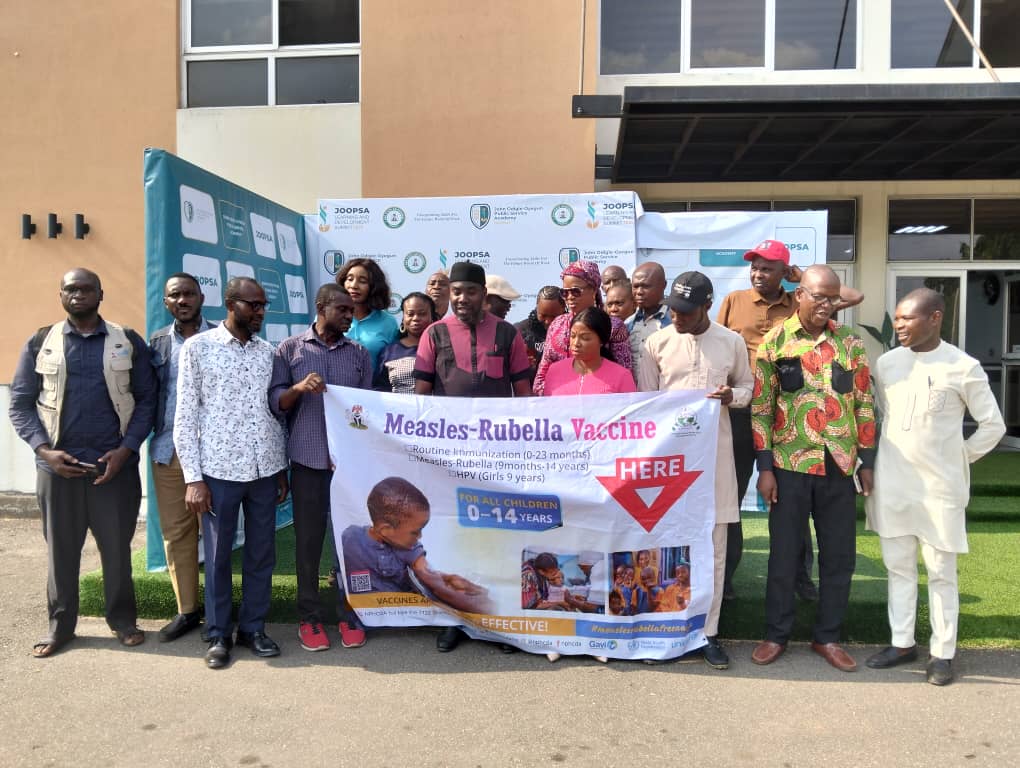
The Edo State Government says it is targeting about 2.2 million children aged between 0 and 14 years for measles and rubella vaccination across the state.
The Director of Disease Control and Immunization at the Edo State Primary Health Care Development Agency, Dr. Eseigbe Efeomon, who disclosed this during stakeholders’ sensitisation meeting in Benin City, said this would be done in collaboration with development partners.
Efeomon, while noting that the vaccination exercise scheduled to hold simultaneously from January 20 to January 30, 2026, across the 18 local government areas of Edo State at designated health facilities and temporary vaccination posts, said the campaign aims to contribute significantly to the reduction of measles and rubella in Nigeria.
He explained that achieving this target requires increased population immunity through sustained vaccination.
READ ALSO:Man Arrested In Edo For Alleged Abduction Of 4-year-old
Dr. Efeomon stressed that only qualified and certified health workers would be recruited as vaccinators because the vaccines are injectable.
According to him, the vaccination strategy would involve fixed posts and temporary fixed posts, and vaccination cards would be issued to all vaccinated children as proof, which parents and caregivers are advised to keep for future reference.
He added that vaccination teams would visit schools, churches, mosques, markets, motor parks, internally displaced persons’ camps and other public places, while children who receive the vaccine would be finger-marked to prevent double vaccination.
He reiterated that the overarching goal of the campaign is to drastically reduce rubella incidence nationwide and protect children from preventable diseases through effective immunisation coverage.
READ ALSO:Edo widow-lawyer Diabolically Blinded Over Contract Seeks Okpebholo’s Intervention
Also speaking, the World Health Organization Local Government Facilitator, Mr. Ajaero Paul, described measles and rubella as major causes of death and congenital abnormalities among children globally.
He said both diseases are preventable through the measles-rubella vaccine, which he described as safe and effective,
He added that sustained advocacy is critical to reducing child mortality and lifelong disabilities.
On his part, UNICEF Social and Behavioural Change Health Officer, Yakubu Suleiman, emphasised that the measles-rubella vaccine is safe and effective for all children aged nine months to 14 years.
READ ALSO:Edo: Suspected Kidnappers Kill Victim, Hold On To Elder Brother
He stated that the government has fully paid for the vaccines, making them available at no cost to all eligible children in government health facilities across the state.
Suleiman explained that vaccination not only protects individual children but also safeguards communities from deadly vaccine-preventable diseases such as measles and rubella.
He added that even children who had previously received the measles vaccine should still be given the measles-rubella vaccine and appealed to schools and other key stakeholders to support the campaign to ensure that no child is left behind.
News
Togo, Niger, Benin Owe Nigeria Over $17.8m For Supplied Electricity – NERC

Nigeria’s electricity regulator has disclosed that three neighbouring countries, Togo, Niger and Benin, are indebted to Nigeria to the tune of $17.8 million, equivalent to more than N25 billion at prevailing exchange rates, for power supplied under bilateral electricity agreements.
The Nigerian Electricity Regulatory Commission, NERC, made this known in its Third Quarter 2025 report, which reviewed market performance within the Nigerian Electricity Supply Industry, NESI.
According to the report, the international customers were billed a total of $18.69 million by the Market Operator for electricity supplied during the third quarter of 2025. However, only $7.125 million was paid, leaving an unpaid balance of $11.56 million for the period under review.
NERC also revealed that the same international offtakers had outstanding legacy debts amounting to $14.7 million from previous quarters. Of this amount, $7.84 million was settled, leaving a residual balance of $6.23 million.
READ ALSO:Expert Identify Foods That Increase Hypertension Medication’s Effectiveness
When combined with the Q3 2025 shortfall, the total outstanding debt stood at $17.8 million, which translates to about N25.36 billion at an exchange rate of N1,425 to one US dollar.
The regulator identified the international electricity customers as Compagnie Énergie Électrique du Togo, Société Béninoise d’Énergie Électrique of Benin Republic, and Société Nigérienne d’Électricité of Niger Republic.
NERC stated that the three utilities collectively paid just $7.125 million against the $18.69 million invoice issued for electricity supplied in the third quarter, resulting in a remittance performance of 38.09 per cent.
This meant that more than half of the billed amount remained unpaid at the close of the quarter.
READ ALSO:Electricity Workers Threatens Shutdown Over Staff Brutality
The commission explained that the electricity exported to the three countries was generated by grid-connected Nigerian generation companies and delivered through cross-border bilateral power supply arrangements.
By contrast, NERC reported a stronger payment performance among domestic bilateral customers. According to the report, local customers paid N3.19 billion out of the N3.64 billion invoiced for the same quarter, representing a remittance rate of 87.61 per cent.
The regulator further noted that some bilateral customers, both international and domestic, made additional payments to offset outstanding invoices from earlier quarters.
READ ALSO:Reps Ask NERC, DISCOs To Reverse Band A Tariff Hike
Specifically, the Market Operator received $7.84 million from international customers and N1.3 billion from domestic customers in settlement of previous obligations.
Beyond bilateral transactions, NERC disclosed that Nigeria’s 11 electricity distribution companies remitted a total of N381.29 billion to the Nigerian Bulk Electricity Trading Plc and the Market Operator in the third quarter of 2025. This was out of a cumulative invoice of N400.48 billion, translating to an overall remittance performance of 95.21 per cent.
The commission said the figures were derived from reconciled market settlement data submitted as of December 18, 2025, as part of its statutory evaluation of the commercial health and performance of the electricity market.

 News5 days ago
What I Saw After A Lady Undressed Herself — Pastor Adeboye
- Headline5 days ago
PROPHECY: Primate Ayodele Reveals Trump’s Plot Against Tinubu
- Metro5 days ago
Armed Robbers Shot PoS Operator To Death In Edo
- Business4 days ago
NNPCL Reduces Fuel Price Again
- Metro4 days ago
AAU Disowns Students Over Protest
- Metro5 days ago
Joint Task Force Kills 23 Bandits Fleeing Kano After Attacks
- Politics5 days ago
2027: Rivers APC Pledges To Follow Wike’s Instructions
- Headline2 days ago
Russia Deploys Navy To Guard Venezuelan Oil Tanker Chased By US In Atlantic
- Metro4 days ago
Edo: Suspected Kidnappers Kill Victim, Hold On To Elder Brother
- Metro4 days ago
Nine Soldiers Feared Dead In Borno IED Explosion


