
News
OPINION: Petrol Pains, Wilderness Wanderings

By Lasisi Olagunju
A young taxi driver sat on the bonnet of his car some years ago thoroughly frustrated by Nigeria’s unending petrol mess. A television reporter asked him to speak on his experience in that filling station where he sat, stranded. He looked straight into the camera and said he wanted “the world to come to an end, this moment. I want all of us to die – all.” He thought Nigeria was a wilderness with a succession of fake Moses leading the country from Egypt to Egypt. To the taxi driver, mass death of victims and their victimisers would be the neat, equitable way to end all suffering. I watched the video and heard more than what the gentleman said. People who think and say what he said are persons who have run and got to the end of running. They are people who have shifted and shifted and have hit the wall.
Over the course of life, suffering, one way or the other, is inevitable. We do not need a priest to convince us of that. But, why is it that here, in this country, time and change give no relief to the poor?
As I write this, everyone is at the petrol station – exactly as they were 30 years ago when they thought democracy was the messiah that would dry their tears. In petrol stations where there are no queues, the price there is killing; where the price smiles a little, bedlam reigns. If matters remain as they are, driving a car anywhere in Nigeria will soon be a mark of the beast, the ultimate evil. Very soon (and I am so scared to say this), having money to buy petrol will be an exposure to marks of the dragon – the kind that is in the Christian Bible: ten horns, seven heads, “with ten crowns on his horns, and on each head a blasphemous name.” Why is this democracy this ugly and so unprofitable to the people?
There is a joke about a man from Israel who demanded to know why Moses promised his ancestors good life, took them out to wander in the wilderness for forty years only to deposit them in a land that has no oil. I won’t be shocked to hear this said about our democracy. What is the worth of that struggle and that vote that birthed this suffering?
Our dog boasted in the last election that there was no danger in Tiger’s forest. That boast appears to have killed it. A saying in Yoruba approximates this: Ajá kì í dán’nu kò séwu lóko ẹkùn. Stealthy, strong Tiger is an ambush, apex predator; dog is one of its preys. The wisdom here eluded many who refused to trust the truth. They are now left behind, stranded by their faith in man born of woman. In their bowl of gaari, they now have water in destructive excess.
FROM THE AUTHOR: OPINION: Sending Ooni Of Ife To Tinubu
You are a very senior professor. Your monthly salary is N700,000, pre-tax. This past weekend, you and other petrol users bought a litre for N1,000. Your car uses 10 litres of petrol per working day. There are five working days in a week. That gives your car 50 litres of petrol per week, the cost is N50,000. There are four weeks in a month. Fifty thousand naira in four places makes it N200,000 – just to fuel your car. Because your residence is allocated Band E by NEPA, your ‘I-better-pass-my-neighbour’ generator will use 10 litres of petrol per day. In 30 days, that gives you 300 litres of fuel. At N1,000 per litre, the cost is N300,000. Do the maths. Petrol alone takes N500,000 from your pre-tax N700,000 salary. Tax takes about N120,000. Do the maths again. What is the way out? The Yoruba will join you to ask: Kí ni ònà àbáyo? Kí ni?
With ‘Darkness Falls’ as its title, the second part of Ngugi Wa Thiongo’s Weep Not, Child is about a country in distress, about a village where light is morbid and darkness is saviour. It is about a home that is no longer a place for telling good stories. It is here that we are asked to “turn to the Gospel according to St Matthew, Chapter 24.” Here we are told that we “shall hear of wars and rumours of wars” and that “nation shall rise against nation, and kingdom against kingdom: and there shall be famines, and pestilences, and earthquakes, in diverse places.” We are told that as horrible as these occurrences are, “they are (just) the beginning of sorrows…And because iniquity shall abound, the love of many shall wax cold.”
Could this moment be Nigeria’s hour of that prophecy? The havoc wreaked in town today is worse than the experience of the ill-starred, anecdotal sentry of Apomu whose oracle (ifa) got stolen and his wife snatched. He reached for his divining chain (òpẹ̀lẹ̀) and saw it in the mouth of an audacious dog. He pursued the dog to retrieve his last hope but the dog ran and jumped into a deep well. While panting, the distraught man was asked what next? “It is time to leave this town,” was his response – (Ìlọ yá Oníbodè Àpòmù, wón kó o ní’fá, wón gbà á l’óbìnrin, òpẹ̀lẹ̀ tí yíò tún fi tọ ẹsẹ̀ e rè, ajá tún gbé e lọ. Ó lé ajá, ajá kó sí kànga. Wón ní, ‘Ilọ yá àbí kò yá?’ Ó ní, ìlọ yáá…).” Today is worse than that hopeless situation. I have never been as afraid for Nigeria as I have been in the last one week.
MORE FROM THE AUTHOR: OPINION: For Yoruba Muslims And Pentecostals
The people are hopeless and helpless but they are quiet. And that is dangerous. There is a passage in Chinua Achebe’s Things Fall Apart which warns about silence and its potent danger: “Mother Kite once sent her daughter to bring food. She went and brought back a duckling. ‘You have done very well,’ said Mother Kite to her daughter, ‘but tell me, what did the mother of this duckling say when you swooped and carried its child away?’ ‘It said nothing,’ replied the young kite. ‘It just walked away.’ ‘You must return the duckling,’ said Mother Kite. ‘There is something ominous behind the silence.’ And so Daughter Kite returned the duckling and took a chick instead. ‘What did the mother of this chick do?’ asked the old kite. ‘It cried and raved and cursed me,’ said the young kite. ‘Then we can eat the chick,’ said her mother. ‘There is nothing to fear from someone who shouts.’ Nigeria’s streets are scanty and sad; neighbourhoods are dank and dark. Where the ice of fuel scarcity appears to be thawing, the price has remained prohibitively high. In food markets, traders’ looks are forlorn; buyers’ heartbeats are irregular. There is darkness in every home where light used to shine. Yet, there is quiet, silence, midnight, graveyard chill where prophets used to warn.
In Matt Lorenz’s ‘The Meaning of life in the Wilderness’, we are told that “the wilderness is a space where human beings can go morally astray.” True, many and more have gone astray here. Henry Bugbee, in his The Inward Morning, says that “our true home is (the) wilderness.” I read this and wanted to disagree. I wanted to ask how our home could be the wildness -uncultivated, uninhabited, inhospitable wild. But, then, I remember William Butler Yeats’s thoughtful line: “…the world is more full of weeping than you can understand.”
As long as we breathe, we keep hoping (and praying) for deliverance from evil. There is a line of divine promise in Ngugi’s ‘Darkness Falls’: “But he that shall endure unto the end, the same shall be saved…” He was quoting the Bible.
We will endure this to the end because we’ve been promised salvation. But, when is the end and where is the saviour? Or, when is the saviour coming? The government is quiet and silent. It acts the perfect I-don’t-care way of lords who have climbed the hills and have seen the very end of the world. But its defenders are not quiet. They blame the past and point at similar acts of official betrayal. What is in uniformity is no longer a shame. There is no new thing under the sun. They open history books of countries outside Africa, the first world. They say “even America once suffered what we suffer. We will be out of the problem one day.” They say the media of that and other countries still reminisce about their own era of anomie. One of such reflections is Reis Thebault’s “Long lines, high prices and fisticuffs”, a Washington Post’s 2023 video on the 1970s petrol shortage bedlam in America. “The line of cars stretches for blocks. Pumps run dry. Newspapers warn of a great ‘gas crunch.’ President urges calm. Panicked motorists turn on one another.” Thebault wrote, mimicking headlines from Nigeria’s future. If the abobaku of this regime come to see this Washington Post content, they will grab it with eureka; they will use it as a justification for the criminal betrayal that professed this suffering. What a country!
MORE FROM THE AUTHOR: OPINION: Bobrisky’s Masque, Yahaya Bello’s Boa
The elephant’s hunger is the shame of the forest. America would have remained where it was in 1970 if what it had were bumbling leaders like ours. To the US, the owner would rather starve than for the thief to be without food. We have that proverb, the United States appropriated it long ago to solve its “pumps run dry” problem. I always wonder why the elephant of oil-rich Nigeria keeps rumbling in the forest and goes to bed hungry. Imagine the Eskimo queueing for ice. But here, children of butchers fight over bones.
What really is the cause of this fuel scarcity? There is neither cohesion nor coherence in the little we’ve heard from persons who sit atop our welfare. All we’ve seen (and we are seeing) are quick-and-slow marches of crass confusion. What are they doing apart from fixing themselves up in vaults? The sheep of Nigerians won’t forget if they do well and provide it just bran. But they are behaving like àgbà òsìkà sowing suffering in people’s lives. They soil their breast pockets with red oil of impunity and keep a straight face. Is it true that this is all about jacking up the price of petrol as instructed by the holders of the Nigerian yam and knife? It is like land grabbers setting fire to a whole market because they covet the land. They are killing us without drawing a sword (apanimáyodà). But, they can eat their excess without scorching the city. Unfortunately, that is what they are doing with their take-it-or-leave it disposition to the petrol wickedness they put on the table. It is dangerous.
I borrow again from Yeats. In his ‘The Wind Among the Reeds’, the poet tells the powerful that he, “being poor” has only his dreams to nurture and keep. Then he begs them: “I have spread my dreams under your feet;/ Tread softly because you tread on my dreams.” The people are the eye of the earth. If this government must tread on them, it should do so gently.
The author, Dr. Lasisi Olagunju is the Saturday Editor of Nigerian Tribune, and a columnist in the same newspaper. This article was first published by the paper (Nigerian Tribune). It is published here with his permission.



News
Six Corps Members Receive N10m Grants To Boost Agribusiness
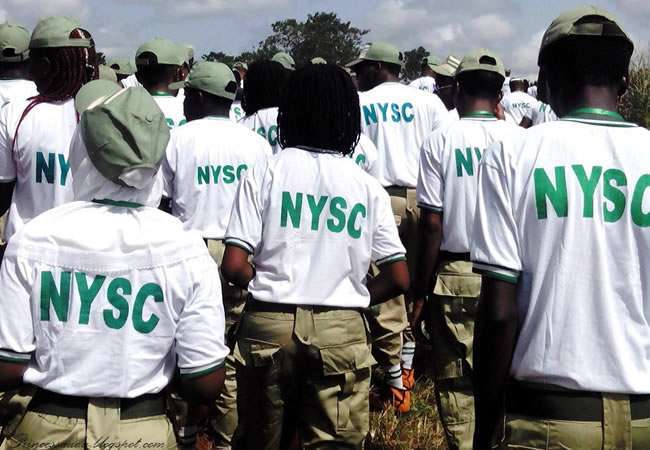
Six members of the National Youth Service Corps (NYSC) have received a total of N10 million in grants to expand their agribusiness ventures under the Farmers for the Future Programme.
The programme was organised on Monday by the British American Tobacco Nigeria Foundation (BATNF) in collaboration with the NYSC to encourage young Nigerians to embrace agriculture and develop sustainable businesses.
Presenting the cheques to the beneficiaries in Abuja, the NYSC Director-General, Brigadier General Olakunle Nafiu, urged Corps members to maximise the opportunities provided by the service year by venturing into commodity marketing and other viable businesses.
Nafiu said agribusiness remained a viable avenue for young people to build sustainable enterprises, create employment and generate wealth.
READ ALSO: NYSC Swears In 1,600 Corps Members In Bauchi
He also stressed the importance of value addition to the success and sustainability of business ventures, while commending BATNF for placing Nigerian youths at the centre of its entrepreneurship initiatives through value-chain development, employment creation and its partnership with the NYSC.
“I charge you to spread the news around. We have seen the outcome, and it is a good idea,” he said.
The beneficiaries are Dominic Olufemi (FC/25C/1143), who received N3 million; Temitope Adewole (ED/26A/2251), N2 million; Abdulwaheed Bala (ED/25B/1402), N2 million; Olanike Mayungbe (OG/26B/1037), N1 million; Kingsley Udoeyen (KG/26A/1735), N1 million; and Lorember Lorsue (JG/25B/1742), N1 million.
Speaking on the selection process, the Acting Director, Skills Acquisition and Entrepreneurship Development (SAED), Mrs Winifred Shopeka, said the programme began with an online registration portal through which Corps Members engaged in agribusiness submitted their business plans.
READ ALSO: NCCSALW Deploys NYSC Members In Fight Against Illegal Arms In Northeast
She said nearly 3,000 Corps members applied and underwent a rigorous selection process that produced 20 finalists.
According to her, the finalists participated in a boot camp and a final pitching session, which produced the 10 best presenters before the six ultimate winners were selected.
Shopeka said the beneficiaries had also been mentored and attached to established market operators to assist them in marketing their products.
She added that Corps Members who did not make the final stage of the competition were also trained by BATNF.
The BATNF Team Lead, Mr Oludare Odusanya, congratulated the beneficiaries and urged Corps Members engaged in agribusiness to master the fundamentals and acquire the knowledge and skills necessary to succeed.
“We are happy with our collaboration with the NYSC, and it will continue,” he said.
READ ALSO: NYSC Lauds Gov. Mohammed’s Intervention In Fence Collapse
Odusanya explained that BATNF was an independent organisation established to contribute to poverty reduction in Nigeria through sustainable agricultural practices and other interventions.
He said the Farmers for the Future Programme was instituted in collaboration with the NYSC to encourage Corps Members to venture into agribusiness and become job creators.
He added that the beneficiaries would be attached to mentors who would guide them towards achieving success in their respective businesses.
According to him, the programme has, since its inception, continued to enhance the entrepreneurial capacity of Corps Members.
News
CBN Reduces Interest Rate To 23%

The Central Bank of Nigeria (CBN) on Tuesday announced the reduction of the interest rate, also known as Monetary Policy Rate (MPR) to 23 percent.
Briefing the media in Abuja, the Governor of the CBN, Mr. Olayemi Cardoso, said at the 307th MPC meeting held on September 22, 2026 agreed the resetting of the MPR and recaliberation of the monetary policy market.
According to Cardoso, the committe is satisfied with the disinflation progress, adding that members noted stable banking sector following successful recapitalisation.
READ ALSO: CBN Monetary Tightening Worsening Nigeria’s N50tn Development Finance Gap – Group
Meanwhile, according to Nigerian Tribune, reports that that the MPC, at its 306th meeting in July 2026, disclosed its resolution to retain the interets at 26.5 percent.
According to the Governor of the CBN, Olayemi Cardoso, “the Committee’s decision to maintain the current policy stance followed a thorough assessment of the balance of risks. Although headline inflation moderated marginally in June 2026, global uncertainties have heightened, due mainly to the renewed hostilities in the Middle East.
“In view of the evolving developments, maintaining a cautious monetary policy stance remains appropriate. In arriving at its decision, the Committee noted the recent resurgence of hostilities in the Middle East, with particular attention to its spillover effects on global energy prices and the potential pass-through to domestic inflation.”
News
NURTW: KWAM1 Settles Long-time Rift Between MC Oluomo, Tafa Sego
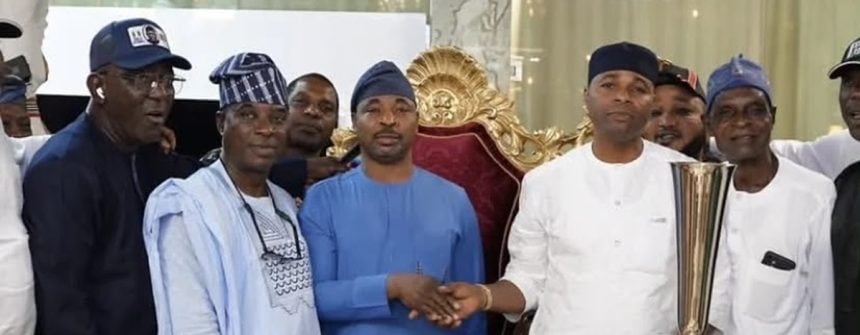
Nigerian Fuji musician, Wasiu Ayinde Marshal, popularly known as KWAM1, has brokered a peace deal between the National Union of Road Transport Workers (NURTW) National President, Musiliu Akinsanya, popularly known as MC Oluomo, and the Lagos State Chairman of the union, Mustapha Adekunle, aka Tafa Sego.
The reconciliation took place at Ojusagbola in Ijebu, Ogun State, where several NURTW chieftains gathered for the meeting.
The development was announced on Tuesday on KWAM1’s digital media page on Instagram, alongside photographs from the meeting.
According to the post, the two union leaders have resolved their differences after years of strained relations.
READ ALSO: Why FG Named KWAM 1 Aviation Security Ambassador — Keyamo
“After years of an age-long rift, MC Oluomo and Tafa Sego have finally settled their differences. And from what we know now, this is final,” the post said.
The musician was said to have intervened as the Mayegun of Yorubaland, with the aim of bringing an end to the longstanding disagreement between the two NURTW figures.
“K1 acted in his role as the Mayegun of Yorubaland by seeking an end to the long-standing rift, once and for all,” it said.
The post also described the meeting as a significant step beyond previous public displays of reconciliation.
READ ALSO: FG Gives KWAM 1 Aviation Appointment, After Airport Incident
“This time, it was not just another handshake for the cameras. The two old friends and colleagues came together at Ojusagbola, with King Wasiu Ayinde Marshal (K1) playing the peacemaker.”
Both MC Oluomo and Tafa Sego were reported to be pleased with the outcome of the intervention.
“Both parties are delighted about the new development,” the post said.
The two men had previously been allies and prominent figures within the Lagos NURTW before their relationship became strained amid disagreements linked to leadership of the union in the state.

 News2 days ago
BREAKING: Tinubu Extends Working Vacation
- News4 days ago
Six Hidden Health Benefits Of Unsweetened Zobo
- News4 days ago
Jehovah’s Witnesses Announce New Position On Blood Transfusion Policy
- News4 days ago
2027: Step-by-step Guide To Applying For INEC Ad Hoc Staff Recruitment
- News4 days ago
How 36 Nigerian States Got Their Names
- Headline4 days ago
Nigerian Man Jailed After Masturbating In Front Of Woman On UK Train
- Headline2 days ago
How To Format An Academic CV For US Master’s, PhD Applications
- News4 days ago
Stop Acid Reflux Pain: Foods You Must Ban From Your Kitchen
- Headline4 days ago
Nigerian Woman Arrested, Charged Over Illegal Voting In US
- News3 days ago
[OPINION] Wike-APC: Fights Always End Adultery


