
News
[OPINION] Rivers: The Futility Of Power And The Illusion Of Victory

By Israel Adebiyi
Power is a strange thing. To some, it is a crown that dazzles; to others, it is a sword that conquers. Yet history, both ancient and modern, is replete with reminders that power is fleeting, fragile, and often fatal to those who cling to it without wisdom. Nigeria’s Rivers State has, in recent months, provided a theatre where this truth has played out in its rawest form, a play in which the actors ranged from elected governors to godfathers in high places, from lawmakers turned pawns to a weary citizenry who bore the bruises of political combat.
As you may have learnt, the democratically elected Governor Siminalayi Fubara is back in the saddle. What a traumatising six months it must have been for the man who thought being the Chief Security Officer of his state truly makes him the man in charge. What a tormenting time it must have been for the legislature, those who, entrusted with making laws, would rather sink the ship of state than allow Fubara to sail. And what excruciating experience it must have been for the people of Rivers themselves: to have their choice nearly swapped for a civilian in khaki, to watch their lives held hostage by political gladiators in a power struggle that never had their welfare at heart.
At the centre of this drama stood the godfather, one who straddles Abuja and Port Harcourt, ministering to the Federal Capital Territory while seeking to lord it over Rivers, unchallenged. His triumphs and setbacks are well-documented, but the bigger question remains: what has the political elite learnt from all this? From potential godsons, to godfathers, to supporters, to the rest of us, the truth is painfully clear, no one wins in a state of anarchy, not even the chest-beating King Kong.
The Rivers imbroglio reinforces a timeless principle: governance does not happen in chaos. The seat of power may be occupied, but when the instruments of state are weaponised against one another, the business of the people suffers. Schools do not function, hospitals languish, investments are scared away, and trust in government crumbles. A peaceful atmosphere is the precondition for governance, for no policy, no matter how well-crafted, can thrive in the soil of instability.
MORE FROM THE AUTHOR:[OPINION] House Agents: The Bile Beneath The Roof
In this sense, what happened in Rivers is not new. History shows us that the vanity of power games leaves behind a trail of ruins. Rome, mighty and invincible, crumbled not because its armies lost their strength but because its leaders indulged in intrigues, conspiracies, and betrayal, weakening the republic from within. In Africa, the ghosts of Liberia’s civil war and Sierra Leone’s dark decade still whisper lessons of how political egos, once unchecked, descend into rivers of blood where the people are the ultimate casualties.
Even in more stable democracies, we see shades of this futility. Recall the Watergate scandal in the United States: an overreach of power that forced President Nixon’s resignation, not because America lacked laws, but because one man believed his political survival was above the rule of law. In Zimbabwe, Robert Mugabe’s prolonged hold on power may have begun with promises of liberation but ended with economic collapse and national despair. In all these, the lesson is the same: unchecked power, exercised without restraint, consumes itself.
The real victims of Rivers’ crisis are not the gladiators in high office; they will always find soft landings. The true casualties are the people, the market woman in Port Harcourt whose business was disrupted by endless protests and palpable fears, the civil servant whose progress and commitment are beclouded by uncertainties, the student whose classroom leaks under the rain because the funds for renovation are trapped in political crossfire.
What is often forgotten in the heat of power play is that governance is not an abstract exercise; it is the daily bread of the people. When leaders quarrel, roads go untarred, hospitals go unequipped, and children go unfed. To reduce governance to a chessboard of egos is to mortgage the people’s welfare for vanity. This, tragically, is the recurring story in Nigeria’s democratic experiment.
MORE FROM THE AUTHOR:OPINION: 200k – The Shameful Prize For Academic Excellence
Philosophers have long wrestled with the meaning of power. Shakespeare, in Macbeth, captured it as “a walking shadow, a poor player that struts and frets his hour upon the stage and then is heard no more.” The story of Rivers is a fresh Nigerian adaptation of this drama. For months, power appeared to belong to one, then another, and then another still. Yet in the end, it was revealed that no one truly wielded power in its purest sense, because power without legitimacy, without the consent of the governed, and without the peace to implement vision, is no power at all.
The futility of the Rivers crisis holds lessons for Nigeria as a whole. Across our federation, godfatherism continues to haunt governance. From Lagos to Kano, from Anambra to Oyo, the tussle between political benefactors and their protégés has become a recurring decimal. Rarely do these battles end in progress for the people; more often than not, they end in paralysis.
The comparison need not be far-fetched. Look at Kenya, where post-election violence in 2007 consumed more than 1,000 lives and displaced hundreds of thousands. The fault line was political ego, the refusal to let the people’s will stand unchallenged. It took the Kofi Annan-led mediation to restore peace. In the Democratic Republic of Congo, decades of instability trace back to leaders who personalised power, treating the state as property and the people as pawns.
Rivers may not have descended into outright war, but the undertones of instability remind us that democracy is not guaranteed; it must be guarded. When politicians play roulette with the rule of law, they court a descent into chaos that ultimately swallows everyone.
The Rivers episode should compel us to reflect on the foundations of Nigeria’s democracy. For too long, politics has been driven not by institutions but by personalities. Our allegiance is more to godfathers than to constitutions, more to individuals than to principles. Yet sustainable governance is only possible when the rule of law, not the whims of men, governs the game.
MORE FROM THE AUTHOR:OPINION: Ezekwesili, The NBA, And The Mirror Of Truth
What does this mean in practice? It means state assemblies must not be reduced to errand boys of powerful interests. It means governors must respect their oaths of office, governing for all, not just for loyalists. It means party structures must operate with transparency, giving room for dissent without retribution. Above all, it means citizens must rise in defence of their democracy, insisting that their mandate cannot be traded on the altar of ego.
The Rivers drama may be easing, but the scars remain. It was a sobering reminder that power, when divorced from service, becomes poison. That democracy, when stripped of rule of law, becomes anarchy. That in the final analysis, no one truly wins when the people lose.
From the godfathers to the godsons, from the lawmakers to the electorate, we must all acknowledge a shared truth: we are losers when power games eclipse governance. The real triumph is not in who sits in Government House, but in whether that House delivers schools, hospitals, jobs, and peace.
Let Rivers be a lesson to Nigeria: that power is not an end in itself, but a means to service. That peace is not weakness, but strength. And that the greatest legacy any leader can leave is not monuments of ego, but institutions that outlast them.
For if Rivers has taught us anything, it is that governance cannot happen in a state of anarchy, and the futility of power is revealed when its pursuit leaves the people broken. Let us, therefore, rise to build a democracy where power serves the people, not the other way round.



News
NAF Launches Attack On Terrorists In Borno
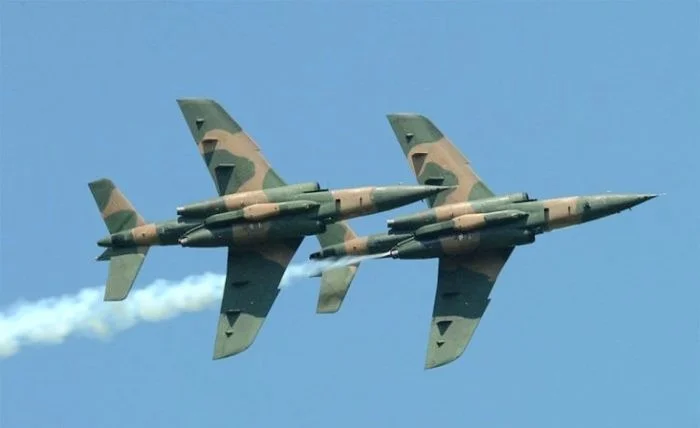
The Nigerian Air Force, NAF, operating as part of the joint task force of Operation Hadin Kai, has carried out a coordinated air interdiction at AbbagaJiri in the Timbuktu Triangle, Borno State.
According to Air Commodore Ehimen Ejodame, Director of Public Relations and Information of NAF, the air strikes successfully paved the way for ground troops.
He explained that the operation was based on actionable intelligence from multiple sources, which confirmed the presence of terrorists, their structures, and concealed logistics facilities in the area.
Ejodame stated that NAF air assets were deployed in integrated surveillance and precision strike roles to target identified threats.
READ ALSO:NAF Hits Bandit Logistics Hub, Neutralises Many In Zamfara
The operation aimed to degrade terrorist capabilities, deny them sanctuary, and shape the battlefield for ground forces, all while strictly adhering to rules of engagement and protecting civilians.
He added, “The Identified terrorist structures were decisively engaged and destroyed, denying the terrorists freedom of action, while a follow-up engagement neutralised armed elements observed converging on the location.”
“Subsequent advances by ground troops into the area confirmed the effectiveness of the air strikes and validated the success of the joint air–land operation.”
Speaking on the mission, Chief of the Air Staff (CAS), Air Marshal Sunday Aneke, said, “The success of the mission reflects the NAF’s resolve to dominate the air domain in support of joint operations.”
READ ALSO:NAF Hits Bandit Logistics Hub, Neutralises Many In Zamfara
Aneke further emphasized that the operation highlighted the service’s commitment to providing precise and decisive air power in support of ground forces.
In his words, “We will continue to deny terrorists freedom of movement, sanctuary, and logistics wherever they seek to hide. Air operations will remain relentless and intelligence-driven.”
“Our operations are carefully planned and intelligence-led, ensuring maximum effect on hostile elements while safeguarding innocent civilians.”
READ ALSO:NAF Announces Two-hour Road Closure In Abuja For 10km Walk
“The Nigerian Air Force will sustain pressure until terrorist networks are completely dismantled.”
He further noted that the operation showcased NAF’s aggressive stance, precision employment of airpower, and dedication to sustained joint operations.
Aneke added that such missions play a crucial role in enabling ground troops to maintain momentum and deliver decisive outcomes against terrorist networks threatening lives, property, and Nigeria’s national security.
News
Lagos Parks To Close For Maintenance – State Govt

The Lagos State Parks and Gardens Agency, LASPARK, has announced that all public parks under its management across the state will be temporarily closed for routine maintenance and upgrades.
In a statement released on January 9 and shared via its official platforms early Saturday, LASPARK said, “All parks under our management will be closed to the public from January 12 to January 31, 2026.
“This follows increased visitor activity during the recent festive season.”
The agency listed several popular recreational spots that will be affected, including “Ndubisi Kanu Park, Alausa JJT Park, Dr. Finnih Abayomi Park in Oregun, and all other LASPARK-managed parks across Lagos State.”
READ ALSO:
Explaining the reason for the closure, LASPARK added, “The temporary shutdown is necessary to carry out essential landscaping, facility repairs, and general upgrades to ensure that our parks remain safe, clean, and enjoyable for residents and visitors.”
The agency also stressed that the exercise aligns with its broader mandate, noting, “This maintenance programme is part of our commitment to providing well-maintained green spaces that promote relaxation, wellness, and environmental sustainability.”
LASPARK assured residents that “all parks will reopen at the end of the maintenance period.”
News
PAP Sends Additional 34 Foreign Post-graduate Scholarship Beneficiaries To UK Varsities

The Presidential Amnesty Programme (PAP) has deployed an additional 34 foreign post-graduate scholarship beneficiaries to various universities in the United Kingdom for the 2025-2026 academic year.
This was contained in a statement made available to newsmen in Warri by Mr Igoniko Oduma, Special Assistant on Media to Dr. Dennis Otuaro, the Administrator, PAP.
According to the statement, the scholars’ programmes include data science, fintech analytics, cyber security, international energy law and policy, construction project management, public health, agri-food technology, electrical and petroleum engineering, among others.
The statement added that more foreign post-graduate scholars will be sent to UK universities in the current academic session.
“In December 2025, nine students, who were the first set of offshore post-graduate scholarship developments by the PAP Administrator, Dr Dennis Otuaro, for the 2024-2025 academic year, graduated from their various programmes in UK universities.
READ ALSO:PAP Scholarship Scheme Vehicle For Better Future For Niger Delta —Otuaro
“Otuaro has deployed over 9000 students to universities within and outside Nigeria for different industry-relevant programmes since he assumed office in March 2024,” the statement partly reads.
Speaking at the pre-departure orientation programme for the scholars at the PAP headquarters in Abuja, on Thursday, Otuaro said that the large-scale deployment was aimed at making the Niger Delta a knowledge-driven region.
He said that his leadership reinvigorated the programme to give it a new momentum in service delivery to the people of the region based on the mandate of President Bola Tinubu.
Otuaro said, “We are sending all of you for post-graduate studies in various universities in the United Kingdom.
“The PAP now has a new momentum and direction because of the repositioning and broad reforms that we carried out in line with the mandate of His Excellency, President Bola Ahmed Tinubu GCFR.
READ ALSO:Otuaro Tasks Media On Objective Reportage
“The objective behind the huge scholarships deployment is to ensure that we develop the needed human capital to transform the Niger Delta and generate knowledge-wealth.
“We want to develop relevant manpower in critical disciplines for our region and by extension, the country, because you are expected to contribute your quota to national development after successful graduation.”
The PAP boss, who was represented at the event by his Technical Assistant, Mr Edgar Biu, advised the scholars to study hard to achieve academic excellence in their various fields of research.
According to him, the scholars have an obligation to justify the Federal Government’s investment in their education and future.
READ ALSO:I’m Not Distracted By Anti-Niger Delta Elements, Says PAP Boss, Otuaro
He reiterated his warning that beneficiaries should not take for granted the opportunity to further their academic pursuits in the interest of the Niger Delta and indeed the country.
Otuaro expressed appreciation to President Tinubu for his “enormous interest and support for the Programme”, particularly the approval of an upward review of the programme’s budget from N65billion to N150billion.
He also expressed gratitude to the National Security Adviser, Mallam Nuhu Ribadu, for his impeccable guidance and supervision of the programme’s initiatives.
Otuaro, therefore, cautioned the scholars to obey their host country’s laws and the rules and regulations of their various institutions, stressing that they are ambassadors of Nigeria, the Niger Delta and their communities and families.
Highpoint of the orientation programme was the presentation of laptops to the scholars to help them in their studies.

 News5 days ago
How To Calculate Your Taxable Income
- Headline5 days ago
Russia Deploys Navy To Guard Venezuelan Oil Tanker Chased By US In Atlantic
- Metro4 days ago
Edo widow-lawyer Diabolically Blinded Over Contract Seeks Okpebholo’s Intervention
- News4 days ago
Expert Identify Foods That Increase Hypertension Medication’s Effectiveness
- Politics4 days ago
APC Leaders, Tinubu/Shettima Group Call For Wike’s Removal As FCT Minister
- Metro5 days ago
JUST IN: Court Grants Malami, Wife, Son N500m Bail Each
- Entertainment5 days ago
VIDEO: ‘Baba Oko Bournvita,’ Portable Drags His Father, Alleges Bad Parenting, Extortion
- Politics5 days ago
2027: Details Of PDP Leaders, Jonathan’s Meeting Emerge
- Politics3 days ago
Wike A ‘Pestilence’ On Rivers, I Resigned Because Of It – Ex-Commissioner
- Politics3 days ago
Wike: Why Removing Fubara Will Be Difficult – Ex-Commissioner


