
News
OPINION: Supper For Nigeria’s Àkébàjé
By Suyi Ayodele
Every home has at least one spoilt child. Such a child is known as an Àkébàjé among my people. The Àkébàjé Omo cries for meat when his mates are asking for food – Àkébàjé únsunkún eran, elegbé e rè únsunkún oúnje. When eventually given what he craves, he complains that the pieces of meat in the plate will not allow him access to the stew (wón fun léran tán, ó tún ni eran ò jé kí òhun run obè). The elders of my place have a descriptive name for such a child: Omo gede aróde tò súlé (an over-pampered brat who leaves the outside to pee inside the living room). Àkébàjé can never be satisfied. He remains implacable. He keeps asking for more like Oliver Twist. He is a child with an eerie entitlement mentality! Every family which attempts to satisfy the many fancies of an Àkébàjé ends up in ruins.
One peculiar nature of an Àkébàjé is that he positions himself as an indispensable member of the family. He tells his parents that he holds the four aces. Usually, he comes in the form of either the only child or as the only male child in a society that is patrilineal and attaches importance to the male gender. In such a circumstance, the entire clan tends to pander to the wishes of an Àkébàjé. His greatest weapon is blackmail. He tells his dotting, and equally fretting parents to either satisfy his wishes or he leaves them in pain. He behaves like an Ogbanje, who can die anytime, prematurely. Whereas, he has everything to lose if he dies, but the parents don’t know this!
The parents of the Àkébàjé operate from a disadvantaged cum weak position. They always believe that the Àkébàjé Omo holds that which is most precious to them. The Àkébàjé knows this weakness of character in his parents. He, therefore, tightens the noose, pummelling his parents to submission, at any given time. Àkébàjé is as unfeeling as he is selfish. He is equally deft on the negotiation table. He is like the Gambler in Kenny Rogers’ song, “The Gambler”, Àkébàjé Omo /…Know when to hold ’em/Know when to fold ’em/Know when to walk away/And know when to run/. Like the gambler that he is, an Àkébàjé /knows the secret to survivin’/ But there are a few members of the clan who feel that the Àkébàjé needs to be treated with tough hands. Some others believe that the spoilt brat should be treated like any other normal child. The basic truth is that any community which pampers the Àkébàjés in its midst ends up very badly.
Nigeria is like that typical parent with an Àkébàjé child. The Àkébàjé of this epoch is the Miyetti Allah Cattle Breeders Association of Nigeria (MACBAN) of the North. The group has been over-pampered by the Nigerian nation for too long. It has grown wild such that it does whatever it likes with an out-and-out impunity. Every government, particularly the ones headed by Southerners, frets at its feet. MACBAN is the law. It decrees a thing, and it comes to pass. It can create or recreate any that catches its fancies. The group blackmails anyone to no end. You can blame it. When a dog has a marksman as a backup, it kills the most ambulant monkey! Supported by a powerful political block up North, Miyetti Allah dictates the pace in virtually every matter that has to do with agriculture. Its greatest weapon is the terror it visits on its hapless victims. Everyone cringes at the mention of herdsmen. Even presidents shiver in its presence. On the negotiation table, Miyetti Allah does not take prisoners. In the last one year, MACBAN has tested the waters on different occasions.
It started its deft calculation in Ibadan, Oyo State capital, on Saturday, April 20, 2024, when the group ‘signed’ a “peace” agreement with the non-existent Commodities Farmers’ Organisation in the South-West. The event was coordinated by one Olusegun Dasaolu, and supervised by the first daughter of President Bola Ahmed Tinubu, Mrs. Folashade Tinubu-Ojo, the Iyaloja General of Nigeria. That adventure birthed a piece titled: Why were Miyetti Allah and Tinubu’s Iyaloja in Ibadan?”, published on this page on April 23, 2024, That piece summarises that the Miyetti Allah and farmers ‘agreement’ in Ibadan was all about the 2027 second-term ambition of Tinubu. I stand by that position till the second coming of my Lord Jesus! What is after six is more than seven, so say our elders. We are coming to witness that in a short while!
MORE FROM THE AUTHOR: OPINION: Tinubu, ECOWAS And Its Rebellious Boys
The North is very wise. I mean wise like the Gambler of Kenny Rogers’ song. The North has over the years “…made a life/Out of readin’ people’s faces/Knowin’ what the cards were/By the way they held their eyes/. So, it is never difficult for them up there to study President Tinubu. They know that one thing rules the president’s life – insatiable craving for power. They know that for Tinubu to realise his second-term ambition, he will give in to anything. The monkey’s keeps its hand permanently in the gourd of banana till the hunter comes and captures it! I alluded to that in the piece referenced above, when I said inter alia: “Tinubu will do anything to get his second term. He will sell where he needs to sell, buy what he needs to buy. Nothing will be too precious for him to trade off…”
Having scored the needed goals and obtained the required points to advance to the next stage of the 2027 political tournament, the North shifted its strategy to the National Assembly. They asked the docile legislative arm to decree it to law that cows are human beings and must be given freedom of movement. Senator Adamu Aliero, former governor of Kebbi State, waved the bait. He was supported by Senator Danjuma Goje, himself also a former governor of Gombe State. But something went wrong in the calculation. The usual yes-man Senate President, Godswill Akpabio, did not catch the bug. He put spanner in the works with his “Cows are not citizens of Nigeria, Senator Aliero; are you arguing with me?” lines. I detailed that encounter in “Distinguished Senator Cow and his human rights”, published on this page on June 11, 2024. I concluded that piece with this prophecy: “I can predict the end. DISASTER!” I hope I am not Jeremiah, the prophet of realism, who many tagged the prophet of doom. Before I finish packing my divination seeds, my Babalawo has started to praise his Opele!
Again, Kenny Rogers cautions. As a good Gambler, he says: /You never count your money/When sittin’ at the table/There ‘ll be time enough for countin’/When the dealin’s done/. The North knew Akpabio’s interjection was a temporary setback. The Senate President has a master, who lives in the rocky area of the capital city. They approached him. I am still trying to hazard a guess on the plausible argument that was presented to President Tinubu on the desirability of a Ministry of Cows! Yes, read that again! The proposed Ministry of Livestock Development is nothing, but Ministry of Cows. I don’t believe in its euphemism dubbed Ministry of Livestock Development. We shall return to this argument on the exclusivity of the ministry, presently.
MORE FROM THE AUTHOR: OPINION: Why Were Miyetti Allah And Tinubu’s Iyaloja In Ibadan?
Why did President Tinubu agree to set aside a new ministry for cows? My ‘infertile’ mind tells me that it could not have been anything beyond the Lagos Boy’s ambition for a second shot at the presidency in 2027. He bought the idea on a weak negotiation table. He told us that we should expect the new ministry. If he ever requires the National Assembly’s endorsement to make that happen, I bet my next salary on it: Akpabio will never use the microphone to ask: “those opposed say nay”. The Executive Bill for the establishment of Ministry of Livestock Development and other departments under it, will pass the first, and second readings, and the Committee of the Whole House, in a matter of minutes. President Tinubu will equally assent to the Bill within the hour. That is the beauty of the ‘cooperation’ between the Executive and the Legislature in this dispensation. This is the era of the you-do-for-me-I-do-for-you concept. With a pliable National Assembly as we have now, anything goes!
Back to the exclusivity of the new ministry for cows and cows alone, I have read a lot about the Solomonic wisdom in establishing the ministry. The government’s mouthpieces on the matter have told us that with the ministry in place, we can kiss the perennial clashes between herders and farmers goodbye for life. Wonderful! I have also tried to ask a few of them why all the talks about the ministry are about cows. Are there no other livestock apart from cows? What about the poultry keepers of Otta, Ogun State. What about those who own piggeries? Those who run snail farms? Herpetaria for snakes, etc? Are they going to get their own ministries? Nobody should deceive us; the new ministry is a Ministry of Miyetti Allah, for the Miyetti Allah, and by the Miyetti Allah, kagane? That group asked for it. That group got it. The group will dominate and run the ministry to the exclusion of other livestock owners! And to those asking us to clap because the ministry would end the clashes between herders and farmers, they did not see this coming!
Miyetti Allah is a typical Àkébàjé. You cannot placate it. President Tinubu had not swallowed the saliva in his throat while announcing the ambitious Ministry of Cows, when Miyetti Allah, like the Àkébàjé that it is asked for another thing. That is the way of the over-pampered child. This time around, Miyetti Allah wants something more! It wants all the governors of the 36 states of the Federation to establish grazing reserves for them in all the states. That group and its promoters have a lot in their kitty. Grazing reserve is another name for Rural Grazing Area (RUGA). RUGA, to bring it to its simplest definition is Fulani settlement in every corner of Nigeria! That is what Miyetti Allah is asking for after getting a ministry for its cows. The group is like the proverbial leper. Try to shake him and he will ask for an embrace and a kiss on the palm!
The issue of RUGA began time immemorial. However, the hegemonic civilian government of General Muhammadu Buhari gave it prominence. The word got more registered in our lexicography in the last nine years. Its younger sibling, “Grazing Routes”, was also brought to our consciousness. Miyetti Allah, nay, the North, will not stop until these two are established. And guess what, if it is established that RUGA and grazing routes will make 2027 happen for Tinubu seamlessly, he will give it everything it takes and requires! That is what ambition does. Little wonder William Shakespeare, in “Hamlet” defines ambition as “a vice of kings; is as bad as the worst thing in the world…” (Act 3, Scene 4).
The leader of the Miyetti Allah, Baba Othman-Ngelzarma, was on the Channels Television’s Sunrise Daily last Wednesday, a few hours after Tinubu announced the establishment of the new Ministry of Livestock Development, to ask for grazing reserves in all the states of the Federation. Of course, he has the usual signature excuse of such putting an end to the seemingly intractable herders/farmers clashes! He has kind words for the would-be landlords. Herders, Othman-Ngelzarma, assured, “don’t care about land; they stay in the forest, when development reaches them, they move further into the forest”. He added that “even in the northern part of the country where the pastoralists belong, they don’t have lands.” I agree with him. Herders don’t have lands. They simply kill for lands! Kajiko? Naaji!
MORE FROM THE AUTHOR: OPINION: Hunger For Us, Jet For Them
I have mentioned it on several occasions on this page. I don’t mind repeating it. Tinubu’s government is at its lowest ebb because every energy is devoted to 2027! You may not like the sound of it; but that is the unfortunate truth. His’ is a pure merchandising government, very transactional in all ramifications! The holder of power today is ready to trade off anything. The race for 2027 began on May 29, 2023. This is a government of no-time-to-waste mentality. The vicious cycle will continue. Tinubu is not like a Buhari who went to sleep when the decision of who his successor would be was being taken. If President Tinubu gets his second term (which I know he will get as long as he lives), the game for a puppet to take over from him will begin immediately! You can engrave this in your mind and thank me later! While that lasts, every other thing will suffer. If you doubt this, I encourage you to do a little research on why kingdoms don’t enthrone the kingmaker. Nigeria has already boarded that bus. Disembarking is not going to be an easy task.
I love peace, no doubt. I want an end to the senseless clashes between herders and farmers. I want Nigerians, irrespective of tribe, creed and language, to be able to live in any part of the country they choose. But I don’t want the peace of the graveyard. I don’t want the constitutional right of residency that does not take cognizance of the traditions and customs of the owners of the land. I equally detest, in greater measure, a situation where the landlord becomes a tenant in his own ancestral home. The new Ministry of Livestock Development is a ruse; it cannot guarantee any peace between two opposed people! It will only give Tinubu what he wants; support of Miyetti Allah, nay a large part of the north, for his second term. It is a selfish decision, taken just for the ambition of the president.
A government that promised prudence should not be doing this if not for selfishness. Can we imagine what goes to the new ministry in terms of finance, personnel and infrastructure! Where is the money coming from in a haemorrhaging economy like ours? What happens to the Department of Livestock in the Federal Ministry of Agriculture? Will there be a Ministry of Fishery Development in the future? A former Service Chief once told us about the profits in snake farming. Which Ministry is overseeing that? What if I decide to rear scorpions and other deadly creatures tomorrow? Will there be a new ministry for such a venture? Cattle rearing, like cocoa farming, and maize plantations, is a private business. The State has no business managing their affairs other than establishing research institutes where the operators can acquire more knowledge. Virtually all conventional universities run Faculties of Agriculture. Nigeria has more than two Universities of Agriculture, and many Colleges of Agriculture. Rather than establishing a new ministry for cows, let the money be channelled to fund more research in those faculties and colleges.
Miyetti Allah should be encouraged to embrace modern farming practices. Enough of this nonsense about RUGA, grazing reserves and grazing routes! It should perish the idea of permanent settlements in other people’s ancestral homes! Giving in to the demands of the group is akin to pandering to the unending wishes of an Àkébàjé. The new ministry is a sumptuous supper for the nation’s Àkébàjé. Tinubu needs the North to win his second term, no doubt. He equally needs every other part of the country. It is high time someone told this over-pampered few that we all own this nation, together! President Tinubu has every right to aspire for a second term. If he likes, he can manipulate the system and get a third, fourth and ad infinitum! But he should be cautious about what he does to the inheritance of the people. If they are deceiving him that establishing an exclusive ministry for the herders of the North guarantees his second term, he should be mindful of what history says about him. He should answer the name, an Ifabonmi (the Oracle does not deceive me) and add its concluding part: Eminabonrami (I will not deceive myself either). As long as Miyetti Allah remains ambulant, there won’t be peace between its members and farmers all over the country; the number of ministries created for them notwithstanding!



News
Six Corps Members Receive N10m Grants To Boost Agribusiness
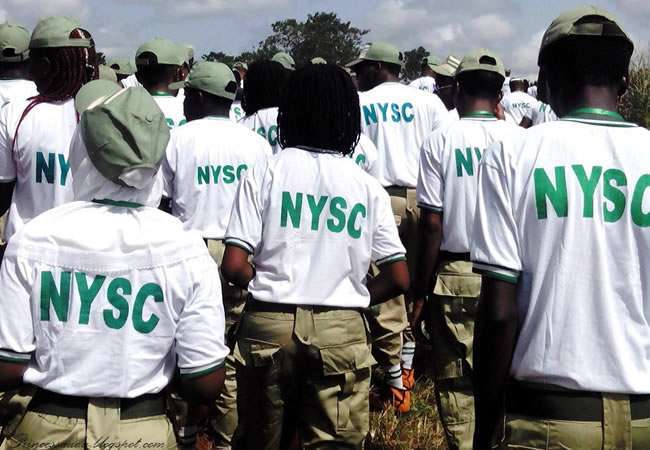
Six members of the National Youth Service Corps (NYSC) have received a total of N10 million in grants to expand their agribusiness ventures under the Farmers for the Future Programme.
The programme was organised on Monday by the British American Tobacco Nigeria Foundation (BATNF) in collaboration with the NYSC to encourage young Nigerians to embrace agriculture and develop sustainable businesses.
Presenting the cheques to the beneficiaries in Abuja, the NYSC Director-General, Brigadier General Olakunle Nafiu, urged Corps members to maximise the opportunities provided by the service year by venturing into commodity marketing and other viable businesses.
Nafiu said agribusiness remained a viable avenue for young people to build sustainable enterprises, create employment and generate wealth.
READ ALSO: NYSC Swears In 1,600 Corps Members In Bauchi
He also stressed the importance of value addition to the success and sustainability of business ventures, while commending BATNF for placing Nigerian youths at the centre of its entrepreneurship initiatives through value-chain development, employment creation and its partnership with the NYSC.
“I charge you to spread the news around. We have seen the outcome, and it is a good idea,” he said.
The beneficiaries are Dominic Olufemi (FC/25C/1143), who received N3 million; Temitope Adewole (ED/26A/2251), N2 million; Abdulwaheed Bala (ED/25B/1402), N2 million; Olanike Mayungbe (OG/26B/1037), N1 million; Kingsley Udoeyen (KG/26A/1735), N1 million; and Lorember Lorsue (JG/25B/1742), N1 million.
Speaking on the selection process, the Acting Director, Skills Acquisition and Entrepreneurship Development (SAED), Mrs Winifred Shopeka, said the programme began with an online registration portal through which Corps Members engaged in agribusiness submitted their business plans.
READ ALSO: NCCSALW Deploys NYSC Members In Fight Against Illegal Arms In Northeast
She said nearly 3,000 Corps members applied and underwent a rigorous selection process that produced 20 finalists.
According to her, the finalists participated in a boot camp and a final pitching session, which produced the 10 best presenters before the six ultimate winners were selected.
Shopeka said the beneficiaries had also been mentored and attached to established market operators to assist them in marketing their products.
She added that Corps Members who did not make the final stage of the competition were also trained by BATNF.
The BATNF Team Lead, Mr Oludare Odusanya, congratulated the beneficiaries and urged Corps Members engaged in agribusiness to master the fundamentals and acquire the knowledge and skills necessary to succeed.
“We are happy with our collaboration with the NYSC, and it will continue,” he said.
READ ALSO: NYSC Lauds Gov. Mohammed’s Intervention In Fence Collapse
Odusanya explained that BATNF was an independent organisation established to contribute to poverty reduction in Nigeria through sustainable agricultural practices and other interventions.
He said the Farmers for the Future Programme was instituted in collaboration with the NYSC to encourage Corps Members to venture into agribusiness and become job creators.
He added that the beneficiaries would be attached to mentors who would guide them towards achieving success in their respective businesses.
According to him, the programme has, since its inception, continued to enhance the entrepreneurial capacity of Corps Members.
News
CBN Reduces Interest Rate To 23%

The Central Bank of Nigeria (CBN) on Tuesday announced the reduction of the interest rate, also known as Monetary Policy Rate (MPR) to 23 percent.
Briefing the media in Abuja, the Governor of the CBN, Mr. Olayemi Cardoso, said at the 307th MPC meeting held on September 22, 2026 agreed the resetting of the MPR and recaliberation of the monetary policy market.
According to Cardoso, the committe is satisfied with the disinflation progress, adding that members noted stable banking sector following successful recapitalisation.
READ ALSO: CBN Monetary Tightening Worsening Nigeria’s N50tn Development Finance Gap – Group
Meanwhile, according to Nigerian Tribune, reports that that the MPC, at its 306th meeting in July 2026, disclosed its resolution to retain the interets at 26.5 percent.
According to the Governor of the CBN, Olayemi Cardoso, “the Committee’s decision to maintain the current policy stance followed a thorough assessment of the balance of risks. Although headline inflation moderated marginally in June 2026, global uncertainties have heightened, due mainly to the renewed hostilities in the Middle East.
“In view of the evolving developments, maintaining a cautious monetary policy stance remains appropriate. In arriving at its decision, the Committee noted the recent resurgence of hostilities in the Middle East, with particular attention to its spillover effects on global energy prices and the potential pass-through to domestic inflation.”
News
NURTW: KWAM1 Settles Long-time Rift Between MC Oluomo, Tafa Sego
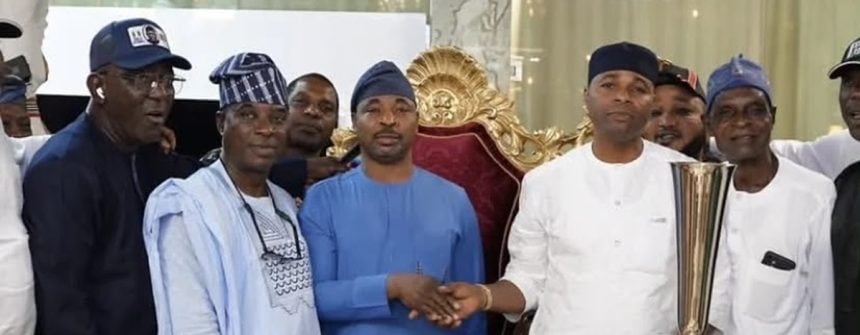
Nigerian Fuji musician, Wasiu Ayinde Marshal, popularly known as KWAM1, has brokered a peace deal between the National Union of Road Transport Workers (NURTW) National President, Musiliu Akinsanya, popularly known as MC Oluomo, and the Lagos State Chairman of the union, Mustapha Adekunle, aka Tafa Sego.
The reconciliation took place at Ojusagbola in Ijebu, Ogun State, where several NURTW chieftains gathered for the meeting.
The development was announced on Tuesday on KWAM1’s digital media page on Instagram, alongside photographs from the meeting.
According to the post, the two union leaders have resolved their differences after years of strained relations.
READ ALSO: Why FG Named KWAM 1 Aviation Security Ambassador — Keyamo
“After years of an age-long rift, MC Oluomo and Tafa Sego have finally settled their differences. And from what we know now, this is final,” the post said.
The musician was said to have intervened as the Mayegun of Yorubaland, with the aim of bringing an end to the longstanding disagreement between the two NURTW figures.
“K1 acted in his role as the Mayegun of Yorubaland by seeking an end to the long-standing rift, once and for all,” it said.
The post also described the meeting as a significant step beyond previous public displays of reconciliation.
READ ALSO: FG Gives KWAM 1 Aviation Appointment, After Airport Incident
“This time, it was not just another handshake for the cameras. The two old friends and colleagues came together at Ojusagbola, with King Wasiu Ayinde Marshal (K1) playing the peacemaker.”
Both MC Oluomo and Tafa Sego were reported to be pleased with the outcome of the intervention.
“Both parties are delighted about the new development,” the post said.
The two men had previously been allies and prominent figures within the Lagos NURTW before their relationship became strained amid disagreements linked to leadership of the union in the state.

 News2 days ago
BREAKING: Tinubu Extends Working Vacation
- News3 days ago
Six Hidden Health Benefits Of Unsweetened Zobo
- News5 days ago
Edo: Council Chairman Under Fire For Threatening Commercial Drivers Who Refuse To Wear APC Insignia
- News5 days ago
Edo: Ekpeson Redeems N20m Pledge To Family Of Fallen Soldier
- News3 days ago
2027: Step-by-step Guide To Applying For INEC Ad Hoc Staff Recruitment
- News5 days ago
OPINION: Nigerian Pastors, Imams And Their Sex Sermon Obsession
- News3 days ago
Jehovah’s Witnesses Announce New Position On Blood Transfusion Policy
- News3 days ago
How 36 Nigerian States Got Their Names
- Headline2 days ago
How To Format An Academic CV For US Master’s, PhD Applications
- News5 days ago
Malnutrition: US Support Reaches Over 40,000 Children In Bauchi — UNICEF


