
News
OPINION: The Body Of The Yoruba King

By Lasisi Olagunju
Okuku town in present Osun State has a well-recorded history of cultural promotion and preservation. Ulli Beier’s ‘Yoruba Beaded Crowns’ (1982) and Karin Barber’s ‘I Could Speak until Tomorrow: Oriki, Women and the Past in a Yoruba Town’ (1991) are two of the contributions of Okuku to Yoruba cultural history. The late Yoruba playwright and culture icon, Adebayo Faleti, told me in 2004 that he wrote one of his major plays in Okuku in the 1950s.
Oba Moses Oyewole Oyinlola was Olokuku of Okuku from 1938 to 1960. A very deeply religious and cultural man, he died on 20 February, 1960 and was buried two days later. Within those two days, there was a flurry of rites in the town and in the palace. The late oba’s grown-up male children feared that the king’s corpse would be tampered with by some unknown people called traditionalists. And so, they met and plotted to stop it.
One of the boys was embedded in the palace room where the remains were laid in state. Armed with a machete, he kept vigil over their dad’s remains while others lurked around as a back-up. Then, deep in the night, with curfew in place, some elderly persons, in a column, filed into the room. They turned out to be known faces; they were the chiefs that reigned with the now dead king.
The chiefs did not see the hiding young man with a machete. They started the rites while the boy watched every aspect of what the chiefs came to do. To his relief, there was no attempt to tamper with the corpse. “They did not even touch it. All they came with were words and wishes. They communicated with their oba asking him to intercede for them before the ancestors so that their own lives and that of the entire town could be as sweet as that of the departed oba.” They finished their prayers and left. Did the sentry leave too? An eye was kept on the remains until they were buried on February 22, 1960 in the premises of St Michael’s Cathedral, Okuku. The tomb is up to today the most prominent there.
MORE FROM THE AUTHOR:OPINION: Olubadan Olákùlẹ́hìn: Names And Destinies
The hiding prince told me all this in 2004 as I was gathering materials for the biography of the late oba, which was published in December 2005. Some people of tradition would ask where the prince is now. He grew to become a man, became successful, earned a PhD, lived well and died a few years ago at almost 90.
The death last Sunday and burial on Monday of the Awujale of Ijebuland, Oba Sikiru Olukayode Adetona, is the top trending topic. His transition and the controversy of his burial have renewed public interest in who should bury an oba and what really happens to the body of a king in Yorubaland when he dies. Do the bodies get mutilated and the hearts removed for the installation of their successors? Do succeeding obas eat the hearts of their predecessors?
I have cited the Okuku case above. I have also read wide and consulted people who should know. All my sources maintained that cannibalism is not one of Yoruba people’s ‘disorder’ and so, eating the heart of a dead king couldn’t have been one of the ingredients of their royal installation rites. The late Awujale, in an old interview that has also gone viral lately, gave his own experience on the heart-eating myth: “I cannot recall any rite that was done behind the scene. Let them come and tell me. It is all lies. Nothing like that. They even tell you that they give the heart of a deceased oba to the new one to eat!…Nothing like that. Okay, which heart did Orimolusi eat when Adeboye died in Tripoli? Besides, when Gbelegbuwa died, I wasn’t in the country. I was abroad and didn’t return until about a year after his death. So, which heart was given to me? I didn’t eat anything oooo. So, no such thing happened.” I think other obas should come out and tell their story. Doing so may stop friends and foes of the Yoruba from looking at them as man-eaters.
Some tradition-loving Yoruba persons are angry because the Awujale was buried by Muslims. Now, I ask: What is traditional burial? What is Muslim burial? Among other obligatory steps, the Muslim corpse is washed and shrouded in a simple white cloth; prayers are offered. Inside the grave, the body is laid on its right side, facing the East. At what point does a received practice become part of one’s tradition? I asked because just like the Muslims, the Lo Dagaa of northern Ghana, who are not Muslims, also bury their dead people “lying on their right side facing the East so that the rising sun will tell them to prepare for hunt or for the farm…” So, what is ‘Muslim’ to Yoruba traditionalists is ‘traditional’ to that Ghanaian ethnic group. We can read this and more in J. Goody’s ‘Death, Property and the Ancestors: A Study of Mortuary Customs of the Lo Dagaa of West Africa’ published in 1962.
MORE FROM THE AUTHOR:OPINION: ‘They Chop Their Own, They Chop Our Own’
It happened that some bad kings received bad burials in the past. One of such punishments for royal misdeeds could be dismemberment of the cadaver. There were other rewards for good and bad behaviour on the throne. When a wicked oba died, the chiefs stormed the palace and seized all items in there as communal property. When a good oba died, the chiefs delayed the announcement until the family of the departed had moved all they wanted out of the palace to his private residence. The chiefs could achieve that because in theory, the Yoruba king owned nothing as personal property. He reigned in the name of the town, got gifts and favours in their name and on their behalf he kept or used them. It was therefore the law that the palace, the king, and all he owned were property of the kingdom. All these, including the body, could go back to the people and the oba’s family stripped naked if the departed was not a good man.
If it is the Yoruba tradition that the king’s body belongs to the community, then we have to define who approximates that community today. The majority Muslim/Christian groups or the minority who claim ‘tradition’ as their religion? If tradition is a people’s way of life, have Christianity and Islam not become part of the Yoruba ‘way of life’? Indeed, there is a whole Odu in Ifa celebrating Islam and Muslims. It is called Odu Imale. Tradition is a river; it draws its strength from the source but gets stronger and larger as it takes from this stream and that tributary. It would be a dirty, diseased pond if it resists the cleansing ritual of free-flowing.
Tradition is not the earthing of a people in a past that is long gone. What is traditional is not exactly what is archaic.
The West brought Christianity and civilisation to the ‘savage’ tribes of Africa. In 1946, they stopped the suicide of an Olokun Esin in Oyo who was billed to accompany the Alaafin on his journey to the ancestors. Since then, no Oyo king has enjoyed having an entourage to heaven. Dying with the king was hugely celebrated in Oyo as the ultimate expression of love for the empire and high-end duty to the king:
Olókùn-esin İbàdàn
K’ó má ba Olókùn-ęsin Ộyộ je
Ẹni ó bá rójú b`óba kú
L’`a á mò l’Ólókùn-esin.
Eyí ti ò rójú b’óba kú
A á maa pè ‘ón l’Ólókùn-eran ni…
(Adeboye Babalola, 2001:125).
It was also part of the ritual of passage for the Alaafin that his crown prince (Aremo) must die with him. But Alaafin Atiba stopped that practice. He got his Aremo Adelu endorsed as his successor before he died in 1858 at the age of 58. There was a resistance to that change snowballing into a very bad civil war – the Ijaye War of 1860-1862. But the reform was eventually upheld because forced suicide (or murder) was repugnant to decency and a violent assault on the prince’s right to life.
MORE FROM THE AUTHOR:[OPINION] Buhari: A Tale Of Two Deaths
Tradition speaks to aspects of a people’s way of life. It is the “inherited beliefs, practices, and values passed down through generations.” But it is not immutable. Traditions are practices in perpetual transition. A tradition isn’t what it is called if it fails to adapt to societal shifts, to advancements in tech, to new cultural influences. Customs and traditions live when they accept modifications, reinterpretations, and even the abandonment of certain practices as societies evolve. Take a glance at the death and burial of King Francis I of France in 1547. I will rely on this quote from Ralph Giesey’s ‘The Royal Funeral Ceremony in Renaissance France’ published in 1960: “With the death of a king, the body was immediately eviscerated, embalmed, and the removed remains subsequently buried apart from the corpse.” Evisceration means to disembowel a person or animal. Would anyone expect the evisceration of a king’s body today in the West? Even French that did it five centuries ago has since abolished the monarchy itself. It did so on 24 February, 1848. Have we paused to ponder the future of Yoruba kingship as democracy digs in?
While we seek to preserve what we call our tradition, have we asked how the various parts came to be? How do traditions get invented? What the French did to the corpse of their king in 1547, the act of disemboweling that took place some 500 years ago, was it for ritual or for medical reasons? W. Arens’ in ‘The Demise of Kings and the Meaning of Kingship’ (1984) from where I got the Giesey quote will serve you if you need more on the sacred and religious contents of that royal burial and the parallel it drew with the burial of kings in a part of Africa.
So, as we bid the iconic Awujale good night, it is time the Yoruba elite and commoners calmed down and got to work on the real issues of development that need urgent tackling. As I told someone at the weekend, the Yoruba have no friend in Nigeria. Onílé owó òtún kò wo niire, ìmòràn ìkà ni t’òsì ngbà, ká lé ni jáde ni tòókán ilé nwí. I will not translate this; rather, I will add that majoring in minor issues degrades the Yoruba advantage of over 200 years of education and of global engagement.



News
Children’s Day: Chaos At Ogbe Stadium As Dozens Faint

Chaos erupted on Wednesday during the Children’s Day celebration as dozens of students reportedly collapsed following a stampede triggered by the use of pepper spray.
The event,
organised by the Edo State Ministry of Education at the Samuel Ogbemudia Stadium was disrupted after some male students of Ihogbe College allegedly made uncompromising advances towards female students at the venue.
A parent who identified himself as Oboh Emmanuel said, “the behaviour of those uncultured students attracted the attention of bouncers stationed at the stadium as they rebuked the male students.”
Oboh said the affected students later regrouped and attacked the bouncers, leading to a confrontation within the crowded arena.
READ ALSO:Children’s Day: Edo Commits To Child Protection
It was gathered that in the ensuing confusion, the bouncers were reported to have deployed pepper spray in an area occupied by a large number of students.
Several students, particularly female students, reportedly fainted after inhaling the substance, while others sustained injuries after being stepped on during the ensuing melee.
The panic was said to have spread across the stadium as students, teachers and parents scampered for safety.
Many of the affected students were reportedly rushed to the Edo Specialist Hospital for medical attention.
READ ALSO: Egor LG Chair, Ogbemudia, Vice, Osawe Impeached
Reacting to the incident, Chief Press Secretary to Governor Monday Okpebholo, Dr Patrick Ebojele, said the security personnel that fired the tear gas had been detained.
He said all the students, except two, that were rushed to the hospital have been discharged.
Ebojele stated that doctors wanted to observe the students till tomorrow before allowing them to go home.
“The two students are not seriously injured. Doctors want to observe them overnight. Permanent Secretary, Ministry of Education is still at the hospital. The man who used pepper spray has been detained.
“The incident did not happen the way it is being exaggerated. All modalities were put in place to ensure the children enjoyed their day.”
News
Okpebholo Salutes Edo Muslims, Seeks Continued Support, Prayers
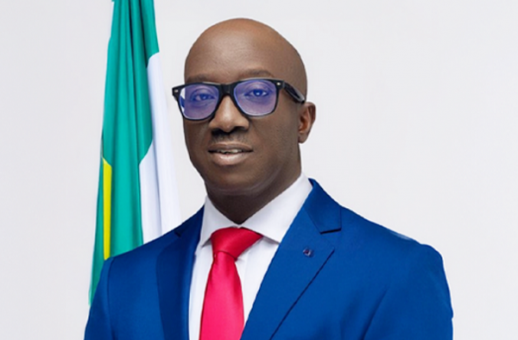
Governor Monday Okpebholo of Edo State has urged Muslims and all Nigerians to continue to pray for peace, unity and progress in the country even as they celebrate the annual Eid-al-Adha
The governor, who was represented by his deputy, Dennis Idahosa, stated this during the annual Eid-al-Adha celebration with Muslim faithfuls held at Government House in Benin City.
He reiterated his administration’s commitment to fairness, inclusivity and equal opportunities for all citizens irrespective of religion and tribe.
READ ALSO:ADC Penetrates Okpebholo’s District As Defections Strengthen Party in Edo Central
According to him, the present administration remains determined to building a government that reflects the diversity of Edo State, noting that competent and qualified Muslims have continued to play vital roles in his government because of their capacity, integrity and commitment to service.
“As a government, we remain committed to fairness, inclusivity and equal opportunity for every Edo citizen, irrespective of religion, ethnicity or political affiliation. This is why quality and competent Muslims are serving in key positions in our administration.”
Okpebholo appreciated the Muslim community in Edo State for their unwavering support and continuous prayers for his administration, noting that such prayers and support have contributed immensely to the peace and steady development being witnessed across the state.
READ ALSO:Okpebholo Felicitates Muslims On Eid-el-Fitr Celebration
He then called on all Nigerians to use the occasion of Eid-al-Adha to pray for the administration of President Bola Ahmed Tinubu, stressing that the country needs collective prayers, unity and cooperation to overcome its present economic and security challenges.
“I urge all Muslims and indeed all Nigerians to use this occasion to pray for our dear nation and for the administration of President Bola Ahmed Tinubu. Nigeria needs our collective prayers, unity and support as we strive to overcome our challenges and build a more prosperous future for all.”
In his remarks, the Chief Imam of Edo State, Abdulfatai Enabulele, applauded the governor for what he described as remarkable developmental strides recorded in less than two years in office.
The cleric commended the administration for ongoing infrastructural development and efforts geared towards improving governance in the state, but appealed to the government to revisit and complete some abandoned projects inherited from the previous administration for the benefit of the people.
News
Children’s Day: Edo Commits To Child Protection
The Edo State Government has reaffirmed its commitment to protecting the rights of children, promoting quality education, and strengthening sports development across the state.
This assurance was given by the governor of Edo State, Monday Okpebholo, during the 2026 Children’s Day Celebration and Governor’s Cup Finale held on Wednesday at the Samuel Ogbemudia Stadium, Benin City.
Addressing pupils, students and teachers,
the governor described children as the pride of Edo State and the future of the nation.
The governor, represented by his deputy, Dennis Idahosa,
noted that the annual celebration provides an opportunity to honour their dreams, talents, and limitless potential.
READ ALSO:Eid-el-Kabir: Edo Deputy Gov Solicits prayers For Okpebholo
Speaking on this year’s Children’s Day theme, “Choose Kindness, Reject Bullying,” the governor said the message was timely and significant, as it emphasizes the need to create safe, supportive, and inclusive environments for children both in schools and communities.
He stated that bullying in all forms — physical, verbal, emotional, or online — has no place in society, adding that the Edo State Government remains fully committed to protecting the rights and dignity of every child.
According to him, the administration will continue to strengthen policies and programmes that promote child protection, discipline, mutual respect, and positive learning environments across schools in the State.
The governor urged children to embrace kindness, compassion, teamwork, and respect for one another, stressing that true strength lies not in intimidation but in empathy, good character, and mutual understanding.

 Metro5 days ago
My Husband Abandoned Me On Our Wedding Night To Attend Political Meeting, I Want Our Marriage Dissolved
- Headline4 days ago
Woman Passes Out After Receiving 100 Strokes Of Cane
- Headline4 days ago
JUST IN: White House Locked Down Briefly As Gunman Opens Fire At Security Checkpoint
- Politics5 days ago
Warri Ijaw Hail INEC Delineation Report, Call For Additional Electoral Wards, Others
- Politics3 days ago
Two Masked Men Gun Down Politician In His Rivers State Hotel
- News3 days ago
More Pain For Nigerians As Cooking Gas Price Increases Nationwide
- News5 days ago
Alleged Terrorism: Court Rejects Defendant’s Bid To Travel Abroad
- Metro5 days ago
My Wife Stop Cooking My Food, Beats Me Black And Blue All the Time, Man Tells Court
- Politics5 days ago
What I’ll Do As President Of Nigeria — Amaechi
- Politics3 days ago
‘Tinubu’s Borrowing In 24 Months Surpasses 55 Years’ Debt Record’


