
News
OPINION: The North And Tinubu’s Appointments

by Lasisi Olagunju
President Bola Tinubu gave our country’s Minister of Defence and Minister of State, Defence to the North; he gave the North Minister of Police Affairs and Minister of State, Police Affairs; he gave the North Minister of Education and Minister of State, Education; he gave the North Minister of Agriculture and Food Security and Minister of State, Agriculture and Food Security. Again; he gave the North the Coordinating Minister of Health and Social Welfare plus Minister of Steel Development and Minister of State, Steel Development. To the North, again, Tinubu gave Minister of Water Resources and Minister of State, Water Resources. I can go on and on and add the Minister of Housing and Urban Development and Minister of State, Housing and Urban Development. No part of the South has that privilege of having ‘couplet’ ministers managing key sectors. It is double, double blessing for the North. I don’t think any president has ever done that – not even the insular nepotist, Muhammadu Buhari, did. But why did Tinubu do that? Sacrifice, obedience and gratitude for favours. Sacrifice (libation) to power timekeepers, obedience to janitors of politics, and gratitude to regime makers. “O Lord that lends me life, lend me a heart replete with thankfulness!” (William Shakespeare in Henry VI).
But my people say it is impossible to get it right if you are asked to sweep the compound of the witch. If you do it well, she will accuse you of overdoing it; if you do not do it well enough, she will accuse you of not doing it at all. The North is like Hades. In the pantheon of the Greek, Hades is that greedy god who wants more of everything and who shares what he has with none. The Yoruba have Esu which takes everything wholly and completely. Those who know who Esu is know how fatally wrong it could be to appease him with one hand; he demands your two hands and ten fingers (owo meweewa) to deliver his offerings. Yet, whether at home or at the crossroads or even in palaces, Esu takes; he does not give; and when he takes, he offers neither thanks nor thankfulness. Those who know his oríkì say he is the master of the marketplace who buys without paying; the one who ensures that nothing is bought and nothing is sold unless it is nightfall – and on his own terms. For their way to be free of trouble, all other deities worship and propitiate him. That is northern Nigeria; it is not enough that it has all the above. It wants more, and maybe all.
FROM THE AUTHOR: OPINION: ‘Alaafin’s Stool Is Not For Sale’
The North is complaining. Its elites say they made this president, now the supposed side chick is ‘forming’ independence; he is neither singing their song nor dancing to their beats – the right way. I have a sultry parallel to draw here: The bed is made, the room is scented with the fragrance of desire, the groom is unknotting his boxers, yet the bride is complaining that her husband is not paying enough attention to her needs. What does the hot bride want to eat that is not yet on fire?
I do not belong to the Tinubu orchestra; what I sing here is my own chord. We may complain about the quality of some of the Tinubu appointees but the justice of the spread between the north and the south no one should. The cluster structure of the appointments would be seen by critics as the president zoning and centralizing prebendal privileges in the hands of regional power lords. His friends and fans would argue that the cluster pattern is the president’s way of ticking problems and attaching them to localised solutions. If the North has Defence Minister and the defence ministry’s Minister of State; if it has Police Affairs Minister and the ministry’s minister of state in addition to the National Security Adviser and the Chief of Defence Staff, should it still have the mouth to complain of lack of official attention to its endemic insecurity? If the North has the Minister of Education and the ministry’s Minister of State, should it still rummage for policies that will wean it of the blight of mass illiteracy and of having uncountable millions of out-of-school-children? If the North has the Coordinating Minister of Health and Social Welfare, should we ever hear it lament high incidences of child and maternal mortality and epidemics of preventable diseases? The whole of the agriculture ministry is ceded to the North; the entire Water Resources ministry belongs to the North. We wait to see how it will use these to feed its dying, hungry poor – more than eighty percent of its population. It is like now that the South-East has the Minister of Works, we wait to see who that zone will blame if the East-West Road remains unbuilt at the end of Tinubu’s reign. And, if the management of the economy is in the hands of the Lagos-Yoruba, the country knows who to attack now that a dollar is selling for a thousand naira.
Samuel Butler, author of ‘The Way of All Flesh’, warns that what is golden is tact, not silence. Although my fish does not swim in Tinubu’s river, I join this ‘noise’ because of the hypocrisy of those involved. New groups are being formed and old hacks are being activated to compose complaints. One of them is the Arewa Economic Forum (AEF) which recently accused Tinubu of what it termed ‘Yorubanisation’ and ‘Lagoslisation’ of his appointments in the economic and finance sectors. Chairman of the Forum, Alhaji Ibrahim Shehu Dandakata, at a press conference in Abuja said the North was not happy that it was being left out “in the Finance and ICT sectors.” Voices from outside the North are also being borrowed the perfect way slave owners deploy their bondmen to battle. There is an Ile Ife man whose business name is MURIC; he joined the orchestra from his Lagos base and wrapped the nepotism charge with boubou of religion: “All five key appointments made by President Tinubu to revive the economy were given to Christians and Yorubas mainly. These new appointees include the Minister of Finance, Wale Edun; the newly nominated CBN Governor, Dr. Michael Cardoso; Hon. Zacch Adedeji, acting chairman, FIRS; the chairman, Tax Reforms Committee, Mr. Taiwo Oyedele, and Mr. Tope Fasua, Special Adviser on Economic Affairs,” MURIC’s promoter, Ishaq Akintola, said in a statement. The MURIC man’s puppeteers did not tell him or he forgot to remind them that an Atiku Bagudu from Kebbi State is the Minister of Budget and Economic Planning. Ishaq Akintola is Yoruba, he is attacking the Yoruba; he is Muslim; he accused his Muslim-Muslim presidency of marginalization of Muslims. Perfect isé erú (slave job) delivered the erú way. In folklore, we tell the hunter to use the sword of Tortoise to kill Tortoise (idà ahun la fií pa ahun). One of the best newspaper articles I read on Nigeria’s north-south relations was written in the early 1980s by Banji Kuroloja, editor of the Nigerian Tribune from 1984 to 1988. Because the title of the piece came very simple and catchy, I will remember it forever: “Singing Their Songs.” I can’t forget. I also can’t forget the takeaway from it: “The ubiquitous North has a way of making others sing their songs.” Forty years plus after that article was published, nothing has changed; the falconer still holds the falcon by the throat, making it say what it is told to say. We’ve seen how abjectly the MURIC man recited his verse, shedding blood when the owner of the problem was shedding tears.
FROM THE AUTHOR: OPINION: Judges And The Future Of Elections
Even the National Publicity Secretary of the North’s apex organization, the Arewa Consultative Forum (ACF), Professor Tukur Muhammad-Baba, joined the discourse. In a newspaper interview, he accused Tinubu of giving sensitive and lucrative appointments to persons from his ethnic Yoruba stock. He said Tinubu should not be doing what he is doing “in a deeply fractious federation like ours.” He remembered that “a part of the constitution directs that… appointments must reflect the social diversity of the country in terms of balancing, of place of origin, indigeneship, ethnicity, religion, etc.” Muhammad-Baba and his ACF did not remember the existence of this constitutional provision throughout the eight years of imperial Buhari, Bayajjida II of the kingdom of Northern Nigeria. “Few love to hear the sins they love to act.” That is how William Shakespeare, in his ‘Pericles, Prince of Tyre’, elegantly explains what hypocrisy does to people’s sense of shame.
Not knowing when to complain is a problem. That the North believes it has the moral right to talk at all is because it thinks itself senior in the Nigerian arrangement. But I know that the greedy is red-eyed twice: when he eats his yam alone and when his neighbours converge to eat their pounded yam. For eight years, Muhammadu Buhari dared the other parts of Nigeria outside his north and fed àdí (palm kernel oil) to Èsù with his provocative nepotism. He did it without personal consequences because he stood on very firm grounds of regional supremacy. While he wantonly shredded Nigeria’s garment of diversity, today’s noisemakers (and their slaves) egged him on with claps of endorsement. They okayed Buhari’s cronyism and hollered that the spread of the appointments was not necessary but that what mattered were competence and performance. They felt (and feel) no shame that at the end of their Buhari’s eight years, what was harvested from their farm of ‘competence’ and ‘performance’ was mass hunger and mass misery.
I know that there are certain All Progressives Congress (APC) masquerades who wear costumes of region and religion to complain about their not having posts (yet). If they are in the cold, whose fault should that be? Tinubu’s is a government of libation, everyone who has sense knows. But when you refuse to offer prayers in the right temple and drop sacrifices in the proper shrines, expect disappointments. There is a Festus Keyamo whose ministerial dream suffered reluctance of nomination and controversy of clearance. But, apparently because he knew in what river to wash his hands, his troubles eased off with apologies in sherds of remorse. There is, on the other hand, the petite Nasir El Rufai who went through the examination process supervised by prayerful Godwin Akpabio but had his result withheld by those who held the yam and the knife. What else is there to say when a pupil finds their report card in the mouth of the headmaster’s goat? Yet, there are some who got what they wanted because of the good boy and good girl they had been to the new powers in town. If you keep your palms clean, it is not every time you pour libation to dispensers of favours. And, I have here Ezeulu in Chinua Achebe’s ‘Arrow of God’. The old priest is full of apologies for not setting before his guests “even a pot of palm wine.” The response he gets is to the effect that “when a father calls his children together, he should not worry about placing palm wine before them” (page 143). But that is a father that has paid his dues and has not taken more than he has put down.
FROM THE AUTHOR: OPINION: King Obasa Of Lagos
Now, is it not a shame that the complaints we hear from the North are about elite privileges and not about the hardship in town? Think about the existential struggles of an average Nigerian and what interests the political class. Like an exasperated friend said on Friday, inflation is hitting the roof, the naira is sinking, market capitalisation at the Nigerian stock market is tumbling, people are dying, yet what interests the elite is what appointees come from their bedrooms. Instead of the northern elites complaining about the ethnic origin of those managing the economy, they should be worried about the calamity of their own failure as leaders and the collapse of all humanity in their region. On the streets of Ibadan, we encounter, daily, beggars from the North with heart-rending stories. This last Saturday, one of them, Harira Muhammadu, told the Saturday Tribune that she left her husband, aged father and children behind in Kano to face a “life of uncertainty” begging on the streets of Ibadan. She said she had no other choice than to beg because the North had collapsed and she could not afford to watch her children starve. “If things were easy and sweet for us back home, we would not come here to live this life of uncertainty. I have some children with me and I do not have anything to feed them with and it is a lot of work…I remember when I first came here many years ago, I did not know where to go or what to do and I was afraid and all. I would cry and wipe my tears. Sometimes, the children would cry with me but I endured because I knew that if I returned home (to the North) the suffering would be more severe,” she said.
There is no southern town or city without sad stories such as that of the beggar above. Yet, check all conferences, read books, monographs and pamphlets from the North, the poor perennially have no space there. There is never a conversation there on the imperative of finding a cure for the pandemic of poverty in that region. The North’s eunuch stands erect (or has an erection) only when there is a South to intimidate. Everything is about power and elite comfort carefully packaged as regional nationalism and/or duty imposed by religion. The elites of the North won’t keep quiet until they are back in power to ride roughshod on the other parts of Nigeria. Check how to deal with bullies. Stand up to them.
This article written by Dr. Lasisi Olagunju, Saturday Editor Nigerian Tribune was first published by the same newspaper, it’s published by INFO DAILY with permission from the author.



News
NAF Launches Attack On Terrorists In Borno
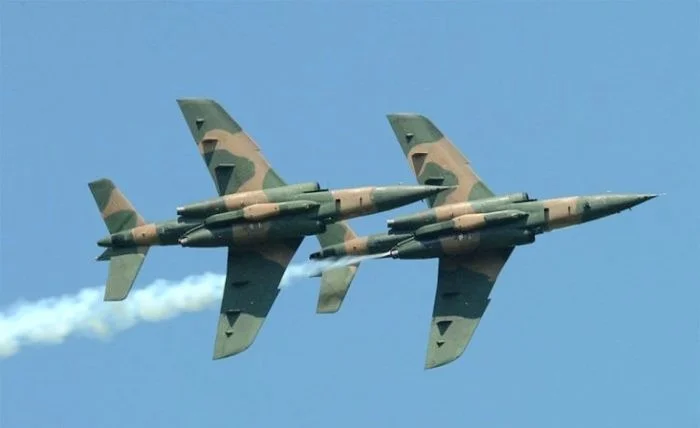
The Nigerian Air Force, NAF, operating as part of the joint task force of Operation Hadin Kai, has carried out a coordinated air interdiction at AbbagaJiri in the Timbuktu Triangle, Borno State.
According to Air Commodore Ehimen Ejodame, Director of Public Relations and Information of NAF, the air strikes successfully paved the way for ground troops.
He explained that the operation was based on actionable intelligence from multiple sources, which confirmed the presence of terrorists, their structures, and concealed logistics facilities in the area.
Ejodame stated that NAF air assets were deployed in integrated surveillance and precision strike roles to target identified threats.
READ ALSO:NAF Hits Bandit Logistics Hub, Neutralises Many In Zamfara
The operation aimed to degrade terrorist capabilities, deny them sanctuary, and shape the battlefield for ground forces, all while strictly adhering to rules of engagement and protecting civilians.
He added, “The Identified terrorist structures were decisively engaged and destroyed, denying the terrorists freedom of action, while a follow-up engagement neutralised armed elements observed converging on the location.”
“Subsequent advances by ground troops into the area confirmed the effectiveness of the air strikes and validated the success of the joint air–land operation.”
Speaking on the mission, Chief of the Air Staff (CAS), Air Marshal Sunday Aneke, said, “The success of the mission reflects the NAF’s resolve to dominate the air domain in support of joint operations.”
READ ALSO:NAF Hits Bandit Logistics Hub, Neutralises Many In Zamfara
Aneke further emphasized that the operation highlighted the service’s commitment to providing precise and decisive air power in support of ground forces.
In his words, “We will continue to deny terrorists freedom of movement, sanctuary, and logistics wherever they seek to hide. Air operations will remain relentless and intelligence-driven.”
“Our operations are carefully planned and intelligence-led, ensuring maximum effect on hostile elements while safeguarding innocent civilians.”
READ ALSO:NAF Announces Two-hour Road Closure In Abuja For 10km Walk
“The Nigerian Air Force will sustain pressure until terrorist networks are completely dismantled.”
He further noted that the operation showcased NAF’s aggressive stance, precision employment of airpower, and dedication to sustained joint operations.
Aneke added that such missions play a crucial role in enabling ground troops to maintain momentum and deliver decisive outcomes against terrorist networks threatening lives, property, and Nigeria’s national security.
News
Lagos Parks To Close For Maintenance – State Govt

The Lagos State Parks and Gardens Agency, LASPARK, has announced that all public parks under its management across the state will be temporarily closed for routine maintenance and upgrades.
In a statement released on January 9 and shared via its official platforms early Saturday, LASPARK said, “All parks under our management will be closed to the public from January 12 to January 31, 2026.
“This follows increased visitor activity during the recent festive season.”
The agency listed several popular recreational spots that will be affected, including “Ndubisi Kanu Park, Alausa JJT Park, Dr. Finnih Abayomi Park in Oregun, and all other LASPARK-managed parks across Lagos State.”
READ ALSO:
Explaining the reason for the closure, LASPARK added, “The temporary shutdown is necessary to carry out essential landscaping, facility repairs, and general upgrades to ensure that our parks remain safe, clean, and enjoyable for residents and visitors.”
The agency also stressed that the exercise aligns with its broader mandate, noting, “This maintenance programme is part of our commitment to providing well-maintained green spaces that promote relaxation, wellness, and environmental sustainability.”
LASPARK assured residents that “all parks will reopen at the end of the maintenance period.”
News
PAP Sends Additional 34 Foreign Post-graduate Scholarship Beneficiaries To UK Varsities

The Presidential Amnesty Programme (PAP) has deployed an additional 34 foreign post-graduate scholarship beneficiaries to various universities in the United Kingdom for the 2025-2026 academic year.
This was contained in a statement made available to newsmen in Warri by Mr Igoniko Oduma, Special Assistant on Media to Dr. Dennis Otuaro, the Administrator, PAP.
According to the statement, the scholars’ programmes include data science, fintech analytics, cyber security, international energy law and policy, construction project management, public health, agri-food technology, electrical and petroleum engineering, among others.
The statement added that more foreign post-graduate scholars will be sent to UK universities in the current academic session.
“In December 2025, nine students, who were the first set of offshore post-graduate scholarship developments by the PAP Administrator, Dr Dennis Otuaro, for the 2024-2025 academic year, graduated from their various programmes in UK universities.
READ ALSO:PAP Scholarship Scheme Vehicle For Better Future For Niger Delta —Otuaro
“Otuaro has deployed over 9000 students to universities within and outside Nigeria for different industry-relevant programmes since he assumed office in March 2024,” the statement partly reads.
Speaking at the pre-departure orientation programme for the scholars at the PAP headquarters in Abuja, on Thursday, Otuaro said that the large-scale deployment was aimed at making the Niger Delta a knowledge-driven region.
He said that his leadership reinvigorated the programme to give it a new momentum in service delivery to the people of the region based on the mandate of President Bola Tinubu.
Otuaro said, “We are sending all of you for post-graduate studies in various universities in the United Kingdom.
“The PAP now has a new momentum and direction because of the repositioning and broad reforms that we carried out in line with the mandate of His Excellency, President Bola Ahmed Tinubu GCFR.
READ ALSO:Otuaro Tasks Media On Objective Reportage
“The objective behind the huge scholarships deployment is to ensure that we develop the needed human capital to transform the Niger Delta and generate knowledge-wealth.
“We want to develop relevant manpower in critical disciplines for our region and by extension, the country, because you are expected to contribute your quota to national development after successful graduation.”
The PAP boss, who was represented at the event by his Technical Assistant, Mr Edgar Biu, advised the scholars to study hard to achieve academic excellence in their various fields of research.
According to him, the scholars have an obligation to justify the Federal Government’s investment in their education and future.
READ ALSO:I’m Not Distracted By Anti-Niger Delta Elements, Says PAP Boss, Otuaro
He reiterated his warning that beneficiaries should not take for granted the opportunity to further their academic pursuits in the interest of the Niger Delta and indeed the country.
Otuaro expressed appreciation to President Tinubu for his “enormous interest and support for the Programme”, particularly the approval of an upward review of the programme’s budget from N65billion to N150billion.
He also expressed gratitude to the National Security Adviser, Mallam Nuhu Ribadu, for his impeccable guidance and supervision of the programme’s initiatives.
Otuaro, therefore, cautioned the scholars to obey their host country’s laws and the rules and regulations of their various institutions, stressing that they are ambassadors of Nigeria, the Niger Delta and their communities and families.
Highpoint of the orientation programme was the presentation of laptops to the scholars to help them in their studies.

 News4 days ago
How To Calculate Your Taxable Income
- Metro4 days ago
Edo widow-lawyer Diabolically Blinded Over Contract Seeks Okpebholo’s Intervention
- News3 days ago
Expert Identify Foods That Increase Hypertension Medication’s Effectiveness
- Headline4 days ago
Russia Deploys Navy To Guard Venezuelan Oil Tanker Chased By US In Atlantic
- Politics3 days ago
APC Leaders, Tinubu/Shettima Group Call For Wike’s Removal As FCT Minister
- Entertainment4 days ago
VIDEO: ‘Baba Oko Bournvita,’ Portable Drags His Father, Alleges Bad Parenting, Extortion
- Politics4 days ago
2027: Details Of PDP Leaders, Jonathan’s Meeting Emerge
- Metro4 days ago
JUST IN: Court Grants Malami, Wife, Son N500m Bail Each
- Headline2 days ago
Science Discovers Why Hungry, Broke Men Prefer Bigger Breasts
- Politics3 days ago
Wike A ‘Pestilence’ On Rivers, I Resigned Because Of It – Ex-Commissioner


