
News
OPINION: The Python And Tinubu-North’s Matrimony
Festus Adedayo
Undoubtedly, the political matrimony between President Bola Tinubu and Northern Nigeria is at Talaq stage. Talaq is the Islamic unilateral repudiation of a marital union. There are no sobs, no wails. No dabbing of the face with a handkerchief. But, the dusts provoked by the matrimonial dislocation hang notoriously in the sky. Even bystanders miles away can see them. The marriage is only 15 months old but the couple’s patience for each other is rope-thin. As our elders say, right in the presence of the kolanut seller, irreverent worms slide inside his pods. A matrimony celebrated with pomp and ceremony is now a chaotic market row. The gluttonous cat has eaten the poisonous meat of a toad. A post on X late last week even claimed that “Northerners have (begun) Al-Qunut prayers against Tinubu…Al-Qunut prayers (are) done…to eliminate evil.” There is a litany of allegations hung on the neck of the seismic marriage. It ranges from prostitution, abandonment, betrayal to battery. While the world sees the palm fronds, (mariwo) the egungun of the matrimony would seem to have been long gone.
Well, as the saying goes, a household of misbehaving children is a reflection that it is devoid of elders with wisdom – (T’ómodé ilé bá ńse réderède, àgbà ibè ni ò ní làákàyè). Elders then summoned the couple and demanded the reason for their tiff. Flaunting patriarchal righteousness, the husband has kept mum, dragging smoke off his burning cigarette intermittently. The Northern wife however did the narration, tears coursing down her cheeks. On her knees, she tells the story of Lagere, the cripple and Python, a huge heavy-bodied reptile which kills its prey by constriction. Lagere was a prince crippled from birth. At his turn to succeed his father, Kingmakers bucked, citing an existing tradition forbidding disabled on traditional stools. Downcast, Lagere hopped down river road to commit suicide. As he folded his deformed leg to jump into the river, a huge python emerged from nowhere and demanded why he contemplated suicide. Moved, Python promised to help him. The snake jumped up, wrapped himself round Lagere and constricted him. Upon unwrapping self from the cripple, the deformed leg received strength. Overexcited, Lagere swore to show gratitude to Python.
Before he was crowned king, continued the Northern Wife, the Ifa Oracle summoned to divine Lagere’s reign muttered a saying, the purport of which was cryptic to all at the time. The Oracle said, “Oore tán, asiwèrè gbàgbé” meaning, at the fullness of time, the foolish will forget a kindness of the past. Lagere then ordered that a groove be earmarked in the palace for the worship of the mysterious reptile. He indeed worshipped Python for months. One day, however, having smoked alien weeds, the king’s head exploded with pride. Lagere reasoned that His Imperial Majesty shouldn’t be seen groveling before an ordinary reptile. He then ordered that the animal be brought to the palace to be sacrificed to him. On seeing what King Lagere was about to do with him, Python cried passionately and asked for mercy. Lagere would not listen. But as he was being dragged down for propitiation, Python suddenly pounced on Lagere, twined self round him. Instantly, he returned to his old cripple state. The town then dethroned Lagere. “That, elders of the land, is my story,” narrated the Northerner wife.
Being a student of Nigeria’s political history and one right inside its vortex, from its beginning, it should have occurred to Tinubu and his Northern bride that their matrimony would be short-lived. As the one who holds an umbrella all-day long would find out only later at sunset that they carry a heavy object, only at dusk would an Oko Ìyàwó Elépòn Búlúù (a vulgar Yoruba folksy appellation for a newly-wedded groom) realize that wedlock is the least of matrimonial rituals. Meeting responsibilities of matrimony is the toughest nut to crack. So long as there is a colony of lice on clothe, the fingernail cannot be devoid of blood. While narrating her ordeals and betrayal of trust from Lagere, the Northerner wife had lapsed into a Yoruba proverb which says that if a monkey is uncertain about the danger upon a tree, it should not be found climbing it (Bi oju alakedun o da igi, kii gun) to which the elders nodded in unison.
READ ALSO: OPINION: ‘Protest’ That ‘Restructured’ Nigeriass
Before the End Bad Governance protests which began on August 1, the depth of the matrimonial discord between Tinubu and the North was, at best, at the level of guesswork. For instance, we knew that it is almost an impossibility that tantrums won’t follow a stubborn child given a knock on the head. When the Tinubu government thus disgraced Nasir el-Rufai last year, tantrums were expected. So when the Tinubu government, for which he pulled critical chestnuts off the fire, rewarded him with a non-ministerial clearance by the Senate, many could swear by their mothers’ graves that the northern Eliri, the minutest of all rats, will become one of the rebellious faggots that will upset the fire. And that, whenever the North was reorganizing for an Araba, Eliri would play a prominent role. Araba should remind any student of Nigerian history of the historical Northern Nigerian cry of disaffection with the Nigerian state of affairs immediately Aguiyi Ironsi promulgated the highly objectionable Decree 34 which rendered Nigeria’s federalism unitarist. The North had earlier visited midless pogrom on eastern Nigeria. I got a whiff of the heartlessness of the bloodletting from a live play of Yoruba Apala music lord, Ayinla Omowura, recently. He sang, “wón ńpa yíbò bí eni p’eran alápatà…” – they butchered Igbo people as though killing cows in a meat shop.
In June, Northern politicians began coalescing around Muhammadu Buhari. They advertised this in a visit which anyone familiar with the colour, tone and tenor of historical serpentine regrouping of the north would know was the beginning of a call to put spanner in the works. Former Vice-President Atiku Abubakar and Aminu Tambuwal, Sokoto state’s ex-governor, kicked off the visit. It was to Buhari in his Daura hometown. Within 24 hours, el-Rufai followed suit. Photograph of the former governor’s legendary stoops to shake hands, similar to Iscariot’s kiss of Jesus, a notorious signature tune heralding betrayal, was amply advertised. Packaged as “Sallah homage,” political watchers claim the visits were the beginning of a packaged northern tempest against the Yarbawa who the north was wedded to in a matrimony that has now gone sour. Shehu Sani, Afro-haired ex-senator said this much in a release and attributed it to an attempt to build a strong northern alliance using Buhari as a rallying point to challenge and evict Tinubu in 2027. On the comedic scene, a Bello Galandachi satirizes the rot in the Tinubu government almost weekly.
The End Bad Governance protest was the strongest alibi for Northern Nigeria to ventilate its 15-month accumulated angst. It has been said that the protest, which kicked off on August 1, was a reflection of the geographical and ethnic politics that Nigeria had practiced from pre-colonial times. While the southeast, in a bid to stamp its disavowal with its typecast as a bellicose race, signed off from the protest, the southwest, which goes on protests, whether it is convenient for it or otherwise, marched out, while the north, often pacifist in matters that doesn’t personally concern it, was at the height of its hostility. The social reality of protest against the status quo in Nigeria is that, outside of university campuses, protests are a rarity on the streets of the Muslim North. For the eight years of Buhari’s non-governance, the north was as constantly docile as the northern star. But in this protest against bad governance, not only did northern protesters go to the Hobbesian state of nature, inflicting nasty, brutish jabs on sanity, some protesters even waved Russian flags, shouting “Putin!”
READ ALSO: Nationwide Protest: The Killer Is Afraid Of Death [OPINION]
There is no denying the fact that the current Tinubu government has made life very excruciating for the people of Nigeria. Perhaps, like no other government in recent history. The pain is such that, as the elders will say, it is only a child who has not beheld the sight of a lion’s devoured carcass in the forest who will pray to be killed by a leopard (Bí omodé ò rí àjekù kìnìhún nínú igbó, á ní kí eran bí ekùn ó pa òhun).The truth is also that, the government has democratized sufferings across board in Nigeria. Tinubu dishes out pains, death, escalating food inflation and hopelessness to Nigerians without any ethnic, religious or social discrimination. As the poor of Kaura-Namoda feels the cluelessness of Aso Rock, the poor of Nchatancha and Telemu equally feel it. But the way the North has taken the lead in escalating the protest this murderously, the question that begs for answer is, what exactly is that region beefing Tinubu about? Hunger? Certainly not. Since we have agreed that no part of Nigeria is spared Tinubu’s merciless, slavish Bretton Woods economic policies, why then is the north crying so vociferously as if it is the only bereaved?
After his announcement as winner of the 2023 presidential election, one of the victorious thoughts that must have crossed Tinubu’s mind was that the ground Chief Obafemi Awolowo wobbled while treading, he gallantly stomped on it. Awolowo’s famous 1959 election campaign round the north, which roused Ahmadu Bello from his slumber, culminating in a Sardauna embarking on a political campaign which got his royal face caked with dusts in the process, opened Awolowo’s eyes to the myth of a monolithic north. Awolowo then came to the conclusion that an alliance of Southern Nigeria with the Middle Belt and Christian North holds the key to a southerner’s presidency of Nigeria. An alliance of his AG with NCNC to form UPGA had Michael Okpara, Eastern Premier, campaigning on the streets of Ibadan. This model still didn’t work during the Second Republic. Citing S. L. Akintola in his book, House of War (2003) Dare Babarinsa said Akintola, Western Nigeria Premier, rationalized his romance with the feudal north in that, the economic, educational and commercial aggressiveness of the Igbo was a greater danger to the Yoruba than the political hegemony of the Hausa/Fulani. An alliance with the NPC, he believed, was the surest way of rescuing the Yoruba from political annihilation. MKO Abiola lapped up the Akintola power model. From his alliance with Muhammadu Buhari in 2014, Tinubu also dusted the Akintola and Abiola handbook hook, line and sinker. On a superficial level, the trio of Akintola, Abiola and Tinubu would seem to be right and Awolowo wrong, right?
The above, however, cannot elicit a QED (quod erat demonstrandum) answer. The northern establishment’s political pedigree hoists it as a typical African witch. Of the many symbols and attributes of the witch, she holds tightly to her ferocious mystic power, using it as bait. She is also reputed with the upside-down symbolism. Among the Akan tribe of Ghana, the witch is literally “inverted.” Hans Werner Debrunner, in his Witchcraft in Ghana: A Study on the Belief in Destructive Witches and Its Effect on the Akan Tribes (1961) said of witches, “Before they leave the body, they turn themselves upside… They walk with their feet in the air, that is, with the head down, and have their eyes at the back of the ankle joints.” The Ewe in same Ghana also believe that witches walk backwards and, in walking upright, have their feet turned backwards. The witch is represented by such animals like snakes, owls, hyenas, and leopards, characteristically nocturnal animals.
READ ALSO: Dangote Refinery: Blind Man And His Yam Scrapers [OPINION]
As it romances political power like the witch, the Northern establishment has an inverted thinking as well. Awolowo’s welfarist philosophy futuristically foretold that a feudal north not weaned of its weaponization of the large population of its Talakawa and roam-about Almajiri children would pose huge danger to the rest of Nigeria. That prophecy has made him a Nostradamus today. In a 1978 presidential speech, Awolowo had said, “For the North, I have three things, Education, Education and Education.” He also maintained that, “The children of the poor you failed to train will never let your children have peace”. The bulk of Nigeria’s social malaises today – insecurity, bloated population, renteer system of overdependence on the lean purse of the federal – come from the north. This has bred multidimensional poverty, misery and anger in the region. Governor Uba Sani recently said the region has over 70% out-of-school children and same number living in grueling poverty. You cannot solely blame Tinubu for all these as the north’s vulture has been suffering the merciless trouncing of rainfall strokes for more than a century. From Yakubu Gowon, Murtala Mohammed, Shehu Shagari, Muhammadu Buhari, Ibrahim Babangida, Sani Abacha, Abdulsalami Abubakar to Musa Yar’Adua, as well as their northern accomplices, successive northern leaders share huge slices of the hopelessness that the north is today. Not minding the multidimensional poverty, the northern establishment still frantically shuts the door against education of this crop of persons, lest they be liberated from its chokehold.
At the turn of Lagere to narrate the root cause of the tiff, the elders were aghast. Rather than him being an ingrate, the python is almost the equivalent of Omolokun, he said. Omolokun is a Yoruba Ifa deity scholar and practitioner, Araba Ifáyẹmi Ọ̀ṣúndàgbonù Elebuibon’s drama series that ran on western Nigerian television in the 1980s. A couple, suffering decades of bareness, besought a deity for a child it named Omolokun. A spoilt brat who demanded the impossible at every point, when Omolokun one day demanded a human being to be propitiated to him, it dawned on the couple that it had a misbegotten ghormid in its household. Lagere reminded the elders that but for him, their son, Buhari, could not have won the presidency. Like Omolokun’s parents, the Lagere in Aso Rock has bent over backwards to please his Python, allocating consequential federal ministries to the North and in many cases, devoting junior and senior ministries to it. Recently, Lagere even established a Federal Ministry of Maalu as sacrifice to Omolokun. Yet, the northern establishment is steeped in roiling anger and cannot be pacified.
Lagere compared the excesses of his Northern wife to an excessive liquour that intoxicates; excessive sun that runs a child mad; excessive stronghold that begets madness and a spinach vegetable which, if it grows in excess by the stream, is rendered a common weed (Bí otí bá kúnnú, otí á p’omo; bí òòrùn bá pò l’ápòjù, á s’omo di wèrè; bí a bá l’óba l’ánìíjù, á sínni n’íwin; bí tètè ègún bá pò á di òleri). Lagere concluded that he had reverenced the cow enough and even went overboard to call it “Brother.”
The target of the Northern Witch is to stop Lagere’s reign. By now, Tinubu must have realized that the Awolowo who divined education and welfare as antidote to the tyranny of the Northern Witch was no fool. The Witch cannot be appeased. It is insatiable. Like Omolokun, this Witch will demand flesh and blood. Suffusing Nigeria with plenty and Northern Talakawa with education is the only route to rescue Lagere from the chokehold of his Python captor.



News
Six Corps Members Receive N10m Grants To Boost Agribusiness
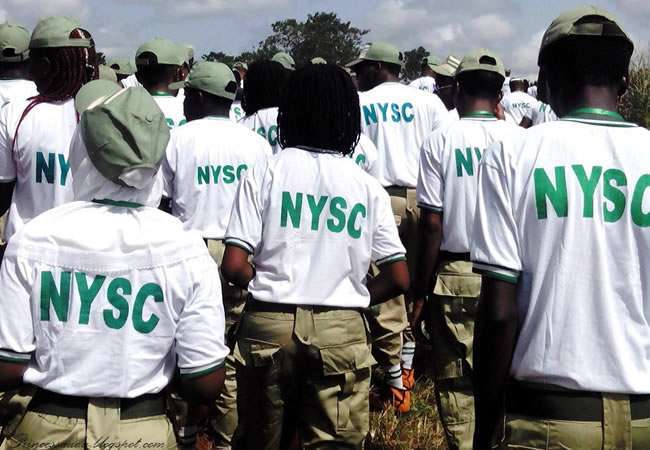
Six members of the National Youth Service Corps (NYSC) have received a total of N10 million in grants to expand their agribusiness ventures under the Farmers for the Future Programme.
The programme was organised on Monday by the British American Tobacco Nigeria Foundation (BATNF) in collaboration with the NYSC to encourage young Nigerians to embrace agriculture and develop sustainable businesses.
Presenting the cheques to the beneficiaries in Abuja, the NYSC Director-General, Brigadier General Olakunle Nafiu, urged Corps members to maximise the opportunities provided by the service year by venturing into commodity marketing and other viable businesses.
Nafiu said agribusiness remained a viable avenue for young people to build sustainable enterprises, create employment and generate wealth.
READ ALSO: NYSC Swears In 1,600 Corps Members In Bauchi
He also stressed the importance of value addition to the success and sustainability of business ventures, while commending BATNF for placing Nigerian youths at the centre of its entrepreneurship initiatives through value-chain development, employment creation and its partnership with the NYSC.
“I charge you to spread the news around. We have seen the outcome, and it is a good idea,” he said.
The beneficiaries are Dominic Olufemi (FC/25C/1143), who received N3 million; Temitope Adewole (ED/26A/2251), N2 million; Abdulwaheed Bala (ED/25B/1402), N2 million; Olanike Mayungbe (OG/26B/1037), N1 million; Kingsley Udoeyen (KG/26A/1735), N1 million; and Lorember Lorsue (JG/25B/1742), N1 million.
Speaking on the selection process, the Acting Director, Skills Acquisition and Entrepreneurship Development (SAED), Mrs Winifred Shopeka, said the programme began with an online registration portal through which Corps Members engaged in agribusiness submitted their business plans.
READ ALSO: NCCSALW Deploys NYSC Members In Fight Against Illegal Arms In Northeast
She said nearly 3,000 Corps members applied and underwent a rigorous selection process that produced 20 finalists.
According to her, the finalists participated in a boot camp and a final pitching session, which produced the 10 best presenters before the six ultimate winners were selected.
Shopeka said the beneficiaries had also been mentored and attached to established market operators to assist them in marketing their products.
She added that Corps Members who did not make the final stage of the competition were also trained by BATNF.
The BATNF Team Lead, Mr Oludare Odusanya, congratulated the beneficiaries and urged Corps Members engaged in agribusiness to master the fundamentals and acquire the knowledge and skills necessary to succeed.
“We are happy with our collaboration with the NYSC, and it will continue,” he said.
READ ALSO: NYSC Lauds Gov. Mohammed’s Intervention In Fence Collapse
Odusanya explained that BATNF was an independent organisation established to contribute to poverty reduction in Nigeria through sustainable agricultural practices and other interventions.
He said the Farmers for the Future Programme was instituted in collaboration with the NYSC to encourage Corps Members to venture into agribusiness and become job creators.
He added that the beneficiaries would be attached to mentors who would guide them towards achieving success in their respective businesses.
According to him, the programme has, since its inception, continued to enhance the entrepreneurial capacity of Corps Members.
News
CBN Reduces Interest Rate To 23%

The Central Bank of Nigeria (CBN) on Tuesday announced the reduction of the interest rate, also known as Monetary Policy Rate (MPR) to 23 percent.
Briefing the media in Abuja, the Governor of the CBN, Mr. Olayemi Cardoso, said at the 307th MPC meeting held on September 22, 2026 agreed the resetting of the MPR and recaliberation of the monetary policy market.
According to Cardoso, the committe is satisfied with the disinflation progress, adding that members noted stable banking sector following successful recapitalisation.
READ ALSO: CBN Monetary Tightening Worsening Nigeria’s N50tn Development Finance Gap – Group
Meanwhile, according to Nigerian Tribune, reports that that the MPC, at its 306th meeting in July 2026, disclosed its resolution to retain the interets at 26.5 percent.
According to the Governor of the CBN, Olayemi Cardoso, “the Committee’s decision to maintain the current policy stance followed a thorough assessment of the balance of risks. Although headline inflation moderated marginally in June 2026, global uncertainties have heightened, due mainly to the renewed hostilities in the Middle East.
“In view of the evolving developments, maintaining a cautious monetary policy stance remains appropriate. In arriving at its decision, the Committee noted the recent resurgence of hostilities in the Middle East, with particular attention to its spillover effects on global energy prices and the potential pass-through to domestic inflation.”
News
NURTW: KWAM1 Settles Long-time Rift Between MC Oluomo, Tafa Sego
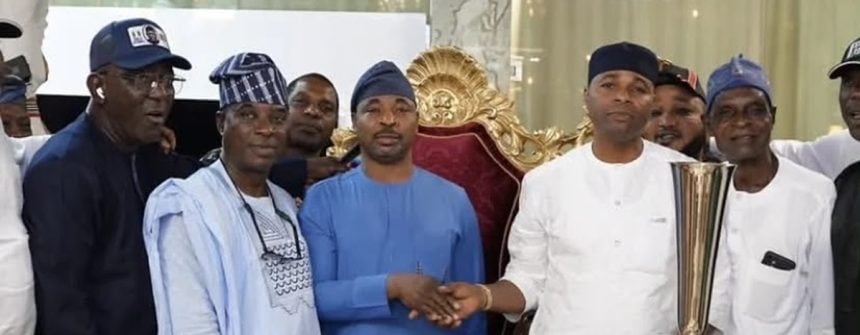
Nigerian Fuji musician, Wasiu Ayinde Marshal, popularly known as KWAM1, has brokered a peace deal between the National Union of Road Transport Workers (NURTW) National President, Musiliu Akinsanya, popularly known as MC Oluomo, and the Lagos State Chairman of the union, Mustapha Adekunle, aka Tafa Sego.
The reconciliation took place at Ojusagbola in Ijebu, Ogun State, where several NURTW chieftains gathered for the meeting.
The development was announced on Tuesday on KWAM1’s digital media page on Instagram, alongside photographs from the meeting.
According to the post, the two union leaders have resolved their differences after years of strained relations.
READ ALSO: Why FG Named KWAM 1 Aviation Security Ambassador — Keyamo
“After years of an age-long rift, MC Oluomo and Tafa Sego have finally settled their differences. And from what we know now, this is final,” the post said.
The musician was said to have intervened as the Mayegun of Yorubaland, with the aim of bringing an end to the longstanding disagreement between the two NURTW figures.
“K1 acted in his role as the Mayegun of Yorubaland by seeking an end to the long-standing rift, once and for all,” it said.
The post also described the meeting as a significant step beyond previous public displays of reconciliation.
READ ALSO: FG Gives KWAM 1 Aviation Appointment, After Airport Incident
“This time, it was not just another handshake for the cameras. The two old friends and colleagues came together at Ojusagbola, with King Wasiu Ayinde Marshal (K1) playing the peacemaker.”
Both MC Oluomo and Tafa Sego were reported to be pleased with the outcome of the intervention.
“Both parties are delighted about the new development,” the post said.
The two men had previously been allies and prominent figures within the Lagos NURTW before their relationship became strained amid disagreements linked to leadership of the union in the state.

 News2 days ago
BREAKING: Tinubu Extends Working Vacation
- News4 days ago
Six Hidden Health Benefits Of Unsweetened Zobo
- News4 days ago
Jehovah’s Witnesses Announce New Position On Blood Transfusion Policy
- News4 days ago
2027: Step-by-step Guide To Applying For INEC Ad Hoc Staff Recruitment
- News4 days ago
How 36 Nigerian States Got Their Names
- Headline4 days ago
Nigerian Man Jailed After Masturbating In Front Of Woman On UK Train
- Headline2 days ago
How To Format An Academic CV For US Master’s, PhD Applications
- News4 days ago
Stop Acid Reflux Pain: Foods You Must Ban From Your Kitchen
- Headline4 days ago
Nigerian Woman Arrested, Charged Over Illegal Voting In US
- News3 days ago
[OPINION] Wike-APC: Fights Always End Adultery


