
News
Dangote Refinery: Blind Man And His Yam Scrapers [OPINION]
By Suyi Ayodele
This blind man trusted no one because he knew the circumstances that led to his blindness. So, he kept on employing servants after servants to help him in his house chores. The blind man loved roast-yam. But he also found faults with his servants over the yam issue. He believed that while scraping the burnt back of the roast-yam, the servants helped themselves to some bits. That was why he fired them frequently, as they came.
One day, however, a vulpine was engaged as the servant of the blind man. Before taking the appointment, the would-be servant asked questions on why nobody stayed so long in the employ of the blind man. The response he got was that there used to be a loss of confidence between the man and his employees over roast-yam. Many people advised the intending servant not to accept the offer. But he had a better idea and a permanent solution to the yam-roasting wahala.
On the first day he would prepare roast-yam for his master, the blind man, as usual, asked the servant to bring the yam close to him so that he would hear the knife as it scraped the yam. The servant did as he was told. When his master asked him to start to scrape the yam, the servant started and then began to whistle. The servant whistled all through the period he scraped the yam, sliced it into bits and placed it before his master. The blind man was happy. A man with yam in his mouth cannot whistle, he noted. The master-servant confidence was built. He retained the servant. However, neighbours and relations noticed that the blind man was dropping in stature while the servant was adding weight by the day. The legend tells us what happened between the scraping of the yam and its slicing. That is a story for another day.
There is an ongoing war between Aliko Dangote and President Bola Ahmed Tinubu’s government. In the ongoing conflict of confidence between the Dangote Refinery and Federal Government of President Tinubu, the president, I will advise, should take a culture detour and behave like the servant of the proverbial blind man above. Our elders say: when you are scraping the back of a roast-yam for the blind, you are advised to keep whistling so that the blind will know you are not eating the yam.
I have elected to appoint myself into the cabinet of President Tinubu. My ‘friends’ who said I am looking for a job should place congratulatory advertorials in the dailies! Otherwise, they would not share in the ‘largesse’ to come! I hold no grudge against those my ‘friends’. It is the way we are wired in this country. Check out most critics of yesteryear. They now constitute the lead vocalists of the hallelujah orchestra of this government. One of them, who once said he could not stand the possibility “of a drug baron becoming the president of Nigeria”, can drink hemlock for the same figure today! Our life is almost measured in terms of Naira and Kobo! Sad for the polity; sad for our being as a nation! In line with my ‘self-appointed appointment’, you are therefore permitted to salute me as ‘The Honourable Senior Special Adviser, Culture and Tradition’, to the President. Hurray! My first duty in office is on the Dangote Petroleum Refinery and the government of President Tinubu.
MORE FROM THE AUTHOR: OPINION: If Tinubu Were Today’s Opposition Leader
Nigerians don’t trust this government. They are right on that! The government itself has not helped matters. There is nothing that this present administration, and the one before it has done to convince the people that they meant well for them. Life has become unbearable for Nigerians in the last nine years. The 16 years of the “cluelessness” of the Peoples Democratic Party (PDP), has paled into insignificance given the pains the All Progressives Congress (APC), which took over government in 2015 has inflicted on the people. It is therefore natural that there would be no confidence between the government and the people.
On any issue, Nigerians have reasons to doubt the sincerity of the government. The Tinubu administration has worsened the situation with its transactional tendencies. Everything the government has done in terms of economic policies, has been largely beneficial to the president and a few of his men! This is why when the conflict of confidence broke out between Dangote Refinery and the government, the public, naturally, moved in support of Dangote. In this present loss of confidence, the people represent the blind man, Dangote Refinery is the roast-yam, and Tinubu’s administration is the servant scraping the back of the roast-yam. The government must whistle, and it will whistle all through. Like we say on the streets: the government go explain tire!
Penultimate week, on this page, I wrote “Supper for Nigeria’s Àkébàjé.” What is playing out between Dangote Refinery, and our Federal Government is the case of an Àkébàjé (spoilt brat) and an unfeeling father. Both parties in the blame game are guilty. Aliko Dangote, the owner of the refinery, has been here for a long time. He is, no doubt, the leader of the class of people known as AGIP (Any Government In Power). His businesses thrive because, like an Àkébàjé, every government pampers him. The Tinubu administration appears to be the only government in our recent history that is not a paddy-paddy government with Dangote. Why it is so, is not our business here, today.
Dangote enjoys what other businessmen in the nation would never get. And he is used to the idea of the government bending backwards to accommodate his numerous demands. Today, Dangote is regarded as the richest African because he survives more on government patronages, rebates and concessions which are detrimental to the economic health of the nation. He cried over the appellation of monopolist he was christened with over the debacle on his refinery and Federal Government represented by the NNPCL. That baffled me. Does it mean that Dangote is not aware that he is the only player in virtually all the ventures he runs in this nation? What about his recent face-off with the BUA Group over the cement issue? Was that not about monopoly? So, is it true that a man with a bad attitude hardly knows how despicable his manners are?
MORE FROM THE AUTHOR: OPINION: Supper For Nigeria’s Àkébàjé
For me, I have been praying for a day when a sane government would come and break the chain of Dangote monopoly in this country. However, I must quickly add that the current face-off between the Dangote Refinery and the Federal Government is not what I had wished for. This is simply not the ideal case of breaking someone’s monopoly. The allegations and counter-allegations in the media space are too disturbing. What we are about to witness is a case of what my people call olè gbe, olè gba (a transfer from one thief to the other).
But in all, the Dangote refinery must not go down! I am not saying this because I never suspected that that enterprise is another scam! General Muhammadu Buhari, as the sitting president, ‘commissioned’ the refinery on Monday, May 22, 2023. That was a week to the end of his tenure! He did that à la Kayode Fayemi, who also ‘commissioned’ the Ekiti Airport on October 18, 2022, and left office on October 18, 2022. Almost two years now, not a single butterfly has touched down at the airport. Interestingly, Buhari and Fayemi are ‘progressives’!
Buhari left office as president on May 29, 2023. Seven days to the end of his tenure, the Mai Gaskiya (the honest man) ‘commissioned’ a refinery that a year and two months after, Nigerians are yet to benefit from. That was the first scam, ever, in the Dangote Refinery! Why are we still talking about NNPCL supplying crude to the refinery that was ‘commissioned’ over one year ago? In performing that scam of a ‘commissioning’, President Tinubu, then as president-elect was seated. Five other African countries’ presidents attended the ceremony. Now the reality is here with us. What Buhari commissioned was a mere carcass. The real refinery is now up, but there is no crude oil for it to refine!
Why are we like this as a people? Why would a president ‘commission’ a project that was still under construction? More importantly, why did Buhari ‘commission’ the Dangote refinery when he knew that the crude oil to be refined is not available because he, Buhari, had used the crude oil to borrow money through the numerous forward sale agreements his government executed? The information in the public space is that Buhari executed seven solid forward sale agreements, which entails that he borrowed money and pledged our crude oil as payment. That will run for several years. Nobody has disputed that; nobody is also asking Buhari any question.
Tinubu came and continued with the shenanigan. His government, it was also said, pledged our crude oil as payment for the $3.3 billion Afrexim Bank loan that he took in August 2023, barely three months after he assumed office. The government has not countered that either! Now, if it is true that Dangote needs about 650,000 barrels of crude oil daily to run his refinery, and the NNPCL has just 200,000 barrels of crude oil per day left because Buhari and Tinubu had pawned the remaining 1,050,000 barrels of crude oil in advance, how would the Dangote Refinery get the products to refine? The problem is bigger than that, anyway. Last December, the government Vuvuzelas told us that the Port Harcourt Refinery was almost ready. When eventually that one comes alive, are we going to import crude oil for the refinery?
MORE FROM THE AUTHOR: OPINION: Nigeria Nor Be Kenya
When I say Dangote refinery must not die, I mean every alphabet of that statement. President Tinubu has the sole responsibility of ensuring that the crisis is resolved. The emotional blackmail by Aliko Dangote of his willingness to sell his shares of the refinery is very immaterial and ultimately childish. Dangote is crying today because he appears to have no ‘friends’ in this present administration. As we say here in the Niger Delta, na who him mama dey kitchen, nor dey hungry! He should learn that there is no champion for life! Nevertheless, the death of Dangote Refinery, by any means, is a huge negative for this government. As it stands today, I doubt if any serious investor would want to put his money into this economy.
What the government should do, is exactly what the Nigerian Tribune suggested in its Editorial of yesterday, Monday, July 29, 2024, under the title: “The Dangote Refinery Issue.” The Editorial reads in part thus: “To be sure, we do not make light of regulatory issues. Regardless of the acclaimed state of the Dangote Refinery and the position of Aliko Dangote, Africa’s richest businessman, in the scheme of things, the law remains the law and ought to be enforced to the letter. The problem is that in this case, there has been no clarity on the actual offence(s) committed by the business in question…. It is a no-brainer that a facility such as the Dangote Refinery, Nigeria’s only functional refinery at the moment, ought not to be trashed by the Nigerian government, particularly given its rhetoric about recovering the Nigerian economy from the current morass…. While we make absolutely no comment about the alleged political underpinnings of the dispute between the Dangote Group and the Federal Government, we are constrained by the lessons of the past to issue a serious warning over the age-long, pernicious practice of destroying local investments and eroding the business climate for partisan reasons.”
The Federal Government should be mindful of the ripple effects of this debacle on its claimed success in attracting foreign investors to our economy. However, the government should not compromise on the standard practice of selling our crude oil to Dangote refinery in Dollars, and not in Naira, as Dangote was said to be asking for. If the Buhari government had given that concession to Dangote as a typical Àkébàjé, the Tinubu government would have my full support if it insisted that it would only sell in dollars. But President Tinubu must be above board in doing that. He must be clean; he must be transparent.
While the Nigerian Tribune Editorial quoted above says it would “make absolutely no comment about the alleged political underpinnings of the dispute between the Dangote Group and the Federal Government”, I am tempted to toe that line. But given my new self-imposed role as an ‘adviser’ in this government, I would like to remind President Tinubu that what is in the public space is that Mr. President is seeking an end of the Dangote Refinery so that his own personal business concerns, and those of his cronies, in that sector, could thrive. True or false, only Tinubu and Dangote know the truth. What should the president do in this circumstance? Let Tinubu continue to whistle while scraping the back of the blind man’s roast-yam. If not for any other thing, but for the sake of thousands of Nigerians who would be thrown back to the labour market should Dangote Refinery die, and the millions of other dependants that will suffer, President Tinubu must show ultimate courage and do everything that is right under the laws to preserve the Dangote refinery. This is the only way any other person would put his money in our economy!



News
Six Corps Members Receive N10m Grants To Boost Agribusiness
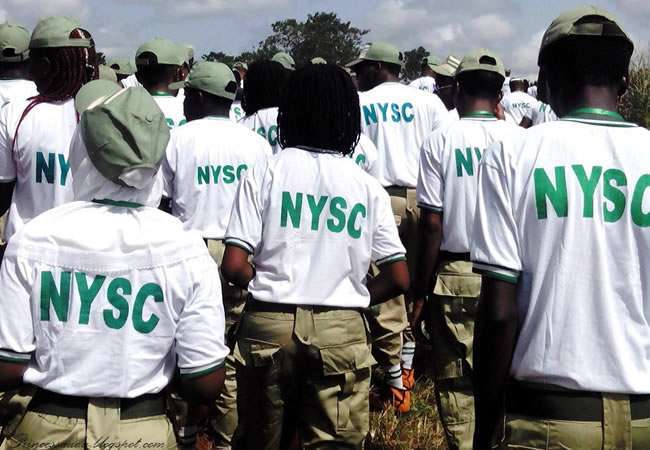
Six members of the National Youth Service Corps (NYSC) have received a total of N10 million in grants to expand their agribusiness ventures under the Farmers for the Future Programme.
The programme was organised on Monday by the British American Tobacco Nigeria Foundation (BATNF) in collaboration with the NYSC to encourage young Nigerians to embrace agriculture and develop sustainable businesses.
Presenting the cheques to the beneficiaries in Abuja, the NYSC Director-General, Brigadier General Olakunle Nafiu, urged Corps members to maximise the opportunities provided by the service year by venturing into commodity marketing and other viable businesses.
Nafiu said agribusiness remained a viable avenue for young people to build sustainable enterprises, create employment and generate wealth.
READ ALSO: NYSC Swears In 1,600 Corps Members In Bauchi
He also stressed the importance of value addition to the success and sustainability of business ventures, while commending BATNF for placing Nigerian youths at the centre of its entrepreneurship initiatives through value-chain development, employment creation and its partnership with the NYSC.
“I charge you to spread the news around. We have seen the outcome, and it is a good idea,” he said.
The beneficiaries are Dominic Olufemi (FC/25C/1143), who received N3 million; Temitope Adewole (ED/26A/2251), N2 million; Abdulwaheed Bala (ED/25B/1402), N2 million; Olanike Mayungbe (OG/26B/1037), N1 million; Kingsley Udoeyen (KG/26A/1735), N1 million; and Lorember Lorsue (JG/25B/1742), N1 million.
Speaking on the selection process, the Acting Director, Skills Acquisition and Entrepreneurship Development (SAED), Mrs Winifred Shopeka, said the programme began with an online registration portal through which Corps Members engaged in agribusiness submitted their business plans.
READ ALSO: NCCSALW Deploys NYSC Members In Fight Against Illegal Arms In Northeast
She said nearly 3,000 Corps members applied and underwent a rigorous selection process that produced 20 finalists.
According to her, the finalists participated in a boot camp and a final pitching session, which produced the 10 best presenters before the six ultimate winners were selected.
Shopeka said the beneficiaries had also been mentored and attached to established market operators to assist them in marketing their products.
She added that Corps Members who did not make the final stage of the competition were also trained by BATNF.
The BATNF Team Lead, Mr Oludare Odusanya, congratulated the beneficiaries and urged Corps Members engaged in agribusiness to master the fundamentals and acquire the knowledge and skills necessary to succeed.
“We are happy with our collaboration with the NYSC, and it will continue,” he said.
READ ALSO: NYSC Lauds Gov. Mohammed’s Intervention In Fence Collapse
Odusanya explained that BATNF was an independent organisation established to contribute to poverty reduction in Nigeria through sustainable agricultural practices and other interventions.
He said the Farmers for the Future Programme was instituted in collaboration with the NYSC to encourage Corps Members to venture into agribusiness and become job creators.
He added that the beneficiaries would be attached to mentors who would guide them towards achieving success in their respective businesses.
According to him, the programme has, since its inception, continued to enhance the entrepreneurial capacity of Corps Members.
News
CBN Reduces Interest Rate To 23%
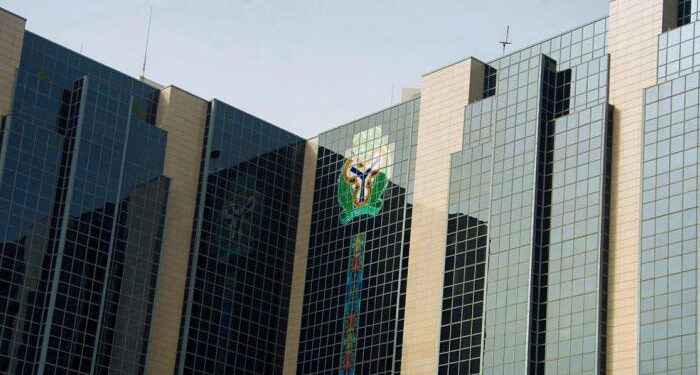
The Central Bank of Nigeria (CBN) on Tuesday announced the reduction of the interest rate, also known as Monetary Policy Rate (MPR) to 23 percent.
Briefing the media in Abuja, the Governor of the CBN, Mr. Olayemi Cardoso, said at the 307th MPC meeting held on September 22, 2026 agreed the resetting of the MPR and recaliberation of the monetary policy market.
According to Cardoso, the committe is satisfied with the disinflation progress, adding that members noted stable banking sector following successful recapitalisation.
READ ALSO: CBN Monetary Tightening Worsening Nigeria’s N50tn Development Finance Gap – Group
Meanwhile, according to Nigerian Tribune, reports that that the MPC, at its 306th meeting in July 2026, disclosed its resolution to retain the interets at 26.5 percent.
According to the Governor of the CBN, Olayemi Cardoso, “the Committee’s decision to maintain the current policy stance followed a thorough assessment of the balance of risks. Although headline inflation moderated marginally in June 2026, global uncertainties have heightened, due mainly to the renewed hostilities in the Middle East.
“In view of the evolving developments, maintaining a cautious monetary policy stance remains appropriate. In arriving at its decision, the Committee noted the recent resurgence of hostilities in the Middle East, with particular attention to its spillover effects on global energy prices and the potential pass-through to domestic inflation.”
News
NURTW: KWAM1 Settles Long-time Rift Between MC Oluomo, Tafa Sego
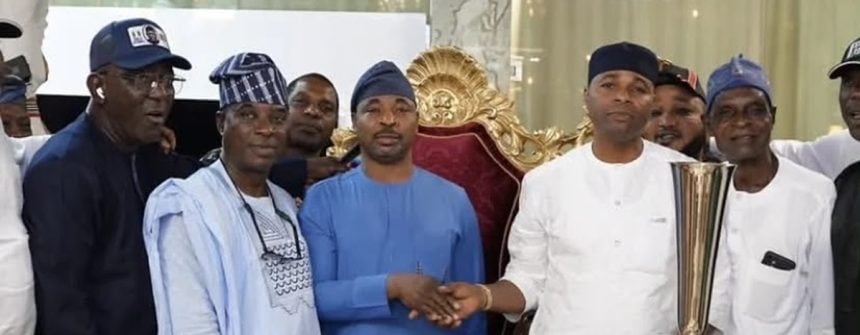
Nigerian Fuji musician, Wasiu Ayinde Marshal, popularly known as KWAM1, has brokered a peace deal between the National Union of Road Transport Workers (NURTW) National President, Musiliu Akinsanya, popularly known as MC Oluomo, and the Lagos State Chairman of the union, Mustapha Adekunle, aka Tafa Sego.
The reconciliation took place at Ojusagbola in Ijebu, Ogun State, where several NURTW chieftains gathered for the meeting.
The development was announced on Tuesday on KWAM1’s digital media page on Instagram, alongside photographs from the meeting.
According to the post, the two union leaders have resolved their differences after years of strained relations.
READ ALSO: Why FG Named KWAM 1 Aviation Security Ambassador — Keyamo
“After years of an age-long rift, MC Oluomo and Tafa Sego have finally settled their differences. And from what we know now, this is final,” the post said.
The musician was said to have intervened as the Mayegun of Yorubaland, with the aim of bringing an end to the longstanding disagreement between the two NURTW figures.
“K1 acted in his role as the Mayegun of Yorubaland by seeking an end to the long-standing rift, once and for all,” it said.
The post also described the meeting as a significant step beyond previous public displays of reconciliation.
READ ALSO: FG Gives KWAM 1 Aviation Appointment, After Airport Incident
“This time, it was not just another handshake for the cameras. The two old friends and colleagues came together at Ojusagbola, with King Wasiu Ayinde Marshal (K1) playing the peacemaker.”
Both MC Oluomo and Tafa Sego were reported to be pleased with the outcome of the intervention.
“Both parties are delighted about the new development,” the post said.
The two men had previously been allies and prominent figures within the Lagos NURTW before their relationship became strained amid disagreements linked to leadership of the union in the state.

 News2 days ago
BREAKING: Tinubu Extends Working Vacation
- News4 days ago
Six Hidden Health Benefits Of Unsweetened Zobo
- News4 days ago
Jehovah’s Witnesses Announce New Position On Blood Transfusion Policy
- News4 days ago
2027: Step-by-step Guide To Applying For INEC Ad Hoc Staff Recruitment
- News4 days ago
How 36 Nigerian States Got Their Names
- Headline4 days ago
Nigerian Man Jailed After Masturbating In Front Of Woman On UK Train
- Headline2 days ago
How To Format An Academic CV For US Master’s, PhD Applications
- News4 days ago
Stop Acid Reflux Pain: Foods You Must Ban From Your Kitchen
- Headline4 days ago
Nigerian Woman Arrested, Charged Over Illegal Voting In US
- News3 days ago
[OPINION] Wike-APC: Fights Always End Adultery


