

Headline
OPINION: Tinubu’s ‘Taste’ Gerontocracy




By Lasisi Olagunju
The University of Ibadan is 75 years old. Chief Bisi Akande celebrated his 85th birthday on January 16 this year. He was made Secretary to Oyo State Government 45 years ago at the age of 40. He was Deputy Governor of Oyo State 42 years ago. He was elected Osun State Governor in 1999 – 25 years ago. He left the office of governor 21 years ago. Last Friday, the 85-year-old man was appointed by President Bola Tinubu to serve the University of Ibadan as its pro-chancellor and chairman of council. When you heard Chief Akande’s name as the appointee, you were almost as sure as I was that the old warrior would reject it in a jiffy. I told myself that he would tell his friend, the president, that his choice for UI’s top job must be an error; that only today’s hound can successfully chase today’s hare. But today is Monday – four days after, Chief Bisi Akande has not rejected the ‘juicy’ job. We have no business rejecting it for him.
An elephant chooses how he wants the forest to address him. If you schooled at the same time as I did, you must have read the poem ‘Salute to the Elephant’. It is there that you meet Elephant – “possessor of a savings-basket full of money” who is “huge as a hill, even in a crouching posture.” The Elephant is that mighty one “who carries mortar and yet walks with a swaggering gait…, animal treading ponderously.” The Elephant, more importantly, is that “mountainous animal, (the) huge beast who tears a man like a garment and hangs him up on a tree.” The sight of the Elephant, the chanter-hunter says, “causes people to stampede towards a hill of safety.” Now, imagine that elephant coming down from the height of his high reputation to mingle with deers in a scavenge-rush for forbs. An elephant would do that if it does not see itself as an elephant. It is his choice. I am not qualified to tell this chief’s elephant not to eat what common goats eat. But if I were his son, I would beg him to say “no, thank you.”
Chief Akande is not alone on that geriatric podium of self-diminution. With him is General Ike Omar Sanda Nwachukwu (Rtd) who was made chairman of the University of Nigeria governing council. The University of Nigeria is 69 years old. It was founded in 1955 but formally opened on October 7, 1960. General Nwachukwu will be 84 years old on September 1, this year. He has been everything anyone would ever want to be in Nigeria. As a soldier, he rose to be Major-General and General Officer Commanding. He was governor of Imo State 40 years ago. He was Minister of Labour 39 years ago. He was Foreign Affairs Minister 34 years ago. He was elected senator 25 years ago. He is back from the bench in this season of renewed past.
Must it be them? Don’t they have around them, in their political party, sleek-headed younger people with knowledge and ideas who can handle these assignments? They have them, but those ones are useful only as aides and as bag carriers.
Writing in May last year for US’ satire newspaper, The Onion, grand old Dianne Feinstein satirized America as “an out-of-touch gerontocracy” where “the average age of a senator is 65” – and the president eighty-something years old. She said she was “glad” not to live and get stuck in that country of “dementia-addled” leaders “who keep a stranglehold on power” and “who prioritise their own careers and bank accounts over the common good.” Then she wondered, angrily “how selfish you’d have to be to cling to power when you’ve long since ceased to understand the needs of ordinary people.” I will be shocked if I am the only one who thinks strongly that Feinstein wrote about Nigeria of today.
MORE FROM THE AUTHOR: OPINION: Homeless Kids Invade South West
I read a sonnet of William Shakespeare where he deplores “age” staying “too long.” In his ‘The Passionate Pilgrim’, Shakespeare explains why “crabbed age and youth cannot live together.” Shakespeare sings of “Youth like summer brave, age like winter bare.” He says “Youth is full of sport, age’s breath is short; Youth is nimble, age is lame; Youth is hot and bold, age is weak and cold; Youth is wild, and age is tame…” Yet, our country’s vote is for the old and cold; the lame, the tame.
We have more of them. Our universities are now a rest home for the ancient. There is also 72-year-old Alhaji Yayale Ahmed who was announced as the chairman of 62-year-old Ahmadu Bello University, Zaria. He was appointed Head of Service of the Federation in the year 2000 – 24 years ago. He occupied that post for seven years, retiring in 2007 to be appointed as the Minister of Defence. He left the office of minister in September 2008 to be appointed as the Secretary to the Government of the Federation. He held sway there till May 2011. He left thirteen years ago. He is back from retirement to preside over ABU’s highest governing body.
These king-size men and others on that long list will be interfacing with a 70-year-old minister. Professor Tahir Mamman is our minister of education. If he had remained in the university system, he would be due for retirement in three weeks’ time. The minister reports to a president who is officially 72 years old. Essentially, these 20th century men are the drivers of the 21st century vision of Nigeria’s knowledge industry. That is the way we roll. The National Universities Commission (NUC) regulates Nigeria’s university system. Who is NUC’s substantive executive secretary? Check if it has. And, who presides over its board? As I write this today, Sunday, 16 June, 2024, the commission in charge of our universities has on its website, Emeritus Professor Ayo Banjo as the chairman of its board. Baba Professor Banjo died last month – he was 90 years old. NUC has not remembered to update its website to reflect that fact – or it is reluctant to let go of the late Professor Banjo.
Beyond the dead, shall we ask the new octogenarian appointees where they hope to start from in this digital age? With their appointments, Nigeria is asking its Gen Z students to use fatigued eyes of tired men to prepare their journey into the future. May God help them.
MORE FROM THE AUTHOR: OPINION: Kano’s Midnight Kingdom
A leader must know when to say enough to seeking power. Someone (I can’t get their name) said knowing when to walk away is wisdom. He also said being able to walk away is courage. Yet, there is a third line: walking away with your head held high is dignity. Why would an eighty-something-year-old man want to be a baggage carrier – porter – to the youth of his land? Someone said it is the love of service. I replied that it is simply a case of an Egungun, because of perks, dancing itself into irrelevance.
Apart from them being his friends, are there patriotic reasons why the president posted these men to those schools? We may not know the real reason why our president made those geriatric choices – unless he tells us. Raul Magni Berton and Sophie Panel in 2017 did a paper on why non-democratic systems produce older leaders. They postulate that leaders’ “ruling styles” are “partly shaped by the rules that brought them to power.” They ask why anyone, even the old, would want to be ruled by aged people. They dissect types and motives of gerontocratic rule. They say “the selection of aging leaders based on premeditated considerations” is the definition of strategic gerontocracy. They contrast this with what they call ‘taste’ gerontocracy “which is based on genuine preference for old leaders”. They speak on ‘skills’ gerontocracy which assumes that the chosen had “specific skills acquired with age.” What special skills do our eighty-something-year-old ‘chairmen’ have that recommended them for our universities as pro-chancellors? Tinubu is not known to be a wine connoisseur who flaunts the old as the better. So, I wonder why the president loves old stuff – old, fossilized national anthem and aged administrators.
This government’s choice of yesterday’s men for today’s work has natural consequences. You know menopause, its complications and implications. That is what the University of Ibadan, UNN and ABU and some others in their geriatric shoes are now married to. Escaping the schools’ climacteric suitors and their creaky beds looks futile. When Humphrey Hawksley wrote his 2009 book, ‘Democracy Kills’, he probably had our case in mind. There is hardly anything which today’s democracy inherited that it has not fed to the dogs. While we fantasised on what the textbook says democracy is, the leaders have unitised the benefits in it; they’ve warehoused the gains in their family silos – for the comfort of their generations and for their friends’.
I am wasting my time writing this. The same applies to you raising complaints about how our planes are being run aground. The government does not care about the public and its opinion. You can’t blame it. There is a problem with winning all bouts all the time. It intoxicates the winner, making them look down on the street and disdainful of even their fans. “At being humble, I’m the greatest”. A Minnesota, United States mother in about 1970, was horrified to hear her young wrestler-son say this as he recorded wins after wins. The woman described that statement of her son as “silly” – but that was hubris at work. We read such ‘humility’ in the insults the Nigerian leadership rolls out almost daily. Everything points at the end of sanity in the conduct of our affairs. Yet, long before this present darkness, there had been eras of rationality and hope. There had been an age when leaders insulted not the people’s sensitivities and the people bowed in respect of fair leadership. We had a past of values which even those who colonised us acknowledged in their own moments of sobriety.
Between the last days of 1927 and the early weeks of 1928, a group of United Kingdom’s Members of Parliament visited Nigeria. They moved from the coasts in Lagos through the hinterland forests to the grasslands of the North. They thoroughly toured the East of Nigeria and the creeks of the Niger Delta – then went back to London through Lagos. At a dinner of the African Society in London on 13 March, 1928, leader of the delegation, Major Walter Eliot, presented his team’s report. In that report, Major Eliot said while in Nigeria, his team saw an “honest attempt” by the black man to build “a house” for his soul; a house “where the black man could find a shelter” against the impact of a strange alien culture; a house “from which in years to come, he may take his own share as a partner in the progress of the world – not as an inferior and certainly not as a serf…” Eliot’s optimism – expressed in that report 96 years ago – was hasty and misplaced. If the Briton visits Nigeria of today, he will meet 200 million people shuffling and struggling (not) to be serfs of power.
MORE FROM THE AUTHOR: OPINION: Petrol Pains, Wilderness Wanderings
That is not all from Eliot. Everywhere they went, his team said they saw a people who had very high regard for their leaders and who had their leaders’ respect. He disclosed that his team members were surprised (and impressed) and were of the conviction that “the black man should look to the black ruler as the keystone in the arch of rule; that the white man should not be the keystone…that the rule should be of the black man by the black man and – as far as we can devise it – for the black man.”
They are long dead, those proud, upright people who were met in Nigeria by the British in 1927. About a hundred years after the Eliot team experience and the positive testimony from London, and 64 years after foreign rule, a virulent strain of disdain for the ruled – and disgust for the ruler – reigns. Our democracy is a despicable bazaar; the classic “every man for himself and God for us all.” What the 1927/28 visitors envisioned as the rule “of the black man by the black man” has turned out not “for the black man.” The rule serves the strongman and his clan whose ways are decidedly not necessarily the ways of their people.
They take the benefits; their children take. Their concubines and mistresses also pick theirs while your own portion is tucked away in their pouch. It is the reason they can’t reason with us when we say Nigeria cannot survive as a unitary presidentialism. They take our call for federalist sanity as a threat to the advantages they enjoy. They think a truly federal Nigeria would be too tight to structurise into personal fiefdoms. They work that federalism won’t happen. Not now, not tomorrow. And they are winning. They spring on us federal surprises everywhere. They set up institutions and make appointments that are designed to unitarise our lives under Big Brother. Because they are smart, they easily know that they can’t compete and feed their greed in a Nigeria that is properly structured. The result of their knowing is that we can’t breathe without their permission.
A restructured Nigeria has the prospect of not surrendering to Comrade Napoleon’s unitary dictatorship in the Animal farm. Less than one week into this democracy, Professor Bolaji Akinyemi, in the Friday, 4 June, 1999 edition of the Nigerian Tribune, warned that Nigeria was on the way to a most destructive form of unitarism. “The road to the hell of unitarism is paved with good intentions. They should be careful…”, he warned the inheritors of the gains of the struggle for this democracy. They ignored him. We were too hopeful to hear him. But, words of elders, if they don’t come true in the morning, they will in the evening. The evening of Nigeria is here.
The author, Dr. Lasisi Olagunju is the Saturday Editor of Nigerian Tribune, and a columnist in the same newspaper. This article was first published by the paper (Nigerian Tribune). It is published here with his permission.




Headline
Oil Prices Drop After Iran Reopens Strait Of Hormuz


Global oil prices dropped sharply on Friday after Iran signalled that the Strait of Hormuz would remain open to commercial shipping during a temporary ceasefire in the Middle East.
Benchmark crude prices fell by more than 10 per cent, with West Texas Intermediate (WTI) slipping below $85 per barrel, while Brent crude declined to about $89 per barrel.
The decline follows comments by Iran’s Foreign Minister, Abbas Araghchi, who said commercial vessels would be allowed to transit the strait for the duration of a 10-day ceasefire involving Israel and Lebanon.
The truce, which began on Thursday, is reported to include the Iran-backed group Hezbollah.
READ ALSO:Crude Oil Prices Jump As Fear Mounts On Fresh Domestic Petrol Hike In Nigeria
Oil prices had surged above $100 per barrel in recent weeks amid heightened tensions in the region, with WTI reaching nearly $113 per barrel earlier this month and Brent climbing above $119 in late March.
Analysts say the reopening of the key shipping route has eased supply concerns in global energy markets.
Brian Therien, a senior investment strategist at Edward Jones, noted that oil futures are now trending lower, with projections suggesting prices could fall to the low $70 range by the end of the year. He added that a sustained drop in prices could help reduce inflationary pressures globally.
The Strait of Hormuz, which links the Persian Gulf to the Arabian Sea, is one of the world’s most critical oil transit routes, accounting for roughly one-fifth of global oil and liquefied natural gas shipments.
READ ALSO:JUST IN: Trump Orders US Naval Blockade Of Strait Of Hormuz
Shipping through the passage had been disrupted during the conflict due to security concerns, including threats of attacks and the presence of naval mines.
An Iranian official told Reuters that vessels moving through the strait during the ceasefire would be required to use designated safe lanes approved by Iranian authorities, while military ships would not be permitted to pass.
Despite the announcement, some shipping firms remain cautious. German carrier Hapag-Lloyd said it is still reviewing the situation before resuming operations in the area.
Meanwhile, Knut Arild Hareide of the Norwegian Shipowners’ Association welcomed the development but warned that uncertainties remain, particularly regarding maritime safety, operational guidelines, and the potential risks posed by unexploded sea mines.
Headline
You Can’t Go To US With Good Feelings Since Trump Returned To Power – Sports Legend


Germany legend, Oliver Kahn, has insisted that one cannot go to the United States with ‘good feelings’ since President Donald Trump returned to the Presidency.
Kahn stated this while speaking to Sky Sport Germany about the upcoming World Cup, which is to be held in the US, Mexico and Canada.
According to the former Bayern Munich goalkeeper, there are so many things happening in the US at the moment that are no longer compatible with ‘values’.
READ ALSO:Trump Tired Of War In Iran – Shehu Sani
“There are simply so many things happening in the USA right now that are no longer compatible with our understanding of values,” Kahn said.
“One example was the war, but I don’t want to list everything Donald Trump has been doing there since he returned to the presidency.
“You can’t go there with a good feeling at the moment.”
Headline
Trump Bows To Pressure, Deletes Post Depicting Self As Jesus

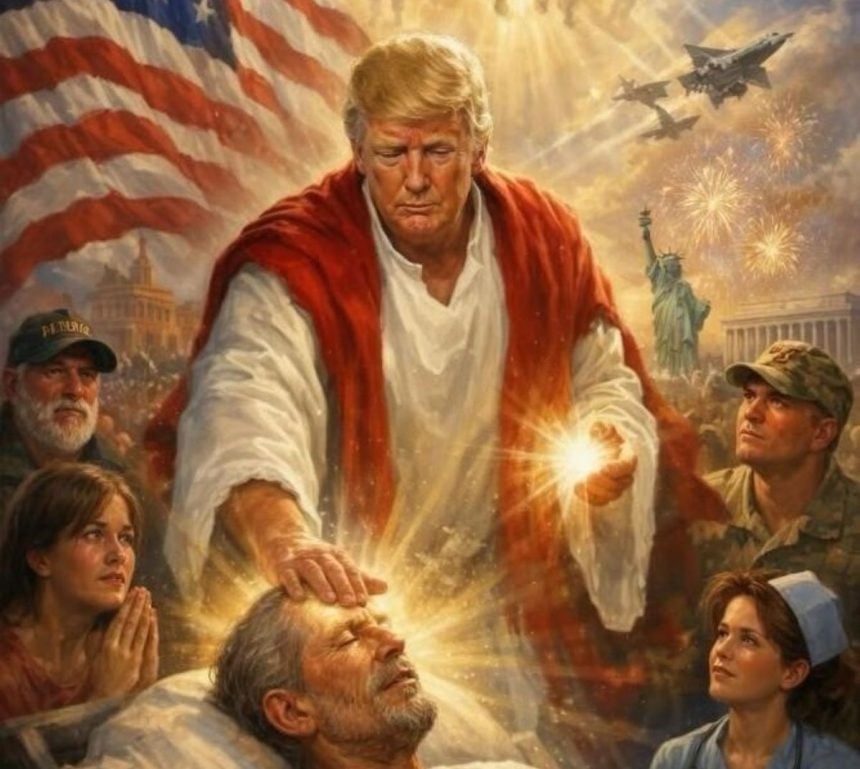
United States President, Donald Trump, has deleted a social media post that appeared to portray him as Jesus, following backlash and rising tensions with Pope Leo XIV over the Iran war.
The image, shared on Truth Social late Sunday, showed Trump as a Christ-like figure healing the sick, surrounded by American flags and eagles.
The post came shortly after the president criticised the pope for opposing the war with Iran.
By Monday morning, the image had been removed from his account. A previous link to the post now leads to a notice stating the “content is no longer available.”
READ ALSO:JUST IN: Trump Orders US Naval Blockade Of Strait Of Hormuz
Speaking later at the White House, Trump denied the interpretation of the image and said he believed it depicted him differently.
“I did post it, and I thought it was me as a doctor, and had to do with the Red Cross,” he told reporters at the White House.
He dismissed claims that the image portrayed him as Jesus, blaming the media for the narrative.
“Only the fake news” could come up with the idea that it depicted him as Jesus.
READ ALSO:I Have To Be Involved In Choosing Iran’s Next Leader – Trump
“I just heard about it, and I said, ‘How did they come up with that?’ It’s supposed to be me as a doctor making people better. And I do make people better,” he said.
The development comes amid an ongoing public disagreement between Trump and Pope Leo XIV over the Iran war.
The pope said Monday he has “no fear of the Trump administration” and would continue to speak out, despite criticism from the president, who described his stance as “terrible for foreign policy.”
Leo, the first American pope, has intensified his criticism of the war in recent days, condemning Trump’s remarks about the Iranian people as “truly unacceptable.”
(CNN)
-

 News5 days ago
BREAKING: JAMB To Release First Batch Of 2026 UTME Results Midnight
-

 News4 days ago
World Bank Flags ‘Hidden Spending System’ Diverting Over N34.53tn Of Nigeria’s Revenue
-

 News5 days ago
Popular Nigerian Broadcast Journalist Is Dead
-

 News5 days ago
FG Bans Unauthorized Use Of Ambassador Title
-

 News4 days ago
VIDEO: I Took Over Leadership From Myself; The Late Buhari Is Me — Tinubu
-

 Metro5 days ago
Police Inspector Arrested For Armed Robbery Dies From Bullet Wounds
-
News3 days ago
FG Slams Import Ban On 17 Items In New Fiscal Policy
-

 News5 days ago
OPINION: Nigerian Military: Death On Battlefield, Crumbs On Payroll
-

 Politics5 days ago
2027: Why Tinubu Should Be Scared – ADC
-

 News4 days ago
Guard Your Admission Carefully – Registrar Urges Newly Matriculated Students
