
News
OPINION: We Are All Àmúpìtàn
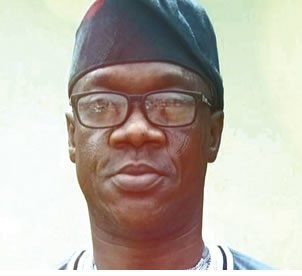
By Suyi Ayodele
Àmúpìtàn – the one whose deeds will be retold in history. If you answer this name, wisdom dictates that you should be conscious of what history holds for you in future. Every human being is an Àmúpìtàn; there is no exception.
Names are significant in the African worldview. Every child is what his name denotes. The wise men of my native land posit that Ìbí ni a únmo iràn (one’s birth denotes one’s ancestry). That axiom remains valid to date because a child sired in the home of wisdom will never go to the house of the foolish to learn
I know of a great Àmúpìtàn. He died about 39 years ago. However, his many deeds while on this side of the planet are celebrated in stories about the greatness of mankind.
I will tell just one of the many deeds of Oba Òjó Àmúpìtàn Olúyeyè Òjoyèbugiòtèwó (he who ascends the throne and uproots the tree of conspiracy) Amélilájetùotùo (he who eats the cow alongside its horns). He was the penultimate Onísè of Odò Orò Èkìtì. The following narrative is presented from the perspective of a narrator as a minor participant.
Odò Orò Èkìtì in the early 70s witnessed a fierce battle between two cousins who jostled for the chieftaincy title of Olókòjú (head of the community’s traditional army). From ancient times, the two cousins have rotated the title. At one point, one of the cousins wanted to make the title his permanent inheritance.
The other cousin kicked against the idea. So, when the title became vacant following the demise of the occupier from the other homestead, the cousin who insisted that the rotational tradition must be respected presented a candidate. The other side, which produced the immediate past Olókòjú, also presented a candidate.
The matter got to a head, and the Onísè-in-Council stepped in. Oba Àmúpìtàn Olúyeyè ruled that the tradition must be sustained. The influence of the other cousin paled into insignificance as the Onísè stood his ground and installed a new Olókòjú from the rightful family according to the rotation history. While the animosity between the two cousins remained, Oba Àmúpìtàn Olúyeyè was at peace with himself and the ancestors because he did the right thing.
Fast forward to the 1981 masquerade festival in the town. As young folks, we were following our favourite masquerade known as Aao (diviner), dancing and soliciting money from townsmen and women, who generously gave to us.
As we moved from one quarter to another, the masquerade party ran into one of the elites of the town. He was working in Gboko, the traditional headquarters of Tiv, Benue State. The man just returned from Western Germany, where he studied.
We stopped his brand-new Peugeot 504 SR salon car, as we were wont to do. We sang and danced. The man would not budge. After a few minutes, we left him. The party moved a few metres away from him and someone raised one of the songs of the elders, to wit: Sékésekè mu (let the handcuffs hamper him)/Àbà mumùmu, àbà (let the pin-it-on-a-spot hinder him)/Kó má le lo (may he not be able to move)/Àbà mumùmu, àbà.
MORE FROM THE AUTHOR:OPINION: Remi Tinubu And Itsekiri’s Egbele-ekokimiyo
For whatever reason, the car stopped working. The man alighted, did all he could, but the car went dead. We kept dancing. And after about five minutes, another person raised another song of the elders, a derisive but potentially esoteric song, asking the bird to take flight.
Probably, that song did the magic as the man entered the car, started the ignition and the car roared to life. Now, the man in question happened to be a younger brother of one of the influential leaders of the other family that lost the early 70s Olókòjú chieftaincy contest.
We were just about leaving the masquerade groove, when policemen arrived. All the adults in the masquerade party were arrested. Among those arrested was a cousin, who happened to be the son of the leader of the family that won the chieftaincy contest a decade earlier.
The community stepped in and ordered the complainant to withdraw the matter from the police. All parties were taken to the palace; a sizable crowd gathered to watch the adjudication. The man was called to state his case.
He alleged that the masquerade party used an object to touch his car, giving the onomatopoeic sound of: “Ò fi ikàn kan bí ìwo kan okò mi kekeke (he used a horn-like object to tap my car), láti ígbá yen ni orí ti ùn fó mi kekeke (ever since, I have been having a nagging headache). The crowd giggled!
One of the palace chiefs asked the elderly fellow to shut his trap. He added that the man should be ashamed of himself if mere children would be the ones to mesmerize him with a ‘horn-like object at his age!
When asked to state our case, the one who spoke on behalf of the masquerade party narrated exactly what happened. The elders asked us to sing the two songs we sang while the encounter happened. We did. Oba Àmúpìtàn Olúyeyè and his chiefs exchanged glances, whispered among themselves, and appointed the chief who spoke earlier to speak on behalf of the throne.
The chief upbraided the complainant for behaving as if he did not know the tradition as it related to the masquerade festival. He added that the town would have punished him for the sacrilege of calling the police on children observing tradition but would allow it to slide because he had never been found flouting the tradition of the people.
As for the young folks, they were cautioned to know who to ask for money next time. And for the two songs, the chief dismissed them as mere “eré omode” (a child’s play), with no esoteric connotations, and asked us to apologise to the man for showing disrespect to him. We did instantly by prostrating, chorusing: “E má bínú sir” (Don’t be offended). The entire crowd chorused Kàbìyèsí, thinking that the matter was over. That was not to be.
As the king made to leave, the influential elder brother of the complainant stepped forward. He told the sitting that he had something to say. The chief, who spoke earlier, asked him to table whatever he had to say. The influential man shocked the gathering. Hear him:
MORE FROM THE AUTHOR:OPINION: The War Of Hubris In Iran
“Kàbìyèsí,” he said, “mo ti dáríji gbogbo àwon omode wòn yí àfi omo Luku.” (I have forgiven all the children except the son of Luke) There was pin-drop silence. The king sighed, the town chorused kàbìyèsí. A chief rose and chanted the panegyrics of the king. Then Oba Àmúpìtàn Olúyeyè took over. It was traditional jurisprudence at its best, when the Oba spoke.
Oba Àmúpìtàn Olúyeyè asked all the arrested youths to step forward. They did. He asked the influential man to point out the one he had not forgiven. He did, pointing at my late cousin and mentor. The king asked the others to go back to the crowd. They did, leaving ‘Omo Luku’ and the elderly man. Attention shifted to them. Silence!
Oba Àmúpìtàn Olúyeyè broke the silence. Pointing his horsetail at the influential man, he said, mentioning the man’s name: “Omo Luku le hìí (this is Luke’s son), ó yá, wí sí ha uhun kò se yàtò sí hì han egbé rè (now tell us the offence he committed that is different from that of his mates). Stalemate! A chief chanted: Òdio (another praise name), and the town answered: Kábíyèsí.
The influential man knew there was a problem. He blabbed about ‘Omo Luku’ being the most aggressive of the masquerade party that day. The king asked anything more, and the elderly man kept quiet. Oba Àmúpìtàn Olúyeyè shook his head, his chiefs hailed Ajìwàjiwa ìlèkè (the one who dangles like expensive coral beads).
Who was the never-to-be-forgiven ‘Omo Luku’? He was no other person than the first son of Baba Luke, one of the leaders of the family that won the aforementioned chieftaincy contest of the early 70s!
When the king spoke again, he was direct; no prevarication. He told the influential man to be ashamed of himself for resurrecting an old grievance over a chieftaincy title that occurred over a decade ago. He asked him what type of elder he intended to be.
The upbraiding was greeted intermittently with the King’s panegyrics: “Igirabatalókun” (the big tree that sprouts from the ocean), “Ukú” (Death), and “Èkejì Òrìsà” (the second-in-command to the deity). The king waved his horsetail. The praise chants stopped.
Then he continued. Oba Àmúpìtàn Olúyeyè said that he was tempted to revisit the sacrilege committed with the invitation of the police by the influential man. The man sensed danger. He went on all fours. His younger brother and other members of his lineage present followed. The king kept silent. His praises rent the air once more. He raised the horsetail, the third time and silence followed.
He pronounced that he would let go but warned that never should anybody ever raise the issue of the Olókòjú chieftaincy matter because it was dead and forgotten. Oba Àmúpìtàn Olúyeyè rose. His chiefs followed him to the inner recess.
The town chorused Kàbìyèsí. The youths broke into a jubilant party, singing: “Ta ló so pé a Ò ní baba” (who says we have no father)/”káì a ní baba” (stop it, we have a father)/Àmúpìtàn Olúyeyè baba wa (Àmúpìtàn Olúyeyè is our father)/Káì a ní baba (stop it, we have a father).
MORE FROM THE AUTHOR:OPINION: History Tinubu Should Have Learnt
This particular story brought out the finest in Oba Àmúpìtàn Olúyeyè. This particular adjudication stands out among the many other good deeds of the late king. At the most critical moment, he spotted where mischief lay. He knew the implications of allowing the influential man to revisit old wounds that had the tendency to divide the community.
At his coronation, Oba Àmúpìtàn Olúyeyè picked the appellation, Òjoyèbugiòtèwó (he who ascends the throne and uproots the tree of conspiracy). At birth, he was named Àmúpìtàn (he whose deeds will be retold in history). Our elders say a child’s name is a pointer to his character (Orúko omo ni ro omo). Oba Àmúpìtàn Olúyeyè knew he could not act contrary to the connotative and denotative nuances of his name.
When duty called, he placed fairness, justice and the unity of the people above other sentiments. Oba Àmúpìtàn Olúyeyè knew when to wield the big stick and do what was right. He understood that being the community’s umpire, his watchwords must be justice and fairness. He did justice in the matter under reference because he was an Àmúpìtàn, the one whose deeds will be a positive reference point in history.
The king was not swayed by position; he was not persuaded by personality. He wanted a positive side of history whenever his reign was mentioned. The Olókòjú of his era had since joined the sage like Oba Àmúpìtàn Olúyeyè did too. Today, the title has gone back to the other family that was aggrieved in the 70s without acrimony because an Àmúpìtàn did what was right, noble and just. History is kind to his name, almost four decades after he had transitioned!
There is another Àmúpìtàn in modern-day Nigeria. On this Àmúpìtàn’s shoulder lies the fate of over 200 million Nigerians. His pronouncements as the head of the nation’s electoral umpire can make or mar the nation. His decisions, actions and inactions have the capacity to break Nigeria or bind it together in unity.
Will this new Àmúpìtàn’ answer his name and occupy the positive side of history? Or will he do otherwise so that in years to come, every reference to his name will be on the deficit side of our political ledger as a nation?
Just as the eyes of all indigenes of the town were on Oba Òjó Àmúpìtàn Olúyeyè when it was most critical for him to adjudicate in a matter that had the potential of polarising the community, the entire nation looks up to Professor Joash Òjó Àmúpìtàn (SAN), the Chairman of the Independent National Electoral Commission (INEC), over the delisting of the leadership of the African Democratic Congress (ADC), from the portal of the electoral umpire last Thursday.
Everything favours Professor Àmúpìtàn to be on the positive side of history. He is well lettered, rising to the position of a professor in academics. The Yoruba translation of professor is Òjògbón (the wise one). In the legal profession, the gods have been kind to him as he rose to the pinnacle of his career as a Senior Advocate of Nigeria (SAN). The INEC Chairman is both a teacher and a lawyer. Therefore, he has no excuse not to be fair, just and noble!
Nigeria is on edge. I hope Professor Àmúpìtàn realises that. A time like this does not allow the coronation of a tyrant as President. Again, I hope Àmúpìtàn knows that he has unconsciously, by delisting the ADC leadership from INEC’s portal, loaned himself to that political perfidy of having President Bola Ahmed Tinubu as the sole candidate of the January 2027 presidential election. This is not the time for diplomacy; the nation’s temperament at the moment abhors such a possibility!
MORE FROM THE AUTHOR:OPINION: City Boys And Ìjímèrè’s Battle Cry
It is unfortunate and equally saddening that those who rose to power with the credentials of democrats are today turning out to be worse than the baldhead-tyrants Nigerians sacrificed their lives to chase away! Professor Àmúpìtàn holds the four aces; he should not hide behind the proverbial one finger of a court order.
The INEC Chairman should not strike the match his appointing authority handed over to him because the nation is in a combustible state. A spark is all that is required, and the whole nation will be aflame! If this sounds pessimistic, sorry, I don’t know the gentleman-way to say it!
It will be an insult to the academic and professional credentials of Professor Àmúpìtàn if he should require a pocket lawyer to educate him that he is not in any position to interpret any court judgement or rulings. He must have taught the numerous students that passed through his tutelage that same jurisprudence. He must have argued such a position before several courts! Why he, at the twilight of his career, chose to do otherwise, is unexplainable!
But if he lacks that knowledge, I impose on him the teachings of the Master of the Rolls, Lord Denning (January 23, 1899-March 5, 1999), who posited that ‘fairness’ is a “bold spirit” that implores “judges to achieve justice and fairness in the individual case, even if it required challenging established legal precedents or strict, technical interpretations of the law”, and placed premium on “reason and justice over rigid legal formalism, often acting as a champion for the ‘little man’ against powerful institutions; preferring to see that ‘justice is done’ rather than strictly adhering to procedural technicalities.”
As a professor and SAN, Àmúpìtàn has adorned himself in white apparel. By accepting the INEC chairmanship in the Tinubu administration, the Kogi-born egghead elected to walk in the stall of palm oil sellers. He needs nobody to counsel him to be circumspect on how he walks through the slippery path history has set before him; otherwise, he gets stained! As a professor and SAN, Àmúpìtàn has seen it all. The INEC chairmanship is a mere jara; a very dispensable credential that adds no value to his already-made personality! Again, I hope he knows that.
The option to choose to be remembered on the positive or negative side of history is his to make. If I were him, I would ask the Appeal Court to decide what it meant by “status quo ante bellum” rather than being interpretative. And it is not too late to do that. If the INEC Chairman got the electoral processes right, his name would remain Àmúpìtàn. If on the other hand, he elected to do otherwise, he would have himself to blame.
What Nigerians want is a process that allows every candidate or political party the opportunity to go to the field and seek the mandate of the people via a free, fair and open election. Nigerians will not accept any establishment-induced technical knockout of any political party. If by any stretch of imagination, the INEC under Àmúpìtàn comes out as a biased umpire, I take a bet: the name, Àmúpìtàn, will assume a new multi-syllabic phonological realisation of À-mú-pì-tàn-bu-rú-kú (the one whose deeds will be retold in bad history). Let Àmúpìtàn choose and choose right!



News
Otuaro: Baseless Allegations, Disregard Them, Group Urges Public
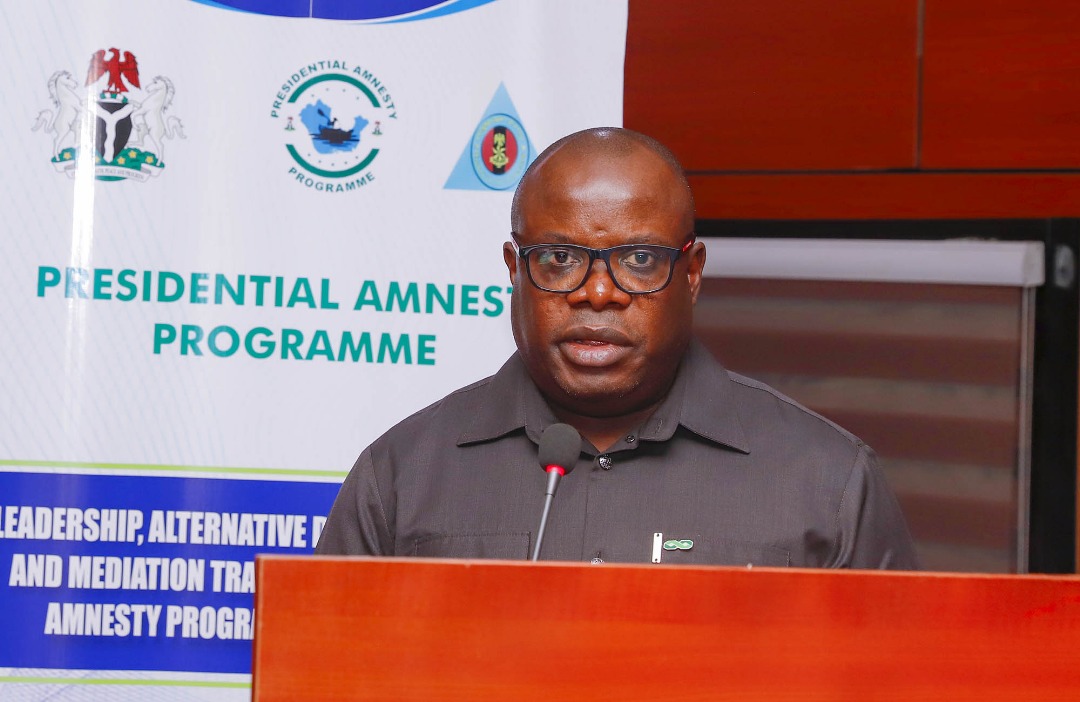
The Ijaw People’s Development Initiative, IPDI has reacted to a statement circulating online regarding the Presidential Amnesty Programme (PAP), describing it as baseless.
The statement under the disguise ‘Niger Delta Stakeholders Forum and Niger Delta Ethnic Nationalities,’ had demanded accountability regarding the management of the Programme and its administrator, Dr Dennis Otuaro.
Reacting to the statement, National President, IPDI, Comrade Austin Ozobo, said: “We consider it necessary to respond point by point to correct misconceptions, reject unsubstantiated claims, and keep the record straight in the interest of PAP beneficiaries, stakeholders, and the general public.
“It is worthy of note that the PAP operates under strict federal financial regulations and is subject to routine audits by the Office of the Auditor-General of the Federation, the Ministry of Finance, and other oversight bodies.
“All disbursements, including stipends, vocational training, education support, and third-party contracts, are processed through the Treasury Single Account, TSA, with verifiable records”, the statement read.
READ ALSO:PAP Sends Additional 15 Scholarship Beneficiaries For Post-Graduate Studies In UK
According to the IPDI, the Programme welcomes lawful criticism and scrutiny at any time. However, linking such a call to specific individuals without evidence amounts to trial by the media and undermines due process.
“Dr Dennis Otuaro, administrator of the Presidential Amnesty Programme has maintained a good record of financial management, hence no formal petition with verifiable evidence has been submitted to any anti-graft agency till date”.
“It may interest you to know that the N65,000 monthly stipend is fixed by the Appropriation Act and can only be reviewed through a budgetary process approved by the National Assembly and the Presidency.
‘The PAP management has consistently conveyed beneficiaries’ concerns on cost of living to relevant authorities”.
“Again, claims that allocations to the Programme have risen significantly while stipends remain unchanged misrepresents the budget structure.
READ ALSO:PAP: N’Delta Stakeholders Laud Otuaro’s 2 Years Of Strategic Reforms
“Note, increased allocations in recent years have been tied to expanded reintegration programs, education sponsorships, skills acquisition, and infrastructure support for training centers, not solely to stipend payments”.
The group reiterated that the allegation that the Amnesty Programme Office “kidnaps and detains delegates” is false, reckless, and defamatory, adding that the PAP has no paramilitary or law enforcement mandate, nor does it operate detention facilities and that any incident involving law enforcement is outside the control and purview of the Programme.
“We challenge the authors to provide verifiable details of time, place, and persons involved so the matter can be addressed through appropriate legal channels,” the group said
On Claims of Selective Empowerment and 500% Payment Increases, the group maintained that payments to contractors, ex-agitator leaders, and service providers were governed by existing contracts and agreements predating the current administration.
“No individual or camp has received unilateral increases without contractual basis or due process. Allegations of 500% increases are unsubstantiated and designed to stoke division among beneficiaries,” it added.
READ ALSO:Otuaro Links Increase In PAP Scholarship Beneficiaries To Tinubu
“The current administration has maintained a policy of transparency in engagement with leaders and has expanded inclusion by verifying and capturing previously omitted beneficiaries where due“, IPDI added.
The group further said, “The PAP remains a neutral, peace-building institution established under the 2009 Amnesty Declaration. Its mandate is to coordinate disarmament, demobilization, and reintegration. The Office does not engage in political victimization, intimidation, or exclusion of stakeholders. Engagement with ex-agitator leaders and community structures is conducted based on their role in maintaining peace and facilitating reintegration, not political alignment”.
“The PAP under Chief Denis Otuaro’s leadership remains committed to transparency, fairness, and the original mandate of the Amnesty Programme. Constructive criticism is welcome and has informed policy adjustments in the past. However, campaigns of calumny, unverified allegations, and attempts to drag the Programme into commercial or political disputes do not serve the interest of peace in the Niger Delta”, IPDI said.
“We urge all stakeholders to channel grievances through the established engagement channels of the Programme and to avoid statements that threaten the fragile stability we have worked to sustain”.
Consequently, the IPDI urges members of the public to disregard what its described as “flimsy and unsubstantiated allegations, misconception, and missives by faceless groups above“.
News
[OPINION] Olukoyede’s EFCC: Taming The ‘Fantastically-Corrupt’

Since its creation 23 years ago, by Chief Olusegun Obasanjo, as president of Nigeria, Africa’s most populous and influential country, the Economic and Financial Crimes Commission (EFCC), had apparently not gotten a head, who had piloted the affairs of the commission, like Mr. Olanipekun Olukoyede, its Executive Chairman, a chief-operations-officer of the Commission.
It could be said that Olukoyede, the Czar thief catcher and arrestor of economic saboteurs, has given the EFCC’s enemies such a tough time as he has taking the anti-graft fight to the doorsteps of the high-profile individuals across the country. These range from former state governors, serving and former ministers, retired and serving civil servants, businessmen, clergies, traditional rulers, cyber-influencer, entertainers, professionals and numerous others.
Olukoyede brings years of experience in law, fraud management, and business intelligence to bear on the position. Before him, Mallam Nuhu Ribadu was EFCC’s inaugural chair; succeeded by the first and only female, Mrs. Farida Waziri; Ibrahim Lamorde, Ibrahim Magu, and Abdul Rasheed Bawa.
The anti-graft agency has its hands full with massive financial fraud and money laundering cases. In the clause of “physicians, look at thyself”, EFCC in its resolve is known to have been flushing out officers within the body, who run foul to the law.
In the past, before Olukoyede’s appointment, it was widely believed that it was only the “fries and not the big fishes”, who the Commission could summon the courage to prosecute; and that most culprits were also left from the hook, because of compromise by some corrupt officers of the Commission, and feeble litigation processes.
Mr. Godwin Emefiele, former Governor of the Central Bank of Nigeria (CBN), happened to have opened to Olukoyede’s a deluge of “big-men and women”, who have been arrested, investigated and cooling their feet in detention or those bailed, that are facing severe court trials. There is the biggest 19-count charge at the Ikeja Special Offences Court, involving an alleged $4.5 billion fraud.
Immediate-paste governor of Kogi State, Yahaya Bello, faces two massive, but separate legal battles totalling over N190 billion on fraud allegation. EFCC secured from the Court of Appeal, forfeiture of 14 properties and huge money linked to him.
Abubakar Malami (former Attorney-General of the Federation), with his son, Abdulaziz and his wife, is currently charged on a-16-count of money laundering. The court has stayed interim forfeiture of 57 properties valued at over N213 billion.
MORE FROM THE AUTHOR:OPINION: Contesting The Portable Vs Carter Efe’s Cruel Ring-fight
EFCC had also secured the arrest of Sadiya Umar-Farouq, a female former Minister of Humanitarian Affairs, and a former Permanent Secretary, through a Federal High Court, on a 21-point alleged fraud and corruption charge, involving $1.3 million and N746.6m and others amounting to 37.1 billion.
Uju Kennedy-Ohanenye, also female and former Minister of Women Affairs, was removed from office by President Bola Tinubu, over alleged misappropriation and diversion of N138.4 million, and had been under EFCC questioning.
A recent discovery, which startled Nigerians and the world, the Commission (EFCC) had reportedly arrested a serving Director-General of the Energy Commission of Nigeria, Dr. Mustapha Abdullahi, over alleged money laundering involving about ₦500 billion.
Somewhat, this had deflated the claim that those arrested and persecuted are political opponents and not serving officers of the Tinubu’s government.
EFCC is a “Nigerian law enforcement and anti-graft agency that investigates financial crimes, such as advance fee fraud (419 Fraud) and money laundering. It was also set up to fight against corruption and to protect the country from economic saboteurs”.
The Commission, whilst responding to pressures from the Financial Action Task Force on Money Laundering (FATF), that named Nigeria as one of 23 countries not cooperating in the international community’s efforts to fight money laundering, had revved in performance, in a bid to roll back the blights.
And so, it is a strenuous goal for EFCC, as entrenched in the ‘EFCC Establishment Act 2004’, which gives it specialist jurisdiction against severe financial and commercial crime – covering multiple high and lower levels.
MORE FROM THE AUTHOR:OPINION: Tenebe Could Deprive Tinubu From Winning Edo Election
Born on 14 October 1969, Olukoyede, a civil servant, has had a clear break from past, where past executive chairmen of the Commission had left the Commission, where all serving officers were drafted from the Nigerian Police Force (NPF). However, President Bola Ahmed Tinubu is widely commended for Olukoyede’s appointment to the position, with the Senate also eulogized for screening him.
Whilst briefing the Press in Abuja, on his two-year activities in office, on October 23, 2025, the Commission’s boss certainly made unprecedented progress in the fight against economic and financial crimes. He spoke through the Director of Public Affairs of the Commission, Wilson Uwujaren, as he listed the recovery of N566 billion, alongside other currencies and assets, among the achievements of the Commission.
He further revealed that the Commission received over 19,000 petitions, conducted 29,240 investigations, filed 10,525 cases in court, and secured 7,503 convictions.
Olukoyede asserted that the Commission recovered ₦566,319,820,343.40, $411,566,192.32, £71,306.25, €182,877.10, and other foreign currencies from proceeds of financial and economic crimes. Added to this was the recovery of 1,502 non-monetary assets, comprising 402 properties in 2023, 975 in 2024, and 125 so far in 2025.
“Among these recovered assets are two notable landmarks: the final forfeiture of 753 units of duplexes in Lokogoma, Abuja, and the forfeiture of Nok University, now the Federal University of Applied Sciences, Kachia, Kaduna State,” he said.
He listed several high-profile cases prosecuted within the period, including those involving former governors Willie Obiano, Abdulfatah Ahmed, Darius Ishaku, Theodore Orji, and Yahaya Bello. Others are former ministers Olu Agunloye, Mamman Saleh, Hadi Sirika, Charles Ugwu, and former Central Bank Governor, Godwin Emefiele.
EFCC was also said to have reentered and invigorated some longstanding fraud cases, such as ones linking Fred Ajudua, former People Democratic Party, PDP National Chairman Haliru Bello Mohammed, ex-National Security Adviser Sambo Dasuki, and former Nigerian Social Insurance Trust Fund, NSITF boss, Ngozi Olojeme.
MORE FROM THE AUTHOR:OPINION: The Rough Games Arewa Bourgeoisies Play With The Talakawas
The EFCC said it arrested 792 suspects involved in asset and cryptocurrency frauds in Lagos, among who were 192 foreigners who were prosecuted and deported.
A Task Force on Naira Abuse and Dollarisation of the Economy was established by EFCC, which accordingly, had notable impacts in sanitizing money actions countrywide. “The campaign against naira abuse, racketeering, and speculative currency trading has helped reduce pressure on the naira and complemented the Central Bank’s efforts in stabilizing the economy,” he said.
Olukoyede also spoke on the Commission’s strengthened partnerships with foreign law enforcement agencies, including the Korean Police, Royal Canadian Mounted Police, Spanish Police, and German Police.
He also mention benefitting synergy with the FBI, the UK’s National Crime Agency (NCA), INTERPOL, and Japan’s JICA, in subsequent joint investigations and the repatriation of stolen assets to victims from Spain, Canada, and the United States.
Strengthening EFFC’s mandate at the regional level, and in Africa, Olukoyede and the Commission are said to be up and doing. For instance, a thing that had never happened to EFFC, he had been twice elected as President of the Network of National Anti-Corruption Institutions in West Africa (NACIWA), which led to the founding of a permanent secretariat in Abuja.
A strong media presence is needed to successfully inform the public of the ideals of EFCC and its update activities. And so, ‘EFCC Radio 97.3FM’, Nigeria’s first anti-corruption radio station, was established Olukoyede. EFCC should count itself very lucky for having in its fold, tested, diligent and veteran journalists who are ostensibly seasoned in the ideals and watchdog principles of the Commission.
News
APC Primaries: Johnny Rallies Support For Senator Thomas’ Re-election Bid

A chieftain of the All Progressives Congress in Delta State, Chief Michael Johnny, has called on Delta South Senatorial District’s party faithful to come out in large tomorrow and vote for Senator Joel-Onowakpo Thomas (JOT) in the party senatorial primary election.
Johnny, widely regarded as a leader par excellence within the APC, described the primary election as a critical moment that will determine the political stability, unity, and future direction of Delta South.
According to him, Delta South needs a detribalized leader with the capacity to unite people beyond ethnic sentiments and political divisions.
He warned against leaders whose style of politics promotes ethnic division and unnecessary tension within the region.
READ ALSO:Violence Rocks APC Reps Primary In Ekiti Ward, Exercise Declared Inconclusive
Chief Johnny stated that Senator Thomas has continued to distinguish himself as a leader who carries everyone along, irrespective of tribe, political background, or local government affiliation.
He noted that JOT’s leadership style has strengthened cooperation, peace, fairness, and political inclusion across Delta South.
Speaking further, Chief Johnny declared that the Ijaw people have resolved to stand firmly behind Thomas because fairness, justice, and political balance must prevail in Delta South.
“As Ijaw people, we have decided to support Senator Joel because this is the turn of the Isoko nation, and Ijaw stands for truth. That is our position,” he stated.
READ ALSO:APC Clears Wike Loyalists, Disqualifies All Fubara-aligned Aspirants For State Assembly
He also appreciated what he described as “genuine Itsekiri sons and daughters” who believe in fairness, equity, and peaceful coexistence, adding that Delta South can only move forward when the various ethnic nationalities work together in unity and mutual respect.
Chief Johnny maintained that the senatorial district must not be dragged backward by divisive politics or ethnic interests capable of weakening the collective strength of the region.
He stressed that all APC members in Delta South must remain united in their support for Senator Joel-Onowakpo Thomas.
“Delta South is bigger than personal interests. This election is about unity, stability, fairness, and the future of our people. Senator JOT represents continuity, experience, and inclusive leadership for all ethnic groups in Delta South,” Chief Johnny added.

 Politics5 days ago
Fubara Clears Air On ‘Defection’ To NDC [VIDEO]
- News4 days ago
Gun Battle In Oyo Forest As Police Disrupt ₦10m Ransom Collection Plot
- Politics3 days ago
Four Fubara Loyalists Disqualified As APC Clears 21 For Rivers Reps Primaries
- News3 days ago
Lagos Sanctions 15 Money Lending Companies For Sharp Practices
 Metro4 days ago
Drama As Teenagers Stage Secret Wedding With N3,000 Bride Price
- Politics3 days ago
2027: Court Rebukes Plaintiff, Lawyer In Suit Against Jonathan, Awards N1m Fine
- Politics5 days ago
2027: Daniel-Abiodun Feud Deepens Over Senatorial Ticket For Ogun East
- News4 days ago
PAP Sends Additional 15 Scholarship Beneficiaries For Post-Graduate Studies In UK
- Sports4 days ago
CAF Introduces New Laws After Chaotic AFCON Final In Morocco
- Entertainment5 days ago
Grammy Announces Date For 2027 Awards Nominations


