
News
OPINION: Kano’s Midnight Kingdom

By Lasisi Olagunju
Today, those whose ancestors snatched Kano are fighting each other over the city and their spoils. The Yoruba would look at their drama and sing for them the song of Ambrose Campbell/ Ebenezer Obey: Eni rí nkan he tó fé kú torí è/ Owó eni tó ti so nù nko? I won’t translate this!
Their victims are taking sides. I shake my head for them. May I never be found on either side of siblings feuding over whose turn it is to loot me.
“Emir Sanusi II should be referred to as the 59th Emir of Kano (and) not the 16th – unless the history of Kano started after Dan Fodio’s Jihad and imposition of Emir Sulaimanu in 1807.” With these words, Journalist Jafaar Jafaar on Friday started an online war which is still raging as I write this. So, two wars are being fought simultaneously on and over Kano. The first is the game of thrones between brother and brother over the city’s kingship and its pricey palace. The second war is on social media being fiercely fought between a conquered people and their conquerors over when the history of the city started.
Jafaar, a Hausa, maintained that “from King Bagauda in the 10th century to Muhammadu Alwali in 1805, there were at least 42 Habe/Hausa rulers documented by history that ruled Kano.” He went on to claim that most of the symbols of authority of today’s Emir of Kano predated the Jihad and the ascendancy of Fulani rulership of the city. The charge and the pushback have been enormous online. Whatever is the fate of the Hausa of Kano today was foretold and it is recorded in their history.
Kano’s monarchy has a very well documented history. The best known by historians is ‘The Kano Chronicle’ – a list of rulers of Kano since the establishment of the Bagauda Dynasty in 998 AD. Long before Bagauda and his tribe of adventurers entered Kano, history says the founding ‘chief’ was a man called Barbushe. He was credited with enormous strength and spirituality – a man who could look very far and see tomorrow. The Kano Chronicle describes this strange man’s own ancestor, Dalla, as “a black man of great stature and might; a hunter who slew elephants with his stick and carried them on his head about nine miles…”
One day, spirit-possessed Barbushe told his people that in the coming years they would lose everything they had to a stranger.
“A man shall come to this land with an army and will gain mastery over us,” he told the people of Kano.
If it was today, those people would snap their fingers over their heads and reject the prophecy. Barbushe’s people did not snap any finger, but they voiced their rejection in their own way. They told him: “Why do you say this? It is an evil saying.”
MORE FROM THE AUTHOR: OPINION: Kneeling For Imams Of Northern Nigeria
The seer kept his peace; he ignored them. Then continued. He told the people that if their conqueror “comes not in your time, assuredly, he will come in the time of your children, and will conquer all in this country, and forget you and yours and exalt himself and his people for years to come.”
The Kano Chronicle said the people were exceedingly downcast because they knew their leader told the truth of a future of slavery awaiting them. They believed him and asked: “What can we do to avert this great calamity?”
He replied them: “There is no cure but resignation.” Then “they resigned themselves” and have remained in that state of resignation till today.
It is a long story. My source is H.R. Palmer’s ‘The Kano Chronicle’ published in 1908. The prophecy is on page 64. You may read that portion and others and match that history with whatever is happening to these people today.
I remembered Barbushe’s prophecy when I saw the Hausa journalist and his online army asking questions and referring to their own ancestors as the ‘Habe’ rulers of Kano. The 19th century Fulani (and their successors) called any people they conquered ‘Habe’.
The Hausa think the altered, contemporary king list of Kano city is rigged against their ancestors. They think it robs them of their royal and cultural essence. The people who enslaved them reset the calendar and the clock of their history. Their existence started with their defeat. Their fate is classic in how not to surrender to fate. Could the 1804 Jihad of Dan Fodio and its spread to Kano be the fulfillment of that promise of eternal subjugation; a rulership which history predicted would misgovern them “till they become of no account”? The prediction, and everything around it, even its myth and legend, appear to have come with a fatal ring of prescient finality wound around these people. Their resignation is proof that there is no medicine against destiny and no armour against fate.
MORE FROM THE AUTHOR: OPINION: Taxing Hunger In Iregba
Students of Kano history would have no problem identifying successive emirs of the city as snacks of power. In some cases, governors munch, chew, and swallow them. Some other times, they try and fail. On January 1, 1954, Premier Ahmadu Bello installed his “close personal friend”, Muhammad Sanusi, as emir of Kano. The man succeeded his father, Abdullahi Bayero. But in August 1963, the friendship was over. Sanusi was dethroned even despite opposition from the federal. On June 8, 2014, Sanusi’s grandson, Lamido, became emir despite opposition from Abuja and its forces. He was there for six years and was dethroned by a governor who was deputy governor when he was enthroned. Last week, Lamido’s destiny brought him back to the throne even in the face of a blitzkrieg from federal forces.
Emirs are riverside reeds, precarious at all times. In 1982, Governor Abubakar Rimi had a big issue with the Emir of Kano and, in an interview, he described the emir as “nothing, nothing, nothing but a public person.” He said the emir was “holding a public office” and was “being paid from public funds” and his “appointment is at the pleasure of the governor of the state.” He said the emir “can be dismissed, removed, interdicted, suspended if he commits an offence.” Rimi said there was “nothing unique about Ado Bayero, the Emir of Kano… believe me, if he commits any offence which will make it necessary for us to remove him, we will remove him and we will sleep soundly.” His listeners shivered. The PRP governor proceeded from there to plot the sack of the emir “for failing to fulfill government orders or to show due respect to the State Governor.” There was opposition from the streets with thousands shouting: “we don’t want the governor; we want the emir.” Ado Bayero survived that coup and soon ate the exit cake of Governor Rimi. The opposite appears to be the case now with Bayero’s son, Aminu.
Perhaps, more importantly, the Kano case has just confirmed to us that the country now has judges without borders; they sit anywhere -in the air and at sea, in their wives’ beds and on their concubines’ laps. They work 24 hours; they operate with the speed of light such that cases can be filed at 11pm and judgment delivered at 12 midnight while the other party is sleeping. Whatever they do is valid. It stands. There is no control again; the steering wheel is rusted and stiff. The state backs its carefully selected judges with everything it has –guns, threats, excuses, lightning and thunder.
The case should strengthen us to double down on our insistence that Nigeria is a federation and must be so governed. A Nigerian Federal High Court sat in the United States of America and plunged a knife into the tendons of Kano chieftaincy. And we are excusing the perfidy with lexis and structure of e-judiciary. You would think under our laws, chieftaincy matters are state and local government matters. That is what our law says but the offshore judge did not think it was necessary to respect that law. Popular comedian, Mr Macaroni, would ask: “Are you normal?” We are not.
MORE FROM THE AUTHOR: OPINION: Petrol Pains, Wilderness Wanderings
Section 251 of our constitution clearly states what areas the Federal High Court has jurisdiction over. The section has three subsections. Subsection 1 gives that court jurisdiction on matters relating to the revenue of the government of the federation and allied matters. It lists those matters. Subsection 2 gives it “jurisdiction and powers in respect of treason, treasonable felony and allied offences.” Subsection 3 gives the court powers to hear cases “in respect of criminal causes and matters in respect of which jurisdiction is conferred by subsection (1) of this section.” Nowhere in that section or anywhere in the constitution is the Federal High Court empowered to sit over chieftaincy matters. Yet, a judge who was not even in the country, assumed jurisdiction under the cover of midnight darkness in the Kano emirship tussle and, aided by candies of impunity, signed an injunction. That judge is, very soon, going to the Court of Appeal on promotion. One day, he will become the Chief Justice of Nigeria.
Power and its allure rob society of order. In William Golding’s ‘Lord of the Flies’, we see how man with power enjoys the anonymity conferred on him by darkness. We see how control is lost and he strays calmly from goodness to savagery. America’s second president, John Adams, in March 1801, stayed up till midnight of the eve of his last night in office creating courts and signing appointment memos of his friends and supporters as judges to fill his freshly minted courts. US history remembers those judges harshly as “midnight judges.” The court ruling at the centre of Kano’s emirship logjam walked in from the United States at midnight on Thursday. The reinstated emir, Muhammadu Sanusi II, jogged into the palace midnight on Friday. The deposed emir, Aminu Ado Bayero, sneaked into the city under the canopy of darkness before dawn on Saturday. The security forces of the federal government soon filed out and took embarrassing positions. The hinge of their involvement was the tokunbo court order from a midnight judge who sat across the seas. Our courts no longer dread darkness and its forbidden fruits; they have become like hired killers, their fingers stained with the blood of justice.
Yet, the judiciary had seen better days – even in the so-called dark days before the white man came with his civilisation. There was a time in Kano when what distinguished judges were learning and piety. Sulyman, emir of Kano from 1807 to 1819, had a very tough mother and an upright alkali (judge). The emir’s mother was found on a particular day ill-treating a private citizen. She was charged for it at the court of Alkali Yusuf al-Hausi. The court found the queen mother guilty and pronounced corporal punishment. Emir Sulyman could neither shield nor save his mother – she served her sentence. Thirty-six years later, Emir ‘Abd Allah Maje Karofi took over the throne of Kano and was there till 1882. At a point during his reign, the emir bought a horse from a Tuareg and refused to pay despite repeated demands. The Tuareg took his case to court and Alkali Ahmad Rufa’i found the king guilty. The king’s punishment was an order that the emir’s confidant named Kasheka, who represented him in court, be seized and sold into slavery to settle the debt. A shaken Emir Karofi quickly arranged for the money and paid his creditor, the Tuareg. My source for these stories is Professor Tijjani Naniya’s ‘The Dilemma of the Ulama in a Colonial Society’ published in the Journal of Islamic Studies in 1993.
The period of those judgments was a time when kings feared and respected the law. It was an era when judges knew the law and applied it as they should, entertaining neither fear nor favour. Today’s judge would jail the creditor and shout rankadede to the debtor-king. The jungle of our judiciary has matured and the beasts grown in all departments.
In my moments of devotion and meditation, I watch wild animals on TV channels. Right before me is a vulture, hyena and lion sizing one another up over a banquet of skunked meat. What we witnessed between Thursday and Saturday night in Kano was exactly that. Beastly fights over meals are a natural feature of life in the jungle. Bayero was dethroned and Sanusi enthroned. Enthronement and dethronement are not strange with monarchies. It didn’t start today in Kano and elsewhere; it won’t end with this Kano matter. How did Sanusi become emir in June 2014? Was he the favourite of the kingmakers? Aminu Ado Bayero, the dethroned emir, how did he get the throne four years ago? General Ibrahim Babangida once said that the moment you get into power through a coup, you should expect that a coup would be staged against you one day. It is delusional not to accept this. It is like Napoleon thinking his revolution would be the last. Russian writer, Yevgeny Zamyatin, says exactly this in his novel ‘We’ – described by a reviewer as “a prediction of the natural conclusions of totalitarianism.” It was from ‘We’ that George Orwell pinched the whole idea of his monumental ‘1984’. In “We” is the warning to all who stand but who think their stability is forever: “How can there be a final revolution? There is no final one. The number of revolutions is infinite.” One era will be succeeded by another era just as one preceded it. There is no goodnight in power politics. Sanusi is back; Bayero is out, but may yet come back. There is no end to snatching and running away with power.
The author, Dr. Lasisi Olagunju is the Saturday Editor of Nigerian Tribune, and a columnist in the same newspaper. This article was first published by the paper (Nigerian Tribune). It is published here with his permission.



News
Six Corps Members Receive N10m Grants To Boost Agribusiness
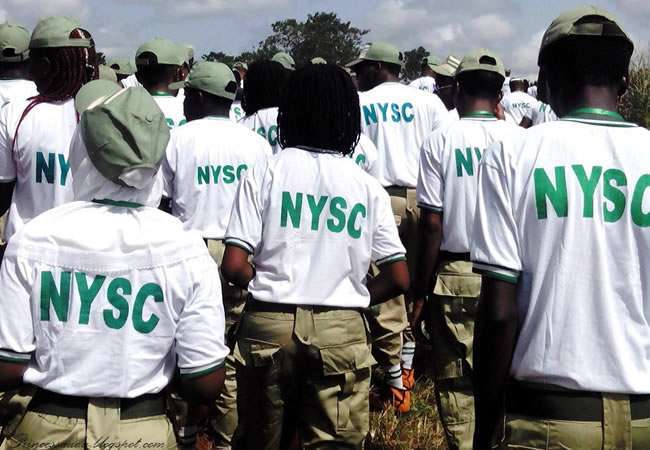
Six members of the National Youth Service Corps (NYSC) have received a total of N10 million in grants to expand their agribusiness ventures under the Farmers for the Future Programme.
The programme was organised on Monday by the British American Tobacco Nigeria Foundation (BATNF) in collaboration with the NYSC to encourage young Nigerians to embrace agriculture and develop sustainable businesses.
Presenting the cheques to the beneficiaries in Abuja, the NYSC Director-General, Brigadier General Olakunle Nafiu, urged Corps members to maximise the opportunities provided by the service year by venturing into commodity marketing and other viable businesses.
Nafiu said agribusiness remained a viable avenue for young people to build sustainable enterprises, create employment and generate wealth.
READ ALSO: NYSC Swears In 1,600 Corps Members In Bauchi
He also stressed the importance of value addition to the success and sustainability of business ventures, while commending BATNF for placing Nigerian youths at the centre of its entrepreneurship initiatives through value-chain development, employment creation and its partnership with the NYSC.
“I charge you to spread the news around. We have seen the outcome, and it is a good idea,” he said.
The beneficiaries are Dominic Olufemi (FC/25C/1143), who received N3 million; Temitope Adewole (ED/26A/2251), N2 million; Abdulwaheed Bala (ED/25B/1402), N2 million; Olanike Mayungbe (OG/26B/1037), N1 million; Kingsley Udoeyen (KG/26A/1735), N1 million; and Lorember Lorsue (JG/25B/1742), N1 million.
Speaking on the selection process, the Acting Director, Skills Acquisition and Entrepreneurship Development (SAED), Mrs Winifred Shopeka, said the programme began with an online registration portal through which Corps Members engaged in agribusiness submitted their business plans.
READ ALSO: NCCSALW Deploys NYSC Members In Fight Against Illegal Arms In Northeast
She said nearly 3,000 Corps members applied and underwent a rigorous selection process that produced 20 finalists.
According to her, the finalists participated in a boot camp and a final pitching session, which produced the 10 best presenters before the six ultimate winners were selected.
Shopeka said the beneficiaries had also been mentored and attached to established market operators to assist them in marketing their products.
She added that Corps Members who did not make the final stage of the competition were also trained by BATNF.
The BATNF Team Lead, Mr Oludare Odusanya, congratulated the beneficiaries and urged Corps Members engaged in agribusiness to master the fundamentals and acquire the knowledge and skills necessary to succeed.
“We are happy with our collaboration with the NYSC, and it will continue,” he said.
READ ALSO: NYSC Lauds Gov. Mohammed’s Intervention In Fence Collapse
Odusanya explained that BATNF was an independent organisation established to contribute to poverty reduction in Nigeria through sustainable agricultural practices and other interventions.
He said the Farmers for the Future Programme was instituted in collaboration with the NYSC to encourage Corps Members to venture into agribusiness and become job creators.
He added that the beneficiaries would be attached to mentors who would guide them towards achieving success in their respective businesses.
According to him, the programme has, since its inception, continued to enhance the entrepreneurial capacity of Corps Members.
News
CBN Reduces Interest Rate To 23%

The Central Bank of Nigeria (CBN) on Tuesday announced the reduction of the interest rate, also known as Monetary Policy Rate (MPR) to 23 percent.
Briefing the media in Abuja, the Governor of the CBN, Mr. Olayemi Cardoso, said at the 307th MPC meeting held on September 22, 2026 agreed the resetting of the MPR and recaliberation of the monetary policy market.
According to Cardoso, the committe is satisfied with the disinflation progress, adding that members noted stable banking sector following successful recapitalisation.
READ ALSO: CBN Monetary Tightening Worsening Nigeria’s N50tn Development Finance Gap – Group
Meanwhile, according to Nigerian Tribune, reports that that the MPC, at its 306th meeting in July 2026, disclosed its resolution to retain the interets at 26.5 percent.
According to the Governor of the CBN, Olayemi Cardoso, “the Committee’s decision to maintain the current policy stance followed a thorough assessment of the balance of risks. Although headline inflation moderated marginally in June 2026, global uncertainties have heightened, due mainly to the renewed hostilities in the Middle East.
“In view of the evolving developments, maintaining a cautious monetary policy stance remains appropriate. In arriving at its decision, the Committee noted the recent resurgence of hostilities in the Middle East, with particular attention to its spillover effects on global energy prices and the potential pass-through to domestic inflation.”
News
NURTW: KWAM1 Settles Long-time Rift Between MC Oluomo, Tafa Sego
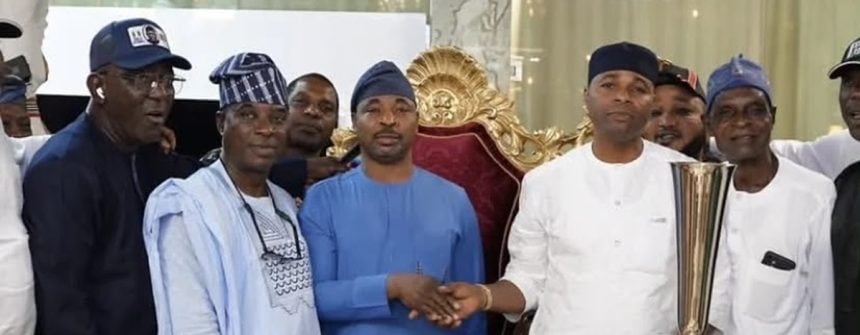
Nigerian Fuji musician, Wasiu Ayinde Marshal, popularly known as KWAM1, has brokered a peace deal between the National Union of Road Transport Workers (NURTW) National President, Musiliu Akinsanya, popularly known as MC Oluomo, and the Lagos State Chairman of the union, Mustapha Adekunle, aka Tafa Sego.
The reconciliation took place at Ojusagbola in Ijebu, Ogun State, where several NURTW chieftains gathered for the meeting.
The development was announced on Tuesday on KWAM1’s digital media page on Instagram, alongside photographs from the meeting.
According to the post, the two union leaders have resolved their differences after years of strained relations.
READ ALSO: Why FG Named KWAM 1 Aviation Security Ambassador — Keyamo
“After years of an age-long rift, MC Oluomo and Tafa Sego have finally settled their differences. And from what we know now, this is final,” the post said.
The musician was said to have intervened as the Mayegun of Yorubaland, with the aim of bringing an end to the longstanding disagreement between the two NURTW figures.
“K1 acted in his role as the Mayegun of Yorubaland by seeking an end to the long-standing rift, once and for all,” it said.
The post also described the meeting as a significant step beyond previous public displays of reconciliation.
READ ALSO: FG Gives KWAM 1 Aviation Appointment, After Airport Incident
“This time, it was not just another handshake for the cameras. The two old friends and colleagues came together at Ojusagbola, with King Wasiu Ayinde Marshal (K1) playing the peacemaker.”
Both MC Oluomo and Tafa Sego were reported to be pleased with the outcome of the intervention.
“Both parties are delighted about the new development,” the post said.
The two men had previously been allies and prominent figures within the Lagos NURTW before their relationship became strained amid disagreements linked to leadership of the union in the state.

 News2 days ago
BREAKING: Tinubu Extends Working Vacation
- News3 days ago
Six Hidden Health Benefits Of Unsweetened Zobo
- News4 days ago
Edo: Council Chairman Under Fire For Threatening Commercial Drivers Who Refuse To Wear APC Insignia
- News4 days ago
Edo: Ekpeson Redeems N20m Pledge To Family Of Fallen Soldier
- News3 days ago
2027: Step-by-step Guide To Applying For INEC Ad Hoc Staff Recruitment
- News4 days ago
OPINION: Nigerian Pastors, Imams And Their Sex Sermon Obsession
- News3 days ago
Jehovah’s Witnesses Announce New Position On Blood Transfusion Policy
- News3 days ago
How 36 Nigerian States Got Their Names
- News4 days ago
Otuaro Harps On Academic Excellence As Another 31 PAP Scholarship Beneficiaries Leave For UK
- Headline1 day ago
How To Format An Academic CV For US Master’s, PhD Applications


