
News
OPINION: Sunkúngbadé At Windsor, Gòngòsú And Èdìdàré

By Festus Adedayo
Two great musicians of the Yoruba extraction, Yusuff Olatunji and Ayinla Omowura — lords of Sákárà and Àpàlà, two generes of Yoruba traditional music — sang of the boundless power of money in resolving life’s knots. In B’ólówó bá té, one of Olatunji’s finest, he extolled wealth’s ability to penetrate every crevice of human existence. His message was clear: only the miser is disgraced by wealth; the generous wield its full force. Olatunji spoke to the illimitable power of money. In B’ólówó bá té, believed to be his ne plus ultra hits, he serenaded the power of wealth and its ability to percolate the nooks and crannies of human life. The summary of Olatunji’s, B’ólówó bá té is that, the rich, wealthy and powerful, can only be put to shame if they are miserly and do not know the illimitable power of what they have in their hands.
Wednesday and Thursday of last week were remarkable moments for Nigeria. Thirty seven years after any Nigerian ruler was hosted at Windsor Castle — the palace of one of the world’s most powerful monarchies — Bola Tinubu, a man so badly shellacked by the opposition as undeserving of honour, was honoured. Is it sparse honour at home and surplusage of honour abroad? For a country typecast as the global capital of poverty and a poster boy for dysfunction, Nigeria’s outing at Windsor Castle signified, however briefly, that the “bad boy” had made good.
As His Majesty King Charles hosted the Nigerian president, his wife, and their entourage, showering them with effusive eulogies, a quiet tear of pride may have escaped the eyes of patriots. His speech, and the parade of horse-driven carriages—complete with Wagonettes, replicas of Victorian-era coaches once used by colonial masters—transported Nigerians back in time. Charles crowned it all with Yoruba greetings: e káàbò, sé dáadáa ni in Tinubu’s native language?
The bones of our forebears must have stirred. Was this not the same Britain whose monarchy and imperial machinery enslaved, exploited, and plundered through the Royal Niger Company and Lord Lugard?
Ancient Iragbiji’s warrior, Sunkúngbadé (Obebe), must have stirred too—this time in joy. Oral tradition says that as a child, he cried incessantly until a miniature crown was placed on his head. His name—“he who cried for a crown”—was born of that insistence. Founder of Iragbiji under the Irá tree, he remains the totem of his people. I return to his mystique shortly.
King Charles, however, ended his speech with what many read as dramatic irony: “Naija no dey carry last!” he said, smiling. But the phrase is uneasy. It speaks to a restless national psyche — our impatient race for quick fixes. “Naija no dey carry last!” is a metaphor for an average Nigerian’s inordinate quest, his race against time and impatient resolve for immediate gains. In dramatic irony, the speaker misses the deeper implication of his words while the audience does not. One wonders: was the monarch unaware? Or, was he, in the midst of the effluxion of panegyrics, trying to rub in the ignoble acts of Tinubu’s constituents whose notoriety all over the world is household knowledge?
MORE FROM THE AUTHOR:OPINION: Bíòbákú’s Party And Tinubu’s Other Malapropisms
The Yusuff Olatunji and Omowuras era produced others who mythologized money. James Hadley Chase, the “thriller maestro,” built entire worlds where money dictated morality. Chase’s characters define money as everything in life.
Omowura offered similar cosmology of wealth. In a posthumous track, he used birds as metaphors, singing about cosmic-ordained order of wealth, and the colours of birds’ plumage as symbols. This bohemian Àpàlà singer then landed in a narrative of the connect between grace and wealth. The Agbe (Blue Turaco bird) must seek indigo; the Àlùkò its yellow; the Lekeleke bird, its whiteness. Each pursues what it is destined to embody. He sang that, it is an impossibility for the day to rise and the Agbe bird would not go in pursuit of the indigo dye (aró) which is the colour of its feathers.
From there, he moved to the Gbajúmò—the celebrated one—whose status commands rescue even in ruin. Omowura then provided a nexus between the Gbajúmò and the power at his behest, his ability to order things in their favour. Through the frog and the toad, he illustrated how power summons salvation, even at the brink of humiliation.
Omowura then used the symbolism of two amphibians, the toad and frog, to explain an ultimate bail-out of a stranded Gbajúmò from his existential travails. Rather than the Gbajúmò suffering the social backlash humiliation, typified by being forced to eat the dry, warty-skinned, short-legged toad (òpòló), he sang, the one who would bail him out by killing the edible, smooth, moist-skinned, long-legged frog (kònkò) and turning it into a satisfying cuisine, would spring up from nowhere. Like Yusuff Olatunji and Hadley Chase did, this is a reification of wealth and the power at the behest of the famous.
If Sunkúngbadé cried six centuries ago for a crown, his descendant in the Villa today sustains his crown with money. Olatunji’s thesis returns: wealth is instrument and insurance. Those who know today’s Nigerian foremost leading political figure attest to his prodigious spending. He solves problems by incinerating money; he does not “see tribal marks” on it. I once wrote of a governorship aspirant, overwhelmed by such largesse, confessing he could never match today’s Villa man’s spending in a lifetime. Sunkúngbadé spends like an elédà — a wealthy but reckless spender — to remain enthroned.
Months ago, I warned that Nigeria had assembled a uniquely cold, crafty, and relentless ruling class. Borrowing from King Sunny Ade, Juju great of all time, I cautioned Nigerians with one of his 1970s line: “Wé mo eni o kò, Paddy…” — you apparently do not know who you are up against. We do not. Perhaps we do now. The political actors in the Villa today are deadly, brutal and crafty. They are brilliant at assembling and dissembling, serpentine in method, unblinking in execution. They are daring, will kill their father and rope their mother for the murder without batting an eyelid. Blood does not flow in their veins. They understand the craft of vices.
MORE FROM THE AUTHOR:OPINION: Tinubu’s Gun And The Fatal Ricochet Of El-Rufai’s Pistol
When Donald Trump began his tirade against Nigeria, breathing hail and brimstone, he may have assumed a monopoly on manipulation. Did we know that Africa does not hold a monopoly on corruption? Trump and his fellow preachers of fire against Nigeria have shown us. They obviously did not grow up in Ibadan, where grit schools cunning, where the underworld teaches that everyone has a price. They soon found out. ‘Everyone has a price tag’ is a major teaching of the underworld. Nigeria’s Villa thawed Trump’s fury with baffling alacrity. More money will do what more money cannot do. Soon, Trump’s ice cube-hard attacks on Nigeria’s alleged hostility to Christians began to thaw like snowflakes in a torrid sun.
In January 2026, the Villa reportedly hired the Washington-based DCI Group for $9 million to reframe Nigeria’s image among U.S. policymakers, particularly on allegations of violence against Christians. The deal—$4.5 million upfront, $750,000 monthly—ran from December 2025 to June 2026, with renewal built in. It was allegedly brokered through the office of the National Security Adviser. Disclosure came via Congressman Chris Smith. But even at that, knowledgeable Nigerians know that what we know about the Villa buying its way through is likely only a fragment of the whole shameless ensemble. That is our president in action. He does not believe that anything, including Trump and his apostles, can stand in the way of humongous money.
Soon, Trump’s icy rhetoric softened. Soon, the First Lady, Remi Tinubu, appeared at the National Prayer Breakfast in Washington. Soon, she was singled out for praise by Trump as “a very respected woman.” Fortuity? Or the quiet arithmetic and algorithm of purchase of influence?
In Yoruba cosmology, honour can be purchased. Nigerian scarce dollars as pawn for honour and positive global acclaim finds anchor even in Yoruba cosmology. Fuji music great, Ayinde Barrister, once musicalized this cosmological belief plainly. While dousing a fan in fragrance of panegyrics, he sang: “Ó f’owó ra’yì ló’ó mi, èmi náà n ò ti’jú ta’yì náà fun” — the fellow purchased honour and prestige from him and he was duty bound to sell it to him, even if coyly. Like Barrister, there is today a blind binge of honour purchase which finds parallel in a numismatist struggling to collect currencies of countries.
So, when Britain rolled out the red carpet last week, discerning Nigerians asked: at what cost? Yes, we are aware that it suddenly became a jamboree for governmental wayfarers to gobble free estacodes. But, it went deeper. Colonialism once came masked as civilization. When the colonialists came to Africa over a century ago, they came disguised as civilizers here to rescue us from ourselves, our perceived state of savagery, barbarism, and alleged unrefined behavior. Today, validation returns in subtler form. Today, offspring of those “savages” go to the colonizers for a second colonialism, in exchange for validation.
Keir Stammer, less coy, wasn’t pretentious about this quid pro quo diplomacy with Nigeria. Tinubu’s country will now harbour thousands of offenders and failed asylum seekers. This same deal had been botched earlier with Rwanda when Boris Johnson, Liz Truss and Rishi Sunak proposed it. Nigeria has accepted. Smart English people are not fools. They are like the devil. If it validates your dross by openly spreading the red carpet for you to walk on, it will ask for your soul. I imagine how many barrels of oil were tethered at the British groove in exchange for the red carpet and parade of horse-driven carriages at Windsor.
MORE FROM THE AUTHOR:OPINION: Igboho, Kanu And The Heroic Igwe Before Tinubu
The visit to the UK is, undeniably, a diplomatic plus. But again: at what cost? A sober balance suggests Britain gained more. We returned with validation; they with tangible benefits. One wonders what, in barrels and bargains, underwrote the pageantry at Windsor. Those who are scorched point at cost of living in handshake with the firmament. Aso Rock’s voodoo economists and their financial necromancers bandy statistics of national arrival at Eldorado. The Villa must think these foreign-purchased validations are enough blanket to shroud our reality from the world.
Domestically, the field appears to be clearing. The APC edges toward solitary dominance in 2027; PDP, LP, ADC struggle for breath. Campaigns may become unnecessary. Baba doesn’t have to worry about the huge health implications of his campaigning round the 36 states of the federation. Now, we are almost in 1964 Ghana under Kwame Nkrumah and Mali in 1960 where one-party state was national pastime. By the time this cycle ends, Nigeria may be unrecognizable in the hands of Bola Tinubu.
Yet many still cannot see beyond the spectacle and cannot see through the window-dressing. D. O. Fagunwa is author of an allegorical work, a Yoruba-written novel with the title, Ìrìnkèrindò Nínú Igbó Elégbèje (1954) Expedition in the Forest of Thousand Deities. In it, he curated a cast of hunters and mythical beings who inhabit a forest ecosystem that has the supernatural in constant but seamless interaction with the mythical and the mundane. This Fagunwa’s will seem to mirror the equation between Nigerians and their present rulers.
By deploying folktale and idioms, with supernatural elements playing significant role in his portrayals, Fagunwa thematically addresses rulers who rule with cunning, subterfuge and govern without purpose. He also addresses uncritical following, selfish rulers and their coterie of sycophants. These are the followers who lick power spittle at every drop. The author then labeled this set of followers as the Gòngòsú.
But, the seemingly powerless wind can ultimately lift a stone. The child who kills the rat and eats it with relish; kills a bird and devours it, when it kills the mythical evil fish called Arogidigba, will run to his father. This lesson was taught by late Ibadan bard, Alhaji Amuda Agboluaje, contemporary of Tatalo Alamu, both Sekere Dundun groups notorious for lacerating lines of their musical turf wars during the height of Ibadan musical supremacy war. By then, this killer of the evil fish will stew in his own broth. That is the kernel of the warning to our Edidare leaders who feel they have everything wrapped up. Bola Tinubu and his APC are about to kill the Arogidigba. And the elders say whoever does what was never done before would see what had never been seen before.



News
UNIBEN Initiates N100bn Trust Fund To Complement Govt Funding
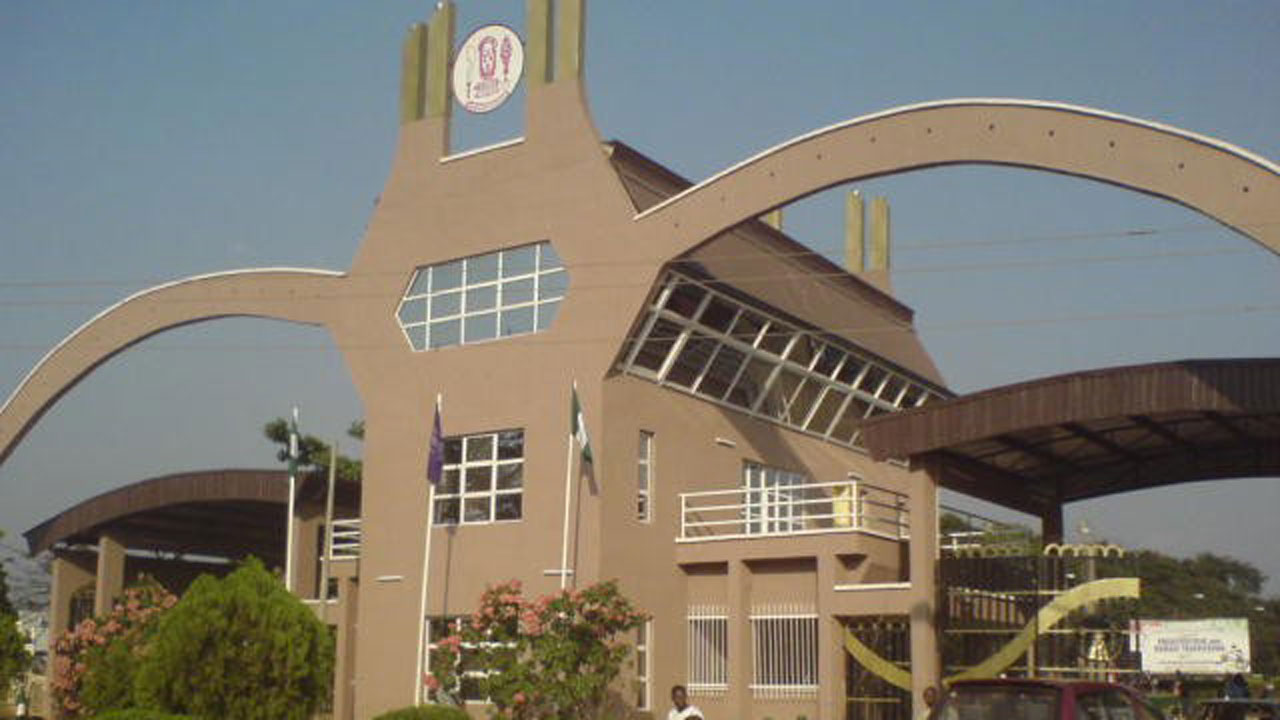
The University of Benin has unveiled a N100 billion Trust Development Fund (TDF) aimed at serving as an alternative source of funding for the institution.
Speaking at the unveiling of the Fund’s web portal, the Vice-Chancellor of the university, Professor Edoba Omoregie, said the UNIBEN TDF was conceived to bridge infrastructure gaps in the institution.
According to Omoregie, he was inspired by a similar initiative undertaken by University of Oxford about 30 years ago.
He explained that upon his return to the university after seven years away, he was confronted with dilapidated infrastructure across the institution’s two campuses, a situation which, according to him, made it obvious that the university needed additional funding beyond government allocations and its Internally Generated Revenue (IGR).
READ ALSO:Edo Promises Digital Skills For Youths As UNIBEN Student Invents Solar-powered Tricycle
The Vice-Chancellor said: “When I took office as Vice-Chancellor, I told myself that the first task was to visit the hostels. I went to all the hostels here in Ugbowo and also on the Ekehuan campus. I also visited some of the academic facilities and, for someone who had been away from the university for about seven years, I did not know the facilities had decayed so rapidly.
“I was deeply concerned. I also looked at the books of the university and saw that its finances were in a shambolic state. We could barely pay the electricity bill; the university was disconnected from the public power supply for three months. There was student unrest, and I was in Abuja at the time, watching from afar and weeping inwardly over what was happening to our university.”
He said he immediately began researching ways the university could access alternative sources of funding, while also taking steps to eliminate waste.
READ ALSO:History Made As UNIBEN Secures Full Accreditation Of All Programmes
In his remarks, the Chairman of the Board of Trustees, Osagie Ize-Iyamu, disclosed that the formal launch of the N100 billion fund would take place on July 4, 2026.
He said the Fund would pursue strategic partnerships and sustainable development models through grants, Public-Private Partnerships (PPP), Build-Own-Operate-and-Transfer (BOOT) frameworks, endowment structures, and global institutional collaborations.
“Through these initiatives, we envision the renewal and expansion of critical infrastructure, including ultra-modern sports facilities, students’ hostels, hotels, innovation hubs, and agro-industrial development projects,” he said.
News
Gun Battle In Oyo Forest As Police Disrupt ₦10m Ransom Collection Plot
There was a gun battle in a forest in Oyo State on Wednesday after operatives of the Nigeria Police Force disrupted an alleged ₦10 million ransom collection operation by a suspected kidnapping gang in Otefon Village Forest, Atiba Local Government Area.
The operation, carried out by the Oyo State Police Command in collaboration with the Vigilante Group of Nigeria (VGN), led to the arrest of one suspect while other members of the gang escaped with suspected gunshot injuries.
According to a statement issued by the Command, on Thursday, credible intelligence was received in the early hours of 13 May 2026 that suspected kidnappers had gathered in the forest to receive ransom for a victim they had abducted earlier.
Acting on the intelligence, the Commissioner of Police, Oyo State Command, CP Abimbola Ayodeji Olugbemiga, directed operatives of the Anti-Kidnapping Squad (AKS) in the Oyo/Iseyin axis, alongside local security operatives, to storm the area and intercept the suspects.
READ ALSO:Gunmen Kidnap Businessman In Ibadan
Preliminary investigation showed that the gang of about six armed men had, on 9 May 2026, invaded the residence of one Alhaji Bagudu in Ilowa Village, Atiba Local Government Area, and abducted him, demanding ₦10 million as ransom.
The police said operatives first ensured the safe release of the victim before advancing towards the suspected ransom collection point to apprehend the criminals.
However, upon sighting the advancing security team, the suspects opened fire, triggering a gun duel in the forest. The exchange forced the gang to flee into surrounding bushes with suspected gunshot wounds.
One of the suspects, identified as Mohammed Sanni, was arrested at the scene.
READ ALSO:Seven Killed, 60 Injured in Ogun, Kano Road Crashes
Items recovered include a motorcycle, a mobile phone, a pair of slippers and a cap, all of which are currently undergoing forensic examination.
The Command said the arrested suspect had already made useful confessional statements, while efforts were ongoing to track down other fleeing members of the gang.
Residents were urged to remain vigilant and report individuals with suspicious injuries or movements to the nearest police formation.
The Commissioner of Police commended the operatives and their collaborators for the successful operation and reaffirmed the Command’s commitment to sustained action against kidnapping and violent crimes across the state.
(GUARDIAN)
News
PAP Sends Additional 15 Scholarship Beneficiaries For Post-Graduate Studies In UK
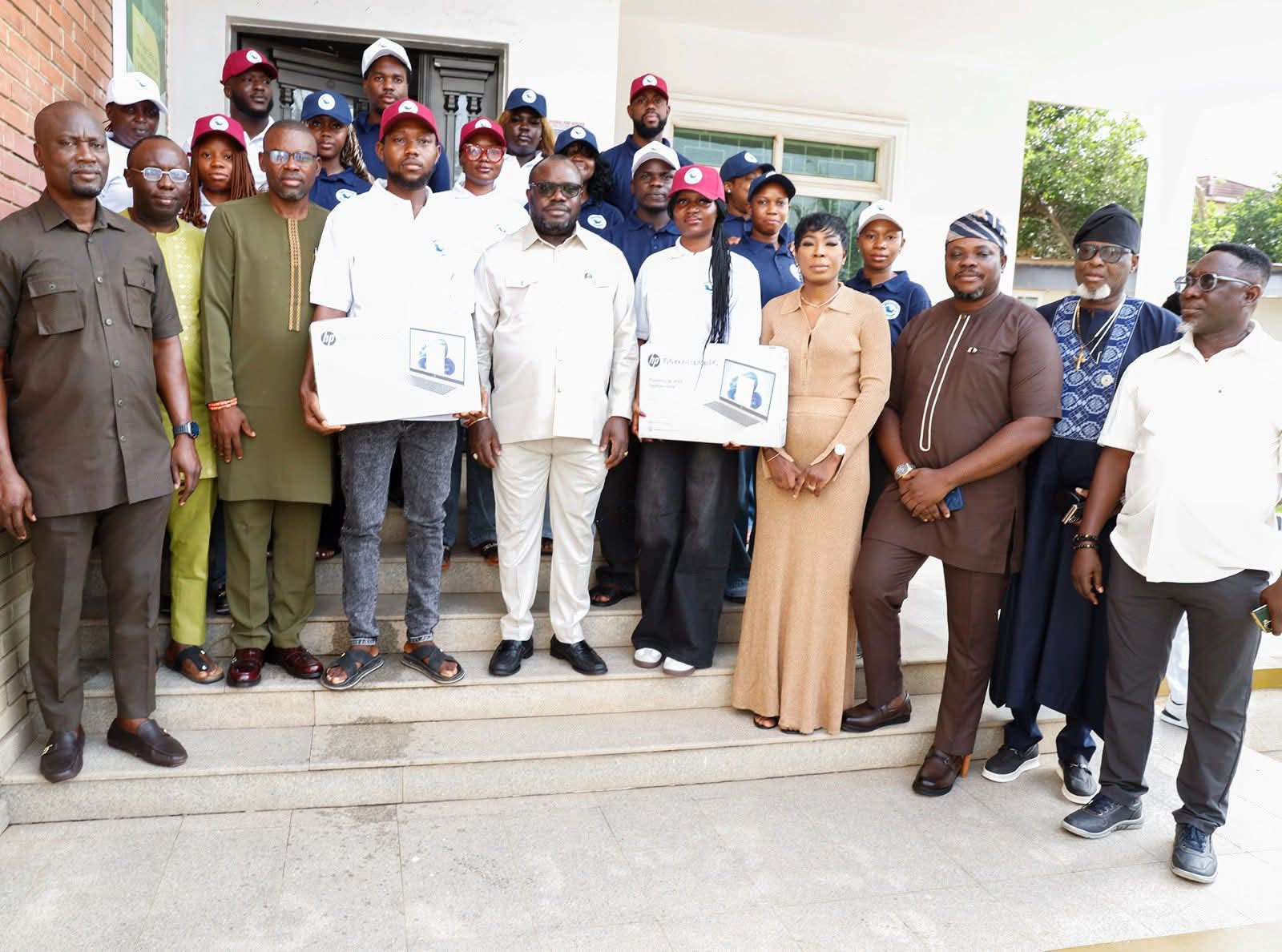
The Presidential Amnesty Programme, on Thursday, sent an additional batch of 15 foreign scholarship beneficiaries for post-graduate studies in the United Kingdom.
In a statement, Mr Igoniko Oduma,
Special Assistant on Media to the Administrator said the scholars will undertake master’s degree programmes in biomedical science, oil & gas engineering, data science, cyber security, software engineering, automotive engineering, communication culture and media, among others.
Speaking at the pre-departure briefing for the beneficiaries held at the agency’s headquarters in Abuja, the first leg of May 2026 deployments, the PAP Administrator, Dr Dennis Brutu Otuaro, said that many of them merited the scholarship because they made a first-class grade in their first degree programmes.
At the event, each of the scholars was given a laptop to enhance their academic studies.
READ ALSO:2027: Hashim, Falana Meet, Vow To Resist One-party System In Nigeria
Dr Otuaro attributed the huge number of onshore and offshore scholarship deployments, and the successes recorded by the PAP, to the strong backing of President Bola Tinubu as well as the efficient supervision by the National Security Adviser, Mallam Nuhu Ribadu.
He said that he was unapologetic over the large-scale deployments, stressing that the decision was hinged on the Renewed Hope Agenda of President Tinubu, who is truly interested in the peace and development of the Niger Delta.
According to him, the programme is building a better future for the Niger Delta as the scholarship beneficiaries will play critical roles in the advancement of the region’s development, sustainable peace and stability.
He urged them to always remember that they were sent for studies, and should be good ambassadors of Nigeria and the Niger Delta while in the UK.
READ ALSO:Gbaboyor’s Allegations Against Otuaro Baseless, Malicious — PAP Office
The PAP boss, while addressing the scholars, said, “All the scholarship deployments and the monumental successes we have achieved are as a result of the strong support of President Bola Ahmed Tinubu, and the efficient supervision by the Office of the National Security Adviser.
“Be good ambassadors of Nigeria while in the United Kingdom, and don’t disappoint Nigeria and the Niger Delta. Do your best and return home after your studies to join hands in advancing peace and development in our communities.
“That is why we are making this effort; we are preparing you for tomorrow, so that you will be part of the process of our development and sustainable peace and stability in the Niger Delta. We are building a civilized, polite, educated and patriotic generation. Use this opportunity very well.
READ ALSO:PAP Begins Second Phase Distribution Of Laptops To Scholarship Beneficiaries
“I am unapologetic about the large number of scholarships that we are giving to young Niger Deltans for studies within and outside the country. I believe that we are doing the best for tomorrow and there is no regret about it.”
Earlier in a presentation, the Head of Education, PAP, Dr Charles Ariye, had shared essential tips with the beneficiaries to guide them in their academic journey in the UK.
Speaking on behalf of the batch, Ikiere Victor, who is deployed for a master’s degree in mechanical engineering at Coventry University, expressed appreciation to the Federal Government, President Tinubu and the PAP Administrator for the opportunity given to them, pledging that they would be good ambassadors of the nation.

 Politics4 days ago
APC Clears Wike Loyalists, Disqualifies All Fubara-aligned Aspirants For State Assembly
- News5 days ago
Edo Bags NECO Excellence Award
- News4 days ago
OPINION: A Dream Of Nigeria
- News4 days ago
UNIBEN Student Killed, Two Injured
- Entertainment3 days ago
BREAKING: Nollywood Actor Alex Ekubo Is Dead
- News5 days ago
Edo Deputy Governor Pays Tribute As Dignitaries Honour Late Mother
- Entertainment4 days ago
AMVCA 2026: Full List Of Winners
- Entertainment4 days ago
‘He’s A Complete Musician’ – Don Jazzy Names His Best Artiste
- News5 days ago
OPINION: Was The Awolowo, Akintola Crisis Instigated By Enemies?
- News4 days ago
OPINION: Xenophobia, South Africa, Nigeria And Children Of Bad Neighbours


