
News
OPINION: The Bile In Oshiomhole’s Heart

Tunde Odesola
Former Governor of Edo State, Senator Adams Aliyu Oshiomhole, was born on April 4, 1952. If baby Adams had come into the world three days earlier, he would have been born on April Fools’ Day. Adams is now 72 years old, long past 40, the popular age society set as the bar for fools to sink or swim. Oshiomhole is not a fool, he was only born on April 4, the same day and month all hell broke loose in 1968 when Martin Luther King Jr. was killed. April 4, unto us a baby is born.
Old age doesn’t always beget wisdom, though experience is its forte. This fact is lost on Nigeria’s President, Asiwaju Bola Tinubu, Nigeria’s National Assembly, and education policymakers, whose aversion to genius and scholarship informed the barring of under-18 students from accessing tertiary education.
Dressed in the robes of fake leaders, Nigeria’s blind visioners in Asso Rock and beyond bark, ‘Kill them before they grow’, at young admission seekers milling around the almighty gates of the Joint Admissions and Matriculation Board, with Bob Marley’s song, “I Shot the Sheriff,” playing in the background.
Oshiomhole loves dancing. As a comrade in the trenches of the Nigeria Labour Congress, he must have danced to Fela Anikulapo’s Beasts of No Nation, in which the Abami Eda describes himself as Basketmouth. Basketmouth is the street slang for the big-mouthed. When Oshiomhole talks, baskets overflow. But a Yoruba proverb warns, òpò òrò ò ká’gbòn, aféfé ló ń gbe lo, a basket full of words is worthless. Whenever he feels strongly about an issue, the force of his oration appears compelling even if what he belches is just hot air, full of sound and fury, signifying nothing.
Adam was the name of the first human created by God, so say the Holy Bible and the Holy Quran. Adam means ‘Son of the Red Earth’. Aliyu is one of the 99 names of Allah. It means ‘The Most High’ or The Exalted One’. As ‘the Son of the Red Earth’, Oshiomhole’s thoughts and actions are expected to be deep-rooted in the soil of wisdom. As ‘The Exalted One’, his words are expected to typify dignity.
But Adams Aliyu Oshiomhole, while on a campaign trail in Edo State a few days ago, defiled his two names. Without regard to wisdom or civility, Oshiomhole threw decency to the dogs as he pronounced his former begotten son and incumbent Edo State Governor, Godwin Obaseki, and his wife, Betsy, childless. A Muslim reportedly converted to Christianity by his late wife, Clara, Oshiomhole’s characteristic aggression is typical of converts.
MORE FROM THE AUTHOR: OPINION: Tinubu, Yusuph Olaniyonu And Hunger Protest
When caught midair in the breaking light of dawn, witches become confused and they drop to the ground. They also confess. Oshiomhole said, “I was shock (sic) yesterday to see Mrs Obaseki, the First Lady, saying that our candidate has no wife; I’m sorry that she has to say that because here’s a woman who has no child. Between him (sic) and Obaseki, they have no child, they’re childless. They are even not ready to adopt. I mean, I don’t blame anybody shouldn’t (sic) have a child but people who have love for children, they go to motherless home(s) and adopt children, they have not adopted, they are both in their 60s.
“So, you married, I don’t know whether it’s a contract one, but whatever it is, but they have no child. Now, our candidate not only have (sic) children, he has invested in the education of those children, such that you watch them on live television, covered by your media stations where the first that spoke is a lawyer, the second one is a medical doctor, and they addressed the crowd in Edo-South, in Edo-Central, in Edo-North, and their mother was there.”
I can’t tell why witches are repetitive but I suspect the electoral whipping Obaseki gave Oshiomhole in the 2020 governorship election in Edo has created a hatred in Oshiomhole’s heart large enough to accommodate 10 wounded lions as he described Obaseki and his wife as childless four times in a one-minute video clip. Osho Baba, na wetin?
MORE FROM THE AUTHOUR: OPINION: Mike Ejeagha And The Power Of Music
The tirade quoted above was what Betsy Obaseki got for declaring at a rally that only the Peoples Democratic Party candidate in the Edo governorship election, Asue Ighodalo, was married. Though she didn’t specifically mention any candidate as being unmarried, the undertone of her message wasn’t lost on her audience. The Betsy innuendo was what Oshiomhole, a former national chairman of the ruling All Progressives Congress, couldn’t take, and he decided to run the errand meant for media aides and party roughnecks, all for his political son, Monday Okpebholo, the APC governorship candidate. What a great national leader Oshiomhole is!
Betsy could have done the more involving breaststroke swimming style in the sewage of Edo’s political bitterness but she didn’t, she chose the stylish backstroke, maybe for its steaze or womanishness. But Oshiomhole would drag anyone, male or female, without a child, to the bottom of the sewage for child-ish baptism because he’s the god of Edo who gives children.
According to the University of California San Francisco’s Memory and Ageing Center – Weill Institute of Neurosciences – there are three major areas of the brain responsible for speech and language. They are the Bocca’s area, Wernicke’s area and the Angular gyrus.
MORE FROM THE AUTHOR: OPINION: Does Sparing The Rod Spoil The Child?
In a research, “Speech and Language,” published on its website, the university says, “When someone has trouble understanding other people (receptive language) or explaining thoughts, ideas and feelings (expressive language), that is a language disorder.”
UCSF, a world-class citadel of knowledge, added, “When someone cannot produce speech sounds correctly or fluently or has voice problems, that is a speech disorder.”
In a society where pettiness is a virtue within the ruling class, Betsy’s preoccupation with marriage and Oshiomhole’s fixation with childlessness reflect the shallowness of the characters who populate Nigeria’s corridors of power.
The lack of roadmaps by Presidents Goodluck Jonathan, Muhamadu Buhari, Bola Tinubu, and governorship, legislative and local government council candidates standing election entrenches us firmly at the bottom of global development. The silence that greets misgovernance in Nigeria concretises our national doom.
At election times, the Nigerian electorate bickers over frivolities and expects candidates who had no manifestos to wave the magic wand after snatching and robbing like mafiosos.
In our electoral childishness, childlessness was a talking point in the Edo governorship election in 2020 when Oshiomhole was accused of not fathering a child with his Cape Verde wife, Iara. Oshiomhole, who has children with his late wife, Clara, could choose not to have children anymore. In Nigerian politics, the shoe is always on the wrong foot. The PDP threw the first stone in 2020, and now the APC is casting a rock.
It’s ironic that Oshiomhole who is kicking against Betsy’s remarks today, had in 2016, accused then-Senator Dino Melaye of not capable of ‘maintaining a decent matrimonial home’ after Melaye said on the floor of the Senate that there was the need to enact a law that would stop Nigerians marrying foreigners from paying dowries in dollars – in a veiled reference to Oshiomhole.
The former Edo governor thundered in a statement, “It’s an open secret that Senatoe Melaye cannot maintain a decent matrimonial home hence he could descend to this pedestrian level of using the hallowed chambers to categorise women as if they were pieces of items for purchase.”
In Africa, children are viewed as inheritances from God. It’s wrong to needle anyone with children or lack of them. When I was a child, I remember I was occasionally taken to the house of my father’s childhood friend, the late Mr Jacob Asha Afainiya, because his wife, the late Mrs Olajumoke Comfort Afainiya, who was my mom’s childhood friend, had not conceived, despite the two couples marrying about the same time.
The Afainiya couple got their firstborn, Seun, when my parents had their third, Florence, now deceased. I occasionally stayed with the Afainiya family, who lived a stone’s throw from us in Mushin, in the belief that my ‘head’ would call from heaven children for the Afainiya couple – ori omo lo ma n pe omo waye. That’s the African belief. It also shows the importance which Africans attach to children. And I enjoyed going to the Afainiyas because mummy Afainiya made okra soup like no other mother.
One day, in the presence of both couples, I told my mom to cook her okra like mummy Afainiya’s, and everyone present laughed. When I got home, I cried for my basket-mouthedness as my mom descended on me.
Nigeria, it’s high time we based our campaigns on developmental issues and stop running our mouths like torn baskets, please.
Email: tundeodes2003@yahoo.com
Facebook: @Tunde Odesola
X: @Tunde_Odesola



News
NAF Launches Attack On Terrorists In Borno
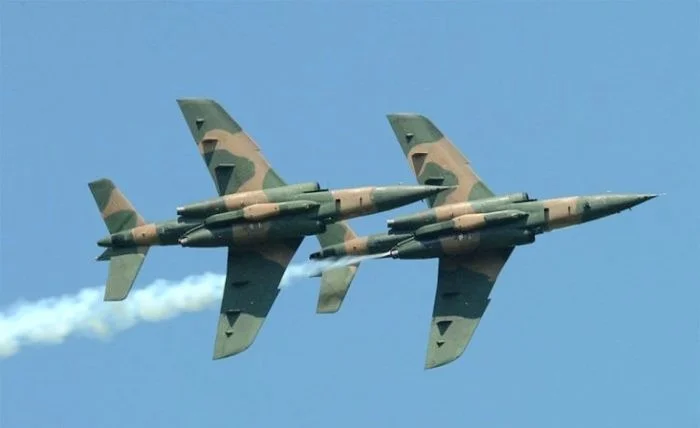
The Nigerian Air Force, NAF, operating as part of the joint task force of Operation Hadin Kai, has carried out a coordinated air interdiction at AbbagaJiri in the Timbuktu Triangle, Borno State.
According to Air Commodore Ehimen Ejodame, Director of Public Relations and Information of NAF, the air strikes successfully paved the way for ground troops.
He explained that the operation was based on actionable intelligence from multiple sources, which confirmed the presence of terrorists, their structures, and concealed logistics facilities in the area.
Ejodame stated that NAF air assets were deployed in integrated surveillance and precision strike roles to target identified threats.
READ ALSO:NAF Hits Bandit Logistics Hub, Neutralises Many In Zamfara
The operation aimed to degrade terrorist capabilities, deny them sanctuary, and shape the battlefield for ground forces, all while strictly adhering to rules of engagement and protecting civilians.
He added, “The Identified terrorist structures were decisively engaged and destroyed, denying the terrorists freedom of action, while a follow-up engagement neutralised armed elements observed converging on the location.”
“Subsequent advances by ground troops into the area confirmed the effectiveness of the air strikes and validated the success of the joint air–land operation.”
Speaking on the mission, Chief of the Air Staff (CAS), Air Marshal Sunday Aneke, said, “The success of the mission reflects the NAF’s resolve to dominate the air domain in support of joint operations.”
READ ALSO:NAF Hits Bandit Logistics Hub, Neutralises Many In Zamfara
Aneke further emphasized that the operation highlighted the service’s commitment to providing precise and decisive air power in support of ground forces.
In his words, “We will continue to deny terrorists freedom of movement, sanctuary, and logistics wherever they seek to hide. Air operations will remain relentless and intelligence-driven.”
“Our operations are carefully planned and intelligence-led, ensuring maximum effect on hostile elements while safeguarding innocent civilians.”
READ ALSO:NAF Announces Two-hour Road Closure In Abuja For 10km Walk
“The Nigerian Air Force will sustain pressure until terrorist networks are completely dismantled.”
He further noted that the operation showcased NAF’s aggressive stance, precision employment of airpower, and dedication to sustained joint operations.
Aneke added that such missions play a crucial role in enabling ground troops to maintain momentum and deliver decisive outcomes against terrorist networks threatening lives, property, and Nigeria’s national security.
News
Lagos Parks To Close For Maintenance – State Govt

The Lagos State Parks and Gardens Agency, LASPARK, has announced that all public parks under its management across the state will be temporarily closed for routine maintenance and upgrades.
In a statement released on January 9 and shared via its official platforms early Saturday, LASPARK said, “All parks under our management will be closed to the public from January 12 to January 31, 2026.
“This follows increased visitor activity during the recent festive season.”
The agency listed several popular recreational spots that will be affected, including “Ndubisi Kanu Park, Alausa JJT Park, Dr. Finnih Abayomi Park in Oregun, and all other LASPARK-managed parks across Lagos State.”
READ ALSO:
Explaining the reason for the closure, LASPARK added, “The temporary shutdown is necessary to carry out essential landscaping, facility repairs, and general upgrades to ensure that our parks remain safe, clean, and enjoyable for residents and visitors.”
The agency also stressed that the exercise aligns with its broader mandate, noting, “This maintenance programme is part of our commitment to providing well-maintained green spaces that promote relaxation, wellness, and environmental sustainability.”
LASPARK assured residents that “all parks will reopen at the end of the maintenance period.”
News
PAP Sends Additional 34 Foreign Post-graduate Scholarship Beneficiaries To UK Varsities

The Presidential Amnesty Programme (PAP) has deployed an additional 34 foreign post-graduate scholarship beneficiaries to various universities in the United Kingdom for the 2025-2026 academic year.
This was contained in a statement made available to newsmen in Warri by Mr Igoniko Oduma, Special Assistant on Media to Dr. Dennis Otuaro, the Administrator, PAP.
According to the statement, the scholars’ programmes include data science, fintech analytics, cyber security, international energy law and policy, construction project management, public health, agri-food technology, electrical and petroleum engineering, among others.
The statement added that more foreign post-graduate scholars will be sent to UK universities in the current academic session.
“In December 2025, nine students, who were the first set of offshore post-graduate scholarship developments by the PAP Administrator, Dr Dennis Otuaro, for the 2024-2025 academic year, graduated from their various programmes in UK universities.
READ ALSO:PAP Scholarship Scheme Vehicle For Better Future For Niger Delta —Otuaro
“Otuaro has deployed over 9000 students to universities within and outside Nigeria for different industry-relevant programmes since he assumed office in March 2024,” the statement partly reads.
Speaking at the pre-departure orientation programme for the scholars at the PAP headquarters in Abuja, on Thursday, Otuaro said that the large-scale deployment was aimed at making the Niger Delta a knowledge-driven region.
He said that his leadership reinvigorated the programme to give it a new momentum in service delivery to the people of the region based on the mandate of President Bola Tinubu.
Otuaro said, “We are sending all of you for post-graduate studies in various universities in the United Kingdom.
“The PAP now has a new momentum and direction because of the repositioning and broad reforms that we carried out in line with the mandate of His Excellency, President Bola Ahmed Tinubu GCFR.
READ ALSO:Otuaro Tasks Media On Objective Reportage
“The objective behind the huge scholarships deployment is to ensure that we develop the needed human capital to transform the Niger Delta and generate knowledge-wealth.
“We want to develop relevant manpower in critical disciplines for our region and by extension, the country, because you are expected to contribute your quota to national development after successful graduation.”
The PAP boss, who was represented at the event by his Technical Assistant, Mr Edgar Biu, advised the scholars to study hard to achieve academic excellence in their various fields of research.
According to him, the scholars have an obligation to justify the Federal Government’s investment in their education and future.
READ ALSO:I’m Not Distracted By Anti-Niger Delta Elements, Says PAP Boss, Otuaro
He reiterated his warning that beneficiaries should not take for granted the opportunity to further their academic pursuits in the interest of the Niger Delta and indeed the country.
Otuaro expressed appreciation to President Tinubu for his “enormous interest and support for the Programme”, particularly the approval of an upward review of the programme’s budget from N65billion to N150billion.
He also expressed gratitude to the National Security Adviser, Mallam Nuhu Ribadu, for his impeccable guidance and supervision of the programme’s initiatives.
Otuaro, therefore, cautioned the scholars to obey their host country’s laws and the rules and regulations of their various institutions, stressing that they are ambassadors of Nigeria, the Niger Delta and their communities and families.
Highpoint of the orientation programme was the presentation of laptops to the scholars to help them in their studies.

 News5 days ago
How To Calculate Your Taxable Income
- Headline5 days ago
Russia Deploys Navy To Guard Venezuelan Oil Tanker Chased By US In Atlantic
- Metro4 days ago
Edo widow-lawyer Diabolically Blinded Over Contract Seeks Okpebholo’s Intervention
- News4 days ago
Expert Identify Foods That Increase Hypertension Medication’s Effectiveness
- Politics4 days ago
APC Leaders, Tinubu/Shettima Group Call For Wike’s Removal As FCT Minister
- Entertainment5 days ago
VIDEO: ‘Baba Oko Bournvita,’ Portable Drags His Father, Alleges Bad Parenting, Extortion
- Metro5 days ago
JUST IN: Court Grants Malami, Wife, Son N500m Bail Each
- Politics5 days ago
2027: Details Of PDP Leaders, Jonathan’s Meeting Emerge
- Politics3 days ago
Wike A ‘Pestilence’ On Rivers, I Resigned Because Of It – Ex-Commissioner
- Headline2 days ago
Science Discovers Why Hungry, Broke Men Prefer Bigger Breasts


